


The Accelink patent portfolio comprises 1,956 patent families, offering a useful window into how this optoelectronics manufacturer protects its technology investments. Of this total, 76.3% remain active, a figure that covers both granted and pending families. Within the portfolio, 1,105 families stand granted, while 387 are still pending examination, giving a grant rate of 56.5%. The remaining families, totalling 464 across lapsed, expired, and revoked status, represent patents that no longer carry enforceable rights. These are prosecution and maintenance metrics, not a direct measure of patent quality or enforceability.
Filing activity peaked in 2021, when Accelink filed 211 patent families, marking the busiest year in the company’s recorded filing history. China dominates the portfolio’s jurisdictional footprint, accounting for 99.4% of filings across a total of 10 jurisdictions covered. On the technology side, optical elements and systems under G02B (Optical Elements, Systems and Instruments) form the largest cluster, with 772 families, well ahead of any other classification.
This report draws on patent filing and legal status data to build a picture of Accelink’s research priorities and protection strategy. Filing counts alone do not establish commercial success, product adoption, or competitive superiority in the market. Readers evaluating specific patent families for licensing, due diligence, or competitive assessment should verify details directly against primary patent office records. The analysis that follows offers directional insight, not a substitute for family-level legal review.
About Accelink
Company Profile: Accelink Technologies is a Chinese optoelectronic devices and modules manufacturer headquartered in Wuhan, Hubei. The company is a high-tech enterprise with systematic research and development capabilities in active and passive chips and integrated optical devices, and specialises in research, manufacture, sales, and technical services for optoelectronic chips, devices, modules, and subsystem products. Its product range covers optical communication modules, optical transceivers, passive optical components and modules, and subsystems.
It primarily serves telecommunications equipment manufacturers across China, the United States, Canada, Germany, Italy, Japan, Korea, and India. The company was listed on the Shenzhen Stock Exchange in 2009, becoming the first listed communication optoelectronic device company in China. Accelink has been named among the “Top 10 Most Competitive Global Optical Device Companies” for 19 consecutive years and ranks fourth in the global optical communication device industry.
The company reports over 1,300 R&D talents, more than 3,000 patents, and participation in drafting over 300 national and industrial standards.
How Healthy is Accelink Patent Portfolio?
Patent portfolio health depends on how many families remain legally active versus how many have lapsed, expired, or been revoked. For Accelink, 56.5% of all families hold granted status, and another 19.8% sit pending, together producing the 76.3% active rate noted earlier. The composition chart in this section shows a portfolio weighted firmly toward granted protection rather than unresolved applications, which signals a mature filing programme rather than one still working through a large examination backlog.
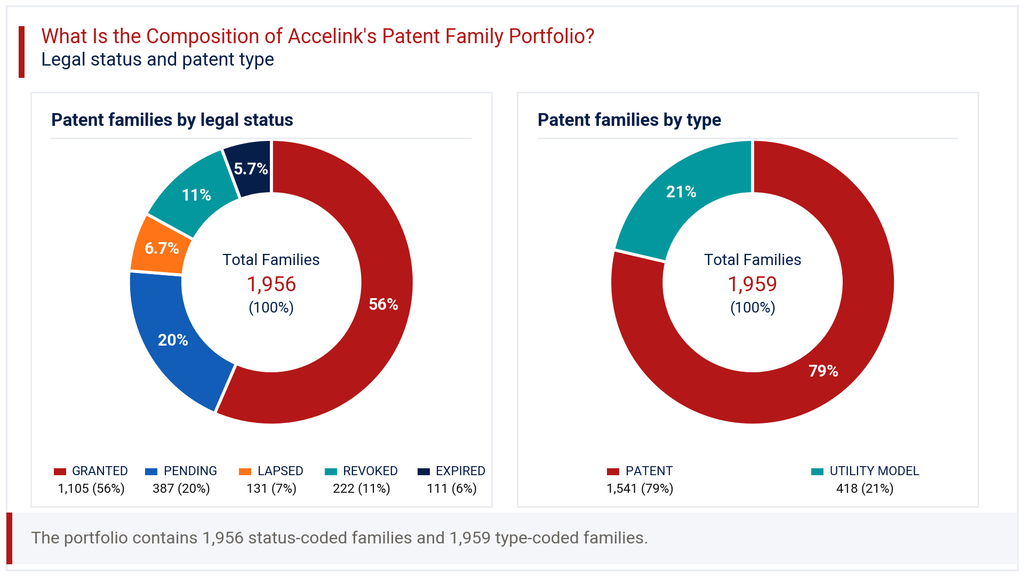
On patent type, standard invention patents make up 78.7% of the portfolio, with utility models accounting for the remaining 21.3%. This split suggests Accelink pursues the stronger, more durable protection route for the bulk of its inventions, reserving utility model filings for a smaller, faster-to-grant subset. The lapsed, expired, and revoked categories together represent 23.7% of families, a level worth monitoring but not unusual for a portfolio of this size and vintage. Taken together, the legal status distribution points to a patent portfolio health profile that is generally sound, with active rights outnumbering inactive ones by a wide margin. Maintenance discipline across jurisdictions, particularly in China, appears consistent rather than patchy.
How Has the Accelink Patent Portfolio Evolved Over Time?
Patent filing trends at Accelink show a clear multi-year build-up followed by a recent plateau. Filings rose steadily from 41 in 2012 to 211 in 2021, the single busiest year on record, reflecting sustained investment in optoelectronic R&D during that decade. The filing-trend chart in this section traces this climb and the subsequent step down through 2022 (195), 2023 (174), and 2024 (166).
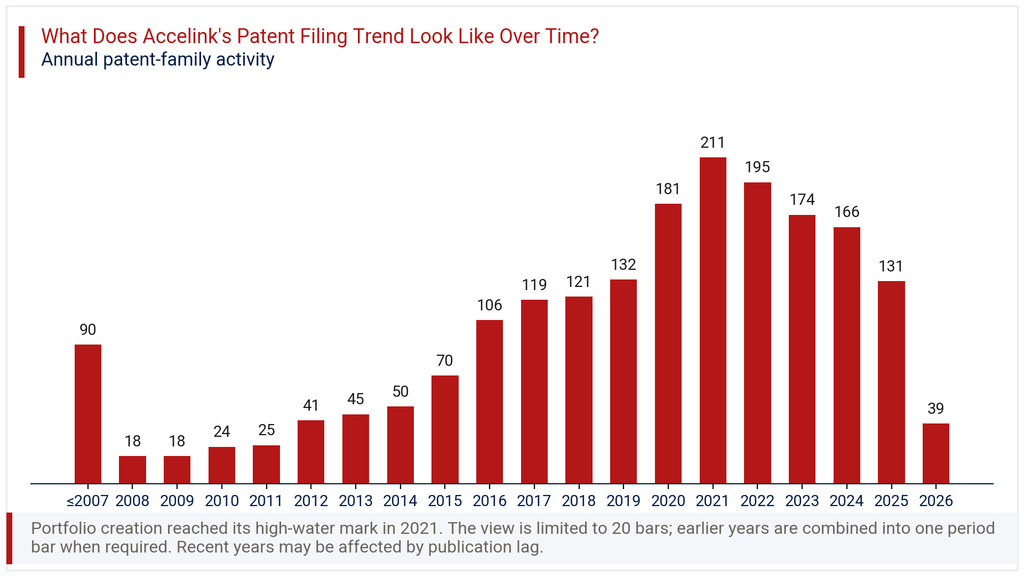
The most recent years, 2025 and 2026, show sharply lower counts, with the latest year change sitting at -70.2%. This drop should not be read as a genuine pullback in research activity. Patent applications typically take 18 months or more to publish, so recent filings are still working through the pipeline and have not yet surfaced in public records. The more reliable signal remains the 2016 to 2021 run, which shows Accelink scaling its filing programme considerably as its product range expanded. Any assessment of current R&D intensity should lean on the 2020 to 2023 window rather than the final two years shown.
Where Does the Accelink Patent Portfolio Prioritize Patent Protection?
Patent geography for Accelink is heavily concentrated in its home market. China accounts for 99.4% of all filings, far outweighing every other jurisdiction tracked. The geographic chart in this section shows WIPO PCT filings next in line at 12.3%, followed by the United States at 5.2% and European Patent filings at 2.2%. Smaller counts appear in Japan, India, South Korea, Singapore, Canada, and Germany.
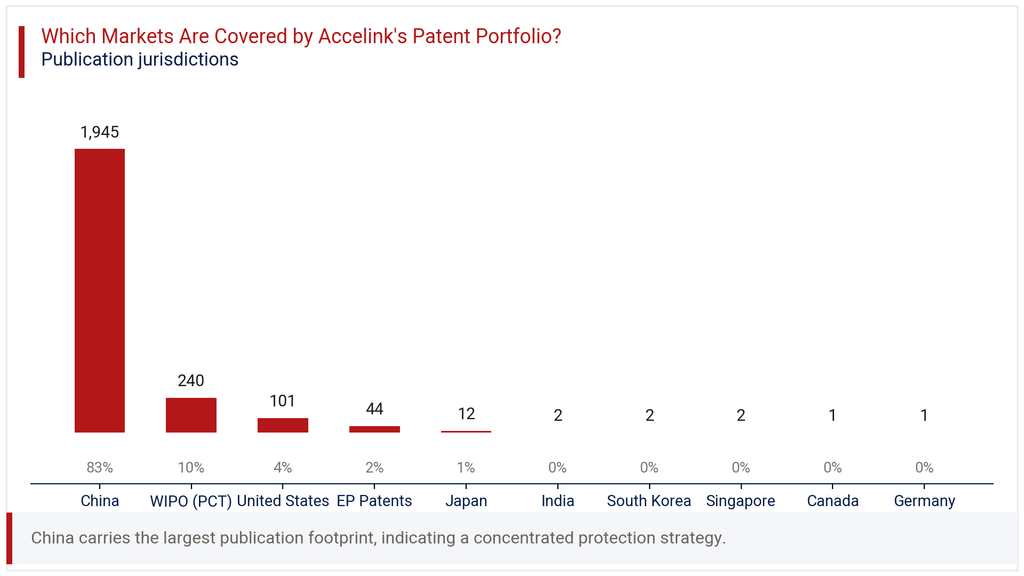
This pattern reflects a company whose commercial base and manufacturing footprint remain primarily domestic, even though its customer list spans telecommunications equipment makers worldwide. The relatively modest PCT share suggests Accelink uses international filing routes selectively, likely reserving them for inventions it considers commercially significant beyond China. The near-absence of direct filings in markets like India, Canada, and Germany, despite the company citing these as service markets, indicates a gap between where Accelink sells and where it formally protects its technology. Companies assessing freedom-to-operate risk outside China should weigh this concentration carefully before assuming broad international coverage.
Where is the Accelink Patent Portfolio Building Protection Across Key Technologies?
IPC analysis of the Accelink patent portfolio reveals a strong tilt toward core optical hardware. G02B (Optical Elements, Systems and Instruments) leads with 772 families, representing 36.3% of the portfolio. H04B (Signal Transmission) follows with 519 families at 24.4%, and H01S, covering laser-related technology, holds 266 families at 12.5%.
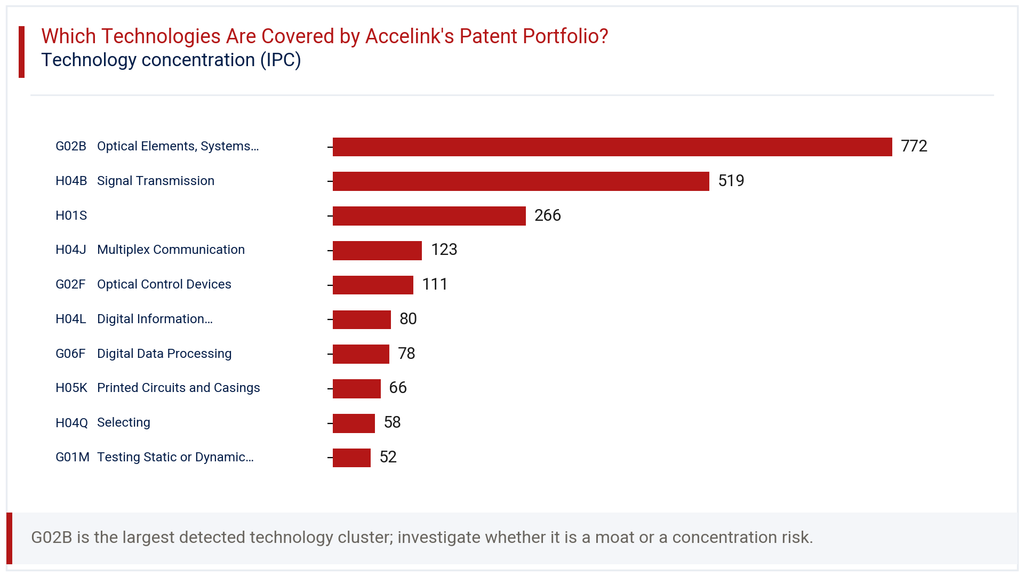
The technology chart in this section also highlights smaller but notable clusters: H04J (Multiplex Communication) at 5.8% and G02F (Optical Control Devices) at 5.2%. Together, these top categories confirm that Accelink’s research effort centres on the physical optical components and transmission systems that underpin its module and transceiver product lines. The presence of digital processing classes like G06F and H04L, though smaller at 3.7% and 3.8% respectively, suggests growing attention to the software and signal-processing layers that sit alongside optical hardware. This mix indicates a company protecting both the physical device layer and the systems that control it, a sensible pairing for a vertically integrated optoelectronics manufacturer.
How Has the Accelink Patent Portfolio Evolved Across Filing Geographies?
Viewed year by year, Accelink’s jurisdictional filing pattern shows China’s dominance deepening rather than easing. Chinese filings rose from 109 in 2016 to a peak of 210 in 2021, before easing to 130 by 2025. The heatmap in this section shows international filings following a different, more volatile path across the same period.
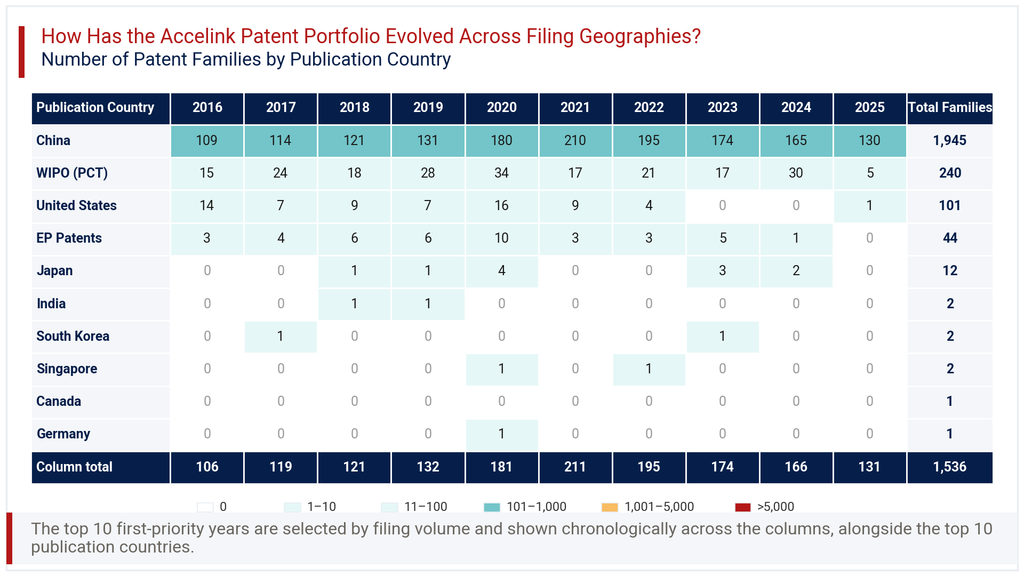
United States filings, for instance, ran at 14 in 2016 but fell to 0 by 2023 and 2024, recovering only marginally to 1 in 2025. WIPO PCT filings peaked at 34 in 2020 before declining to just 5 by 2025. EP filings show a similar fade, from 10 in 2020 to 0 in 2025. This divergence suggests Accelink pulled back on international filing activity in recent years even as domestic Chinese filings remained comparatively strong through 2022 and 2023. The pattern points to a tightening of international patent strategy, possibly reflecting cost discipline or a sharper focus on markets where enforcement and commercial return seem clearer.
Consultant’s Perspective on Accelink Patent Portfolio
Taken as a whole, the Accelink patent portfolio tells a story of a technically focused, domestically anchored filer. The 1,956 families and 56.5% grant rate point to a patent programme with real substance behind it, not just a defensive filing exercise. The concentration in G02B and H04B classes aligns closely with Accelink’s stated product lines in optical modules and transceivers, which is a reassuring consistency check for anyone assessing the portfolio’s credibility.
The clearer area for attention is international protection. With 99.4% of filings in China and international counts thinning out after 2021, Accelink’s patent footprint abroad looks narrower than its commercial reach suggests. For a company serving customers across eight countries, this gap between market presence and patent protection carries risk, particularly in competitive jurisdictions like the United States and Europe. A reasonable recommendation would be to revisit international filing priorities, especially for recent core inventions in laser and signal transmission technology, before competitors or customers encounter protection gaps in markets that matter commercially. Monitoring how the 2025 and 2026 filing cohorts mature, once publication lag clears, will offer a truer read on whether this international pullback is tactical or structural.
Explore Deeper Insights with Expertlancing Research
This overview only scratches the surface of what the Accelink patent portfolio reveals about the company’s technology direction and market priorities. Expertlancing Research helps clients go further, with family-level validation, competitor benchmarking, and custom technology landscape studies tailored to specific business questions. Whether the goal is licensing due diligence, freedom-to-operate assessment, or R&D strategy, our analysts can build on this foundation. Reach out to Expertlancing Research to commission a deeper, decision-ready analysis.