

The Xiaomi Patent Portfolio offers a useful window into how one of the world’s largest consumer electronics companies protects its technology investments. Across a total of 49,524 patent families, 82.0% remain active, a figure covering both granted and pending cases. Of this total, 24,528 families have been granted and 16,076 are still pending, giving a grant rate of 49.5%. The remaining families, comprising lapsed, expired, and revoked cases, add up to 8,920. These figures describe prosecution and maintenance status only, not the legal strength or commercial value of any individual patent.
Filing activity within the Xiaomi Patent Portfolio peaked in 2023 with 7,235 new families, following a steady climb through the previous decade. China dominates the jurisdictional mix, accounting for 96.8% of filings, and the portfolio spans 10 jurisdictions in total. On the technology side, wireless communication networks under IPC class H04W form the largest cluster, with 10,900 families, reflecting Xiaomi’s deep investment in connectivity hardware and protocols.
This report draws on patent filing and status data to describe the shape and direction of Xiaomi’s intellectual property activity. Filing volume alone does not confirm commercial success, product differentiation, or freedom to operate in any market. Readers considering licensing, litigation, or competitive assessments should verify the specific patent families in question before relying on them. What follows is a structured review of portfolio health, filing trends, geographic focus, and technology concentration.
About Xiaomi
Company Profile: Xiaomi Corporation is a Chinese multinational corporation and technology company headquartered in Beijing, China. It is best known for its consumer electronics, software, and electric vehicles. Xiaomi was founded in April 2010 and listed on the Main Board of the Hong Kong Stock Exchange on July 9, 2018.
The company describes itself as a consumer electronics and smart manufacturing company with smartphones and smart hardware connected by an IoT platform at its core. It is the third-largest smartphone seller in the world as of 2025, behind Apple and Samsung, most of which run on the Xiaomi HyperOS operating system. It has 754.1 million global monthly active users, as of December 2025. The company has also established a consumer AIoT platform, reaching approximately 861.4 million connected smart devices as of September 30, 2024.
In October 2023, Xiaomi upgraded its strategy to a “Human x Car x Home” smart ecosystem, merging personal devices, smart home products, and cars. In March 2024, Xiaomi’s first electric vehicle, the Xiaomi SU7, was officially unveiled. The company is ranked 232nd and is the youngest company on the Fortune Global 500.
How Healthy is Xiaomi Patent Portfolio?
The composition chart shows a portfolio weighted toward granted protection, with 49.5% of families reaching grant and 32.5% still pending examination. This balance points to a mature filing operation that continues feeding new applications into the pipeline. Lapsed families make up only 3.4%, while expired cases stand at 1.4%, both modest shares. Revoked families account for 13.2%, a figure worth watching given its size relative to lapsed and expired combined.
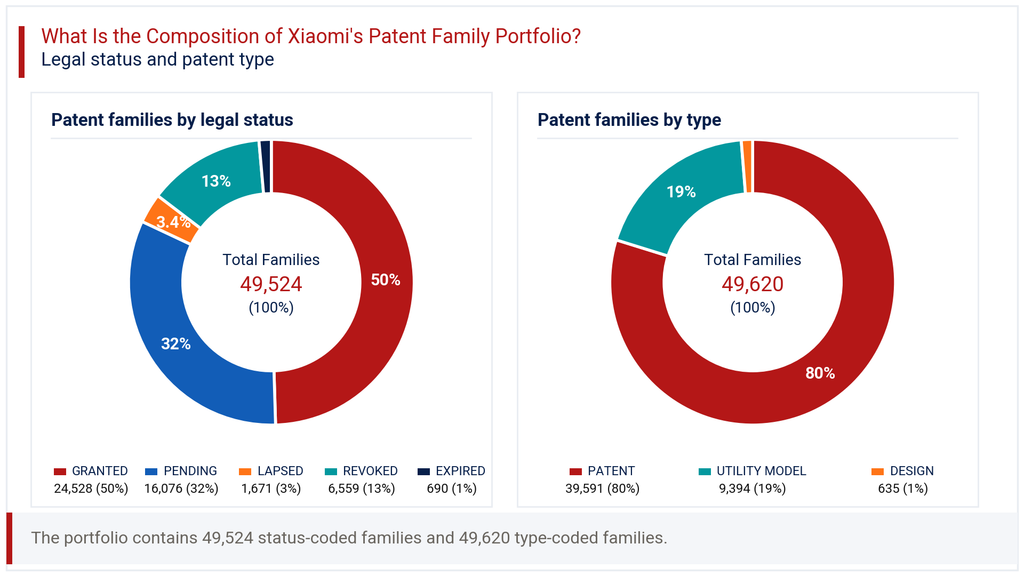
By patent type, standard patents dominate at 79.8%, followed by utility models at 18.9% and design rights at just 1.3%. This mix suggests Xiaomi pursues durable, examined protection rather than relying heavily on the faster but narrower utility model route common in China. The active rate of 82.0% across granted and pending families indicates the portfolio is largely in good standing from a maintenance perspective. Patent portfolio health here reflects strong prosecution discipline rather than aggressive abandonment. The revocation share, however, deserves closer legal review to understand which technology areas or jurisdictions are driving it. Taken together, the legal status data paints a portfolio that is active, well maintained, and still expanding rather than winding down.
How Has the Xiaomi Patent Portfolio Evolved Over Time?
The filing-trend chart tells a clear growth story. Annual filings rose from just 45 in 2008 to a peak of 7,235 families in 2023. Growth accelerated sharply after 2014, when filings jumped to 1,516, then continued climbing through 2015 at 3,377 and beyond. The period between 2021 and 2023 marks the most intense filing phase, with counts moving from 4,451 to 7,024 and then to the peak year.
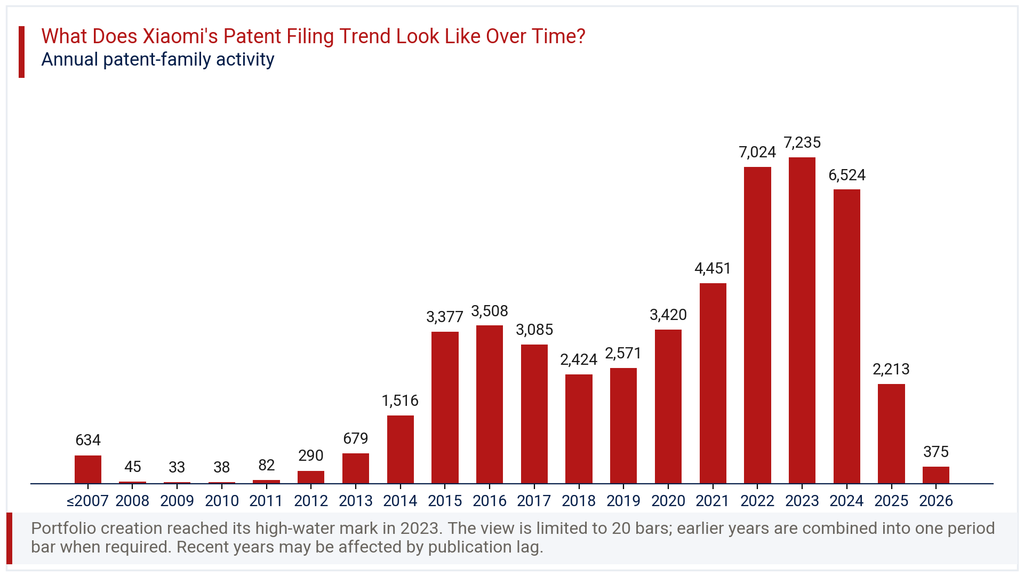
Counts for 2024 and 2025 show 6,524 and 2,213 respectively, with the latest year reflecting a -83.1% change. This drop should not be read as a genuine pullback in filing activity. Patent applications typically take twelve to eighteen months to appear in public databases, so recent years are naturally undercounted. The broader patent filing trends still point to a company investing heavily and consistently in intellectual property protection, with the apparent recent decline being a reporting artifact rather than a strategic retreat.
Where Does the Xiaomi Patent Portfolio Prioritize Patent Protection?
The geographic chart confirms China as the overwhelming priority, holding 96.8% of all filings and 47,918 families in absolute terms. This is consistent with a company whose primary manufacturing base, home market, and regulatory relationships sit within China. Beyond its home jurisdiction, Xiaomi uses the WIPO PCT route for 21.2% of filings, a common strategy for preserving international filing options before committing to specific national phases.
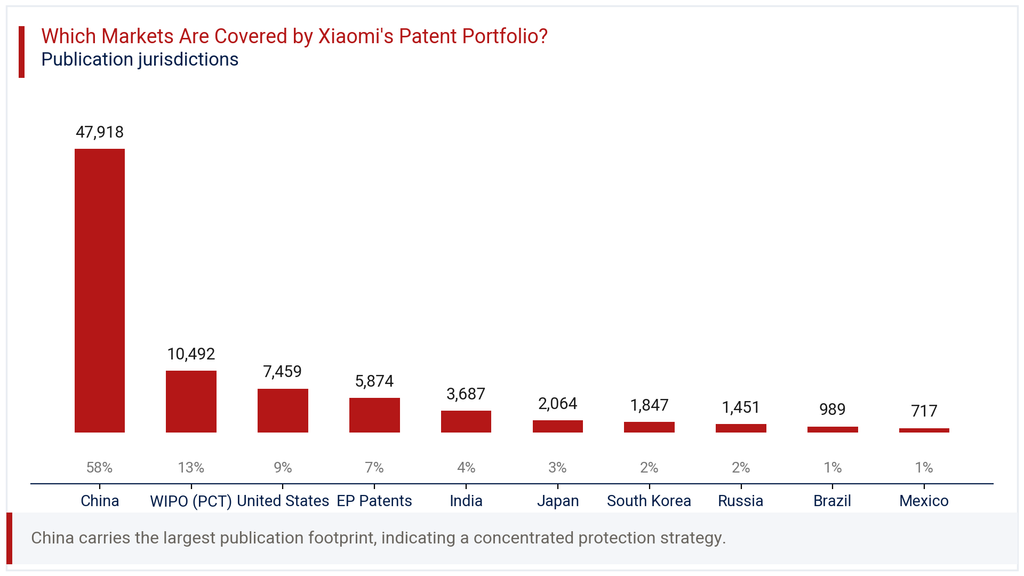
Direct filings in the United States account for 15.1%, while European Patent filings stand at 11.9%. India represents 7.4% of the portfolio, a meaningful share given Xiaomi’s strong smartphone presence there. Japan, South Korea, Russia, Brazil, and Mexico round out the remaining jurisdictions, each below 5% individually. This patent geography suggests a two-tier approach: exhaustive domestic coverage in China paired with selective, market-driven protection abroad. The 10 jurisdictions covered indicate a deliberate rather than scattershot international filing strategy, concentrated where Xiaomi has real commercial stakes.
Where is the Xiaomi Patent Portfolio Building Protection Across Key Technologies?
The technology chart in this section highlights wireless communication as the clear anchor, with IPC class H04W contributing 10,900 families, or 24.6% of the total. Digital data processing under G06F follows closely at 10,039 families and 22.6%, reflecting software and computing investments that extend beyond core telephony hardware. Digital information transmission, class H04L, adds another 6,153 families at 13.9%.
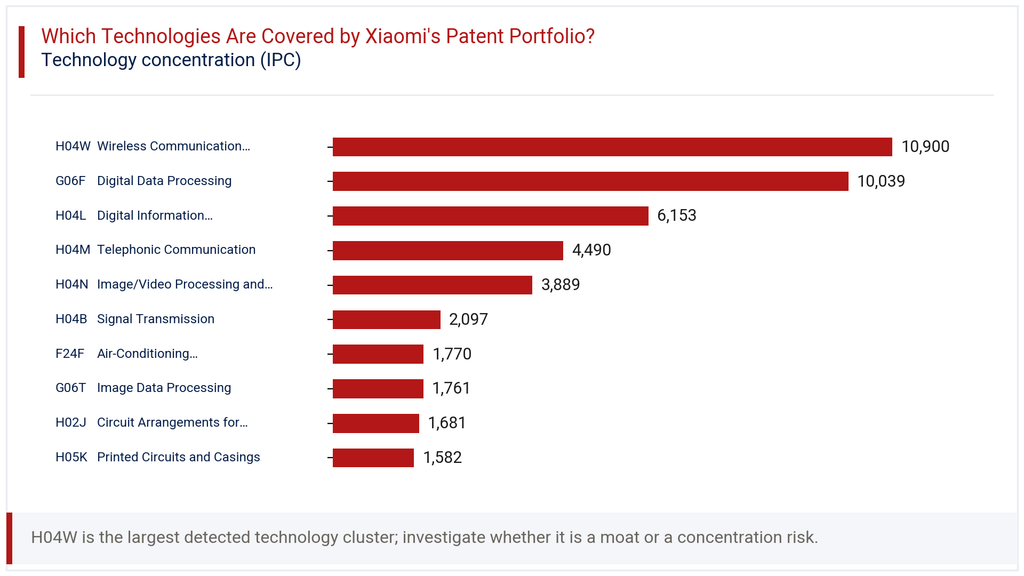
This IPC analysis shows a portfolio built around connectivity and data handling rather than any single product line. Telephonic communication under H04M holds 10.1%, while image and video processing under H04N contributes 8.8%, both tied closely to smartphone functionality. Smaller but notable clusters include air conditioning and humidification under F24F at 4.0%, signaling Xiaomi’s smart home appliance ambitions, and power supply circuits under H02J at 3.8%. The spread across these classes confirms that Xiaomi protects its full device and platform stack, not just handsets.
How Has the Xiaomi Patent Portfolio Evolved Across Filing Geographies?
The heatmap reveals how China’s dominance has deepened over time rather than diminished. Chinese filings rose from 3,359 in 2015 to a peak of 7,191 in 2023, consistently dwarfing every other jurisdiction year on year. WIPO PCT filings grew from 497 in 2015 to 2,041 in 2022, showing steady reliance on international applications during Xiaomi’s expansion years.
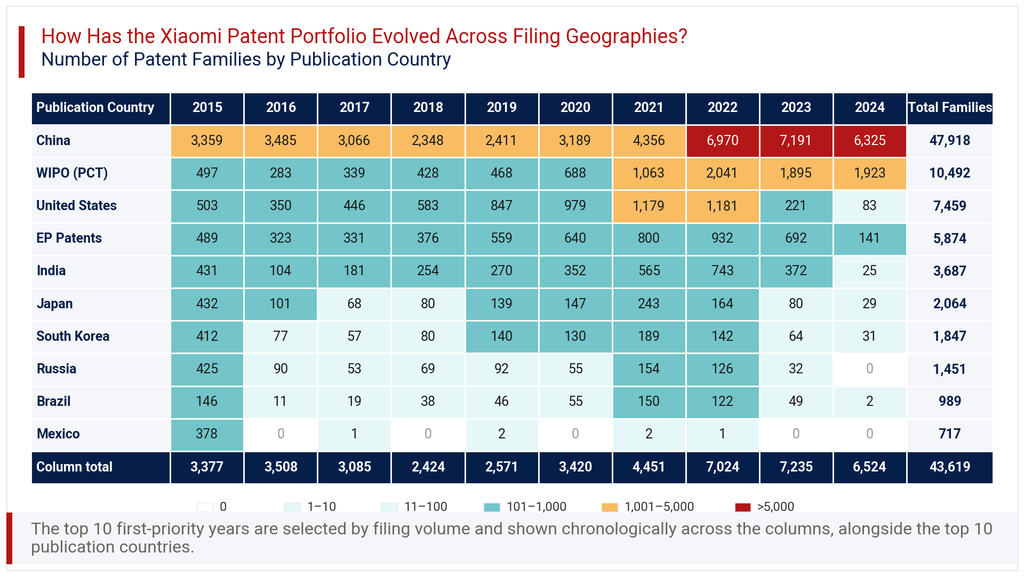
United States filings tell a different story, climbing to 1,181 in 2022 before falling sharply to 221 in 2023 and just 83 in 2024. European filings followed a similar pattern, dropping from 932 in 2022 to 141 by 2024. India, Japan, South Korea, Russia, and Brazil all show comparable declines in the most recent years. This pattern aligns with the publication lag already noted, meaning recent-year figures across most jurisdictions understate actual filing activity rather than reflecting genuine retreat from these markets.
Consultant’s Perspective on Xiaomi Patent Portfolio
The Xiaomi Patent Portfolio reflects a company treating intellectual property as core infrastructure rather than a defensive afterthought. The scale of filing, over 49,524 families, and the concentration in connectivity and computing classes align closely with Xiaomi’s stated smart manufacturing and IoT strategy. The grant rate of 49.5% combined with an 82.0% active rate suggests a portfolio built for durability rather than speed alone.
Two areas merit attention from any business evaluating this portfolio. First, the 13.2% revocation share is higher than typical lapsed or expired rates and warrants jurisdiction-specific legal diligence. Second, the heavy China concentration at 96.8% means competitive assessments outside China should weight filing counts carefully against actual market presence.
Looking forward, Xiaomi’s push into electric vehicles and smart home integration will likely test whether its filing patterns in classes like F24F and H02J expand meaningfully. Companies tracking Xiaomi as a competitor or licensing partner should monitor filings in automotive-adjacent IPC classes over the next two to three years, since current data may not yet capture that strategic shift fully.
Explore Deeper Insights with Expertlancing Research
This review only scratches the surface of what the Xiaomi Patent Portfolio can reveal about competitive positioning and technology direction. Expertlancing Research helps businesses go further, with family-level validation, competitor benchmarking, and custom technology landscape studies tailored to specific markets. Whether you are assessing licensing risk, tracking a competitor, or scoping an acquisition target, our analysts can build the detailed evidence base you need. Reach out to Expertlancing Research to commission a deeper, decision-ready patent analysis.