


The ZTE Patent Portfolio offers a useful window into how one of China’s largest telecom equipment makers has built and defended its technology holdings over nearly two decades. Across 69,851 total patent families, 40.9% of the portfolio remains active, a figure that covers both granted and pending cases. Of these, 19,516 families have been granted and 9,024 remain pending, giving a grant rate of 27.9%. The remaining families, numbering 41,311 when lapsed, revoked and expired cases are combined, show a portfolio that has shed a large share of its older filings. These are prosecution and maintenance metrics only, not a verdict on patent quality or enforceability.
Filing activity peaked at 5,742 families in 2009, reflecting ZTE’s aggressive expansion phase during that period. China dominates the jurisdictional spread, accounting for 98.0% of filings, and the portfolio spans 10 jurisdictions in total. On the technology side, digital information transmission under H04L leads all categories with 29,123 families, underscoring ZTE’s core focus on network infrastructure and data transmission systems.
This report is meant to help readers interpret ZTE’s filing behaviour at a macro level, not to serve as a substitute for due diligence. Filing counts alone cannot confirm commercial success, market share, or technical superiority. Readers evaluating specific families for licensing, litigation, or investment purposes should verify details directly against primary patent office records before relying on them externally.
About ZTE
Company Profile: ZTE Corporation is a Chinese partially state-owned technology company that specializes in telecommunication. Founded in 1985, ZTE is listed on both the Hong Kong and Shenzhen Stock Exchanges. ZTE’s core business is wireless, exchange, optical transmission, data telecommunications gear, telecommunications software, and mobile phones. It primarily sells products under its own name, but it is also an OEM. On its official site, the company states it serves global telecom operators, government and enterprise customers, and consumers, covering more than 160 countries and regions, serving over 1/4 people worldwide. In 2022, the company reported net income of CN¥8.08 billion, total assets of CN¥180.95 billion, and total equity of CN¥58.64 billion , with 74,811 employees. The company has also faced criticism in the United States, India, and Sweden over ties to the Chinese government, and in 2017 was fined for illegally exporting U.S. technology to Iran and North Korea.
How Healthy is ZTE Patent Portfolio?
Patent portfolio health depends heavily on legal status distribution, and ZTE’s figures tell a layered story. Granted patents make up 27.9% of the total, while 12.9% remain pending before patent offices worldwide. Lapsed families account for the largest share at 40.7%, followed by revoked cases at 15.4% and expired filings at 3.0%. The composition chart in this section shows that nearly four in ten families have fallen out of force, a pattern common among companies with long filing histories and large early-stage portfolios.
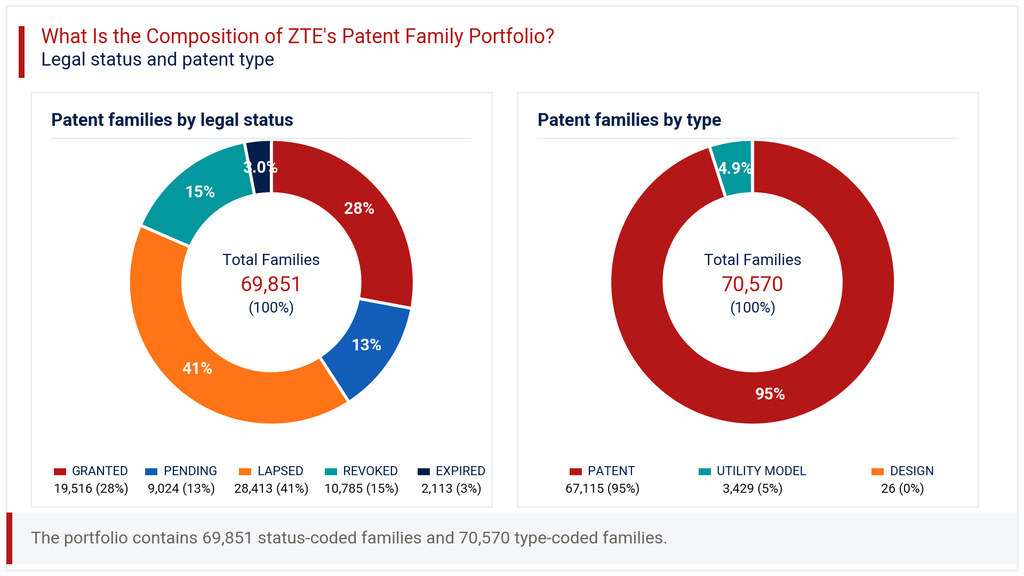
Patent type composition adds further texture. Standard patents represent 95.1% of the portfolio, utility models account for 4.9%, and design filings are negligible at 0.0%. This heavy tilt toward standard patents suggests ZTE has historically prioritized core technical inventions over incremental or cosmetic protections. The active rate of 40.9% combining granted and pending families indicates a portfolio still generating legal weight, even as older filings age out. For stakeholders assessing patent portfolio health, the mix points to a mature filer managing a large legacy base alongside newer, still-pending applications. The proportion of revoked cases warrants attention, since it may reflect either validity challenges or deliberate portfolio pruning by ZTE itself.
How Has the ZTE Patent Portfolio Evolved Over Time?
Patent filing trends for ZTE show a distinct arc across the years tracked. Filings before 2007 totalled 10,403 families, followed by a strong run through 2008 to 2011, when annual counts stayed above 4,900. The peak came in 2009 with 5,742 families, a year that likely coincided with ZTE’s push into international markets and broader technology development. The filing-trend chart in this section captures a gradual decline through the mid-2010s, with counts settling between 2,100 and 2,600 annually from 2020 onward.
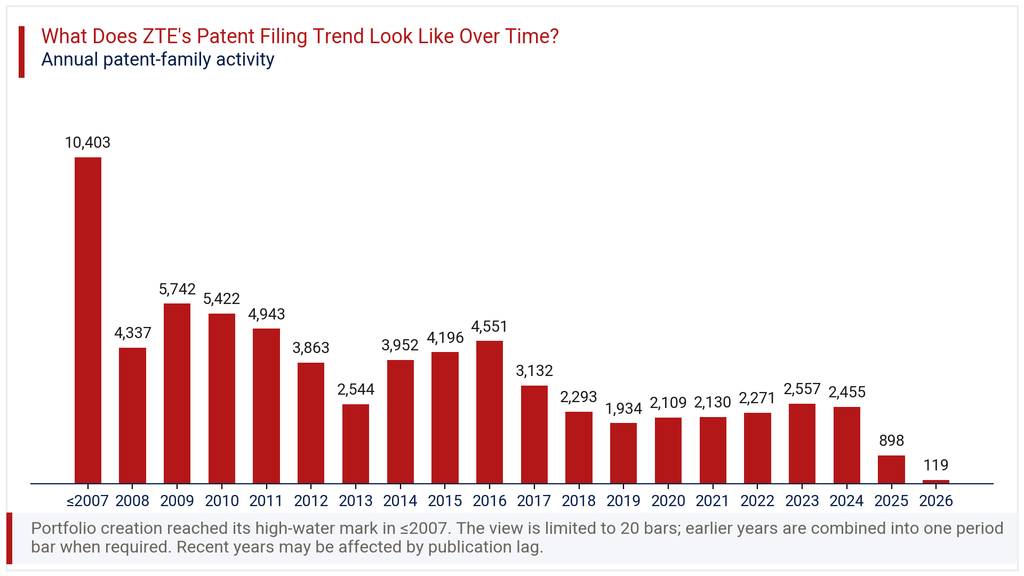
The most recent years need careful reading. Figures for 2025 and 2026 show sharp drops, down to 898 and 119 respectively, with a year-over-year change of -86.7%. This does not necessarily signal a real pullback in filing activity. Patent applications typically take 18 months or longer to publish, so recent filings are often undercounted in any dataset pulled before that window closes. The more reliable signal lies in the 2017 to 2024 period, where ZTE settled into a steadier, lower filing cadence than its 2008 to 2016 peak years, suggesting a more selective filing strategy.
Where Does the ZTE Patent Portfolio Prioritize Patent Protection?
Patent geography for ZTE centres overwhelmingly on its home market. China accounts for 98.0% of all filings, a figure that reflects both domestic R&D strength and the practical need to protect inventions where ZTE manufactures and sells most heavily. The WIPO PCT route follows at 55.3%, showing that ZTE uses international applications extensively as a bridge to multiple national markets later in the process.
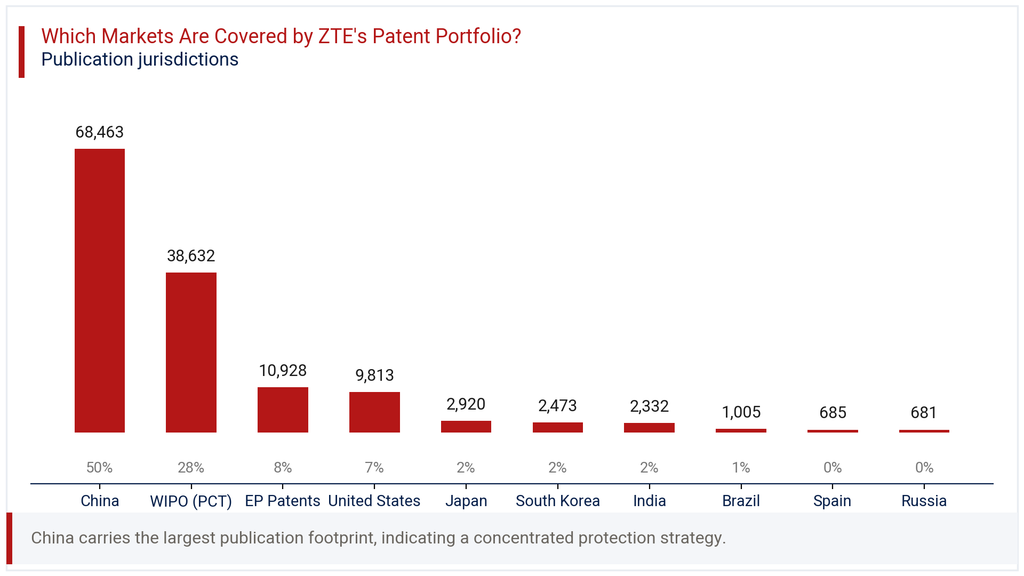
Beyond these two, protection thins out quickly. European patents stand at 15.6%, the United States at 14.0%, and Japan at just 4.2%. South Korea, India, Brazil, Spain, and Russia each account for less than 4% individually. The geographic chart in this section shows a portfolio concentrated in a small number of markets, with China and the PCT route together forming the backbone of ZTE’s protection strategy. This pattern is typical of Chinese technology firms whose primary commercial base remains domestic, even as they pursue selective international coverage. For competitors or partners evaluating ZTE’s reach, the data suggests meaningful enforcement risk in China specifically, with comparatively lighter coverage across Western markets outside the US and Europe.
Where is the ZTE Patent Portfolio Building Protection Across Key Technologies?
IPC analysis of the ZTE Patent Portfolio points clearly toward communications infrastructure as the dominant theme. Digital information transmission under H04L leads with 29,123 families, representing 31.4% of the total. Wireless communication networks under H04W follow closely at 26,968 families, or 29.1% of filings. Together these two categories account for more than six in ten patent families, confirming ZTE’s core identity as a telecommunications equipment and network technology company.
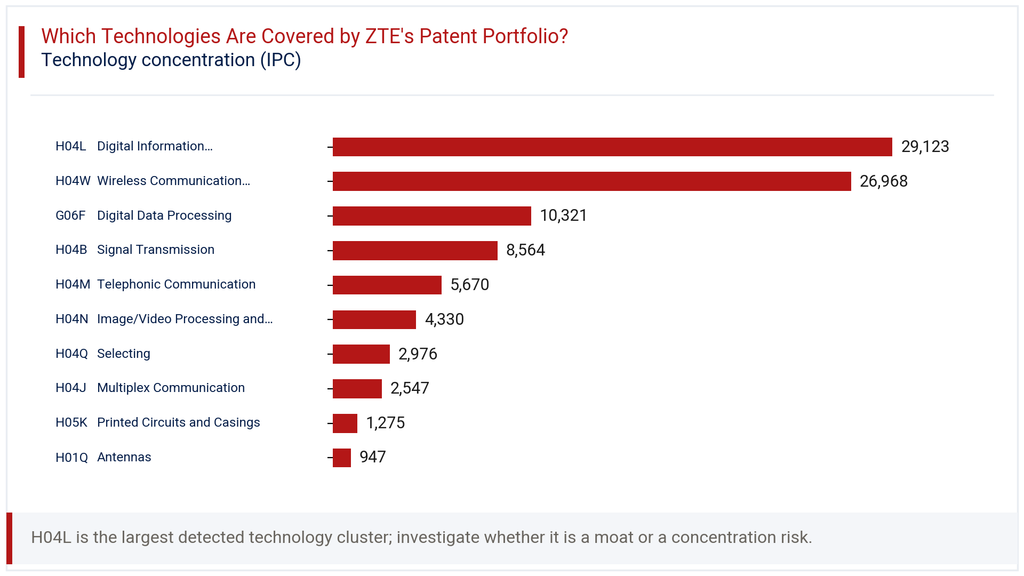
Supporting categories reveal where ZTE invests beyond its core strength. Digital data processing under G06F holds 11.1% of the portfolio, while signal transmission under H04B accounts for 9.2%. Telephonic communication, image and video processing, and multiplex communication each contribute smaller but meaningful shares. The technology chart in this section shows a clear hierarchy, with network and transmission technologies at the top and supporting software and hardware categories beneath. This concentration suggests ZTE’s R&D investment tracks closely with its product lines in wireless infrastructure, data networks, and telecom hardware, rather than diversifying broadly into adjacent software or consumer technology domains.
How Has the ZTE Patent Portfolio Evolved Across Filing Geographies?
Viewing filing activity by year and jurisdiction together reveals how ZTE’s international strategy has shifted. China filings stayed strong through the entire tracked period, from 5,668 in 2009 down to 2,261 by 2022, mirroring the broader decline in overall volume. The WIPO PCT route followed a similar arc, moving from 2,783 in 2009 to 1,801 in 2022, confirming its role as a consistent secondary channel.
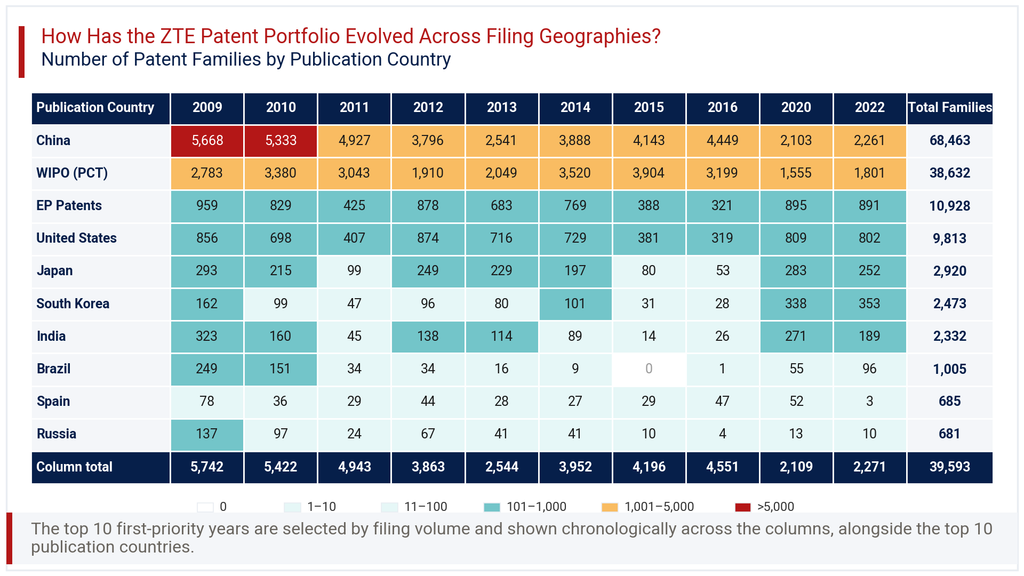
The heatmap in this section highlights some interesting divergences among smaller markets. South Korea actually grew over time, rising from 162 filings in 2009 to 353 in 2022, bucking the general downward trend. India and Brazil, by contrast, fell sharply, with India dropping from 323 to 189 and Brazil swinging from 249 down to single digits before recovering slightly to 96 by 2022. The United States and European filings held relatively steady in absolute terms across the same years. This uneven pattern suggests ZTE recalibrated its international filing priorities over time, pulling back in some emerging markets while sustaining or increasing presence in others like South Korea and the US.
Consultant’s Perspective on ZTE Patent Portfolio
Reading the ZTE Patent Portfolio as a whole, two things stand out. First, the scale is considerable, but a large share of older filings has already lapsed or been revoked, leaving an active base of 40.9%. Second, the technology concentration in digital transmission and wireless networks, together exceeding 60% of filings, confirms a tightly focused R&D strategy rather than a scattered one.
The jurisdictional imbalance deserves attention from anyone assessing ZTE commercially. With 98.0% of filings in China, overseas enforcement options outside the PCT and a handful of major markets remain comparatively thin. Businesses negotiating licensing deals, assessing freedom-to-operate, or benchmarking competitive technology positions should treat the China-heavy footprint as a structural feature, not an oversight.
Going by the filing cadence from 2017 onward, ZTE appears to have moved toward a more selective, quality-over-quantity approach rather than its earlier high-volume years. This is a reasonable response to rising patent costs and stricter examination standards globally. Organizations tracking ZTE as a competitor or potential partner should monitor upcoming grant activity in pending cases, since 9,024 families still awaiting decision could materially shift the active base in either direction over the next few years.
Explore Deeper Insights with Expertlancing Research
Understanding a patent portfolio at this scale takes more than reading summary figures. Expertlancing Research helps technology companies, investors, and legal teams go beyond the headline numbers through custom patent analytics, competitive benchmarking, and technology landscape studies. If your organization needs a deeper assessment of ZTE’s patent holdings, or a comparative study against other telecom players, our research team can build that analysis around your specific business question. Reach out to discuss how a tailored patent intelligence project could support your next strategic decision.