

The Yangtze Memory Patent Portfolio offers a useful lens into how one of China’s most closely watched chipmakers builds and defends its technology base. Across 5,953 patent families, 89.4% remain active, a figure covering both granted and pending cases. Of these, 3,681 have been granted and 1,640 are still pending, giving a grant rate of 61.8%. A combined 632 families sit in lapsed, expired or revoked status. These are prosecution and maintenance metrics only, not a verdict on patent quality or enforceability.
Filing activity peaked in 2021, when the company filed 1,175 families in a single year. China dominates the jurisdictional footprint, accounting for 98.2% of filings across a spread of 10 jurisdictions tracked in this dataset. On the technology side, H10B, covering 3D memory device structures, leads the portfolio with 3,093 families, making it the single largest cluster by a wide margin.
This article is meant to help readers interpret filing patterns, not to declare competitive outcomes on its own. Patent counts tell us where a company is investing attention and resources, but they do not by themselves confirm commercial success or market dominance. Readers considering business or investment decisions around the Yangtze Memory Patent Portfolio should validate specific families and their legal status before relying on them externally.
About Yangtze Memory
Company Profile: Yangtze Memory Technologies Corp, known as YMTC, is a Chinese semiconductor integrated device manufacturer specializing in flash memory NAND chips. The company was founded in Wuhan, China, in 2016, with government investment and a goal of reducing the country’s dependence on foreign chip manufacturers. It was formerly a subsidiary of partially state-owned enterprise Tsinghua Unigroup.
YMTC’s core products include 3D NAND flash-memory wafers and packaged chips, embedded memory solutions such as eMMC and UFS, and consumer and enterprise solid-state drives. The company produces enterprise solid state drives under its own brand and for resellers like Lexar, HP, Acer, Kingston and Teamgroup. Its consumer products are marketed under the brand ZhiTai. YMTC operates under the Xtacking technology brand. The company reports a workforce of approximately 8,000 employees as of 2023, with Chen Nanxiang serving as chairman and CEO.
How Healthy is Yangtze Memory Patent Portfolio?
Patent portfolio health starts with legal status, and the numbers here are reassuring. Granted patents make up 61.8% of the portfolio, while 27.5% remain pending, still working through examination. Only 0.1% are lapsed and 10.5% have been revoked, with no families recorded as expired. The composition chart in this section shows how these categories stack up, and the balance leans clearly toward active protection rather than attrition.
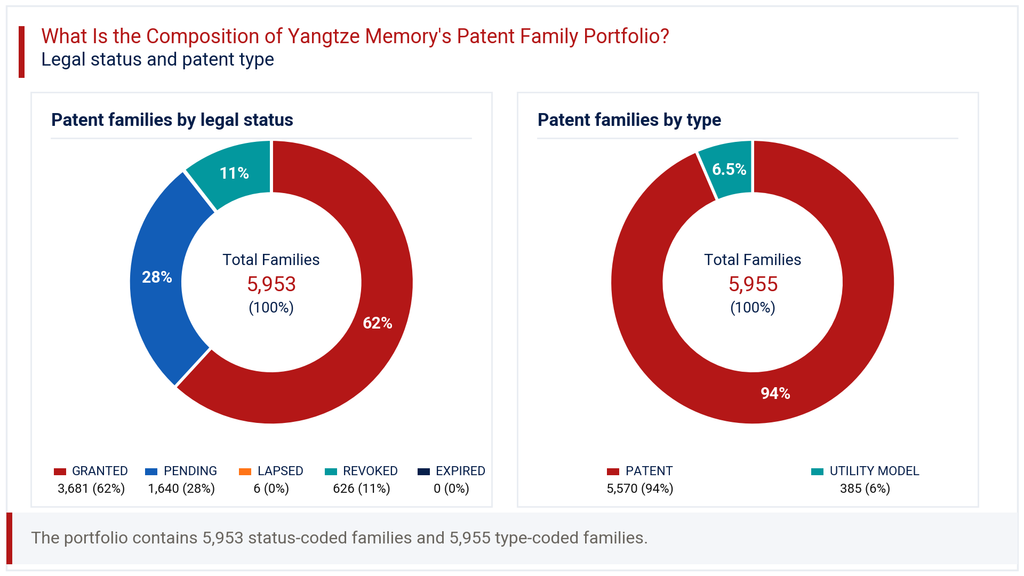
Patent type adds another layer. Standard patents account for 93.5% of filings, with utility models making up the remaining 6.5%. This mix suggests the company relies mainly on full patent examination rather than the lighter utility model route common in China. A 10.5% revocation rate is worth watching, since it is higher than typical lapse figures, though it still leaves the bulk of the portfolio either granted or in active prosecution. For a company operating in a sensitive, export-controlled semiconductor segment, maintaining a high active rate across granted and pending cases signals consistent investment in legal protection rather than a one-time filing push.
How Has the Yangtze Memory Patent Portfolio Evolved Over Time?
Patent filing trends for Yangtze Memory show a sharp rise followed by a recent pullback. Filings were negligible before 2017, then jumped to 322 that year as the company scaled its research output. Growth continued steadily through 2018 (480), 2019 (617), and 2020 (983), reaching a peak of 1,175 families in 2021. The filing-trend chart in this section traces this curve clearly, showing a multi-year build-up followed by moderation.
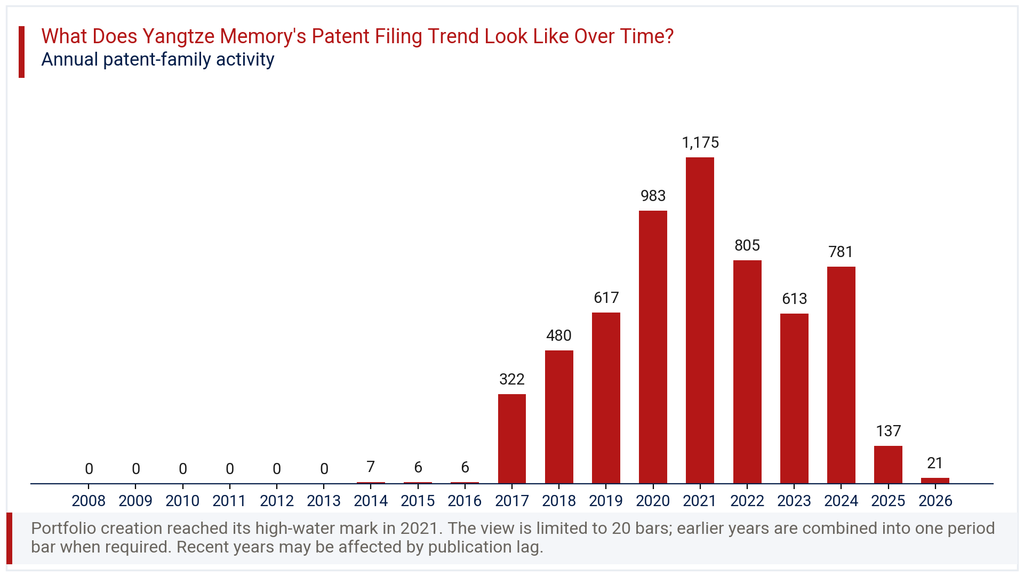
After the 2021 peak, filings dropped to 805 in 2022 and 613 in 2023, before recovering to 781 in 2024. The 2025 figure of 137 reflects a 84.7% decline versus the prior year, but this should be read cautiously. Patent applications typically take 12 to 18 months to publish, so recent-year counts are almost always undercounted until records catch up. Rather than signaling a real slowdown in innovation, the 2025 and 2026 figures most likely reflect publication lag common to patent databases, not a genuine retreat in filing activity.
Where Does the Yangtze Memory Patent Portfolio Prioritize Patent Protection?
Patent geography for Yangtze Memory is heavily concentrated at home. China accounts for 98.2% of all filings, by far the dominant jurisdiction, reflecting the company’s domestic manufacturing base and government-backed mandate. The United States follows at 27.4%, then WIPO PCT filings at 16.6%, giving the company a route into multiple markets through a single international application. The geographic chart in this section lays out this distribution across all 10 jurisdictions tracked.
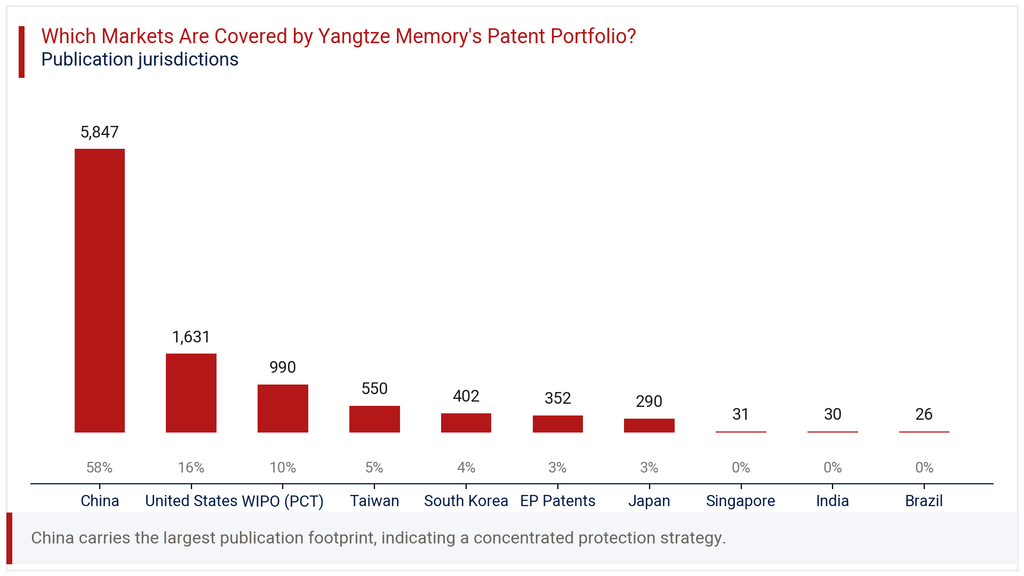
Beyond these three, Taiwan (9.2%), South Korea (6.8%), EP Patents (5.9%) and Japan (4.9%) round out the meaningful filing destinations, each representing established semiconductor manufacturing or consumption hubs. Singapore, India and Brazil each sit below 1%, suggesting these markets are not currently treated as filing priorities. This pattern points to a company protecting its core innovation domestically first, then selectively extending coverage to jurisdictions where competitors, customers or manufacturing partners are concentrated, rather than pursuing broad global filing from the outset.
Where is the Yangtze Memory Patent Portfolio Building Protection Across Key Technologies?
IPC analysis of the Yangtze Memory Patent Portfolio points to a clear technical center of gravity. H10B, covering 3D memory device structures, leads with 3,093 families, representing 37.1% of the entire portfolio. This aligns directly with YMTC’s core business in 3D NAND flash memory and its Xtacking architecture. The technology chart in this section shows just how dominant this single class is relative to everything else filed.
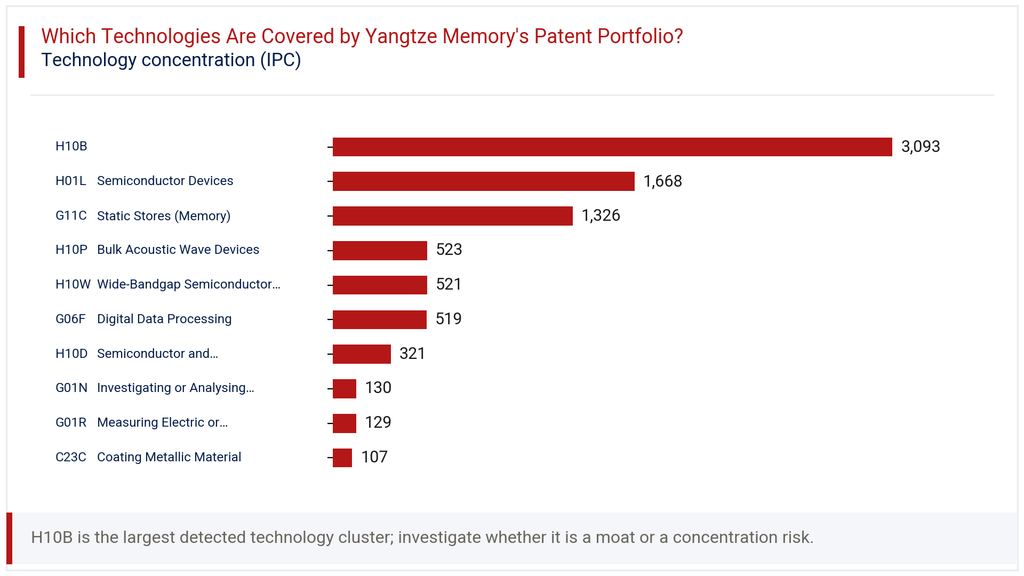
Behind H10B, H01L (semiconductor devices generally) holds 20.0% with 1,668 families, and G11C (static memory stores) accounts for 15.9% with 1,326 families. Together, these three classes make up roughly 73% of the portfolio, confirming a tight technical focus rather than diversification. Smaller clusters in bulk acoustic wave devices (H10P, 6.3%), wide-bandgap semiconductors (H10W, 6.2%) and digital data processing (G06F, 6.2%) suggest early-stage exploration into adjacent hardware domains, but none yet approach the scale of the core memory-device filings.
How Has the Yangtze Memory Patent Portfolio Evolved Across Filing Geographies?
Viewed year by year, China has anchored almost every filing wave in this portfolio, starting from 7 families in 2014 and scaling to 982 by 2020 and 1,172 by 2021. The heatmap in this section shows this domestic surge against a comparatively modest international build-up across the same years. The United States shows steadier, more gradual growth, rising from 39 in 2017 to 400 by 2024, suggesting a sustained rather than opportunistic approach to that market.
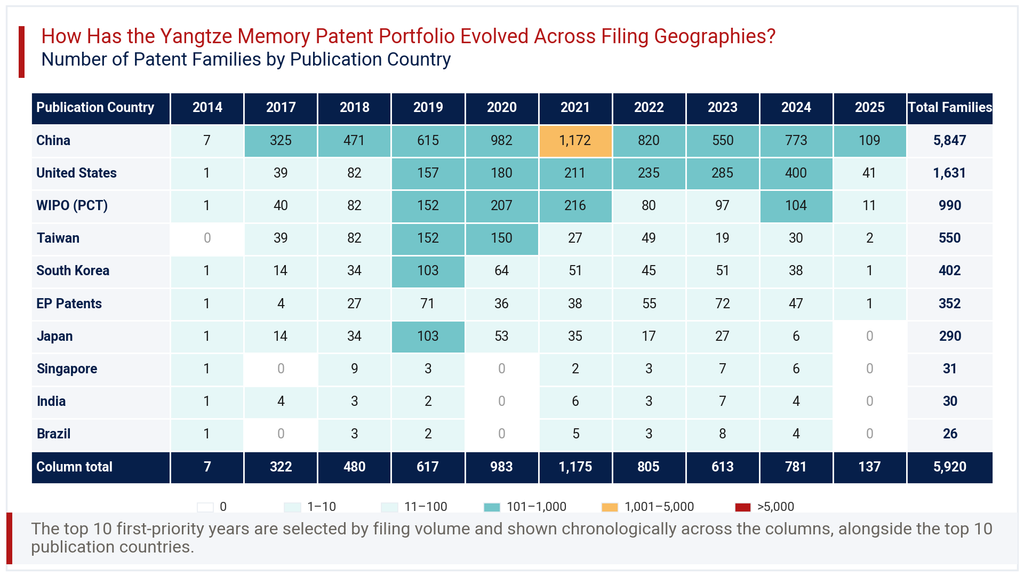
WIPO PCT filings peaked at 216 in 2021 alongside the broader domestic surge, then fell to under 100 annually from 2022 onward. Taiwan and South Korea both show earlier peaks around 2018 to 2020, followed by consistent decline, hinting that early cross-strait and regional filing priorities have since cooled. Japan’s filings have also tapered sharply, down to single digits by 2024. This geographic pattern across years reinforces that international expansion, while real, has not kept pace with the scale of domestic filing growth.
Consultant’s Perspective on Yangtze Memory Patent Portfolio
Taken as a whole, the Yangtze Memory Patent Portfolio reads as a textbook case of domestically anchored, technically concentrated patent strategy. The heavy skew toward China (98.2%) and toward 3D memory architecture (H10B at 37.1%) tells a consistent story: a company building deep, defensible protection around its core manufacturing process rather than spreading thin across unrelated fields.
What stands out to me is the discipline in technology focus. Three IPC classes cover close to three-quarters of all filings, which is unusual for a company of this scale and suggests deliberate rather than scattershot R&D investment. The 10.5% revocation rate deserves monitoring, particularly given the geopolitical scrutiny this company faces in export-control discussions, but it does not currently threaten the overall health of the portfolio.
My recommendation for anyone evaluating this company, whether as a competitor, supplier or investor, is to track two things closely: how quickly international filings (US, EP, Japan) grow relative to China, and whether the 2025-2026 filing dip resolves into normal publication-lag catch-up. Both will signal whether YMTC’s next phase of growth extends beyond its domestic base.
Explore Deeper Insights with Expertlancing Research
This overview only scratches the surface of what the Yangtze Memory Patent Portfolio can reveal about competitive positioning, white space opportunities, and technology risk. Expertlancing Research helps clients go beyond headline figures, through family-level validation, claim-level technical mapping, and tailored competitive benchmarking. If you are assessing YMTC or its peers for a business, legal, or investment decision, reach out to our team for a deeper, customized patent intelligence engagement.