

The Wuxi Jiangnan patent portfolio spans 984 total patent families, of which 39.3% remain active through granted and pending status combined. Of these families, 327 have been granted and 60 are still pending examination, giving a grant rate of 33.2%. The remaining families, totalling 597 across lapsed, expired and revoked status, make up a significant share of the portfolio. These figures describe prosecution and maintenance outcomes only, not a judgment on patent quality or enforceability.
Filing activity peaked in 2020 with 127 families filed that year, the highest single-year count in the portfolio’s history. China dominates the jurisdictional footprint, accounting for 100.0% of filings across 2 jurisdictions tracked, the other being WIPO under the PCT route. The leading technology cluster is H01B, covering cables, conductors and insulated wires, with 515 families, by far the largest concentration in the dataset.
This report draws on patent filing and legal-status data to help readers assess the shape and depth of Wuxi Jiangnan’s innovation activity. Filing counts alone do not establish commercial success, product adoption or competitive strength in the market. Readers considering specific families for licensing, diligence or competitive benchmarking should independently verify details before relying on them externally.
About Wuxi Jiangnan
Company Profile: Wuxi Jiangnan most likely refers to Wuxi Jiangnan Cable Co., Ltd., a wire and cable manufacturer based in Jiangsu, China. The company’s official website describes it as a national key High and New Technology Enterprise integrating research and development, production and sales of wires and cables.
It covers an area of more than 650,000 square meters, with a construction area of 400,000 square meters and total assets of more than 10 billion yuan. The firm employs more than 2,300 people, of which more than 30 percent are middle and senior technical and management personnel.
Its production relies on more than 1,500 sets of domestic and foreign advanced production and testing equipment, including extra high voltage cable production lines from Maillefer of Finland and equipment from Germany, France, Italy and Switzerland. However, there is no unified Wikipedia page confirming group-level patent activity, so this profile should be treated as provisional pending clearer identification of the exact corporate entity intended.
How Healthy is Wuxi Jiangnan Patent Portfolio?
The composition chart in this section shows a portfolio weighted toward lapsed and expired status rather than active protection. Granted families represent 33.2% of the total, while pending applications add another 6.1%, bringing the active rate to 39.3%. Lapsed families account for 39.4%, the single largest category, followed by expired families at 16.0% and revoked families at 5.3%. This pattern of patent legal status suggests many older filings were allowed to lapse rather than maintained through their full term.
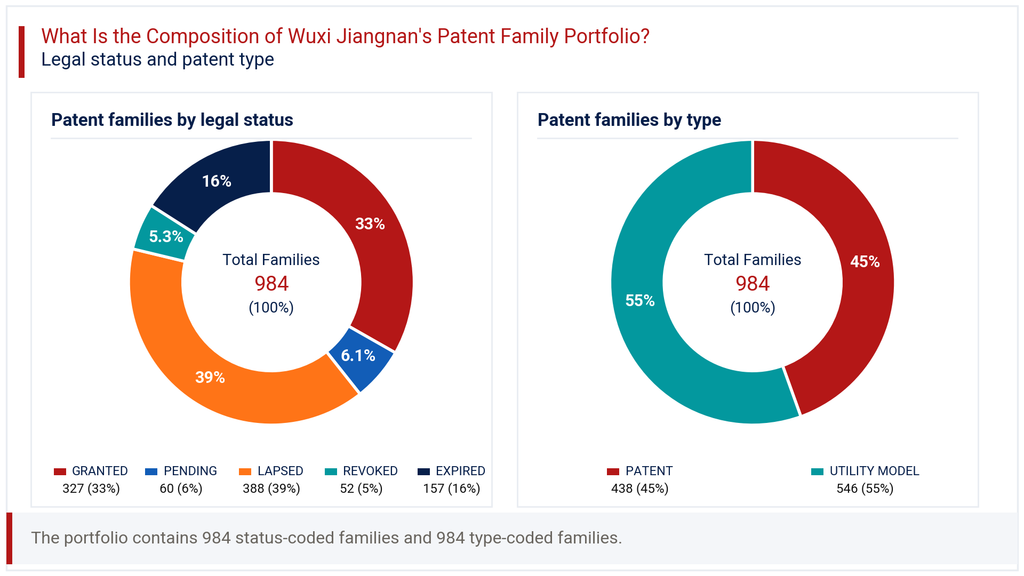
On patent type, utility models outnumber invention patents, making up 55.5% against 44.5% for standard patents. Utility models in China carry shorter examination timelines and shorter maximum terms, which often signals a focus on incremental, practical engineering improvements rather than foundational breakthroughs. Combined with the lapsed-heavy status split, this points to a portfolio built for operational and manufacturing protection rather than long-horizon strategic blocking. Overall patent portfolio health here reflects a company maintaining a working set of protections while letting older, less commercially relevant filings expire naturally over time.
How Has the Wuxi Jiangnan Patent Portfolio Evolved Over Time?
The filing-trend chart tracks a gradual climb from single digits before 2008 through to a first major surge in 2015, when filings reached 117. Activity dipped through 2017 to 2019, settling between 30 and 37 families annually, before spiking again in 2020 to the portfolio’s peak of 127 filings. This two-wave pattern suggests distinct bursts of research investment rather than one continuous expansion phase, possibly tied to product cycles or facility upgrades.
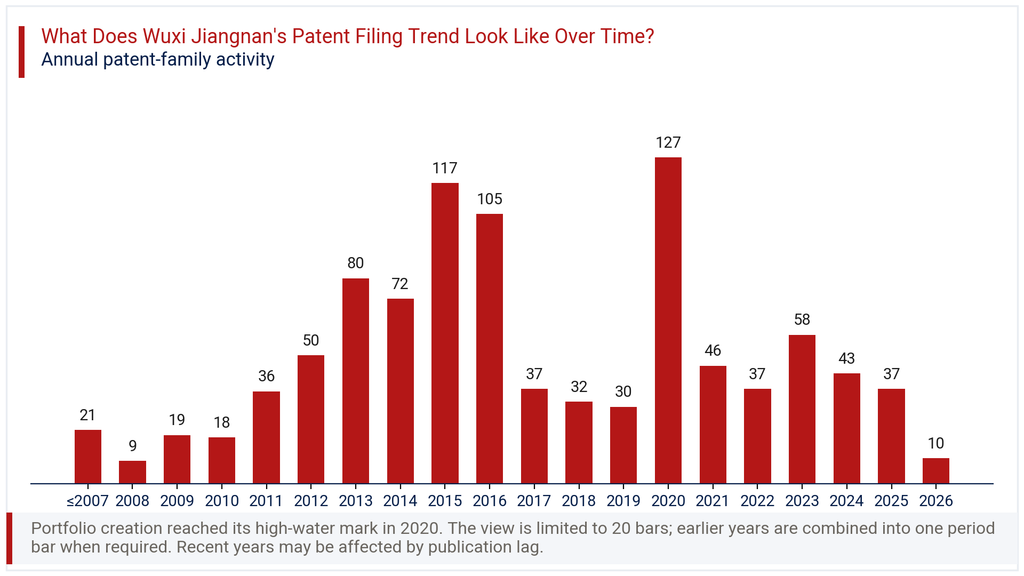
Filing counts after 2020 decline steadily, falling to 46 in 2021 and settling near 37 to 58 through 2023 and 2025. The most recent year on record, 2026, shows only 10 families, a drop reflected in the -73.0% figure for latest-year change. This should be read cautiously, since publication lag typically understates filings from the most recent one to two years before full data catches up. The broader patent filing trends still indicate a company with sustained, if uneven, research output across more than two decades.
Where Does the Wuxi Jiangnan Patent Portfolio Prioritize Patent Protection?
The geographic chart makes the jurisdictional concentration immediately clear. China accounts for 100.0% of the portfolio’s jurisdictional share, with 984 families filed domestically. Only a single family has been routed through WIPO under the Patent Cooperation Treaty, representing 0.1% of jurisdictional share. Across the two jurisdictions tracked in this analysis, the imbalance is stark and leaves little ambiguity about where protection has been prioritised.
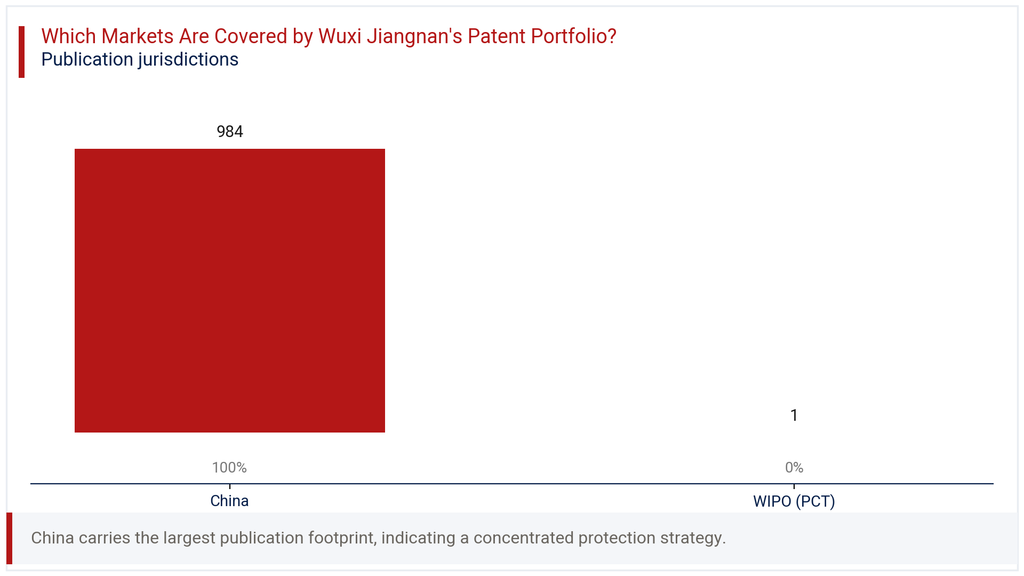
This patent geography points to a company oriented primarily around its domestic manufacturing base and customer relationships within China. The near-absence of international filing activity suggests limited reliance on patents to protect export markets or overseas licensing arrangements. For competitors or partners assessing global exposure, this narrow jurisdictional footprint matters directly. It implies that competitive risk or freedom-to-operate concerns tied to this portfolio are concentrated almost entirely within Chinese territory, with negligible protection claimed elsewhere.
Where is the Wuxi Jiangnan Patent Portfolio Building Protection Across Key Technologies?
The technology chart in this section shows an overwhelming concentration in one IPC class. H01B, covering cables, conductors and insulated wires, accounts for 515 families, or 64.9% of the entire portfolio. This single classification dwarfs every other category, confirming that core cable and wire technology sits at the centre of the company’s research effort.
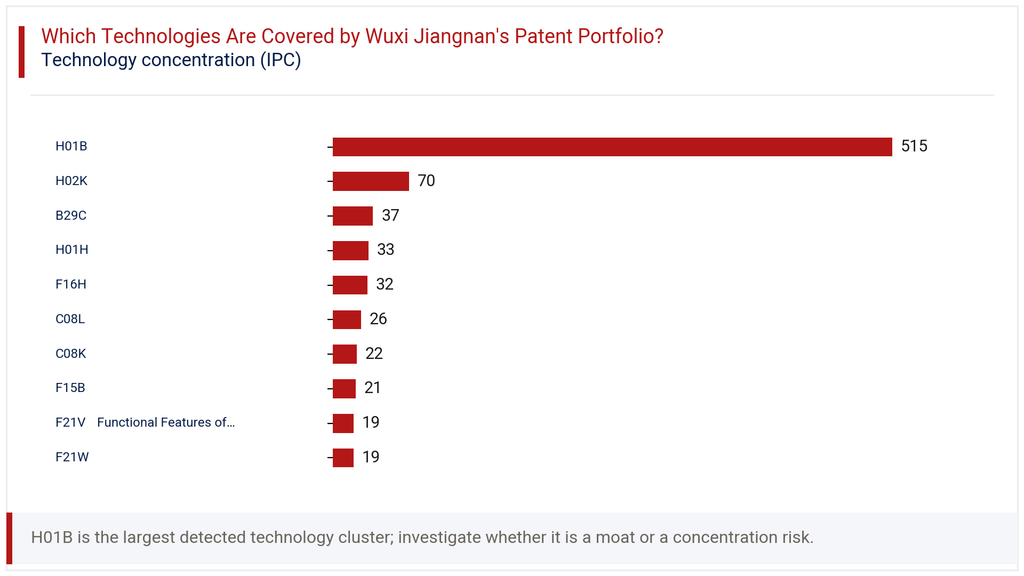
Secondary clusters trail far behind. H02K, covering dynamo-electric machines, holds 70 families at 8.8%, while B29C, covering plastics and polymer shaping processes, holds 37 families at 4.7%. Smaller clusters include H01H switches and circuit breakers at 4.2%, F16H power transmission at 4.0%, and materials-related classes C08L and C08K at 3.3% and 2.8% respectively. This IPC analysis confirms a tightly focused research agenda built around core cable manufacturing, with only modest diversification into adjacent mechanical, electrical and materials science fields supporting that primary business.
How Has the Wuxi Jiangnan Patent Portfolio Evolved Across Filing Geographies?
The heatmap in this section reinforces what the jurisdictional breakdown already suggests, with China carrying almost every year of recorded activity. Domestic filings rose from 50 in 2012 to 80 in 2013, then to 117 in 2015, tracking the portfolio’s overall filing rhythm closely. The 2020 peak of 127 families was again entirely domestic, confirming that China has remained the sole meaningful filing venue throughout the company’s active history.
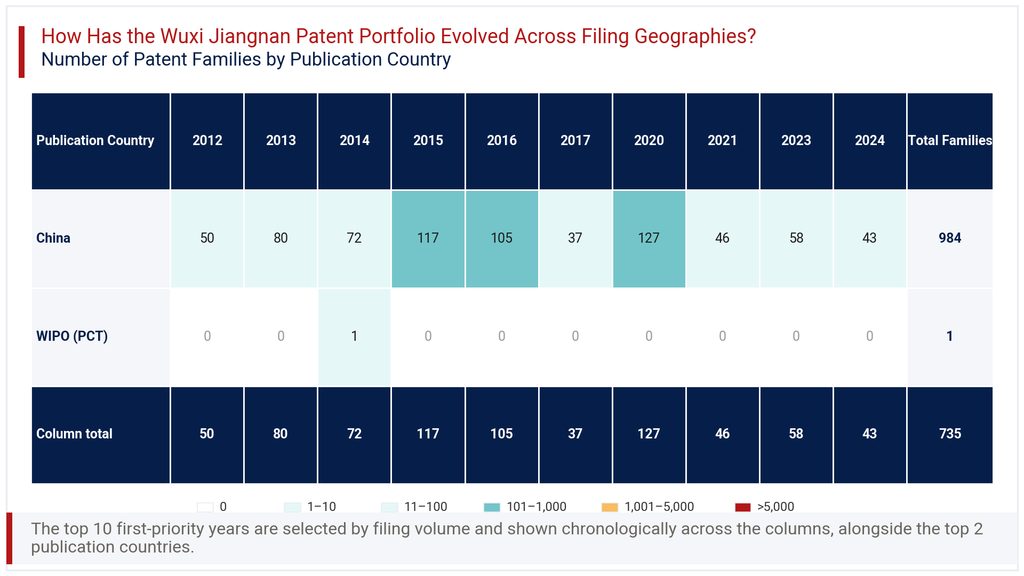
WIPO activity appears just once, with a single family filed in 2014 and no PCT filings recorded in any other year shown in the matrix. This near-total absence of parallel international filing alongside domestic activity suggests the company has not pursued simultaneous multi-jurisdiction strategies common among exporters. Each wave of domestic filing growth, whether in 2013, 2015, or 2020, happened without a corresponding international filing wave. This consistency across years strengthens the view that patent protection strategy here has remained domestically anchored by design, not by oversight.
Consultant’s Perspective on Wuxi Jiangnan Patent Portfolio
Reading across all sections, the Wuxi Jiangnan patent portfolio presents a focused, domestically oriented filing strategy built around core cable and wire technology. The dominance of H01B at 64.9%, paired with 100.0% China-based filings, suggests a company whose patent activity exists primarily to protect manufacturing processes rather than to stake out international competitive ground. The utility model share of 55.5% reinforces this reading, since this filing type suits incremental process and product refinements common in cable manufacturing.
The lapsed and expired share, together exceeding half the portfolio, raises a reasonable question about maintenance discipline. Whether this reflects deliberate pruning of outdated filings or budget-driven attrition is not something filing data alone can answer. Given the 2020 peak followed by a declining trend through 2025, with the 2026 figure likely understated due to publication lag, the near-term trajectory remains uncertain. A sensible recommendation is to track filing counts over the next one to two reporting cycles once lag effects settle. Any party evaluating this portfolio for partnership, licensing or competitive purposes should pair this filing analysis with a direct review of specific active families, since aggregate counts cannot substitute for claim-level diligence.
Explore Deeper Insights with Expertlancing Research
This analysis only scratches the surface of what patent filing data can reveal about a company’s technology direction and competitive posture. Expertlancing Research helps organisations go deeper, validating specific patent families, benchmarking against competitors and tracking filing trends as they develop. Whether you are assessing a potential partner, screening for freedom-to-operate risk, or building internal technology intelligence, our team can tailor the analysis to your exact question. Reach out to discuss how a customised patent study could support your next decision.