


The AUX Group Patent Portfolio offers a useful window into how one of China’s largest diversified manufacturers protects its engineering work. Across 41,777 total patent families, the active rate stands at 46.2%, a figure that combines granted and pending filings still holding some legal weight. Of this total, 16,785 families have been granted, while 2,513 remain pending before patent offices worldwide. The grant rate comes in at 40.2%, and a combined 22,479 families sit in lapsed, expired, or revoked status (10,262 lapsed, 9,052 expired, and 3,165 revoked). These figures describe prosecution and maintenance outcomes only, not the commercial value or enforceability of any particular patent.
Filing activity peaked in 2019, when the group recorded 3,413 new families, the highest annual count in the dataset. France leads all jurisdictions with a 50.6% share of jurisdictions_pct, and the portfolio spans 10 jurisdictions in total. On the technology side, air conditioning and humidification work under IPC class F24F dominates, accounting for 11,722 families, by far the largest cluster in the portfolio.
This report is meant to help readers understand filing patterns, not to draw conclusions about product performance or market standing from counts alone. Patent volume reflects filing behaviour and legal administration, not demonstrated competitive advantage. Anyone using this analysis for diligence, licensing, or investment decisions should validate specific families directly with patent offices before relying on them externally.
About AUX Group
Company Profile: AUX Group was established in 1986 and is headquartered in Ningbo, Zhejiang, China. The group is an enterprise covering several industries, including air conditioning, power utilization, power distribution, new energy, and medical services. For many years, it has ranked among China’s Top 500 Enterprises. In 2025, the group’s revenue reached RMB 81.6 billion, with total assets of RMB 76.4 billion.
It has over 40,000 employees, 17 manufacturing bases across Ningbo, Nanchang, Ma’anshan, Zhengzhou, Wuhu, Brazil, Indonesia, Thailand, Poland, Germany, Mexico, and Kenya, plus 7 R&D centers worldwide. It has invested in and operates 50 hospitals. The group owns three listed companies. It is recognised as a National-Recognized Enterprise Technology Center and owns two globally known brands, AUX and Sanxing, valued at over RMB 57.1 billion combined. The company recently became an official global partner of Manchester City Football Club and showcased AI-powered air solutions at IFA Berlin.
How Healthy is AUX Group Patent Portfolio?
Patent portfolio health depends on how filings move through legal status over time, and the numbers here tell a mixed story. Granted patents make up 40.2% of the portfolio, the single largest status category, while pending applications add another 6.0%. Together these yield the 46.2% active rate cited earlier. On the other side, lapsed families account for 24.6%, expired ones for 21.7%, and revoked filings for 7.6%. The composition chart in this section shows these categories side by side, making the scale of non-active filings clear at a glance.
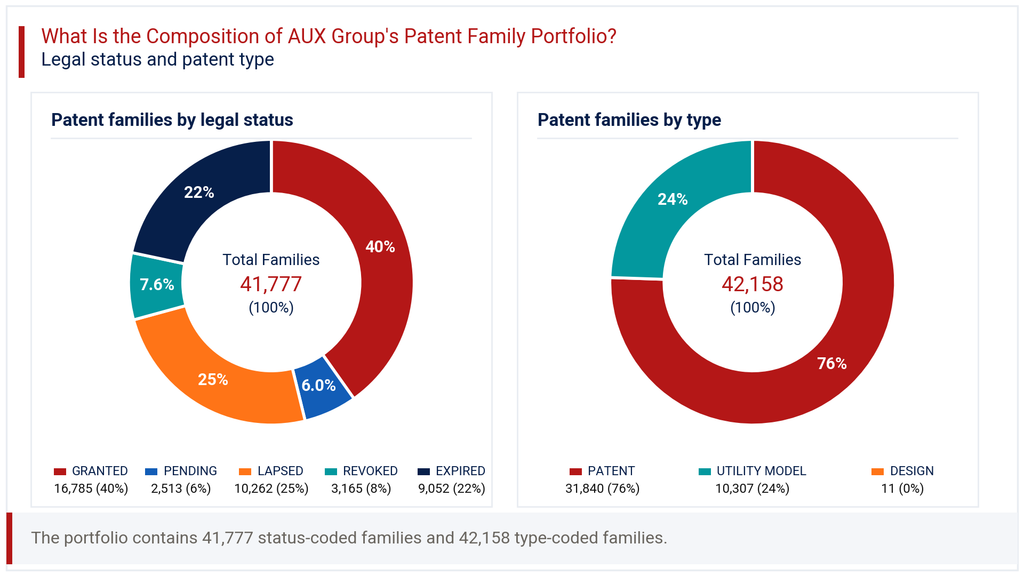
By patent type, traditional patents dominate at 75.5% of the portfolio, with utility models contributing 24.4% and design filings a negligible 0.0%. This split suggests AUX Group leans heavily on full patent protection rather than the faster, shorter-term utility model route common among Chinese filers. The sizeable lapsed and expired share is not unusual for a portfolio of this age and scale. It likely reflects natural attrition among older filings rather than a systemic weakness in current filing quality or legal strategy.
How Has the AUX Group Patent Portfolio Evolved Over Time?
Patent filing trends across AUX Group show a long build-up followed by a sharp climb and a recent pullback. Annual filings held below 1,000 through much of the early 2010s, then rose steadily from 963 in 2014 to 1,862 in 2017. The real surge came between 2018 and 2019, when counts jumped to 2,781 and then 3,413, the portfolio’s peak year. The filing-trend chart in this section captures this rise clearly, along with the moderation that followed.
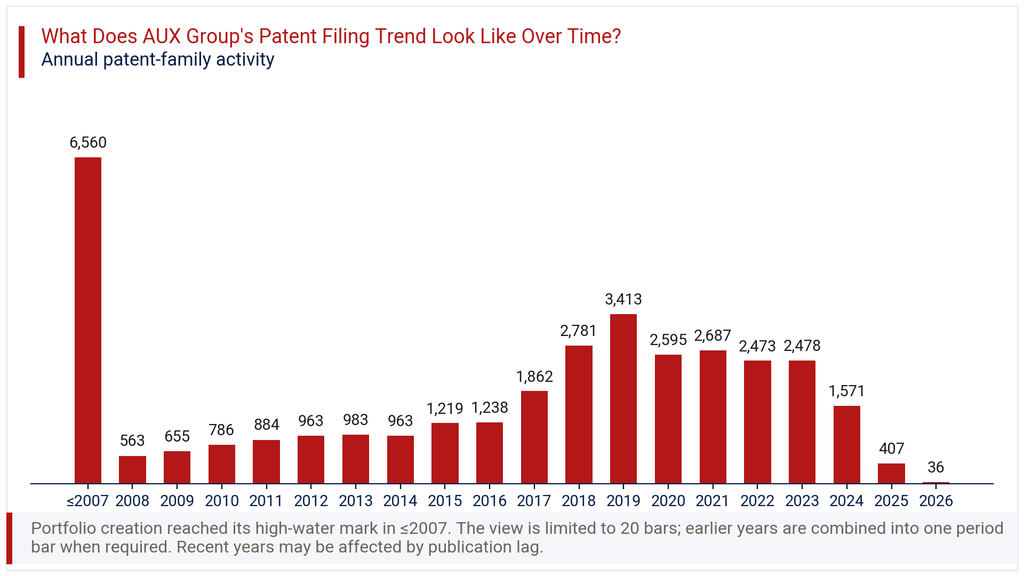
Filings eased to 2,595 in 2020 and hovered near 2,500 through 2023, before dropping to 1,571 in 2024 and just 407 in 2025. The percentages data confirms a 91.2% decline in the latest year tracked. This drop should not be read as a genuine pullback in innovation activity. Patent publication typically lags actual filing by twelve to eighteen months, so recent years remain incomplete in most patent databases. The 2024 and 2025 figures will likely revise upward as more applications publish.
Where Does the AUX Group Patent Portfolio Prioritize Patent Protection?
Patent geography within this portfolio points to a deliberate, multi-region filing strategy rather than a purely domestic one. France sits at the top with 21,132 families, a 50.6% share, which is notable for a Chinese manufacturer. China follows closely with 19,050 families at 45.6%, confirming that the home market remains a core priority. European Patent Office filings add 13,431 families, representing 32.1% of the portfolio, while the United States holds 12,623 families at 30.2%. The geographic chart in this section lays out all ten jurisdictions by volume.
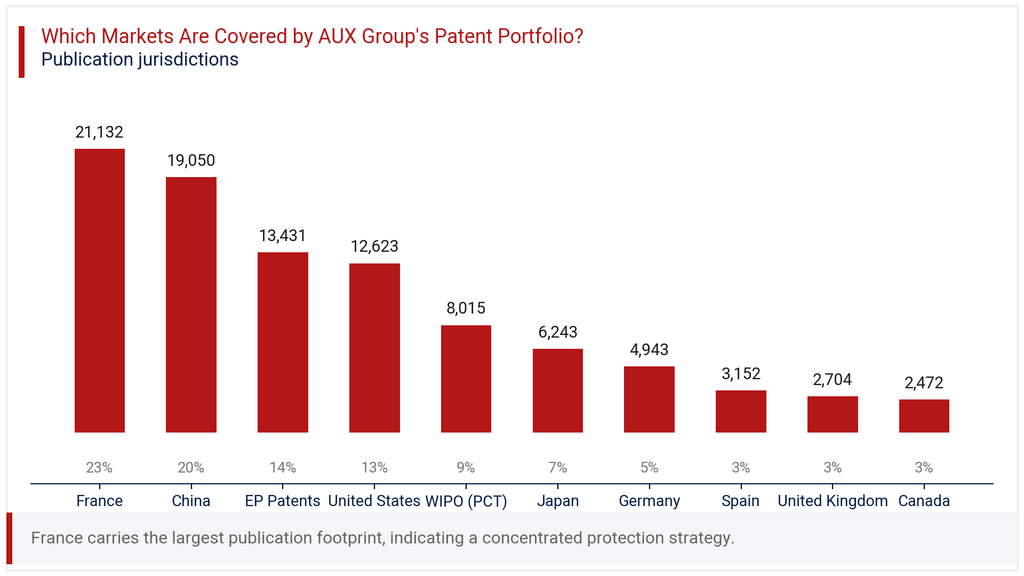
WIPO PCT filings, used to initiate international protection, cover 19.2% of the portfolio with 8,015 families. Japan, Germany, Spain, the United Kingdom, and Canada round out the remaining jurisdictions at smaller shares. This spread across 10 jurisdictions indicates AUX Group treats Europe and North America as genuine commercial markets worth protecting, not just defensive filing destinations. The heavy France and EP presence together suggests particular attention to the European air conditioning and appliance market.
Where is the AUX Group Patent Portfolio Building Protection Across Key Technologies?
IPC analysis of the portfolio confirms air conditioning as the technological core of AUX Group’s filing activity. Class F24F, covering air-conditioning and air-humidification, leads with 11,722 families, a commanding 42.3% share of all classified filings. The technology chart in this section shows a steep drop after this leading cluster. Semiconductor devices under H01L rank second with 3,526 families at 12.7%, followed by materials investigation under G01N with 2,621 families at 9.5%.
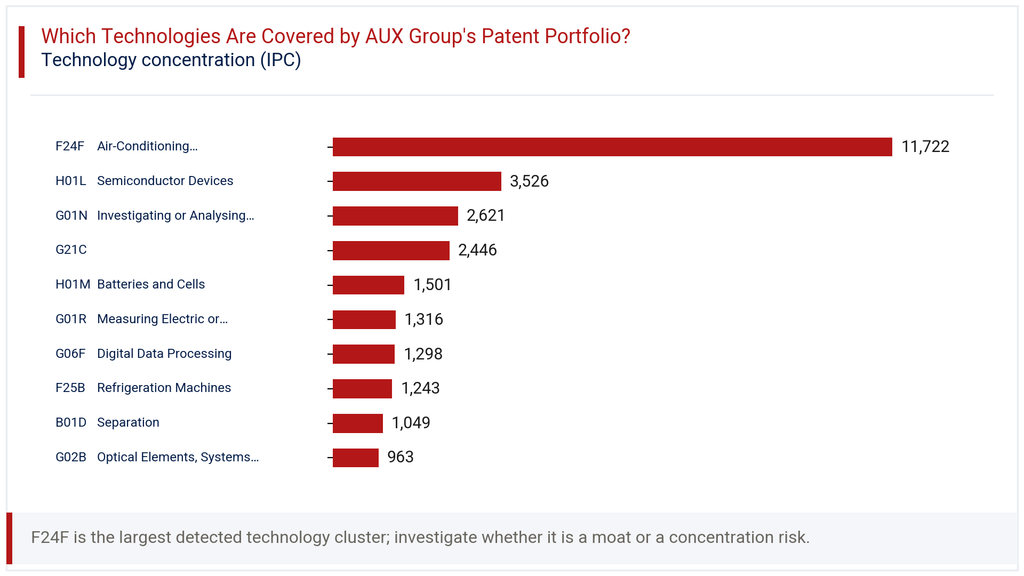
Nuclear-reactor-related class G21C holds 2,446 families at 8.8%, an interesting adjacency given the group’s stated focus on new energy. Battery technology under H01M contributes 1,501 families at 5.4%, while measuring instruments, digital data processing, refrigeration machinery, separation technology, and optical systems each add smaller shares between 3.5% and 4.8%. This spread shows AUX Group diversifying beyond its core appliance business into semiconductors, batteries, and energy-adjacent fields, likely supporting its new energy and power distribution divisions.
How Has the AUX Group Patent Portfolio Evolved Across Filing Geographies?
The heatmap in this section tracks filing volume by jurisdiction and year, revealing distinct regional trajectories. China shows the clearest growth story, rising from 366 families in 2010 to a peak of 2,841 in 2019, before settling around 1,900 through 2023. This pattern lines up closely with the group’s overall filing surge and suggests domestic R&D expansion drove much of the 2017 to 2019 spike.
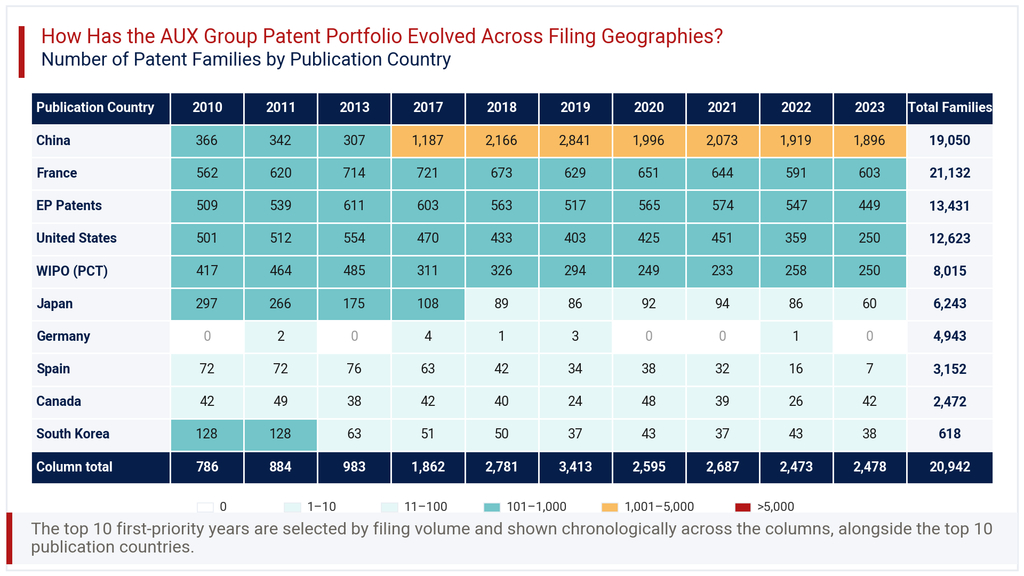
France and the European Patent Office, by contrast, stayed comparatively stable across the same period. France moved from 562 families in 2010 to 603 in 2023, without the dramatic swings seen in China. The United States and Japan both show gradual decline, with the US falling from 501 in 2010 to 250 in 2023, and Japan dropping from 297 to just 60. Spain’s filings nearly vanished, down from 72 to 7 over the same window. This divergence suggests AUX Group has consolidated its international filing priorities while continuing to expand domestically.
Consultant’s Perspective on AUX Group Patent Portfolio
Taken as a whole, the AUX Group Patent Portfolio reflects a company anchored firmly in its core air conditioning business while testing adjacent technology areas. The 42.3% concentration in F24F classifications confirms where the real engineering investment sits. Forays into semiconductors, batteries, and nuclear-adjacent classes point toward diversification efforts tied to the group’s new energy ambitions, though at much smaller scale.
The filing trajectory, rising sharply through 2019 and cooling since, mirrors broader shifts in Chinese patent filing incentives and corporate IP strategy during that period. The apparent decline after 2023 is mostly a publication-lag artifact and should not be treated as reduced R&D output. What stands out more is the geographic consolidation: steady commitment to France, Europe, and China, alongside retreat from Japan, Spain, and other smaller markets.
For stakeholders assessing this portfolio, the practical takeaway is to track upcoming publications from 2024 and 2025 filing years closely, since current figures understate real activity. Any licensing or competitive assessment should also weigh the 24.6% lapsed share carefully, verifying which specific families remain enforceable before drawing conclusions.
Explore Deeper Insights with Expertlancing Research
Numbers alone cannot tell the full story behind a patent portfolio of this scale. Expertlancing Research helps clients go beyond headline figures, validating specific families, benchmarking against competitors, and identifying white space for future filing. If this analysis raises questions about AUX Group’s technology direction or your own competitive position, our team can build a tailored assessment. Reach out to discuss how a deeper patent intelligence engagement could support your next strategic decision.