
The Baidu Patent Portfolio offers a useful lens into how one of China’s largest technology companies builds and defends its intellectual property position. Across its filing history, the portfolio spans 32,867 patent families, of which 81.2% remain active, combining both granted and pending cases. Within this base, 20,768 families have been granted and 5,923 remain pending examination, producing a grant rate of 63.2%. A further 6,176 families sit in lapsed, revoked, or expired status, reflecting the combined total of 1,374 lapsed, 4,693 revoked, and 109 expired cases. These figures describe prosecution and maintenance outcomes only, not a verdict on patent quality or enforceability.
Filing activity peaked in 2021, when Baidu recorded 4,424 new patent families in a single year. China remains the dominant jurisdiction, accounting for 99.1% of filings, across a portfolio that spans 10 jurisdictions worldwide. On the technology side, the leading cluster is G06F Digital Data Processing, covering 18,215 families, the single largest concentration in the entire portfolio. This combination of scale, geography, and technical focus sets the frame for the analysis that follows.
This report draws on filing and legal status data to describe how Baidu has built its patent position over time. Filing counts alone cannot confirm commercial success, product adoption, or competitive strength in any market. Readers considering licensing, litigation, or investment decisions should verify specific patent families independently before relying on them. What follows is meant to orient strategic thinking, not substitute for legal due diligence.
About Baidu
Company Profile: Baidu is a Chinese technology company headquartered in Beijing, in the Haidian District. Baidu was incorporated in January 2000 by Robin Li and Eric Xu, with origins in RankDex, an earlier search engine Li developed in 1996. It offers services including its internet search engine, maps, antivirus software, and an online encyclopedia. The company has built a full AI stack, including software, chips, cloud infrastructure, foundation models, and applications.
A key initiative is the Apollo project, a self-driving vehicle platform including vehicle hardware, an open-source software platform and cloud data services. In September 2017, Baidu launched a 1.5 billion dollar autonomous driving fund to invest in up to 100 autonomous driving projects over three years. Its Apollo Go robotaxi service has expanded operations across multiple Chinese cities. In 2022, Baidu reported revenue of 17.93 billion US dollars. Robin Li continues as co-founder and chief executive.
How Healthy is Baidu Patent Portfolio?
Patent portfolio health depends on how many families remain legally active versus how many have lapsed or been revoked. Baidu’s legal status mix shows 63.2% granted, 18.0% pending, 4.2% lapsed, 14.3% revoked, and 0.3% expired. Combined, granted and pending cases give an active rate of 81.2%, a reasonably strong figure for a portfolio of this size. The revoked share of 14.3% is worth watching, since it signals meaningful attrition through opposition or invalidation proceedings. The composition chart in this section lays out this distribution clearly across all five status categories.
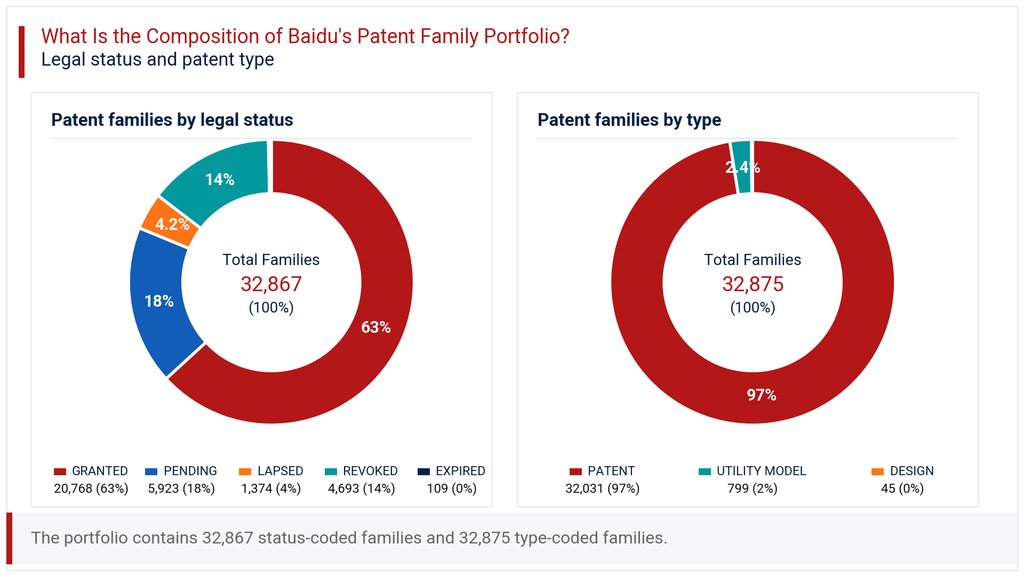
Looking at patent type, the portfolio is overwhelmingly utility patents, at 97.4% of filings. Utility models account for 2.4% and design filings just 0.1%, both minor categories. This heavy tilt toward standard patents suggests Baidu pursues full-term protection rather than shorter, lower-bar utility model routes common in China. Combined with a grant rate of 63.2%, the pattern points to a portfolio built for durability rather than speed. For a company competing in fast-moving AI and software fields, this emphasis on substantive patents fits its broader technology ambitions well.
How Has the Baidu Patent Portfolio Evolved Over Time?
Baidu’s patent filing trends show a clear arc of acceleration followed by moderation. Filings were modest through the early years, rising from single digits before 2010 to 401 by 2011. Growth then compounded steadily, reaching 1,603 in 2017 and more than doubling to 2,896 the following year. The portfolio peaked in 2021 at 4,424 new families, after strong years in 2019 (3,294) and 2020 (4,046). The filing-trend chart in this section traces this buildup and the subsequent pullback across two decades.
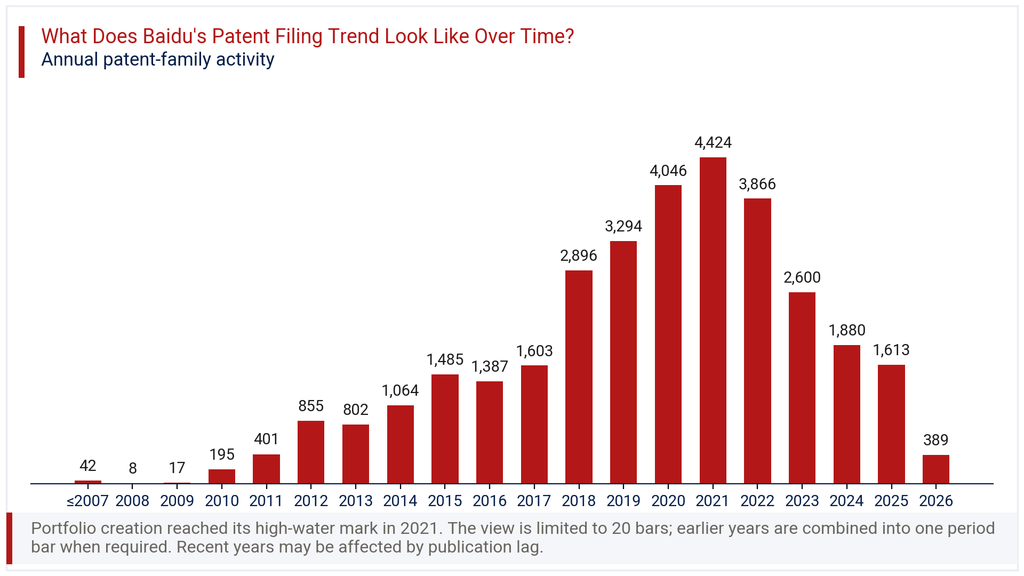
Filings have declined each year since the peak, falling to 3,866 in 2022 and 2,600 in 2023. The most recent full years show 1,880 in 2024 and 1,613 in 2025, with latest_year_change_pct at -75.9%. Part of this apparent drop reflects publication lag, since recently filed applications take time to appear in public databases. Readers should treat 2024 and 2025 figures as provisional rather than a confirmed slowdown in research output. The longer trend, from under 50 annual filings pre-2008 to thousands per year by the late 2010s, still points to sustained investment in patent protection.
Where Does the Baidu Patent Portfolio Prioritize Patent Protection?
Patent geography for Baidu is heavily concentrated at home. China accounts for 99.1% of all filings, by far the dominant jurisdiction in the portfolio. The United States follows at 14.8%, then Japan at 7.4%, the European Patent Office at 6.0%, and South Korea at 4.6%. WIPO PCT filings, which often precede national phase entry, sit at 3.8%. The geographic chart in this section shows just how steep this concentration curve really is.
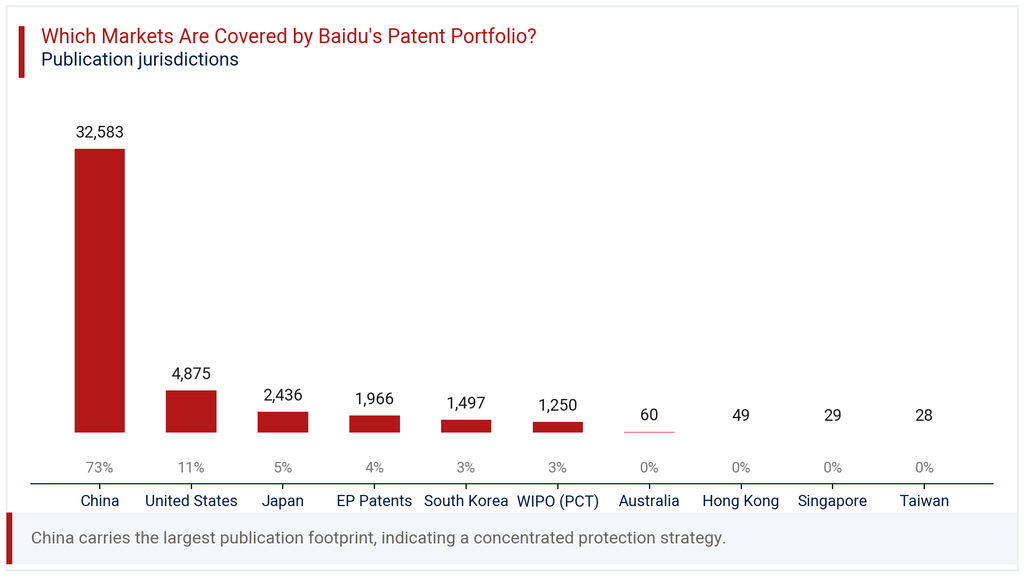
Beyond these five, filings thin out quickly: Australia, Hong Kong, Singapore, and Taiwan each register below 0.2% of total share. In absolute terms, China carries 32,583 families versus 4,875 for the United States and 2,436 for Japan. This pattern reflects a company whose primary commercial and regulatory exposure remains domestic. The modest but consistent US, Japanese, and European presence suggests selective protection in markets relevant to AI research partnerships, cloud infrastructure, and autonomous driving pilots. It is not, however, evidence of broad global commercialization strategy.
Where is the Baidu Patent Portfolio Building Protection Across Key Technologies?
IPC analysis of the Baidu Patent Portfolio points clearly toward core software and AI domains. The largest cluster is G06F Digital Data Processing, with 18,215 families, representing 40.3% of all filings. Next comes G06N Computing Based on Specific Models, covering 6,682 families at 14.8%, a category closely tied to machine learning methods. G06V Image or Video Recognition follows at 9.0%, with 4,071 families, reflecting strength in computer vision. The technology chart in this section ranks all ten leading classification codes side by side.
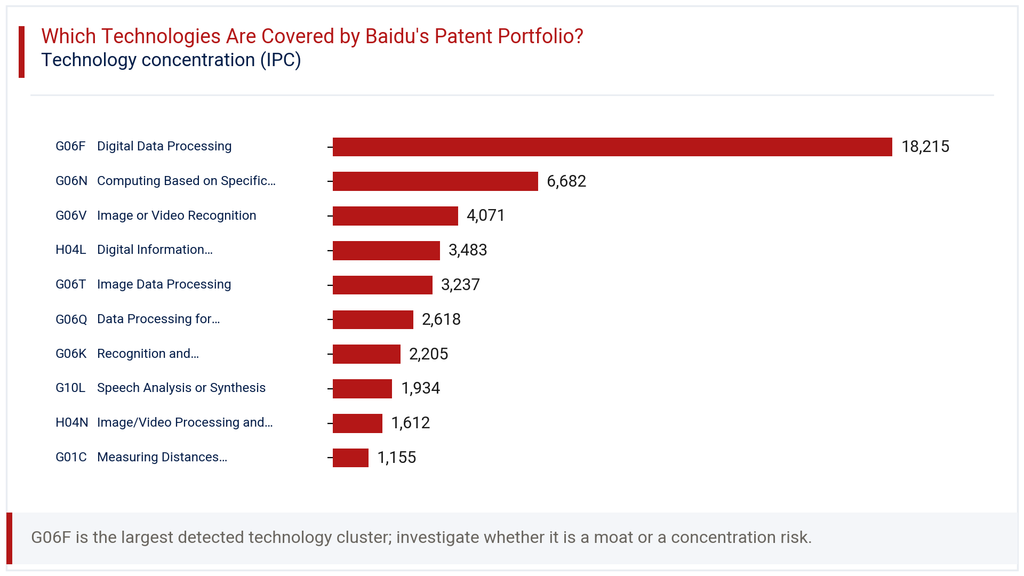
Further down the list, H04L Digital Information Transmission holds 3,483 families, and G06T Image Data Processing adds 3,237 more. Rounding out the top ten are G06Q (data processing for commercial purposes, 2,618), G06K (recognition and presentation of data, 2,205), G10L (speech analysis or synthesis, 1,934), H04N (image and video processing, 1,612), and G01C (distance and position measurement, 1,155). Together, these categories describe a portfolio anchored in data processing, pattern recognition, and language or speech technologies, consistent with Baidu’s AI stack and autonomous driving ambitions described in its company profile.
How Has the Baidu Patent Portfolio Evolved Across Filing Geographies?
Viewing filing activity by year and jurisdiction together reveals how Baidu’s international footprint shifted alongside its domestic growth. China’s filings climbed from 1,481 in 2015 to a high of 4,368 in 2021, mirroring the overall portfolio trend. The United States followed a similar arc, rising from 148 in 2015 to 1,074 in 2020, then falling sharply to 85 by 2023. Japan, the EP route, and South Korea all show a similar spike around 2020, each roughly doubling or tripling versus prior years. The heatmap in this section makes these parallel peaks easy to compare across markets.
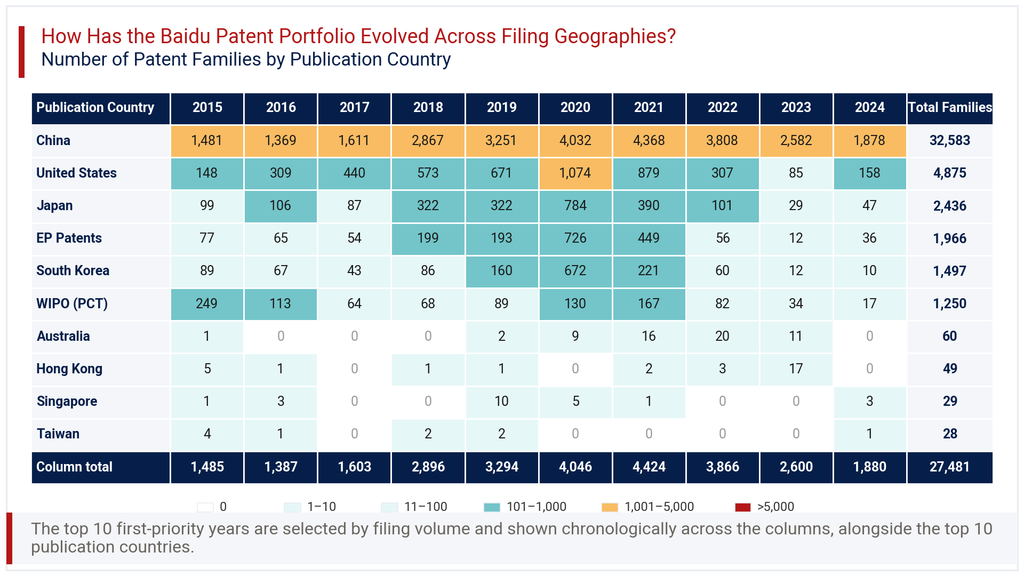
This synchronized pattern, a broad 2020–2021 surge followed by a steep pullback across nearly every jurisdiction, suggests a centrally coordinated filing strategy rather than organic, market-by-market growth. Smaller jurisdictions like Australia, Hong Kong, Singapore, and Taiwan show sporadic, low-volume activity throughout, with no consistent year-on-year pattern. The sharpness of the 2022 to 2024 decline across all major markets, not just China, reinforces that publication lag and filing strategy changes, rather than a single-market retreat, likely explain the recent numbers.
Consultant’s Perspective on Baidu Patent Portfolio
From an advisory standpoint, the Baidu Patent Portfolio reflects a company that treats patenting as core infrastructure, not an afterthought. The scale, 32,867 families, and the concentration in AI-adjacent IPC codes like G06F and G06N, align tightly with Baidu’s publicly stated AI stack strategy. The 81.2% active rate indicates a portfolio under active management rather than one left to decay. A 14.3% revocation share, however, deserves closer scrutiny, particularly for any families relevant to licensing or litigation planning.
The jurisdiction mix tells its own story. With 99.1% of filings in China and single-digit percentage shares elsewhere, Baidu’s patent protection remains primarily a domestic risk-management tool. Companies evaluating competitive exposure outside China should not overweight this portfolio’s international reach without verifying specific families. The recent filing decline, most likely a lag artifact rather than a genuine pullback, is worth revisiting once 2024 and 2025 data mature further.
Going forward, stakeholders should track how the revoked share trends and whether international filing share grows as Apollo and cloud AI products scale abroad. A portfolio this concentrated in one jurisdiction carries both strength and exposure, depending on where Baidu’s next growth phase unfolds.
Explore Deeper Insights with Expertlancing Research
Patent data tells only part of the story. Understanding what the Baidu Patent Portfolio means for competitive positioning, licensing risk, or market entry requires deeper, family-level analysis. Expertlancing Research helps technology companies, investors, and legal teams translate raw patent data into decisions they can act on. If this overview raised questions about specific filings, jurisdictions, or technology clusters, our analysts can help you dig further. Reach out to Expertlancing Research to commission a tailored patent landscape study built around your exact business question.