


The ChangXin Memory Patent Portfolio spans 3,095 patent families, offering a window into how this Chinese DRAM manufacturer builds and defends its technology base. Of these families, 93.9% remain active, combining both granted and pending cases that still carry legal weight. The breakdown shows 2,352 granted patents and 553 pending applications, with a grant rate of 76.0% across the portfolio. A smaller group of 190 families fall into lapsed, revoked, or expired status, representing cases no longer in force. These figures describe prosecution and maintenance outcomes only, not a judgement on patent quality or enforceability.
Filing activity tells its own story. The year 2022 marks the peak, with 1,043 families filed, following strong momentum built up over the prior two years. China stands as the top jurisdiction, holding 95.5% share of jurisdictions_pct across a portfolio that spans 10 jurisdictions worldwide. On the technology side, H01L Semiconductor Devices leads as the dominant cluster, accounting for 1,487 families, the single largest concentration in the dataset.
This report works best as a starting point for understanding ChangXin Memory’s filing behaviour, not as a final verdict on its competitive standing. Filing counts alone cannot confirm product success, market dominance, or technical superiority over rivals. Readers considering business decisions, licensing discussions, or competitive assessments should validate specific patent families directly before relying on them externally. The analysis that follows breaks down legal status, filing trends, geography, and technology clusters in turn, each offering a different lens on the same underlying portfolio.
About ChangXin Memory
Company Profile: ChangXin Memory Technologies, known as CXMT, is a Chinese semiconductor integrated device manufacturer. It is headquartered in Hefei, Anhui, and specializes in the production of DRAM memory. As of 2020, ChangXin manufactured LPDDR4 and DDR4 memory on a 19 nm process, with a capacity of 40,000 wafers per month. The company was producing 720,000 wafers per quarter by the end of 2025, and as of 2026 it is China’s largest and the world’s fourth-largest DRAM maker.
In 2025, it unveiled DDR5 DRAM and planned a Shanghai initial public offering to fund production upgrades and advanced DRAM research and development. Along with Fujian Jinhua Integrated Circuit and Xi’an UniIC Semiconductors, its predecessor Innotron was among Chinese semiconductor plants established in 2016, and in 2017 a 7.2 billion dollar deal was announced for a 125,000 wafer per month fabrication plant.
The company operates as part of China’s broader push toward domestic semiconductor self-sufficiency.
How Healthy is ChangXin Memory Patent Portfolio?
Patent portfolio health starts with legal status, and here the numbers look encouraging. 76.0% of families hold granted status, while 17.9% remain pending examination. Together these groups push the active rate to 93.9%, meaning most of the portfolio still carries enforceable or prospective rights. Only a modest fraction has lapsed, been revoked, or expired, at 1.4%, 3.1%, and 1.6% respectively. The composition chart in this section illustrates how thinly these inactive categories are spread against the much larger active base.
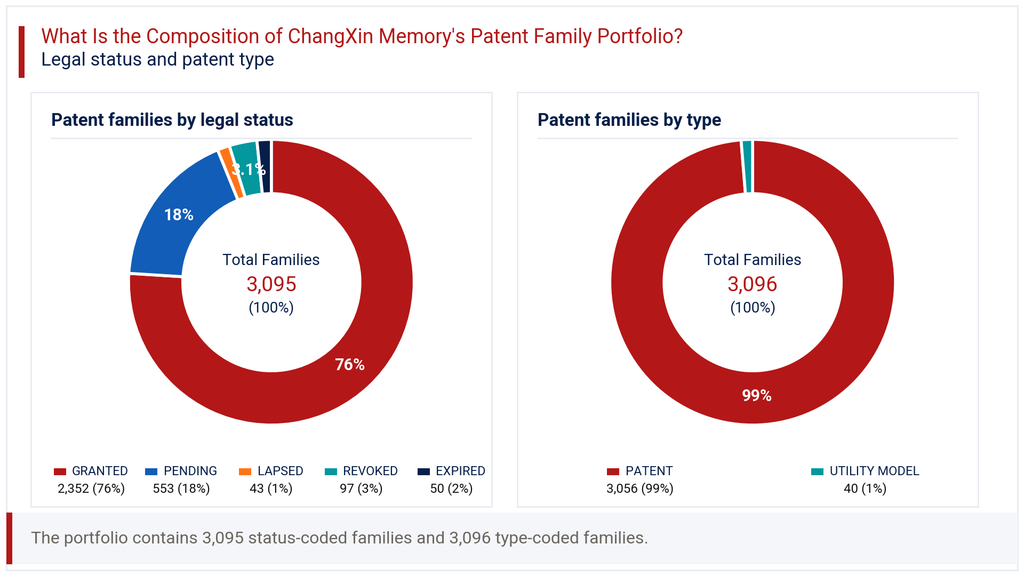
Patent type adds another dimension to this picture. Standard patents make up 98.7% of filings, with utility models accounting for just 1.3%. This heavy tilt toward full patents, rather than utility models, suggests ChangXin Memory pursues stronger, more durable protection for its core DRAM and semiconductor innovations. Utility models typically offer shorter terms and lighter examination, so their near absence here points to a deliberate filing strategy favouring long-term defensibility. Taken together, the legal status and patent-type data indicate a portfolio that is young, largely active, and weighted toward substantive protection rather than quick, low-cost filings.
How Has the ChangXin Memory Patent Portfolio Evolved Over Time?
Patent filing trends for ChangXin Memory show a clear inflection point around 2019. Filings jumped from 110 that year to 699 in 2020, then climbed further to 969 in 2021 and 1,043 in 2022, the portfolio’s peak. This sharp rise lines up with the company’s expansion into higher volume DRAM production described in its company profile. The filing-trend chart in this section captures this acceleration clearly against a near-flat baseline in earlier years.
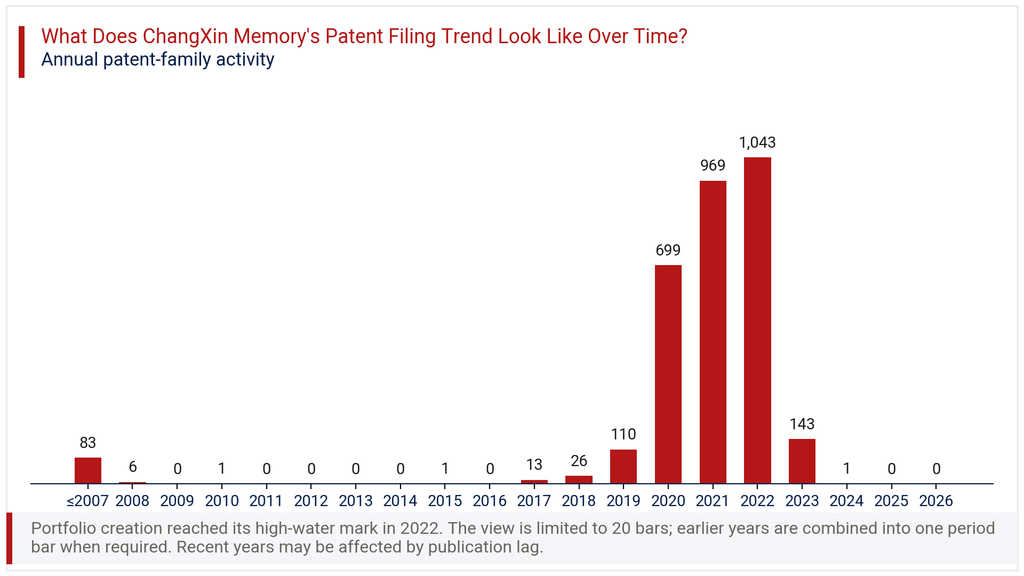
The sudden drop to 143 families in 2023 and just 1 in 2024 deserves a careful read rather than alarm. Patent applications typically take 18 to 24 months to publish, so recent filing years almost always appear artificially low in any dataset pulled today. Readers should treat 2023 and 2024 as incomplete windows, not genuine declines in filing activity. The stronger signal is the multi-year build from 2019 through 2022, which shows a company scaling its patent filing trends in step with its manufacturing growth, rather than a business now pulling back from innovation investment.
Where Does the ChangXin Memory Patent Portfolio Prioritize Patent Protection?
Patent geography for ChangXin Memory centres heavily on its home market. China accounts for 95.5% of jurisdictions_pct share, by far the largest single destination for filings. WIPO PCT applications follow at 86.8%, reflecting a strategy of using international filing routes to preserve optionality across multiple countries later. The United States ranks third at 79.5%, a meaningful figure given the ongoing scrutiny around Chinese semiconductor firms in American markets.
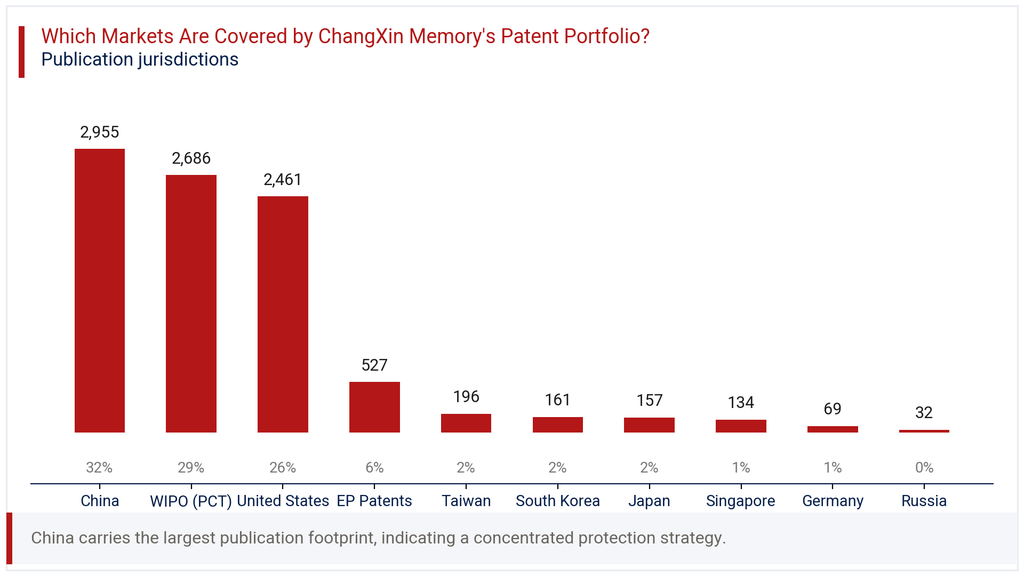
Beyond these three, protection thins out quickly. EP Patents hold 17.0% share, followed by Taiwan at 6.3%, South Korea at 5.2%, and Japan at 5.1%. Singapore, Germany, and Russia round out the remaining jurisdictions at low single-digit shares. The geographic chart in this section shows this steep drop-off visually, with China, WIPO, and the United States forming a dominant top tier. This pattern suggests ChangXin Memory protects its core inventions broadly across major markets first, then selectively extends coverage into smaller or strategically relevant jurisdictions based on commercial priorities.
Where is the ChangXin Memory Patent Portfolio Building Protection Across Key Technologies?
IPC analysis of the ChangXin Memory Patent Portfolio points firmly toward semiconductor device architecture. H01L Semiconductor Devices leads with 1,487 families, representing 26.4% of classified filings. Close behind sits H10B, a DRAM-specific classification, with 1,216 families at 21.6% share. Together these two categories account for close to half the entire technology footprint, confirming memory chip architecture as the clear centre of gravity.
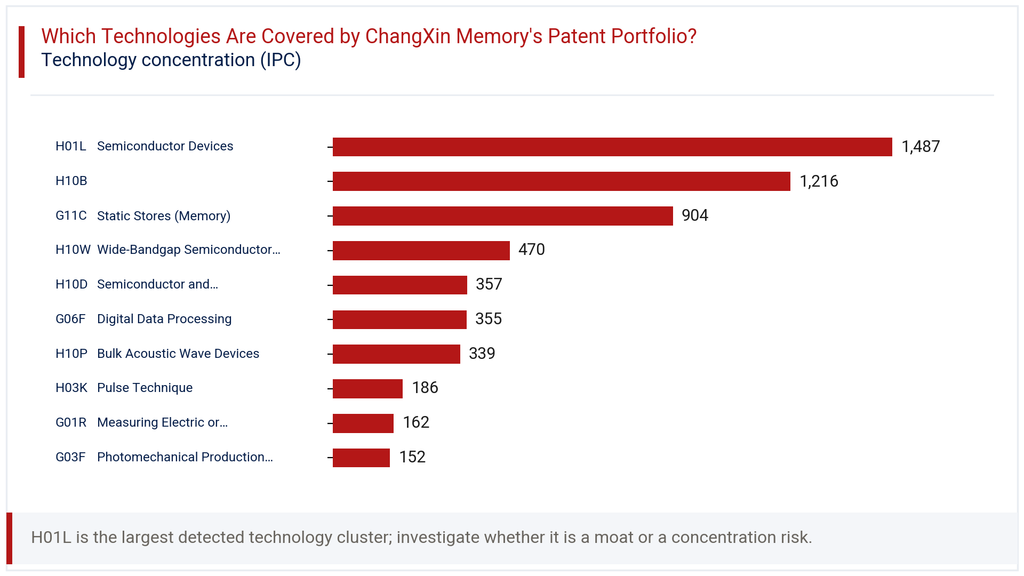
G11C Static Stores (Memory) follows with 904 families at 16.1%, reinforcing the memory-specific focus already visible in the top two categories. Further down, H10W Wide-Bandgap Semiconductor Devices holds 8.4% share, while H10D Semiconductor and Solid-State Devices and G06F Digital Data Processing each sit around 6.3%. The technology chart in this section lays out this distribution clearly, showing a small number of core clusters dominating the broader spread. This concentration signals that ChangXin Memory’s research investment stays tightly focused on DRAM cell design, memory architecture, and the semiconductor processes that support them.
How Has the ChangXin Memory Patent Portfolio Evolved Across Filing Geographies?
Viewing jurisdictions alongside filing years reveals how ChangXin Memory’s geographic strategy shifted as the company matured. China, WIPO, and the United States all show modest filings before 2017, then a sharp jump starting in 2019 and accelerating through 2020 to 2022. The United States peaked at 879 families in 2021 before dropping to 671 in 2022 and sharply to 15 in 2023, likely reflecting both publication lag and possible strategic recalibration.
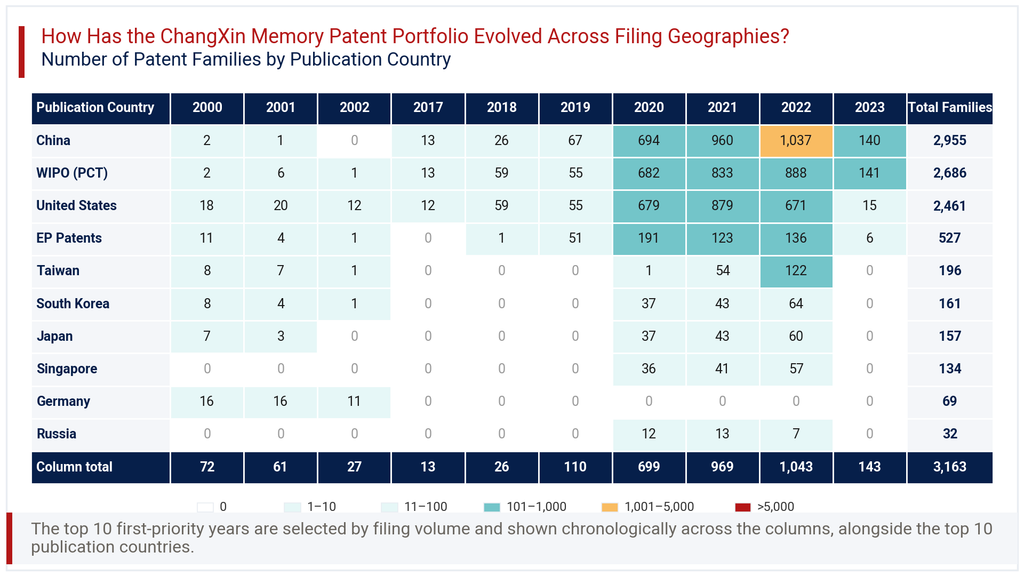
Smaller jurisdictions like Taiwan, South Korea, and Japan show a different pattern, with filings appearing almost entirely from 2020 onward and peaking in 2022. The heatmap highlights this late arrival clearly, showing these markets as a more recent addition to ChangXin Memory’s protection strategy rather than a long-standing priority. Germany, by contrast, shows only early filings tied to predecessor entities and nothing in the recent surge. This mix suggests a company that initially protected inventions through its home base and major international routes, then broadened into additional Asian markets as production scaled.
Consultant’s Perspective on ChangXin Memory Patent Portfolio
Viewed as a whole, the ChangXin Memory Patent Portfolio reflects a company moving quickly from early-stage filer to a serious technology player. The jump from double-digit annual filings before 2017 to over 1,000 families in 2022 is not typical of a gradual research programme. It points instead to a coordinated push, likely backed by significant capital, to establish a defensible position in DRAM technology within a short window.
The concentration in H01L and H10B classifications confirms this is a focused bet on core memory architecture, not a diversified technology play. Combined with a 76.0% grant rate and 93.9% active rate, the portfolio looks both substantial and procedurally sound. The heavier reliance on China and WIPO filings, relative to thinner coverage in Europe and Russia, suggests a home-market-first approach with selective international expansion.
Going forward, the key variable to watch is whether filing volumes recover once 2023 and 2024 data fully publish, confirming whether the 2022 peak was a one-time surge or a sustained new baseline. Companies evaluating ChangXin Memory as a competitor or partner should pay close attention to how US filings evolve given the current trade environment. A detailed family-by-family review would sharpen this assessment considerably.
Explore Deeper Insights with Expertlancing Research
This overview offers a starting point, not a complete competitive assessment. Expertlancing Research helps technology companies, investors, and legal teams go deeper into portfolios like this one, validating individual families, assessing freedom-to-operate risk, and benchmarking against competitors. If ChangXin Memory’s filing patterns matter to your business decisions, our research team can build a tailored analysis around your specific questions. Reach out to Expertlancing Research to commission a detailed patent intelligence study suited to your strategic needs.