


The China Academy of Telecommunications Technology Patent Portfolio offers a useful lens into one of China’s oldest telecom research institutes. Across its filing history, the portfolio spans 2,686 patent families, with an active rate of 76.4% covering both granted and pending cases. Of these, 2,042 families have been granted and 9 remain pending, giving a grant rate of 76.0%. The remaining 635 families fall into lapsed, revoked, or expired status combined. These figures reflect prosecution and maintenance outcomes only, not a judgment on patent quality or enforceability.
Filing activity peaked in 2018, when the company filed 332 patent families, the highest single-year count on record. China stands as the top jurisdiction, holding 95.9% of the jurisdictions_pct share across a total of 10 jurisdictions tracked. The leading technology cluster is H04W (Wireless Communication Networks), accounting for 2,196 families, by far the dominant classification in the portfolio.
This report frames the portfolio from a filing-activity standpoint, not a verdict on commercial outcomes. Patent counts alone do not establish product success or market dominance. Readers evaluating specific families for licensing, litigation, or competitive assessment should validate details directly against primary patent office records before relying on them externally.
About China Academy of Telecommunications Technology
Company Profile: The China Academy of Telecommunications Technology is a Chinese state research institute founded in 1957. It trades as Datang Telecom Group, officially Datang Telecom Technology & Industry Group, and manufactures telecommunications equipment. Datang has been the trading name of the academy since September 1998. The group is a state-owned enterprise, owned by the Chinese Central Government, and serves China while also exporting worldwide. Its product range covers microelectronics, software, communication access, communication terminals, and communication application and service. In 1998, the academy incorporated a listed subsidiary, Datang Telecom Technology, on the Shanghai Stock Exchange. During the 2G and 3G eras, Datang Telecom was regarded as one of China’s four major domestic telecommunications equipment manufacturers alongside Julong Telecom, ZTE and Huawei, and its corporate group held the intellectual property of TD-SCDMA technology. In April 2007, Datang secured a 36.6% share of China Mobile’s first large-scale TD-SCDMA network construction contracts.
Since 2018, its ultimate parent has been the China Information and Communication Technologies Group, a central state-owned enterprise supervised by SASAC.
How Healthy is China Academy of Telecommunications Technology Patent Portfolio?
Patent portfolio health starts with legal status. Granted families make up 76.0% of the total, a solid majority that signals steady prosecution success over the decades. Pending cases are minimal at 0.3%, suggesting the backlog of unresolved applications has largely cleared. Revoked families stand at 14.7%, while lapsed cases add 7.1% and expired ones contribute 1.9%. Together these inactive categories account for a meaningful share worth watching.
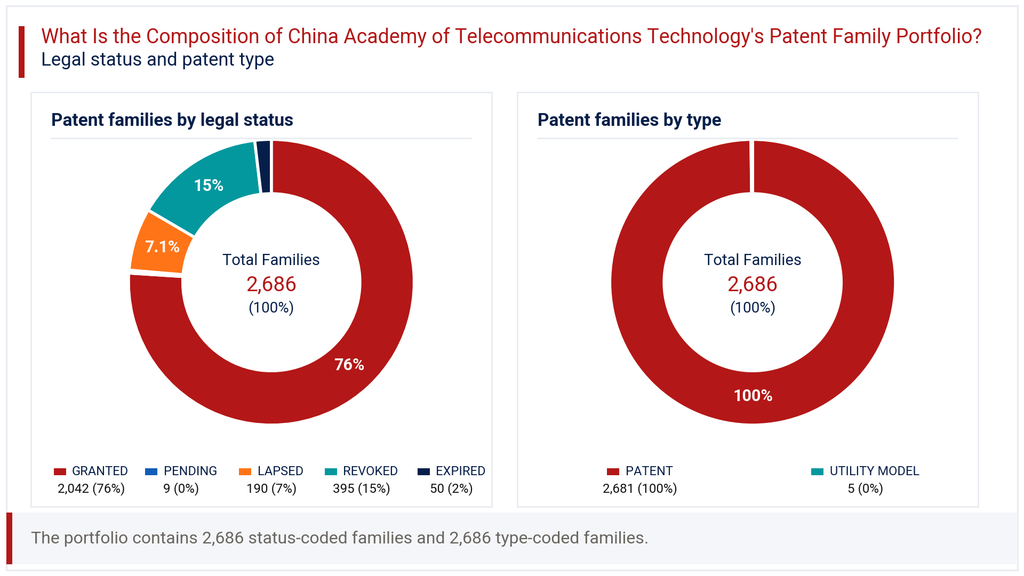
The composition chart in this section shows patent filings dominate the portfolio at 99.8%, with utility models forming a negligible 0.2%. This heavy tilt toward full patents, rather than utility models, points to an institute pursuing durable, examined protection rather than quick, lightly-scrutinized registrations. The relatively high revocation share deserves attention, since it may reflect aggressive validity challenges common in contested wireless standards. Still, an active rate of 76.4% indicates the bulk of the China Academy of Telecommunications Technology patent portfolio remains legally enforceable today. For a research institute operating across multiple generations of mobile standards, this health profile looks broadly sound, though monitoring future revocation trends would be prudent.
How Has the China Academy of Telecommunications Technology Patent Portfolio Evolved Over Time?
Patent filing trends across this portfolio show a long buildup followed by a sharp, likely misleading drop. Filings rose from 55 in 2008 to 332 by 2018, with notable surges in 2016 (289) and 2017 (293). This decade-long climb reflects sustained investment in wireless and digital transmission research, aligned with China’s push through 3G, 4G, and 5G standards development.
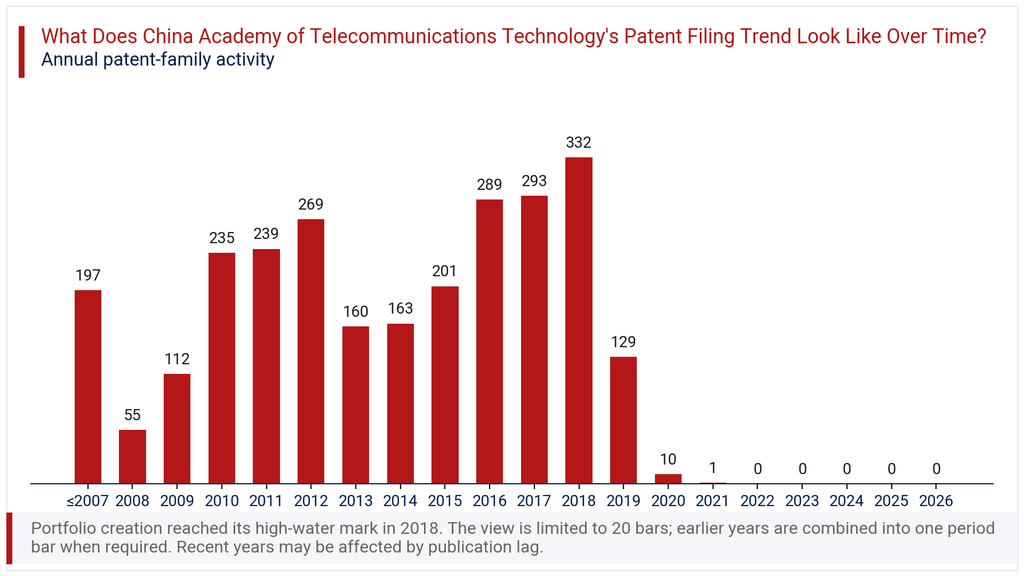
The filing-trend chart in this section shows a steep fall after 2019, down to 129, then near zero by 2020 and beyond. This decline is almost certainly a publication lag artifact, not a genuine pullback in research activity. Patent applications typically take 18 to 24 months to publish, so the most recent one to two years will always appear thin in any live dataset. Readers should treat 2020 through 2026 figures as incomplete rather than evidence of declining innovation output. The real story lies in the 2016 to 2018 peak years, a period of concentrated filing that likely corresponds to 5G standardization work gaining momentum globally.
Where Does the China Academy of Telecommunications Technology Patent Portfolio Prioritize Patent Protection?
Patent geography reveals a strongly China-centric filing strategy. Domestic filings account for 95.9% of the portfolio, covering 2,577 families, confirming the home market as the primary protection zone. WIPO PCT applications follow at 82.9% (2,226 families), the route used to preserve international filing options before entering national phases.
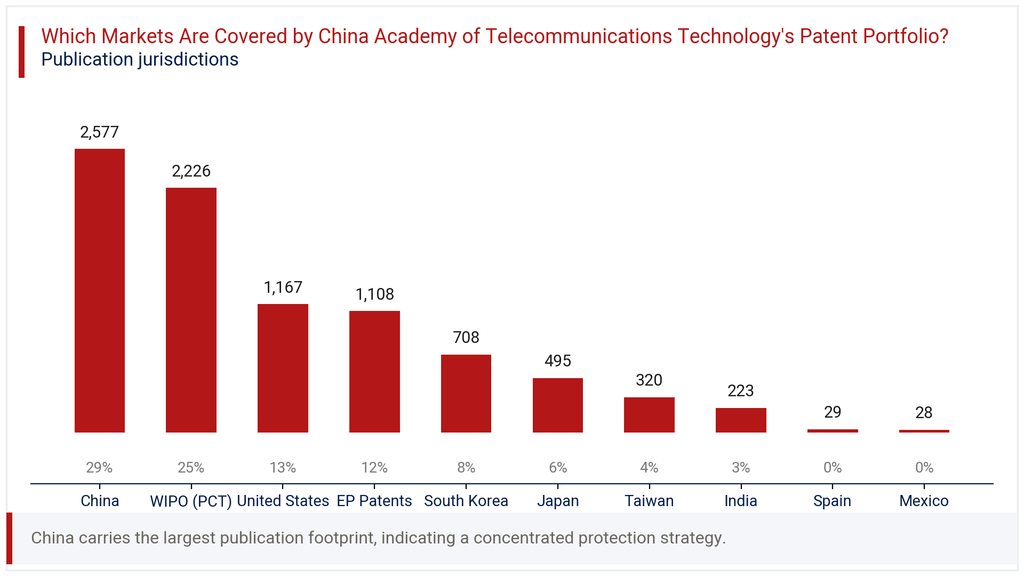
The geographic chart in this section shows a clear secondary tier: United States at 43.4%, EP Patents at 41.3%, and South Korea at 26.4%. Japan follows at 18.4%, Taiwan at 11.9%, and India at 8.3%. Spain and Mexico trail well behind, each near 1%. This spread suggests a deliberate focus on markets with large telecom equipment demand and standards-essential patent licensing potential, rather than broad global coverage. The relatively modest India presence, despite the country’s growing telecom market, may represent an opportunity area. For competitors or licensees, the concentration in China, the US, Europe, and Korea signals where enforcement risk and negotiating leverage concentrate most heavily.
Where is the China Academy of Telecommunications Technology Patent Portfolio Building Protection Across Key Technologies?
IPC analysis of this portfolio points firmly toward wireless communication. H04W (Wireless Communication Networks) leads with 2,196 families, representing 47.9% of all classified filings. This is nearly double the next closest category, confirming wireless networking as the institute’s core research identity.
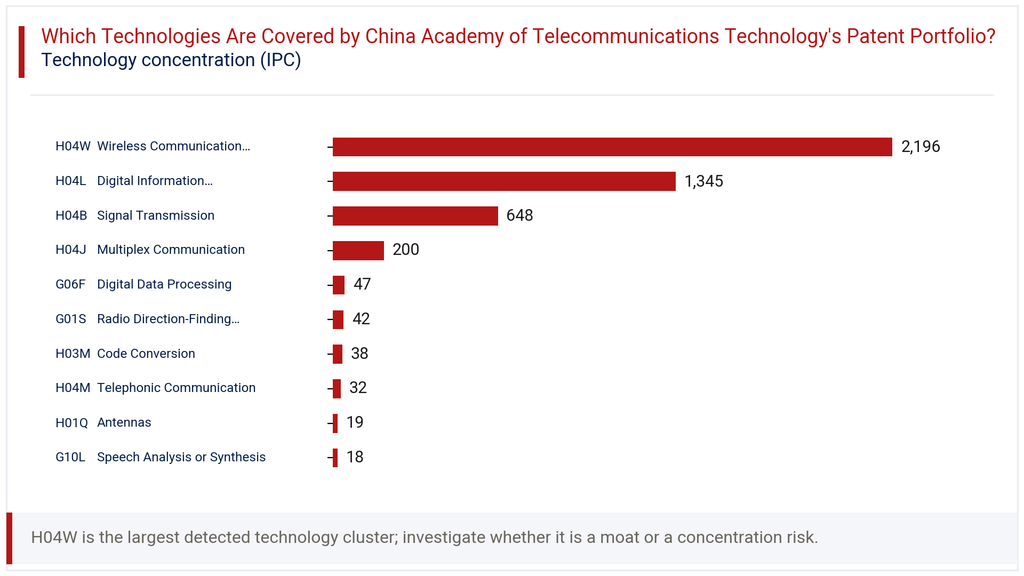
The technology chart in this section shows H04L (Digital Information Transmission) in second place at 29.3% (1,345 families), followed by H04B (Signal Transmission) at 14.1% (648 families). Together, these three classes account for over 91% of the entire portfolio, a tight concentration unusual for institutes of this scale. Smaller categories include H04J (Multiplex Communication) at 4.4% and G06F (Digital Data Processing) at just 1.0%. This narrow technology spread confirms the China Academy of Telecommunications Technology patent portfolio is built almost entirely around core wireless and digital transmission infrastructure, consistent with its historical role in TD-SCDMA and subsequent mobile standards work, rather than diversified technology bets.
How Has the China Academy of Telecommunications Technology Patent Portfolio Evolved Across Filing Geographies?
Year-by-jurisdiction patterns in the heatmap reveal how international filing grew alongside domestic activity. China filings rose steadily from 230 in 2010 to 301 by 2018, while WIPO PCT filings climbed even faster, from 166 to 317 over the same stretch. This parallel growth suggests international protection became a priority as domestic output scaled up.
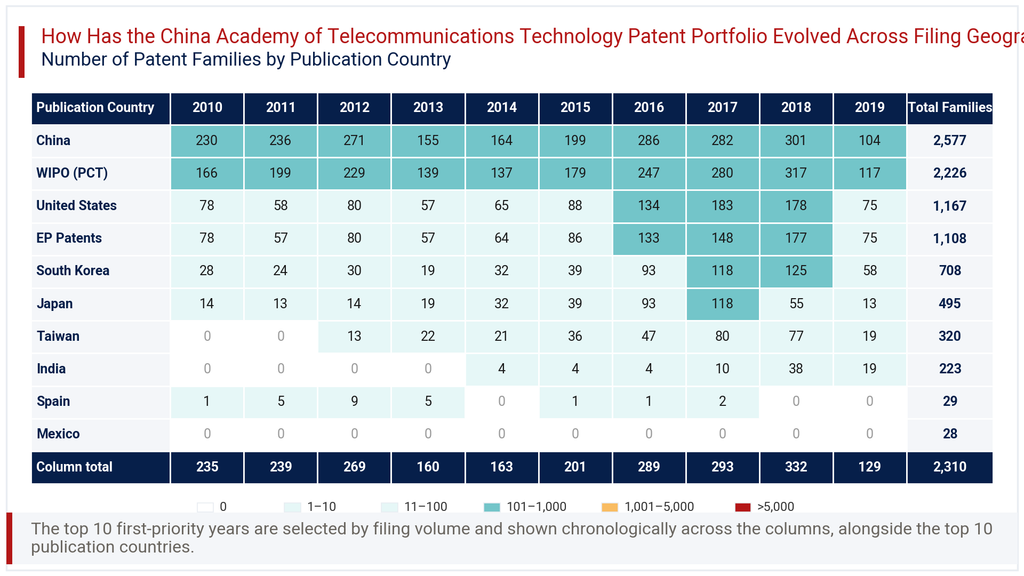
The heatmap in this section shows United States and EP filings tracking closely together each year, moving from under 80 in 2010 to 178 and 177 respectively by 2018. South Korea and Japan show similar synchronized jumps around 2016, both touching 93 that year. Taiwan filings appeared later, starting meaningfully only from 2012, while India entered the picture even later, from 2014 onward with modest volumes. Mexico shows no recorded activity across the entire period. This pattern indicates the institute expanded its filing geography in phases, prioritizing established markets first, then extending reach to emerging jurisdictions like India as its international commercial footprint grew.
Consultant’s Perspective on China Academy of Telecommunications Technology Patent Portfolio
From an advisory standpoint, the China Academy of Telecommunications Technology Patent Portfolio reflects a research institute with deep, concentrated expertise rather than broad diversification. The 47.9% weight on wireless communication networks, paired with a grant rate of 76.0%, points to a focused filing strategy executed with reasonable prosecution discipline. This is not an organization spreading resources thin across unrelated fields.
The China-first, PCT-second filing pattern makes commercial sense given the institute’s state-backed mandate and domestic market priority. However, the 14.7% revocation share warrants closer scrutiny by anyone assessing licensing or litigation exposure. Revocations at this level, concentrated likely within contested wireless standards, suggest some claims faced genuine validity challenges from competitors or regulators.
Looking forward, stakeholders should track whether filing activity resumes once publication lag clears for 2020 onward years. Given China’s continued 5G and 6G research push, a plateau seems unlikely to be permanent. Organizations engaging with this portfolio, whether for licensing, competitive benchmarking, or freedom-to-operate analysis, should treat the 2016 to 2018 peak years as the most informative baseline for understanding this institute’s true technological priorities.
Explore Deeper Insights with ExpertLancing Research
This overview only scratches the surface of what a full patent intelligence review can reveal. ExpertLancing Research helps organizations move beyond headline figures into family-level validation, competitor benchmarking, and licensing risk assessment. Whether you are evaluating a potential partnership, tracking a competitor’s technology direction, or preparing for freedom-to-operate analysis, our analysts can build a tailored study around your specific business question. Reach out to ExpertLancing Research to turn this portfolio snapshot into a decision-ready report.