


China Mobile’s patent portfolio spans 52,337 patent families, offering a window into how the company directs its research investment. The portfolio shows an active rate of 84.0%, a figure that covers both granted and pending families still alive in the system. Of these, 20,449 families have been granted and 23,523 remain pending before patent offices. The grant rate stands at 39.1%, while 8,365 families fall into lapsed, revoked, or expired categories combined. These are prosecution and maintenance metrics only, not a verdict on patent quality or enforceability.
Filing activity peaked in 2024, when China Mobile filed 8,271 patent families, the highest single-year count in the dataset. China dominates as the top jurisdiction, accounting for 99.8% of filings across 10 jurisdictions tracked. On the technology side, wireless communication networks under H04W lead the portfolio with 16,378 families, ahead of every other technical cluster. These three data points together sketch a company concentrating most of its filing energy domestically while building deep technical strength in wireless and networking fields.
This report draws on structured patent filing data to describe what China Mobile has filed, where, and when. It does not attempt to measure commercial success, product adoption, or litigation outcomes tied to any single family. Filing volume alone cannot confirm competitive advantage in a given market. Readers using this analysis for investment, partnership, or competitive benchmarking should verify specific patent families independently before drawing firm conclusions.
About China Mobile
Company Profile: China Mobile Limited was incorporated in Hong Kong on 3 September 1997. Its shares were listed on the Hong Kong Stock Exchange on 23 October 1997 and joined the Hang Seng Index in January 1998. On 5 January 2022, the company’s RMB ordinary shares were listed on the Shanghai Stock Exchange. The Group provides communications, computing and AI services across all provinces in mainland China and Hong Kong SAR, plus roaming services to over 200 countries. Communications services include mobile communications, broadband networks, cellular IoT and satellite internet. Computing services cover data centers and cloud computing. AI services include data algorithms and embodied intelligence. As of 30 June 2026, the Group had 457,000 employees, 1,011 million mobile customers and 337 million broadband customers, with first-half 2026 operating revenue of RMB538.0 billion. Yang Jie serves as Chairman , with the Chinese government holding majority ownership.
How Healthy is China Mobile Patent Portfolio?
Patent portfolio health depends on how many families remain legally active versus how many have lapsed, expired, or been revoked. China Mobile’s legal status breakdown shows 39.1% granted, 44.9% pending, 3.2% lapsed, 11.6% revoked, and 1.2% expired. The composition chart in this section illustrates how pending applications now outnumber granted patents, a pattern typical of a portfolio still working through examination backlogs. The active rate of 84.0% suggests most filings remain viable, either already secured or still under review.
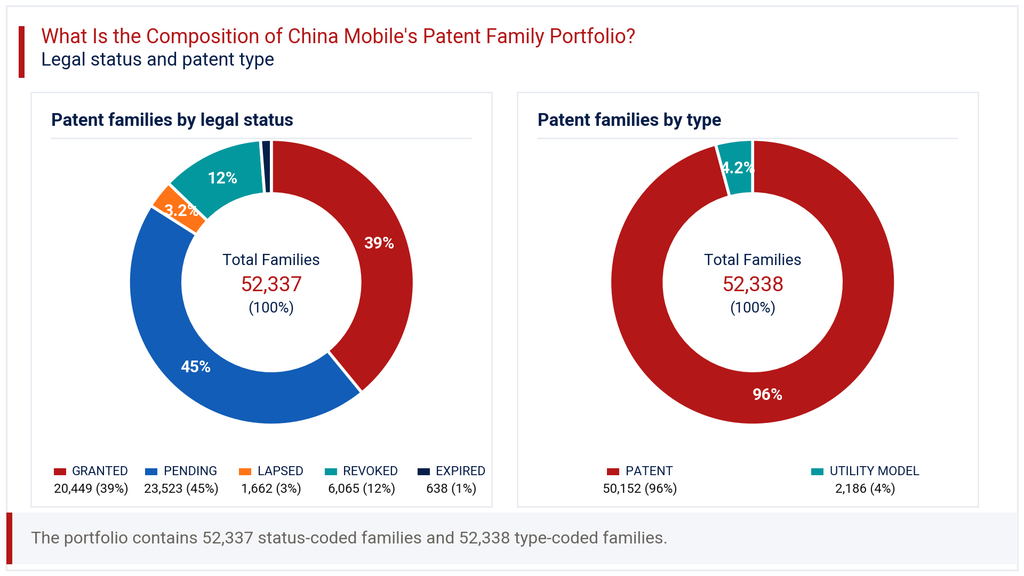
The revoked share of 11.6% deserves attention, since it represents families that failed to hold up through opposition or invalidation proceedings. This is not unusual at this filing scale, but it does mean a meaningful slice of historical filings did not convert into lasting rights. On patent type, standard patents make up 95.8% of the portfolio against 4.2% utility models, indicating China Mobile favors full patent protection over the shorter-term utility model route. This mix points to a portfolio built for durable technical claims rather than quick, narrower filings, consistent with a telecom operator investing in long-cycle network and computing technologies.
How Has the China Mobile Patent Portfolio Evolved Over Time?
China Mobile’s patent filing trends show a long, steady climb from under 1,000 families annually before 2008 to 8,271 in 2024, the peak year on record. Growth accelerated sharply after 2016, when filings crossed 1,623, and continued almost every year through 2024. The filing-trend chart in this section shows this acceleration clearly, with the steepest jump occurring between 2020 and 2022 as filings rose from 3,424 to 4,730.
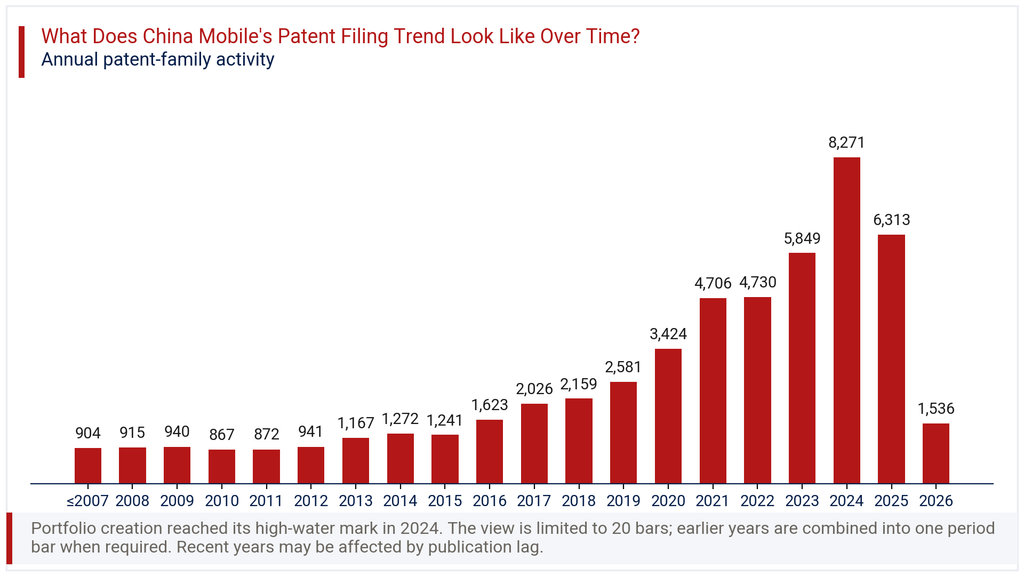
The year 2025 recorded 6,313 families, and 2026 shows only 1,536 so far, a -75.7% change from the prior year. This drop should not be read as a genuine pullback in research activity. Patent applications typically take months, sometimes years, to appear in public databases after filing. The most recent one to two years in any patent dataset will understate real filing volume simply due to this publication lag. The broader trajectory, from low hundreds annually to multiple thousands, confirms a company that has substantially scaled its patenting activity over the past decade, aligned with its expansion into computing and AI services alongside core telecom operations.
Where Does the China Mobile Patent Portfolio Prioritize Patent Protection?
Patent geography for China Mobile is heavily domestic. China accounts for 99.8% of all filings, a concentration that reflects the company’s primary market and regulatory environment. The geographic chart in this section shows every other jurisdiction trailing far behind, with WIPO PCT filings at 4.6% representing the main channel for international reach.
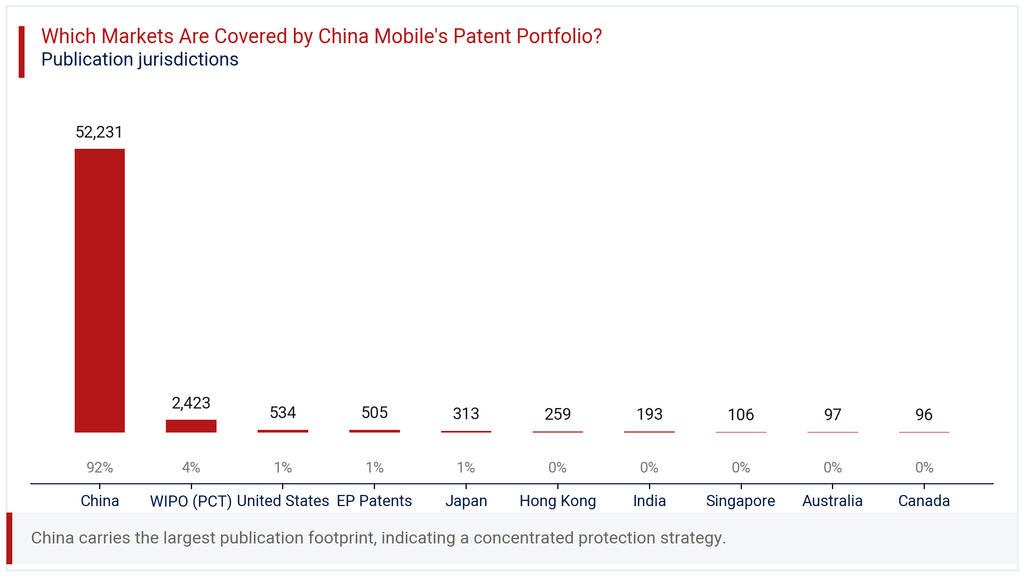
Beyond China and the PCT route, direct filings into the United States, Europe, Japan, Hong Kong, India, Singapore, Australia, and Canada each account for 1.0% or less of the total portfolio. The United States and EP Patents jurisdictions each sit at 1.0%, followed by Japan at 0.6% and Hong Kong at 0.5%. This pattern suggests China Mobile treats international filing as a selective, secondary activity rather than a parallel global strategy. For a company operating primarily within mainland China and Hong Kong SAR, this domestic concentration aligns with its core market footprint, though it may limit enforceable protection in markets where competitors or partners operate.
Where is the China Mobile Patent Portfolio Building Protection Across Key Technologies?
IPC analysis of the portfolio points to wireless and digital communication as the dominant technical themes. H04W, wireless communication networks, leads with 16,378 families, or 24.4% of the portfolio. Close behind sits H04L, digital information transmission, with 16,059 families at 24.0%. The technology chart in this section shows these two classes together accounting for roughly half of all filings.
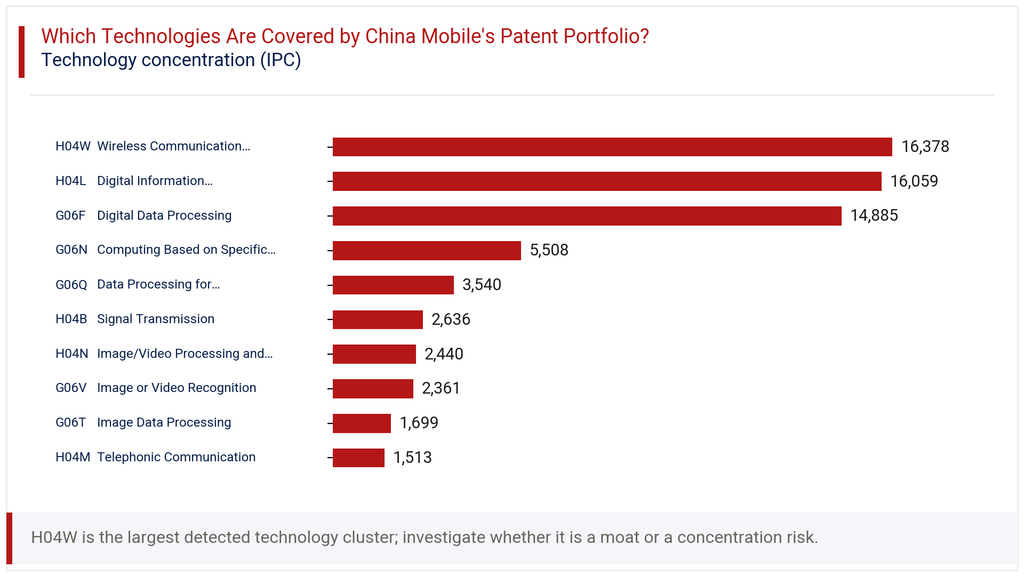
G06F, digital data processing, ranks third with 14,885 families at 22.2%, confirming substantial investment in computing infrastructure alongside telecom networking. Further down, G06N, computing based on specific models, holds 5,508 families at 8.2%, while G06Q, administrative and commercial data processing, accounts for 3,540 families at 5.3%. Smaller clusters in image and video processing, including G06V and G06T, together add a few thousand more families. This distribution shows a company whose patent filing trends trace a shift from pure telecom infrastructure toward computing and data-driven technologies, consistent with its stated move into AI and cloud services.
How Has the China Mobile Patent Portfolio Evolved Across Filing Geographies?
Viewing filings by year and jurisdiction together reveals how China Mobile’s international activity has shifted over time. The heatmap in this section shows Chinese filings rising every year from 1,621 in 2016 to 8,255 in 2024, dwarfing all other jurisdictions throughout. WIPO PCT filings grew more modestly, from 73 in 2016 to a high of 457 in 2024, before dropping sharply in 2025.
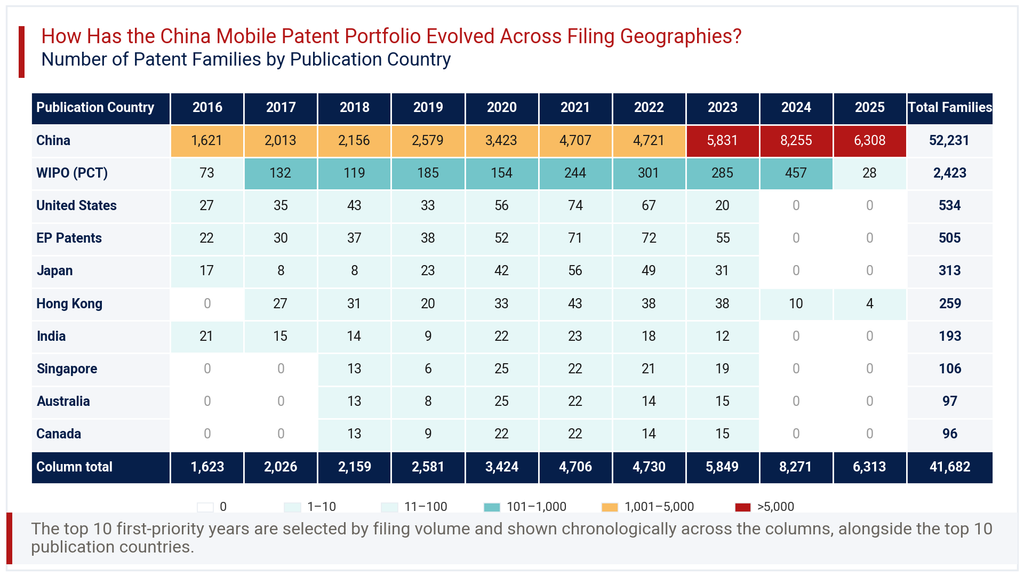
Direct filings into the United States and EP Patents jurisdictions both stopped appearing after 2023, with zero recorded in 2024 and 2025. The same pattern holds for Japan, India, Singapore, Australia, and Canada, all showing zero filings in the most recent two years. This likely reflects publication lag rather than an actual halt in international filing activity, since such a uniform drop across many jurisdictions simultaneously is unusual. Hong Kong is the exception, showing small but continued filings of 10 in 2024 and 4 in 2025. The overall picture confirms China remains the near-exclusive focus, with international filing treated as a limited supplementary effort.
Consultant’s Perspective on China Mobile Patent Portfolio
China Mobile’s patent portfolio reflects a company whose R&D investment tracks closely with its business transformation from a traditional telecom operator into a communications, computing, and AI services provider. The dominance of wireless and digital transmission technologies makes sense given its core business, but the meaningful weight of digital data processing and computing-based models signals a real pivot toward data and AI capabilities, not just a defensive filing exercise.
The near-total concentration in China, at 99.8% of filings, is the most important structural feature to watch. For a company serving over 200 countries through roaming agreements, the limited direct filing footprint abroad may eventually constrain enforcement options in markets where its technology gets used or licensed. Given the pending share of 44.9%, a substantial volume of applications still await examination outcomes, meaning the active patent count will shift materially over the next few years.
My recommendation is to track the grant and revocation rates on these pending families closely, since they will determine whether the China Mobile patent portfolio converts its scale into durable, enforceable rights or whether attrition continues to shrink it over time.
Explore Deeper Insights with ExpertLancing Research
This overview only scratches the surface of what China Mobile’s patent data can reveal. Questions around specific technology clusters, competitor benchmarking, or licensing risk require deeper, family-level examination. ExpertLancing Research helps technology leaders, investors, and legal teams translate raw patent data into decisions they can act on. If you need a tailored assessment of this portfolio or a comparable competitor analysis, reach out to our research team to scope the next steps.