


The China Telecom patent portfolio spans 26,282 families, offering a clear window into how this state-backed carrier approaches research and technology protection. Of this total, 86.0% remains active, counting both granted and pending matters awaiting examination. Granted families stand at 10,661, while pending applications number 11,943, producing a grant rate of 40.6%. The remaining families, totaling 3,678 across lapsed, revoked and expired status, have exited the active pipeline. These figures describe prosecution and maintenance outcomes only, not a judgment on patent quality or enforceability.
Filing activity peaked in 2024 at 4,686 families, marking the busiest year in the company’s filing history. China dominates jurisdictional coverage, accounting for 99.7% of filings across 10 jurisdictions tracked in this analysis. The leading technology cluster is H04L (Digital Information Transmission), carrying 9,379 families, well ahead of every other classification. This concentration signals where China Telecom has placed its heaviest research and development bets over the years.
This report reads the China Telecom patent portfolio as a lens on filing behavior, not as a verdict on commercial success. Raw filing counts cannot by themselves confirm market advantage or product traction. Readers considering licensing, litigation risk, or competitive benchmarking should verify specific families independently before relying on them externally. The analysis that follows walks through legal health, filing trends, geographic priorities, technology focus and year-by-year jurisdictional shifts, each grounded in the figures above.
About China Telecom
Company Profile: China Telecom Corporation Limited operates as a major Chinese telecommunications company, trading as China Telecom. It is the principal landline service provider of China and the second-largest mobile telecommunication provider in China. China Telecom is the second-largest wireless carrier in China, with 362.49 million subscribers as of June 2021. The company’s H shares have been publicly traded on the Hong Kong Stock Exchange since 15 November 2002. In January 2021, China Telecom was delisted from the NYSE in response to United States Executive Order 13959, and the FCC revoked China Telecom (Americas) Corporation’s operating license in the United States. Its parent group, China Telecommunications Corporation, operates globally through subsidiaries including China Telecom Global. China Telecom provides comprehensive, high-quality integrated information service solutions to international operators, multinational companies, and overseas Chinese customers, helping customers achieve digital transformation.
It operates 259 overseas points of presence and 304T of international connectivity bandwidth and capacity through 185 submarine and terrestrial cables. The group ranked 134th on the 2025 Fortune Global 500 list.
How Healthy is China Telecom Patent Portfolio?
Patent portfolio health depends on how filings move through legal status over time. For China Telecom, 45.4% of families sit in pending status, awaiting examiner action, while 40.6% have reached grant. Together these account for the 86.0% active rate referenced earlier. The composition chart in this section shows a smaller but notable share sitting outside the active pool: 10.1% revoked, 3.2% lapsed, and 0.7% expired. A revoked share above ten percent warrants attention, since it suggests some filings faced validity or opposition challenges after grant.
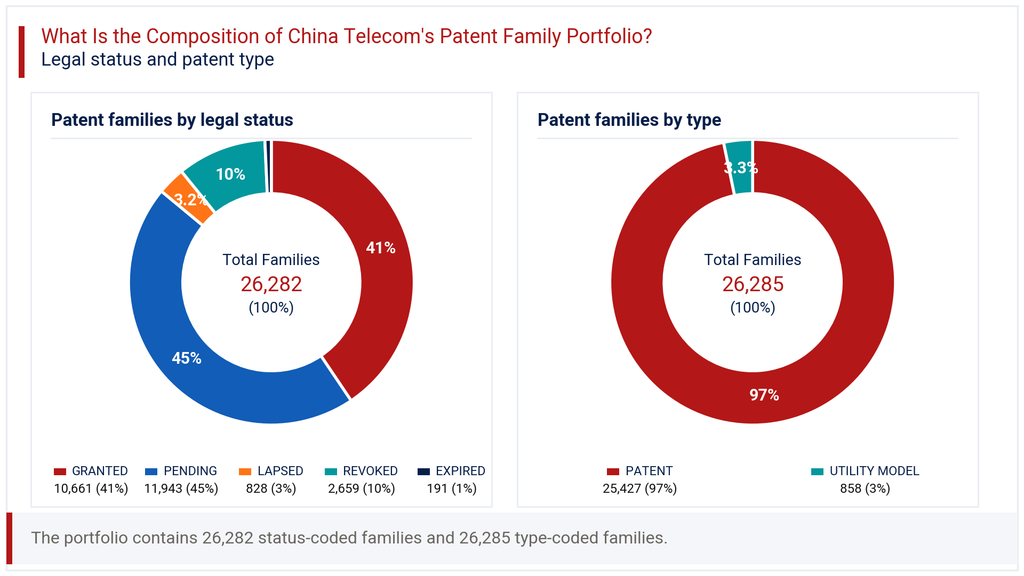
Patent type composition adds further texture. Ordinary patents make up 96.7% of the portfolio, with utility models filling the remaining 3.3%. This split points to a filing strategy weighted toward invention-grade protection rather than the shorter-term, lower-threshold utility model route common in China. The high pending share also reflects the recent filing surge discussed in the next section, since large cohorts of applications from 2022 through 2024 simply have not finished examination. Taken together, the legal status mix shows a portfolio still working through a substantial backlog, with grant outcomes yet to catch up to filing volume.
How Has the China Telecom Patent Portfolio Evolved Over Time?
The filing-trend chart in this section shows a long, steady climb followed by a sharp inflection. Annual filings stayed in the low hundreds through the 2010s, moving from 344 families in the pre-2008 period to 612 by 2017. Growth accelerated meaningfully after 2020, when filings reached 863, then jumped to 2,666 in 2021 and 4,100 in 2022. This represents a structural shift in filing intensity, not a gradual trend.
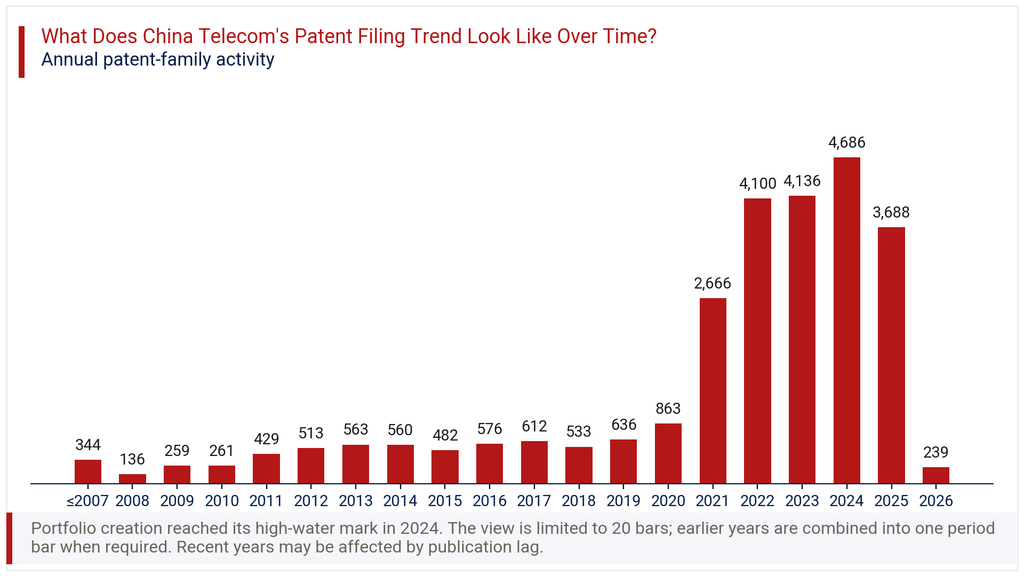
Volumes held near this elevated plateau through 2023 at 4,136 and peaked at 4,686 in 2024. The apparent pullback to 3,688 in 2025 and 239 in 2026, a drop the data shows as a 93.5% decline in the latest year, should not be read as an actual slowdown. Patent applications typically take twelve to eighteen months to publish, so recent years remain understated until records catch up. The more reliable takeaway is that China Telecom entered a sustained high-filing phase starting in 2021, likely tied to expanded investment in digital infrastructure and network technology research.
Where Does the China Telecom Patent Portfolio Prioritize Patent Protection?
Patent geography for China Telecom is heavily domestic. The geographic chart in this section shows China accounting for 99.7% of all filings, a concentration that leaves little room for other jurisdictions. WIPO’s PCT route follows at 6.6%, used mainly as a bridge for potential international expansion rather than a destination in itself. Direct filings in the United States, Europe, Japan and other markets each fall below one percent individually.
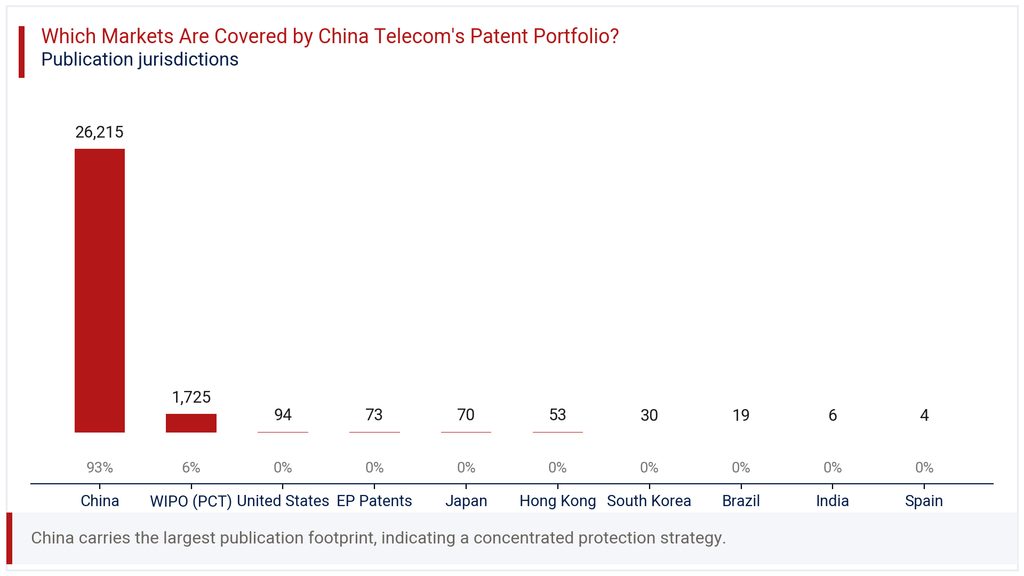
This pattern tells a clear story about priorities. China Telecom files first and overwhelmingly for domestic protection, consistent with its role as a state-linked carrier serving the Chinese market. The limited overseas footprint, just 94 United States families and 73 European filings against 26,215 Chinese ones, suggests international patent protection has not been a primary objective historically. Companies evaluating competitive exposure outside China should weigh this concentration carefully. It indicates lower litigation or blocking risk abroad, but also signals that China Telecom’s technology claims are not yet broadly contested or protected beyond its home jurisdiction.
Where is the China Telecom Patent Portfolio Building Protection Across Key Technologies?
The technology chart in this section highlights a portfolio anchored in core telecommunications infrastructure. H04L (Digital Information Transmission) leads with 9,379 families, representing 27.9% of the total. G06F (Digital Data Processing) follows at 7,320 families, or 21.8%, with H04W (Wireless Communication Networks) close behind at 7,099 families and 21.1%. These three clusters alone account for more than 70% of all filings, a sign of concentrated rather than diversified research focus.
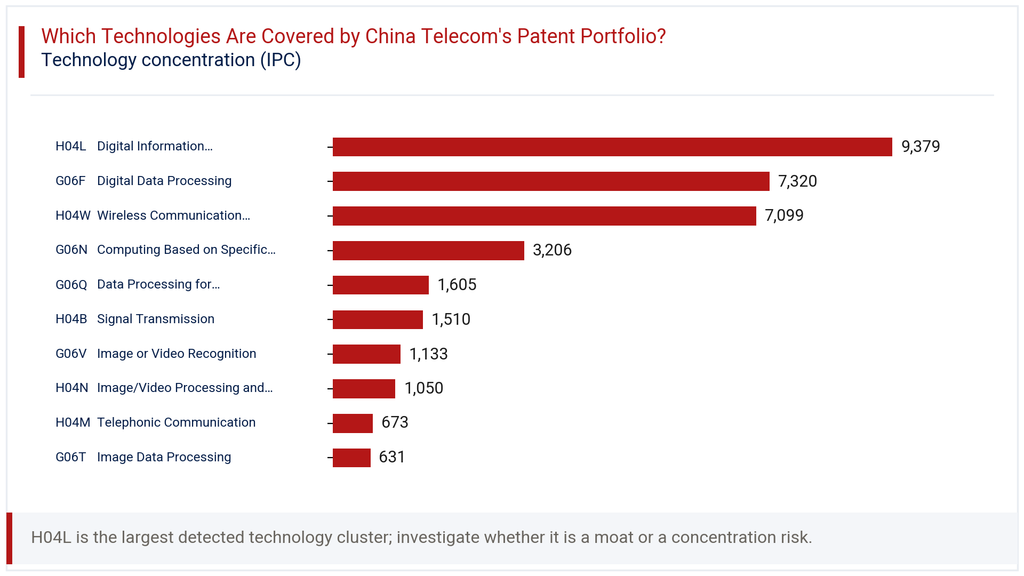
Beyond these leaders, G06N (Computing Based on Specific Models) holds 3,206 families at 9.5%, reflecting growing interest in artificial intelligence and machine learning methods. Smaller but meaningful clusters include G06Q (Data Processing for Administrative/Commercial Purposes) at 4.8% and G06V (Image or Video Recognition) at 3.4%. This IPC analysis suggests China Telecom’s research investment centers on network transmission, data processing and wireless infrastructure, with computing intelligence emerging as a secondary but rising priority within the broader patent portfolio.
How Has the China Telecom Patent Portfolio Evolved Across Filing Geographies?
The heatmap in this section tracks how jurisdictional activity shifted alongside the overall filing surge. China’s domestic filings moved from 576 in 2016 to 4,690 in 2024, mirroring the company’s broader growth curve. WIPO PCT filings, by contrast, stayed marginal until 2022 and 2023, when they rose to 268 and 570 respectively, before falling sharply in 2025.
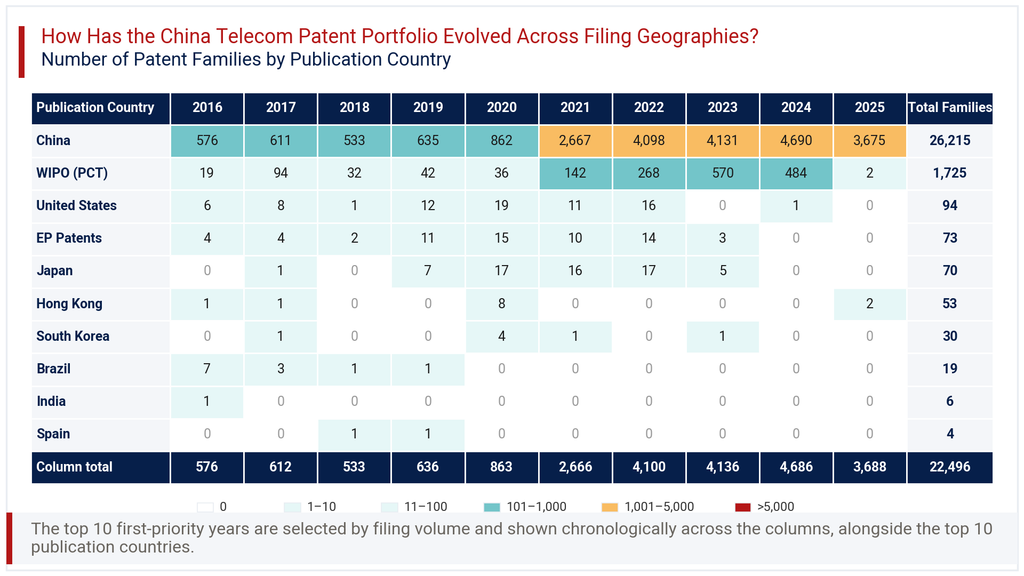
Other jurisdictions tell a story of fading rather than growing interest. United States filings never exceeded 19 in any single year and dropped to zero by 2023. European filings followed a similar pattern, peaking at 15 in 2020 before tapering to nothing by 2024. Japan and South Korea show small, inconsistent activity across the period, with no filings recorded in the most recent years. This pattern confirms that China Telecom’s international filing appetite, modest to begin with, has narrowed further even as its domestic volume expanded. The geographic imbalance has widened over time rather than correcting itself.
Consultant’s Perspective on China Telecom Patent Portfolio
The China Telecom patent portfolio tells a story of scale concentrated almost entirely at home. A filing base of 26,282 families, growing sharply since 2021, demonstrates serious investment in domestic research output. Yet the near total reliance on Chinese jurisdiction, at 99.7%, leaves this intellectual property largely untested in international markets where competitors and licensing partners operate.
From a business standpoint, this creates both reassurance and caution for external stakeholders. Partners assessing China Telecom’s technology claims in network transmission, wireless systems and computing should recognize that enforceability outside China remains largely unproven. The 10.1% revocation rate also merits scrutiny before any licensing or acquisition conversation proceeds. Buyers and competitors alike should treat headline filing counts as a starting point for due diligence, not a conclusion.
Looking forward, the sensible move for any stakeholder is targeted validation. Identify the specific families relevant to a transaction or competitive assessment, then confirm current legal status and claim scope directly. Given the publication lag affecting 2025 and 2026 data, revisiting this analysis in twelve months will likely reveal a fuller, more accurate filing picture for those years.
Explore Deeper Insights with ExpertLancing Research
This overview only scratches the surface of what the China Telecom patent portfolio can reveal. ExpertLancing Research helps clients go further, with family-level validation, competitor benchmarking and technology-specific deep dives tailored to specific business decisions. Whether the goal is licensing due diligence, white space analysis or monitoring a competitor’s filing behavior, our analysts can build the evidence base needed. Reach out to ExpertLancing Research to commission a customized patent intelligence study built around your specific questions and timelines.