

The China Tower Patent Portfolio spans 2967 patent families, giving a clear view into how this state-owned tower operator is building its technology base. Of these families, 75.2% are currently active, a figure that covers both granted and pending cases still alive in the system. The breakdown shows 934 granted patents against 1297 pending applications, with a grant rate of 31.5% across the full portfolio. The remaining families sit in lapsed, expired, or revoked status, totalling 736 cases combined. These are prosecution and maintenance metrics only, and should not be read as a verdict on patent quality or enforceability.
Filing activity tells its own story. The peak year was 2025, when China Tower filed 859 patent families, by far the busiest year on record. China dominates as the filing jurisdiction, holding 100.0% share across a total of 7 jurisdictions covered by this portfolio. On the technology side, G06F Digital Data Processing leads as the top cluster, accounting for 523 families, ahead of every other classification tracked here.
This report draws on structured patent filing records to map where China Tower has concentrated its innovation effort and where gaps or slowdowns appear. Filing counts alone do not confirm commercial success, market dominance, or technical superiority over rivals. Readers considering this analysis for investment, partnership, or competitive benchmarking should validate individual patent families directly before relying on them externally.
About China Tower
Company Profile: China Tower Corporation Limited is a state-owned telecommunications company based in Beijing. The company provides telecommunication tower construction, tower maintenance, ancillary facilities management, and other services through mainland China. It was established in July 2014 by merging the telecom tower businesses of China Mobile, China Unicom and China Telecom. China Tower was the largest telecommunications tower group by revenue and became a separate listed company in 2018. China Telecom, China Mobile and China Unicom remained its largest clients as of 2018. Its official history page notes the company was formed with an initial registered capital base, later expanded through asset acquisitions from these three operators. It established Southeast Asia Tower Co., Ltd. in Laos in November 2018, marking its first step into international business. China Tower listed on the Hong Kong Stock Exchange on 8 August 2018, with its IPO raising approximately HK$58.8 billion.
The company operates under the Hong Kong ticker SEHK: 788.
How Healthy is China Tower Patent Portfolio?
Patent portfolio health depends heavily on legal status distribution, and China Tower’s numbers show a mixed but workable picture. Granted patents make up 31.5% of the total, while pending applications represent 43.7%, the single largest bucket in the composition chart. This weighting toward pending cases suggests a portfolio still working through examination, rather than one that has matured and settled. Lapsed families account for 15.6%, revoked cases sit at 7.8%, and expired patents are a small 1.4% slice.
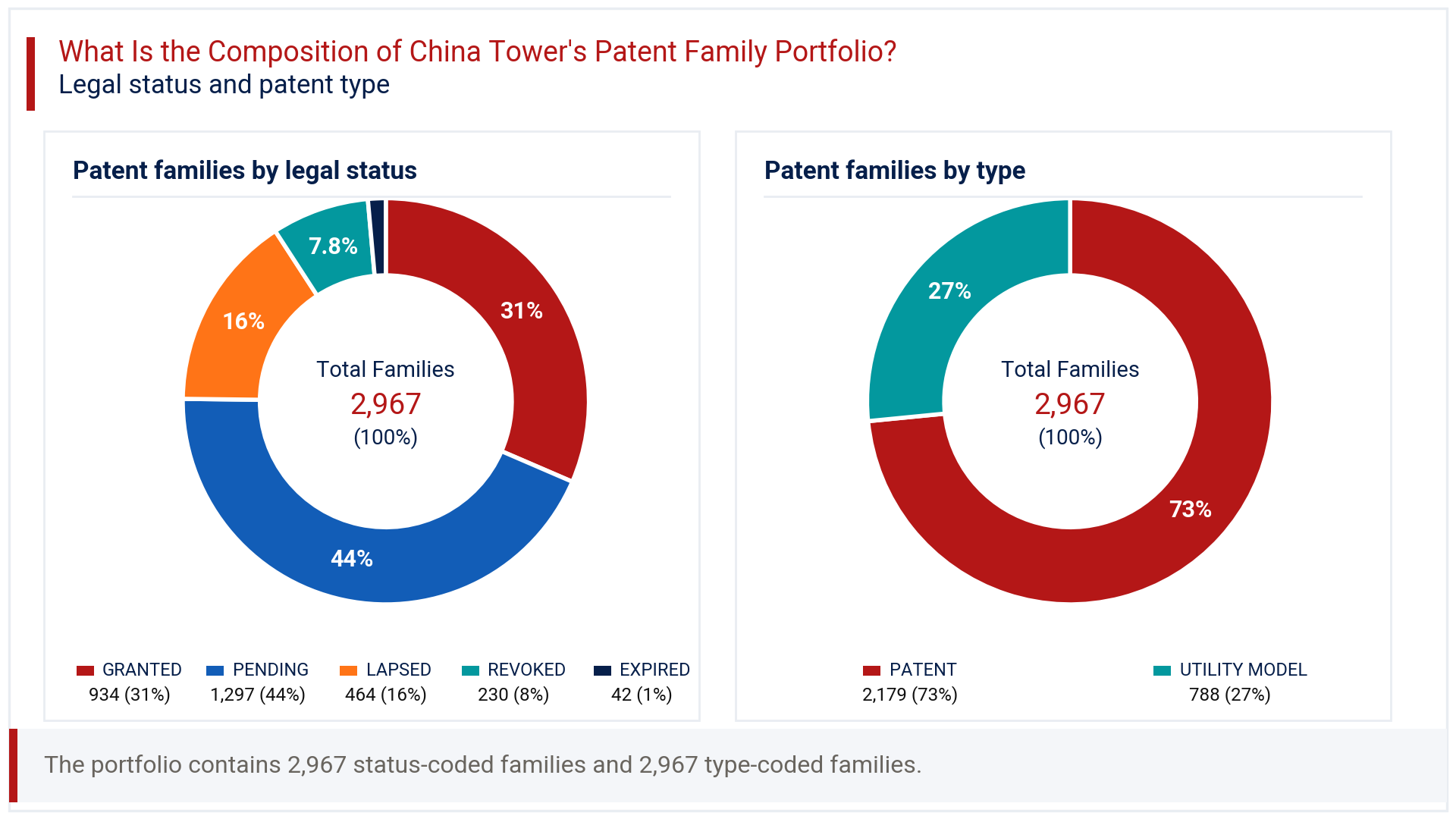
The active rate of 75.2% combines granted and pending families, giving a reasonable signal of portfolio vitality. Patent type composition adds further texture: standard patents form 73.4% of filings, against 26.6% for utility models. This split favors stronger, more durable protection over the shorter-lived utility model route common in Chinese filing practice. Taken together, the legal status and patent type data point to an operator actively building formal patent protection rather than relying on quick utility model filings. The heavier pending share does mean the final grant outcome for recent years remains uncertain.
How Has the China Tower Patent Portfolio Evolved Over Time?
Patent filing trends for China Tower show a long quiet period followed by sharp acceleration. Filings stayed in single digits or zero through most years before 2014, then rose steadily from 5 families that year. The growth from 2015 onward, moving through 85, 95, and 122 filings in consecutive years, marks a clear strategic shift. Activity continued climbing through 2020 and 2021, before a pronounced jump in 2022 and 2023.
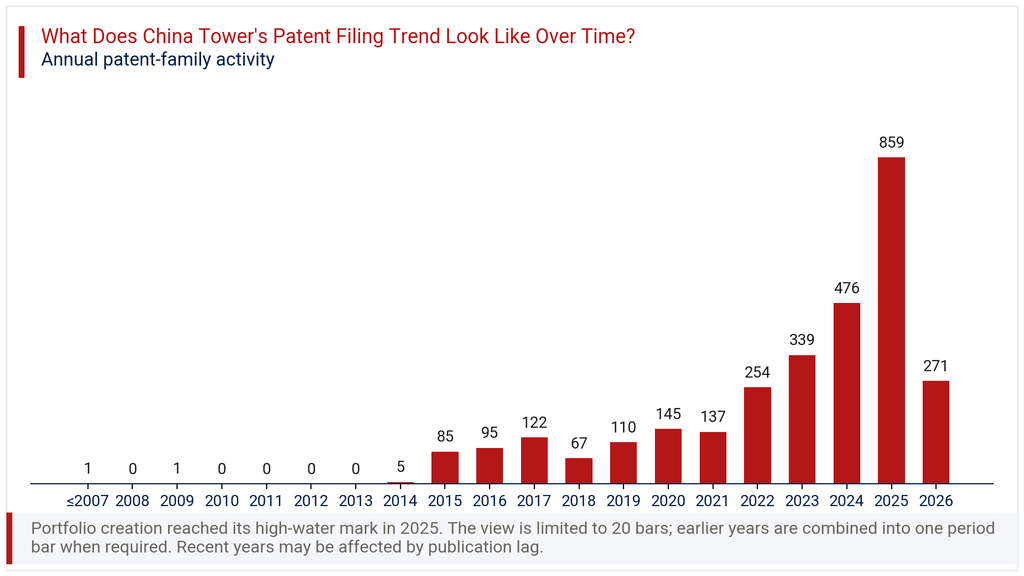
The filing-trend chart in this section shows 2025 as the standout year, with 859 families, the highest volume in the company’s history. This matches a broader pattern of Chinese infrastructure and technology firms expanding patent activity sharply in recent years. The 2026 figure of 271 families and the year-over-year change of -68.5% likely reflect publication lag rather than a genuine pullback. Patent applications typically take many months to appear in public databases, so the most recent one to two years should be read cautiously. The underlying trajectory through 2025 points to sustained, deliberate investment in filing activity, not a slowdown.
Where Does the China Tower Patent Portfolio Prioritize Patent Protection?
Patent geography for China Tower is about as concentrated as it gets. China accounts for 100.0% of all filings, based on the geographic chart covering 7 jurisdictions in total. The remaining jurisdictions, including WIPO (PCT), EP Patents, Japan, United States, Australia, and Spain, each contribute only marginal counts, at 3, 2, 2, 2, 1, and 1 families respectively.
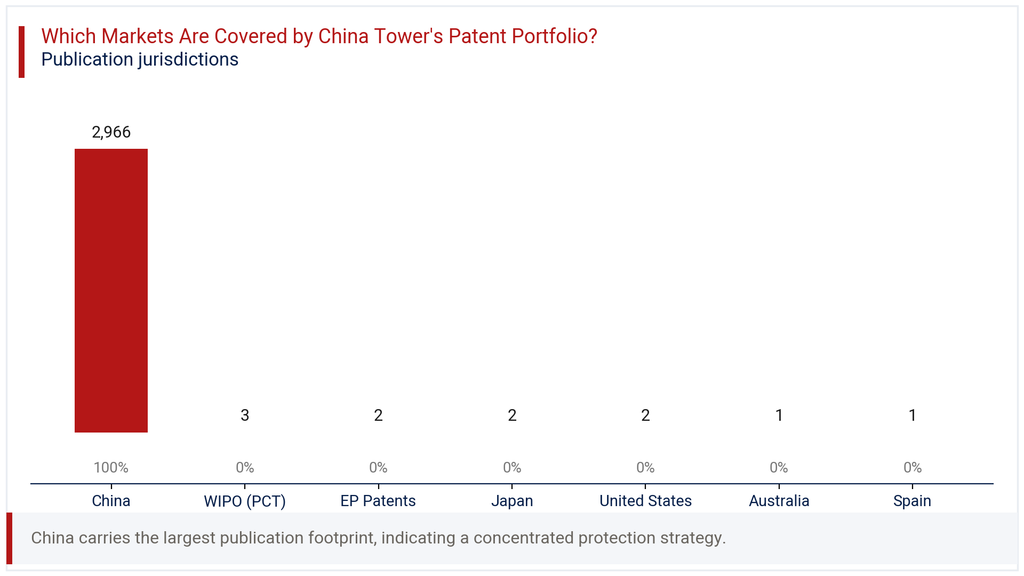
This pattern reflects a company whose commercial footprint remains almost entirely domestic. China Tower’s core business, tower infrastructure and maintenance across mainland China, naturally ties its patent filing behavior to the home market. The minimal international filing, each non-China jurisdiction sitting at 0.1% or less, suggests limited current appetite for protecting these inventions abroad. For a company with a single international subsidiary noted in Laos, this domestic concentration is broadly consistent with its stated business scope. Companies eyeing partnership or licensing deals with China Tower should treat the near-total China filing concentration as a structural feature, not a gap to be read as oversight.
Where is the China Tower Patent Portfolio Building Protection Across Key Technologies?
IPC analysis of the China Tower portfolio reveals a company whose innovation center of gravity has shifted well beyond tower hardware. The top classification, G06F Digital Data Processing, covers 523 families, or 18.3% of total filings. Close behind sit G06N Computing Based on Specific Models at 437 families (15.3%) and G06V Image or Video Recognition at 359 families (12.5%).
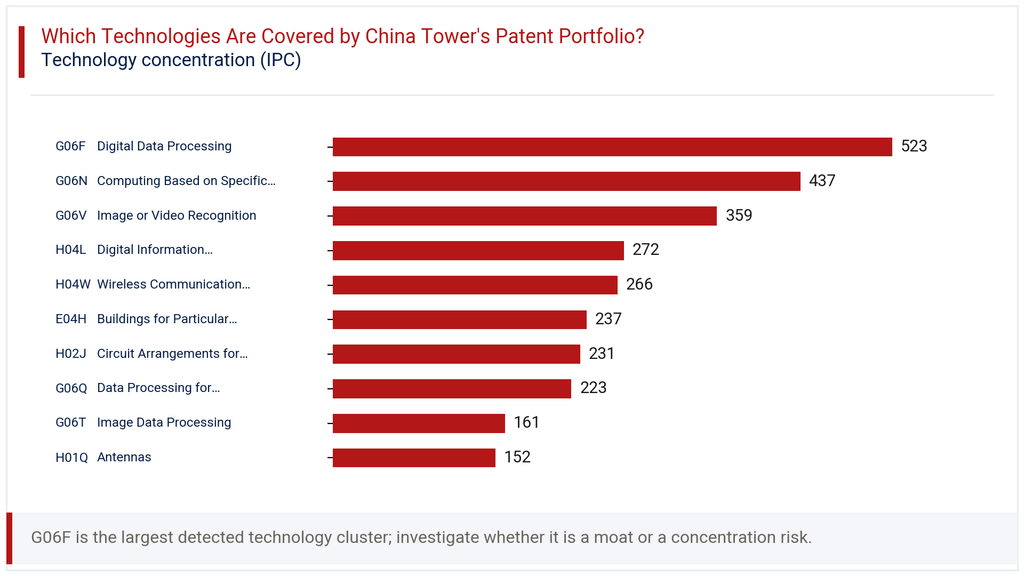
The technology chart in this section also highlights strong activity in H04L Digital Information Transmission (272 families, 9.5%) and H04W Wireless Communication Networks (266 families, 9.3%). Traditional tower-related categories still appear, with E04H Buildings for Particular Purposes at 237 families and H01Q Antennas at 152 families. But the heavier weighting toward data processing, computing models, and image recognition signals a pivot toward digital infrastructure and smart monitoring technologies. This mix suggests China Tower is positioning its patent base around data-driven tower management and broader digital services, not just physical infrastructure.
How Has the China Tower Patent Portfolio Evolved Across Filing Geographies?
The heatmap view of filings by year and jurisdiction confirms what the geography data already suggests: China is the whole story. Year-over-year, China’s filing counts track almost exactly with the portfolio’s overall totals, rising from 95 in 2016 to 859 in 2025. Every other jurisdiction shows only isolated, single-digit activity across the entire period, with WIPO (PCT) recording just 1 filing in 2024.
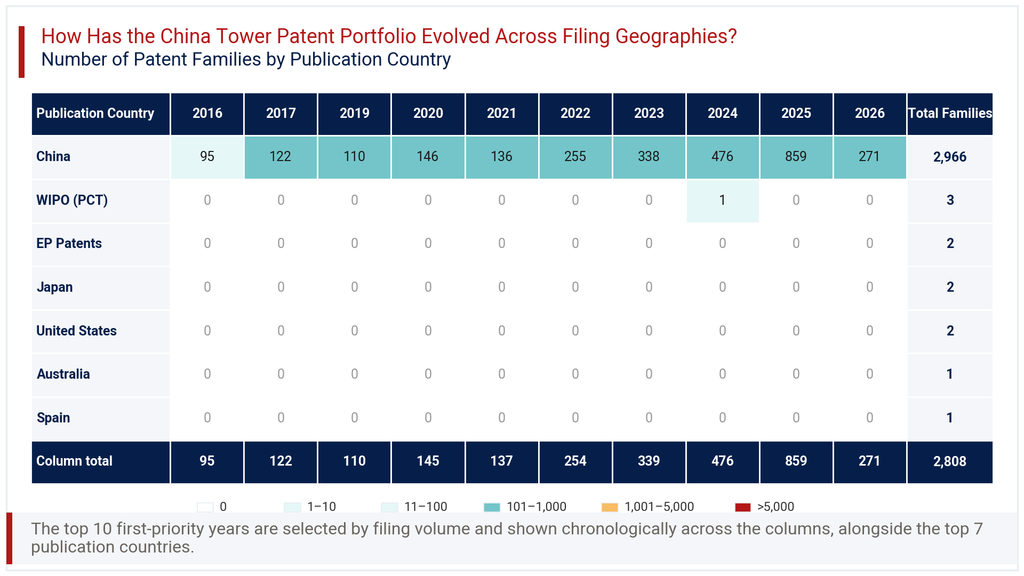
This near-total overlap between total filings and China-only filings means there is no meaningful cross-border filing strategy to analyze year by year. The heatmap essentially shows one jurisdiction’s trajectory, since China represents 100.0% of the portfolio throughout. For readers tracking how international ambitions might translate into patent strategy, this is the clearest signal available: there is none yet, at scale. Any future shift toward multi-jurisdiction filing, particularly as China Tower’s Southeast Asia operations mature, would represent a meaningful change worth monitoring in subsequent filing years.
Consultant’s Perspective on China Tower Patent Portfolio
Reviewing the China Tower Patent Portfolio as a whole, two things stand out immediately. First, the filing volume surge since 2022 is substantial and deliberate, not incidental. Second, the technology mix has moved decisively toward software, data processing, and recognition systems, away from pure tower engineering. This suggests a company repositioning itself as a digital infrastructure operator, not simply a passive tower landlord.
The domestic concentration, at 100.0% of filings, is the one area worth watching closely. As China Tower’s international footprint grows beyond Laos, a continued absence of overseas filing could eventually limit its ability to defend these innovations outside China. The heavy pending share, 43.7% of the total portfolio, also means grant outcomes over the next two to three years will materially reshape the active patent count.
My recommendation for anyone assessing this company: treat the 2025 filing peak as a genuine signal of R&D intent, but watch the pending-to-granted conversion rate closely. The next filing cycle will clarify whether this digital pivot translates into durable, enforceable protection or simply reflects speculative filing volume.
Explore Deeper Insights with Expertlancing Research
This overview only scratches the surface of what the China Tower patent data can reveal. ExpertLancing Research helps technology leaders, investors, and legal teams go deeper, mapping competitor filings, tracking examiner trends, and benchmarking against sector peers. If you need a sharper view of where this portfolio creates real competitive advantage, or exposure, our analysts are ready to help. Reach out to commission a custom patent intelligence study built around your specific business questions.