


The China Unicom Patent Portfolio offers a clear window into how one of China’s largest state-owned telecom operators protects its technology investments. Across 22,544 total patent families, 84.7% remain active, a figure covering both granted and pending filings. Of these, 11,117 have been granted and 7,975 remain pending, giving a grant rate of 49.3%. The remaining families sit in lapsed, expired, or revoked status, together totaling 3,452 records. These figures describe prosecution and maintenance activity only, not a judgment on patent quality or enforceability.
Filing activity peaked in 2023, when China Unicom recorded 4,530 new patent families, the highest annual count in the portfolio’s history. China dominates the filing geography, accounting for 100.0% of jurisdictional share, though the portfolio extends across 10 jurisdictions in total. Among technology areas, H04L Digital Information Transmission leads the pack with 6,783 families, reflecting sustained investment in core data transmission capability.
This report draws on patent filing and legal status data to describe portfolio composition and direction, not commercial outcomes. Filing counts alone cannot confirm product success, market share, or competitive advantage in any technology area. Readers considering business or investment decisions should validate specific patent families independently before relying on these findings externally.
About China Unicom
Company Profile: China Unicom, formally China United Network Communications Group Co., Ltd., is a Chinese state-owned telecommunications operator. It operates as a state-owned telecommunications business, originally founded in 1994 as a wireless paging and GSM mobile operator. China Unicom (Hong Kong) Limited was incorporated in Hong Kong on 8 February 2000 and listed on the New York Stock Exchange and the Stock Exchange of Hong Kong in June 2000. The company merged with China Netcom Group Corporation in October 2008. China Unicom operates branches across 31 Chinese provinces and multiple overseas markets, with a telecommunication network and customer service system connecting China to the world. It has featured in the Fortune Global 500 for consecutive years, ranking 269th in 2025. Core services span mobile, fixed-line, data communication, internet access and digital television. In 2023, the company reported 244,508 employees.
In December 2024, it partnered with Huawei to launch a 5G-A V2X innovation base in Beijing focused on intelligent driving and smart parking.
How Healthy is China Unicom Patent Portfolio?
Patent portfolio health depends heavily on legal status distribution, and China Unicom’s numbers tell a reasonably encouraging story. Of 22,544 total families, 49.3% carry granted status, while 35.4% remain pending examination. Combined, this produces an active rate of 84.7%, a healthy share for a portfolio of this scale. Revoked families account for 13.2%, with lapsed and expired records contributing smaller shares of 1.5% and 0.5% respectively. The composition chart in this section illustrates how these categories sit relative to one another across the full dataset.
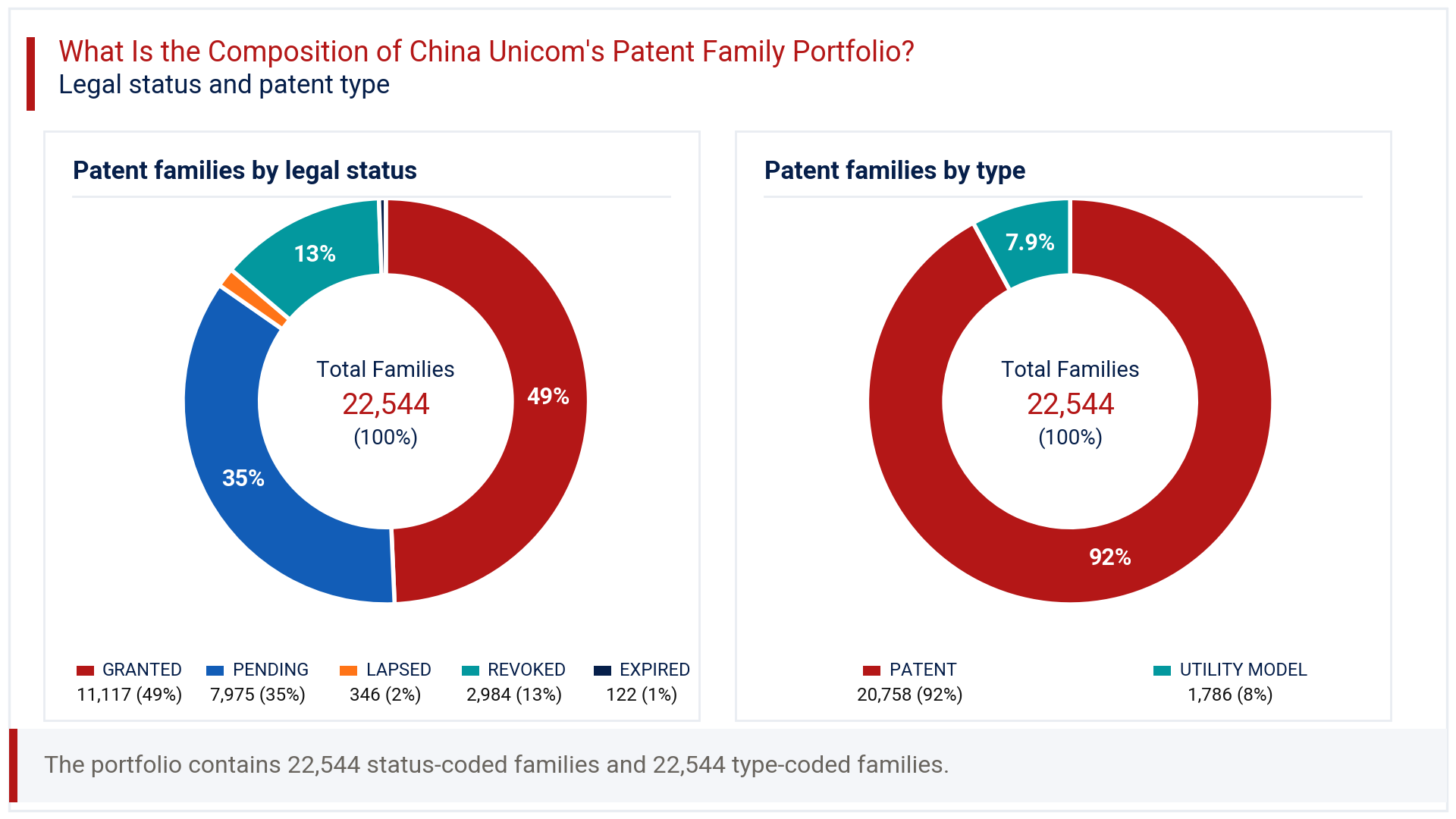
On patent type, the portfolio leans heavily toward standard patents over utility models. Standard patents make up 92.1% of filings, compared to 7.9% for utility models. This split suggests China Unicom pursues deeper technical protection rather than relying on faster, less rigorously examined utility model routes. The relatively high revoked share warrants monitoring, since it may reflect either deliberate portfolio pruning or examination outcomes that did not favor the applicant. Taken together, the legal status mix points to a portfolio under active management rather than passive accumulation.
How Has the China Unicom Patent Portfolio Evolved Over Time?
Patent filing trends across the China Unicom Patent Portfolio show a long, steady build followed by a sharp late-stage surge. Filings grew from just 53 families in the earliest period to 433 by 2013, then climbed further through the mid-2010s. The pace accelerated meaningfully from 2018 onward, rising from 1,126 that year to 1,842 in 2020. The filing-trend chart in this section captures this multi-year acceleration clearly across the full timeline.
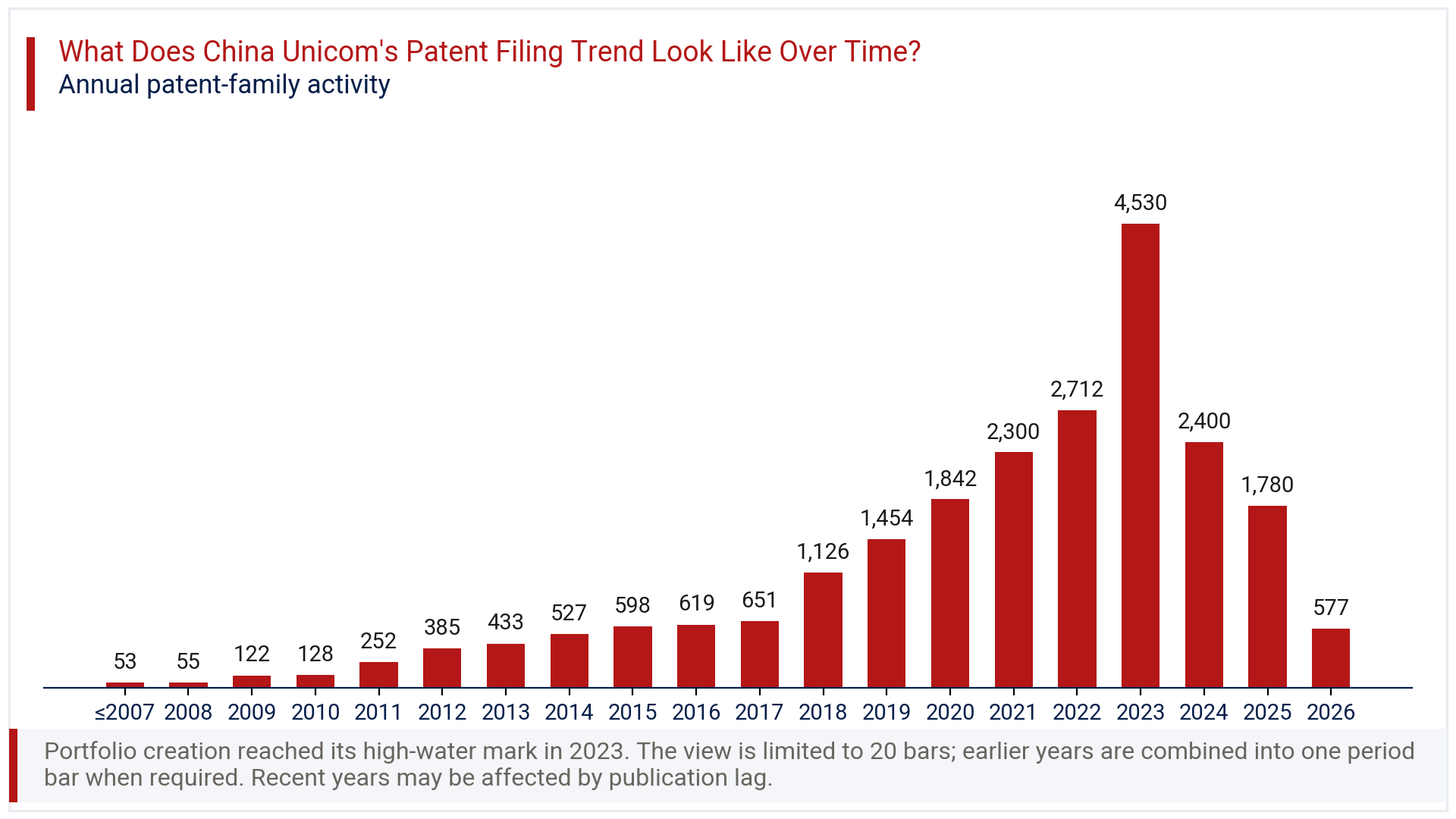
The most dramatic jump arrived in 2023, when filings hit 4,530, roughly double the 2022 count of 2,712. This single year stands out as the portfolio’s clear inflection point. Counts for 2024 and 2025 show 2,400 and 1,780 respectively, with a stated year-over-year change of -67.6% in the latest period. Rather than reading this as a genuine pullback, it more likely reflects publication lag, since recently filed applications often take a year or more to appear in public records. The underlying filing trend through 2023 still points to sustained, growing investment in patent protection.
Where Does the China Unicom Patent Portfolio Prioritize Patent Protection?
Patent geography within this portfolio is overwhelmingly domestic. China accounts for 22,537 families, representing 100.0% of jurisdictional share based on the data provided. The next largest jurisdiction, WIPO’s PCT route, holds just 99 families and 0.4% share. The geographic chart in this section shows how sharply filing activity concentrates within a single home market.
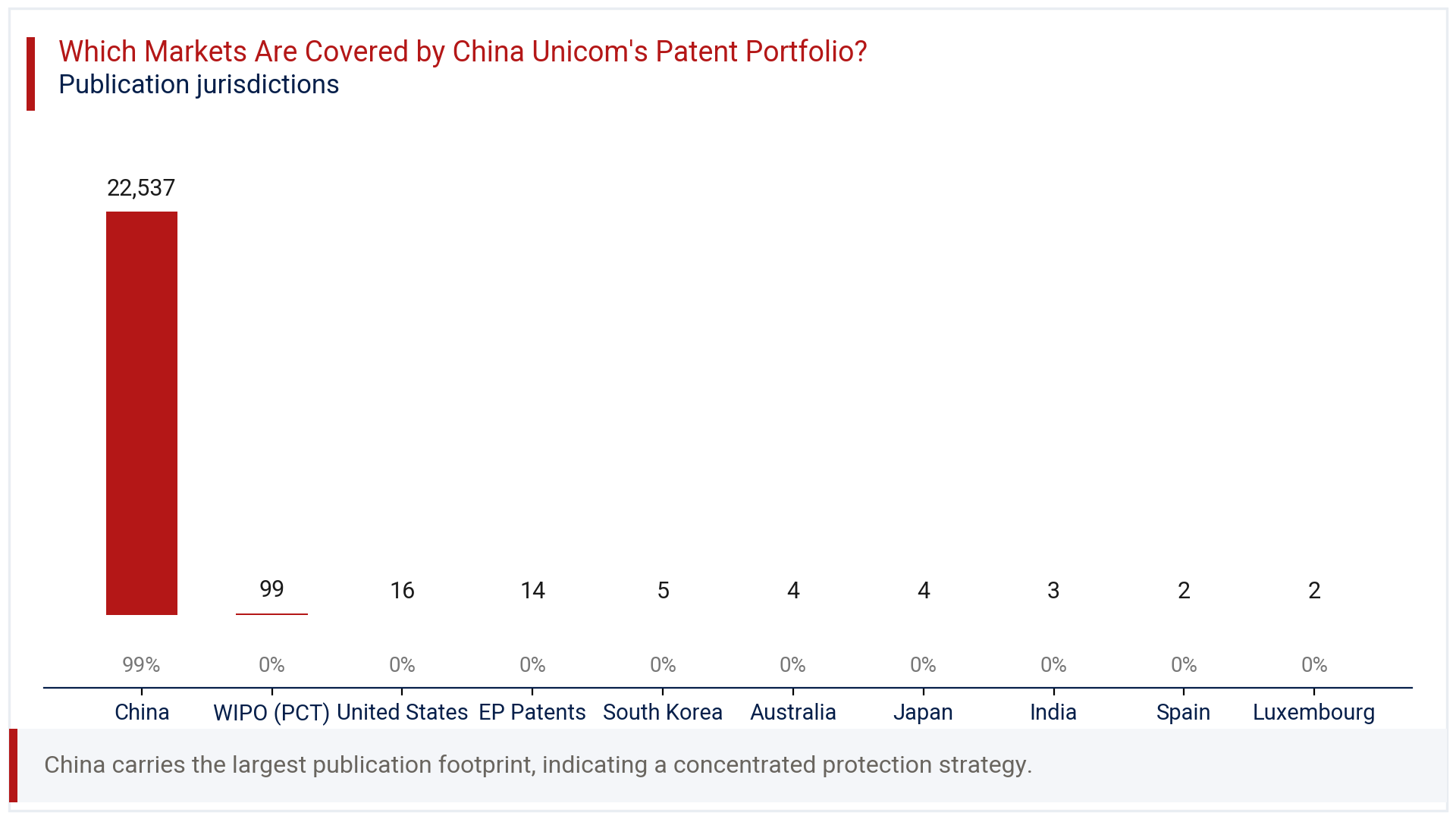
Beyond China and the PCT channel, international filings remain minimal. The United States shows 16 families, EP Patents account for 14, and South Korea, Australia, Japan, and India each register single-digit counts. This pattern is common among Chinese state-owned telecom operators whose primary commercial activity, regulatory relationships, and infrastructure deployments remain centered at home. It does suggest, however, that China Unicom’s international patent protection remains limited relative to its domestic footprint. For businesses assessing competitive exposure outside China, this concentration matters as much as the headline family count.
Where is the China Unicom Patent Portfolio Building Protection Across Key Technologies?
IPC analysis of the China Unicom Patent Portfolio reveals a clear concentration around communications and data processing. H04L Digital Information Transmission leads with 6,783 families, or 25.1% of classified filings. Close behind sits H04W Wireless Communication Networks at 6,756 families and 25.0% share. Together these two clusters account for roughly half of all technology-classified patents, underscoring the company’s telecom core.
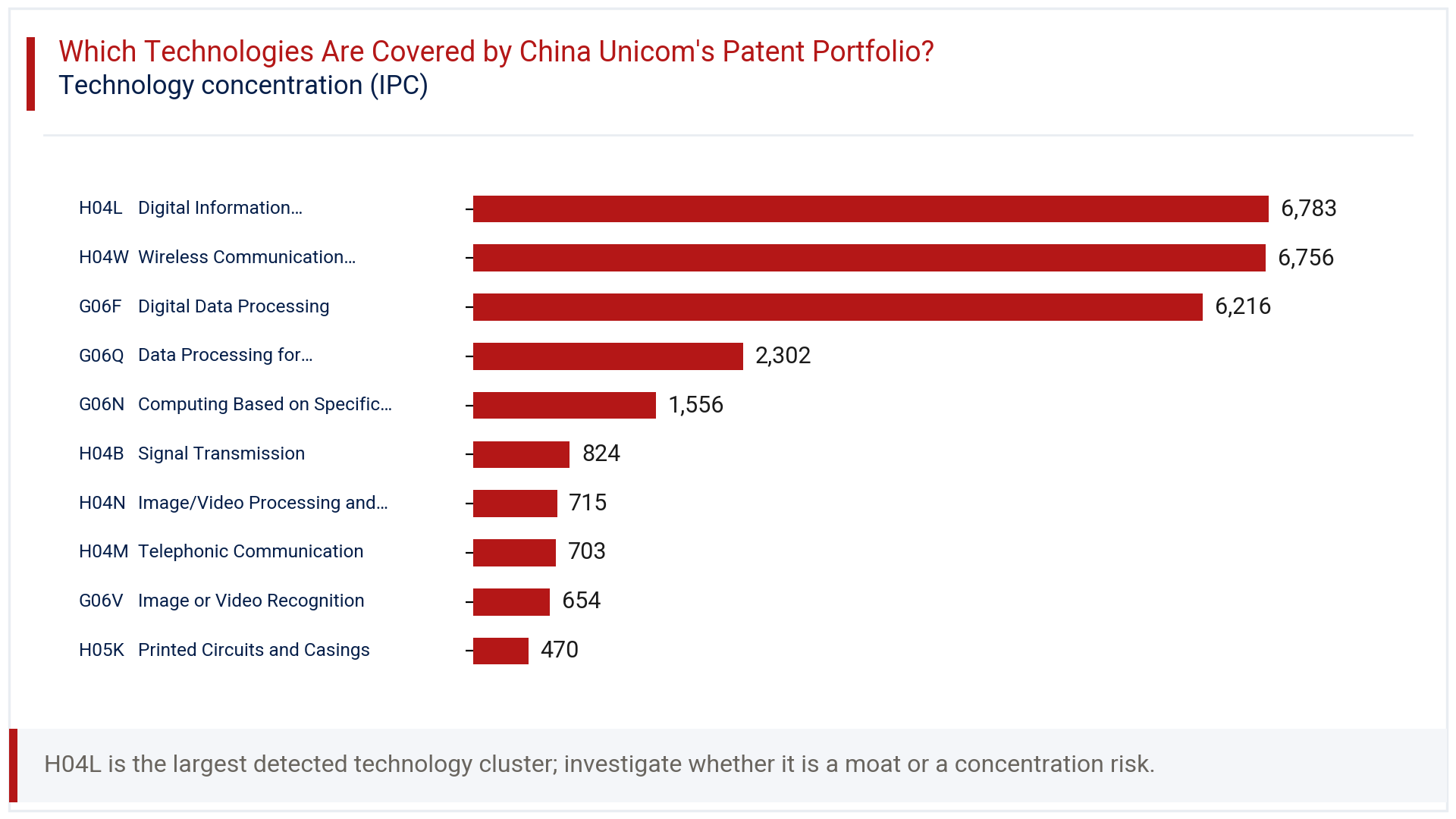
G06F Digital Data Processing follows with 6,216 families at 23.0%, reflecting substantial software and computing-adjacent investment. Further down, G06Q Data Processing for Administrative/Commercial Purposes holds 2,302 families, and G06N Computing Based on Specific Models, covering areas like machine learning, accounts for 1,556 families. The technology chart in this section lays out these clusters against smaller categories like H04B Signal Transmission and G06V Image or Video Recognition. This spread indicates China Unicom is protecting not just transmission infrastructure but also the software and intelligence layers built on top of it.
How Has the China Unicom Patent Portfolio Evolved Across Filing Geographies?
Viewed year by year, China’s dominance within the portfolio has only strengthened since 2016. Domestic filings rose from 618 in 2016 to 4,527 in 2023, mirroring the portfolio’s overall growth curve. The heatmap in this section shows this concentration intensifying rather than diversifying over the decade.
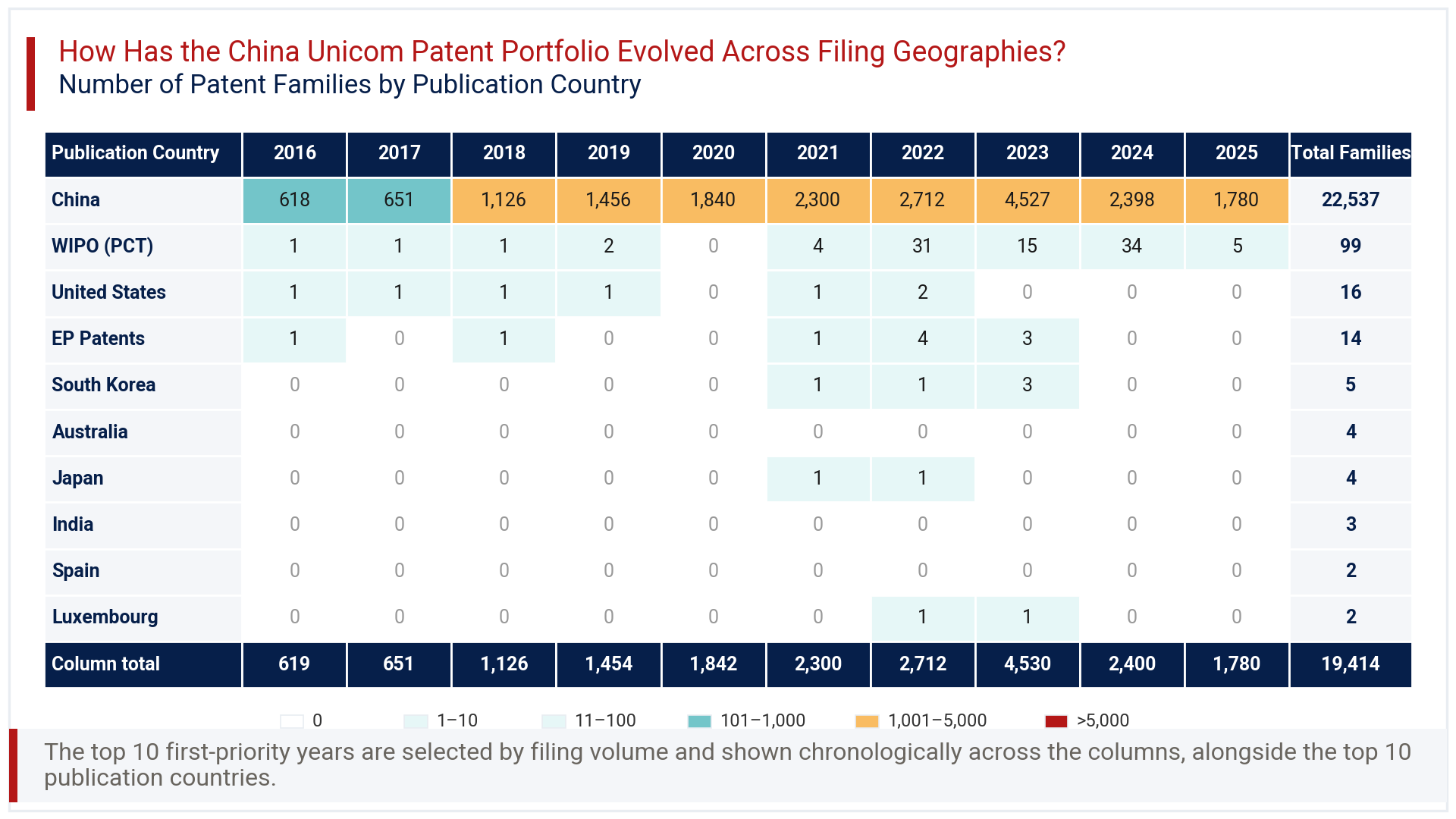
International filings, by contrast, stayed thin throughout the same period. WIPO PCT filings touched a modest peak of 31 in 2022, while the United States and EP Patents never exceeded single or low double digits in any year. South Korea, Japan, and Luxembourg appear only sporadically, often with just 1 family in a given year. This pattern suggests that as China Unicom’s overall filing volume expanded sharply after 2018, nearly all of that growth was directed inward. For a reader evaluating global patent exposure, the heatmap makes clear that scale and geographic reach are not moving together here.
Consultant’s Perspective on China Unicom Patent Portfolio
From an advisory standpoint, the China Unicom Patent Portfolio reflects a company investing seriously in domestic technology protection while keeping international filing deliberately narrow. The 84.7% active rate and steady grant outcomes point to a portfolio that is actively prosecuted rather than left to lapse. The 2023 filing peak of 4,530 families signals a genuine innovation push around digital transmission, wireless networks, and data processing, areas directly tied to China’s 5G and smart infrastructure priorities.
The concentration risk is equally clear. With 100.0% of filings in China and only token presence elsewhere, China Unicom carries limited patent leverage in overseas markets. For competitors or partners assessing exposure, this means China Unicom’s defensive and offensive patent options outside China remain constrained today. Given recent initiatives like the Huawei 5G-A V2X collaboration, expanding filings in markets tied to intelligent driving and connected infrastructure would strengthen the company’s global negotiating position. Monitoring whether the 2024 and 2025 dip reflects true deceleration or simple publication lag will matter for anyone tracking this portfolio’s next phase.
Explore Deeper Insights with ExpertLancing Research
Understanding a patent portfolio at this depth takes more than counting filings. ExpertLancing Research helps businesses, investors, and legal teams interpret portfolios like China Unicom’s with precision, context, and commercial relevance. Our analysts validate individual patent families, benchmark against competitors, and translate technical filings into decisions you can act on. If you are assessing partnership risk, licensing opportunity, or competitive positioning tied to telecom patents, reach out to ExpertLancing Research for a tailored deep-dive analysis built around your specific question.