

The Daqo Patent Portfolio offers a useful lens into how a leading polysilicon manufacturer protects its process innovations. Across 3,192 patent families, 61.2% remain active, a figure covering both granted and pending cases. Of these, 1,770 have been granted while 184 are still pending examination, giving a grant rate of 55.5%. Meanwhile, 1,238 families sit in lapsed, expired or revoked status combined. These are prosecution and maintenance indicators, not a verdict on patent quality or enforceability.
Filing activity peaked twice at 363 families, in both 2023 and 2024, pointing to sustained investment in recent years. China dominates the filing geography, accounting for 99.9% of the portfolio across 3 jurisdictions tracked. The leading technology cluster is H02B, Boards, Switchgear, Substations, with 663 families, making it the single largest area of protection within the Daqo Patent Portfolio.
This report draws on patent filing and status data to frame how Daqo builds and defends its technology positions. Filing counts alone do not prove commercial success or confirm competitive advantage in the market. Readers considering licensing, investment, or competitive benchmarking should validate specific families before relying on them externally. The analysis that follows is meant to guide direction, not substitute for legal or technical due diligence.
About Daqo
Company Profile: Daqo New Energy Corp. (NYSE: DQ) is a leading manufacturer of high-purity polysilicon for the global solar PV industry. Founded in 2007, the Company manufactures and sells high-purity polysilicon to photovoltaic product manufactures, who further process the polysilicon into ingots, wafers, cells and modules for solar power solutions. The Company has a total polysilicon nameplate capacity of 305,000 metric tons and is one of the world’s lowest cost producers of high-purity polysilicon.
It utilizes the chemical vapor deposition process, or the modified Siemens process, with upgraded hydrochlorination technology, and has fully implemented a closed loop system. The company imposes rigorous quality control standards, testing raw materials and inputs at every manufacturing stage. It holds a number of patents based on in-house innovation and has adopted an integrated quality management system. According to Wikipedia, the company operates a mono-Si and poly-Si manufacturing facility located in Shihezi, Xinjiang Province, China.
Its headquarters are based in China, with a Cayman Islands incorporation structure.
How Healthy is Daqo Patent Portfolio?
Patent portfolio health depends heavily on legal status composition, and the numbers here tell a mixed story. Granted families make up 55.5% of the total, while pending cases add another 5.8%, giving an active rate of 61.2%. On the other side, lapsed filings account for 18.3%, expired ones 14.8%, and revoked cases 5.7%. The composition chart in this section shows these proportions clearly, and the split suggests a portfolio that has matured through several filing cycles rather than one built recently from scratch.
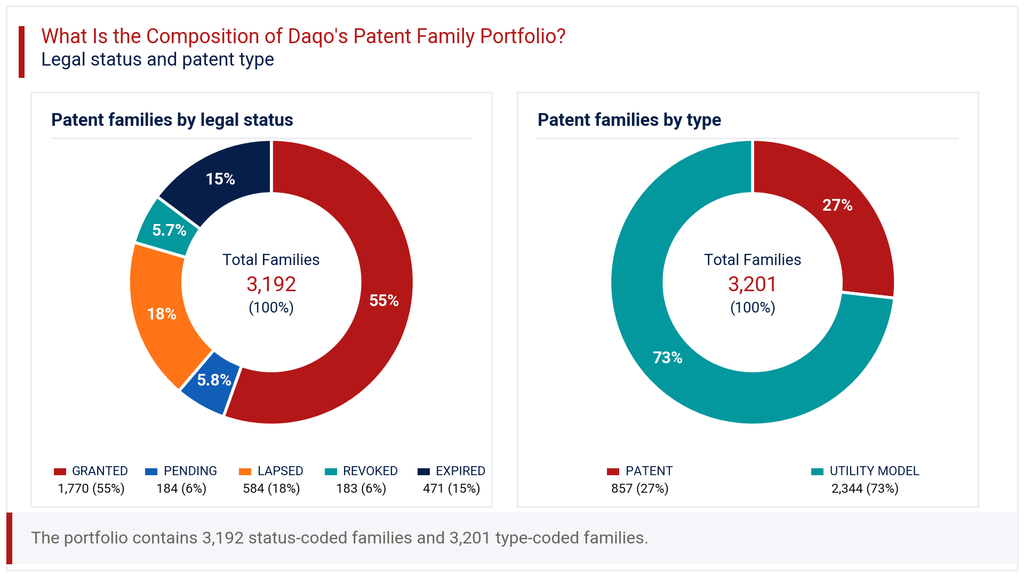
Patent type adds another dimension worth noting. Utility models represent 73.2% of filings against 26.8% for standard patents, based on counts of 2,344 and 857 respectively. This heavy tilt toward utility models is typical for Chinese manufacturing entities, where faster examination suits incremental process improvements. For a company like Daqo, where operational efficiency in polysilicon production drives margins, utility models offer quicker protection for equipment and process tweaks. The legal status mix combined with this type preference indicates a portfolio managed for practical, production-floor innovation rather than pure invention breadth.
How Has the Daqo Patent Portfolio Evolved Over Time?
Patent filing trends across the Daqo Patent Portfolio show a long accumulation phase followed by a sharp recent surge. Early years stayed modest, with filings in the double or low triple digits through 2013, when the count reached 139. Growth became more visible from 2015 onward, with 175 families that year, climbing further to 220 in 2016. The filing-trend chart in this section captures this gradual build clearly across nearly two decades.
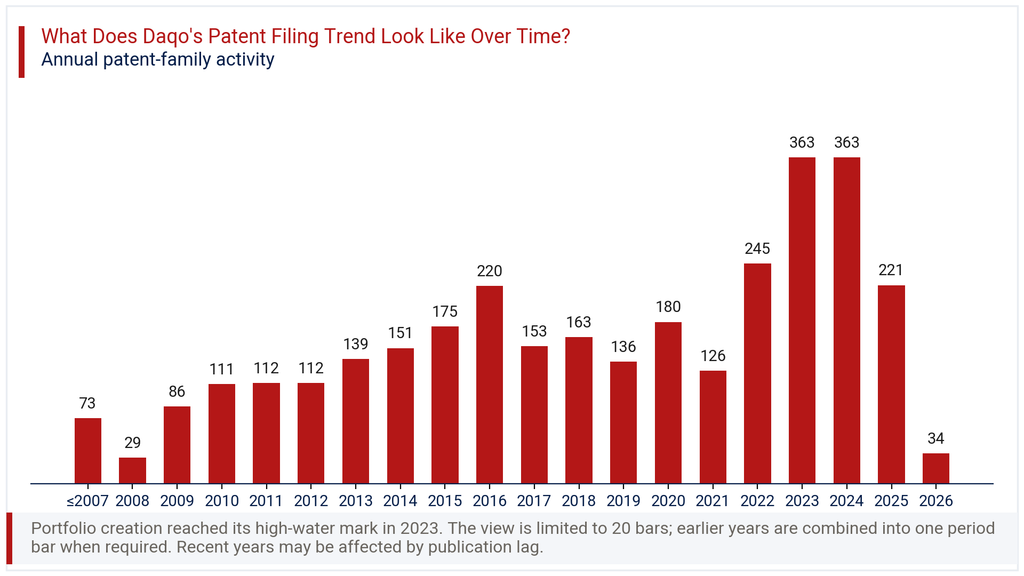
The most striking move comes in 2022 and after, when filings jumped to 245, then touched 363 in both 2023 and 2024, the portfolio’s peak years. This coincides with expansion in polysilicon capacity and intensified competition in the solar supply chain. The apparent drop to 221 in 2025 and just 34 in 2026, a decline of 84.6% from the prior year, reflects publication lag rather than a genuine pullback in filing activity. Patent applications typically take twelve to eighteen months to appear in public databases, so recent years will likely revise upward as records catch up.
Where Does the Daqo Patent Portfolio Prioritize Patent Protection?
Patent geography within the Daqo Patent Portfolio is heavily concentrated in a single market. China accounts for 99.9% of all filings, with 3,188 families registered domestically. This leaves WIPO PCT filings at 0.8% and Australia at just 0.4%, translating to 27 and 12 families respectively. The geographic chart in this section makes the imbalance immediately apparent.
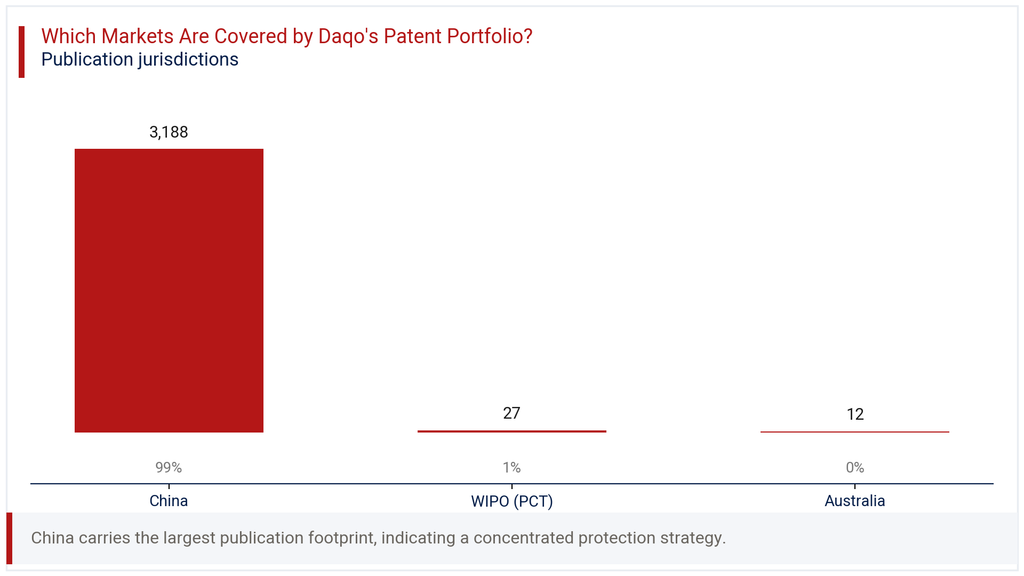
Such concentration aligns with where Daqo’s manufacturing operations and production assets sit. The company’s facilities in Xinjiang Province drive its core research and development activity, and domestic filing naturally follows that footprint. However, this pattern also signals limited international patent protection outside China. Competitors or customers operating in Europe, the United States, or Southeast Asia would find little direct patent coverage from Daqo in those regions. For a company serving a genuinely global solar supply chain, this gap between operational reach and filing geography deserves attention from a competitive protection standpoint.
Where is the Daqo Patent Portfolio Building Protection Across Key Technologies?
IPC analysis of the Daqo Patent Portfolio reveals a strong tilt toward electrical and chemical process technologies. The leading class, H02B covering boards, switchgear and substations, holds 663 families, or 26.9% of the total. Close behind sits H01H at 23.0% with 566 families, followed by C01B, inorganic chemistry, at 9.1% with 225 families. The technology chart in this section lays out these clusters by relative size.
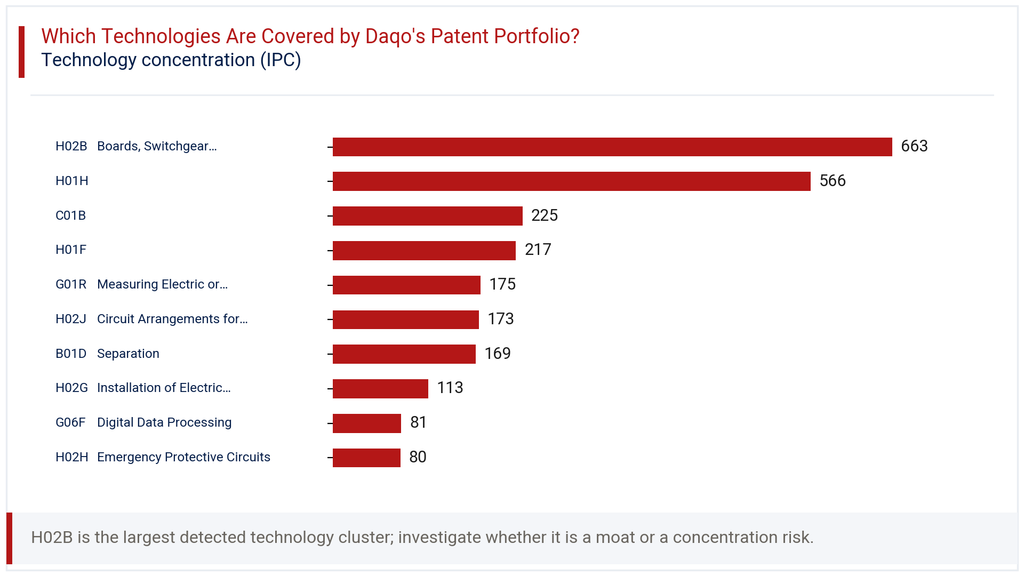
Other notable areas include H01F at 8.8%, G01R for measuring electric and magnetic variables at 7.1%, and H02J, circuit arrangements for power supply, at 7.0%. B01D, separation processes relevant to polysilicon purification, accounts for 6.9%. This spread shows Daqo protecting both the electrical infrastructure used in its manufacturing plants and the chemical separation steps central to polysilicon purity. The emphasis on switchgear and circuit protection technologies suggests significant investment in plant safety and power management, areas directly tied to operational cost control in energy-intensive polysilicon production.
How Has the Daqo Patent Portfolio Evolved Across Filing Geographies?
The heatmap in this section tracks how filing activity by jurisdiction has shifted year over year. China has remained the constant anchor throughout, rising from 151 filings in 2014 to 363 in both 2023 and 2024. This steady domestic climb mirrors the broader filing trend already discussed, confirming China as the unchanging center of gravity for the Daqo Patent Portfolio.
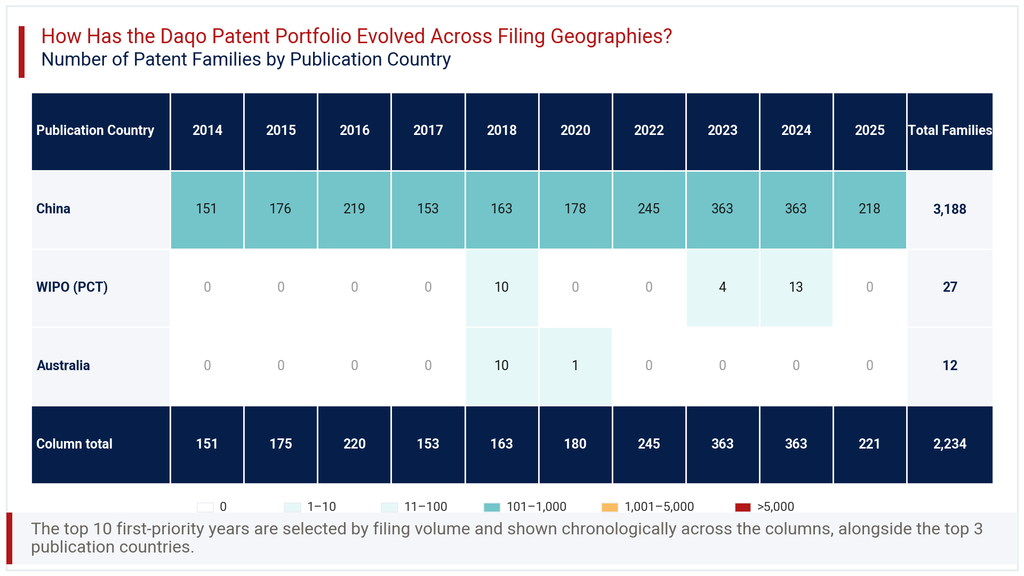
International filings appear only sporadically against this backdrop. WIPO PCT activity shows up in 2018 with 10 filings, then resurfaces briefly in 2023 with 4 and 2024 with 13. Australia recorded 10 filings in 2018 and just 1 in 2020, with no activity before or after. This intermittent pattern suggests Daqo pursues international protection selectively, likely tied to specific project needs or export considerations, rather than running any sustained international filing programme alongside its domestic strategy.
Consultant’s Perspective on Daqo Patent Portfolio
The Daqo Patent Portfolio reflects a manufacturer deeply focused on domestic process protection rather than broad international coverage. With 99.9% of filings in China and a grant rate of 55.5%, the pattern fits a company whose innovation serves its own production lines first. The heavy utility model share, 73.2% against 26.8% for standard patents, reinforces this reading. Daqo protects practical manufacturing improvements, not necessarily platform technologies meant for licensing or broad market defense.
The concentration risk here is real for a company competing globally. Polysilicon customers and competitors outside China face little patent friction from Daqo’s filings, which may understate the company’s actual innovation value when discussed in cross-border deals or investor conversations. The recent filing surge through 2024 shows continued investment appetite, and the apparent decline in 2025 and 2026 almost certainly reflects publication lag rather than slowing activity.
Going forward, Daqo would benefit from expanding PCT filings to better match its international customer base. Investors and partners evaluating the company should treat the domestic concentration as a known feature, not a weakness, but one requiring careful context in any cross-border assessment.
Explore Deeper Insights with Expertlancing Research
Understanding a patent portfolio takes more than reading the numbers, it requires context on strategy, competitors and market timing. Expertlancing Research helps technology buyers, investors and legal teams interpret filings like these with precision. Our analysts combine patent intelligence with market and competitive research to answer the questions that matter for your decision. If you are evaluating Daqo, a competitor, or an entire technology space, reach out to Expertlancing Research for a tailored deep-dive analysis built around your specific business question.