


The Dawning Patent Portfolio spans 1,890 patent families, offering a useful lens into how this Chinese supercomputer maker protects its engineering work. Of this total, 80.6% remain active, a figure that covers both granted and pending filings. Granted families number 885, while 638 are still pending examination, giving a grant rate of 46.8%. The remaining families, a combined 367 (lapsed, revoked, and expired together), have exited active protection. These are prosecution and maintenance statistics, not a measure of patent quality or enforceability.
Filing activity peaked in 2011, when the company filed 267 patent families in a single year, a spike well above any other year in the dataset. China dominates the jurisdictional spread, accounting for 98.8% of all filings across a total of 8 jurisdictions covered. The leading technology cluster is G06F (Digital Data Processing), with 1,167 families, confirming computing hardware and data processing as the company’s core patenting focus.
This report draws on patent filing records to describe how Dawning has built and maintained its intellectual property position over time. Filing volume alone does not establish commercial success, product adoption, or competitive superiority in the market. Readers evaluating specific families for licensing, litigation, or investment purposes should verify details independently before relying on them externally.
About Dawning
Company Profile: Dawning Information Industry Company Limited, known as Sugon, is a Chinese supercomputer manufacturer. The company is a spin-off from research done at the Chinese Academy of Sciences, and still has close links to it. The company was tasked with developing further supercomputers under the 863 program, which led to the Dawning 5000A and 6000 computers.
The company was listed on the Shanghai Stock Exchange in 2014. Dawning was the company’s initial name; it was later changed to Sugon. Its products include supercomputers and x86 servers, serving mainly the Chinese market. In May 2025, it was announced that Sugon would merge with Hygon Information Technology. In October 2022, the United States Department of Defense added Sugon to a list of “Chinese military companies” operating in the U.S. On December 9, 2025, Sugon and Haiguang Information simultaneously announced the termination of their restructuring.
The company remains a major player in China’s high-performance computing sector.
How Healthy is Dawning Patent Portfolio?
Patent portfolio health depends on how many filings remain enforceable versus how many have lapsed or been withdrawn. Within the Dawning Patent Portfolio, 46.8% of families hold granted status, representing 885 patents that have cleared examination. Another 33.8%, or 638 families, sit in pending status, awaiting office action or final decision. Together, these account for the 80.6% active rate referenced earlier, a reasonably strong position for a filer of this scale.
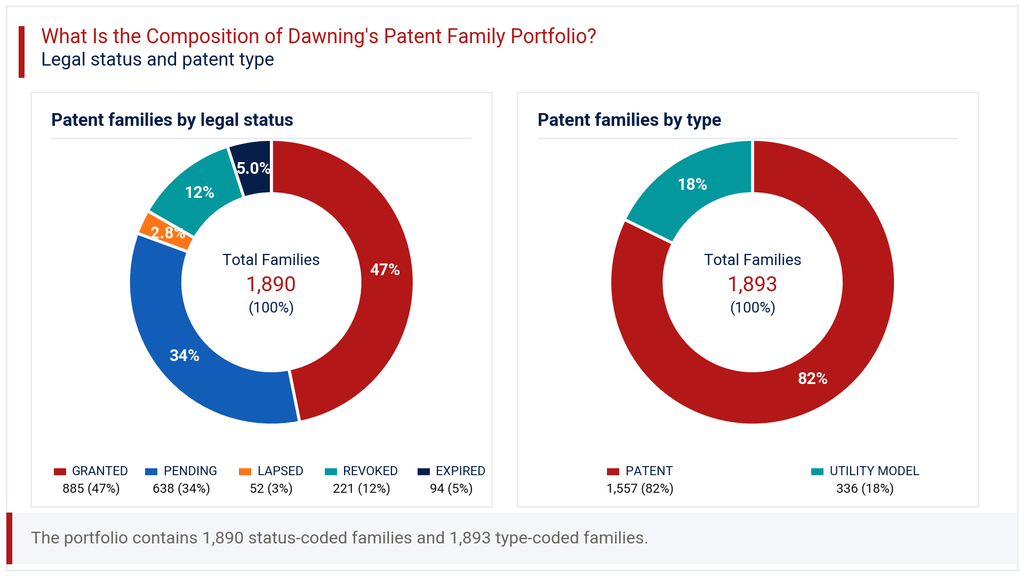
The remaining share tells a different story. Revoked families make up 11.7% of the portfolio, a notable chunk that merits attention from a legal status standpoint. Expired filings account for 5.0%, and lapsed ones a smaller 2.8%. On patent type, the composition chart shows 82.3% of families classified as standard patents versus 17.7% as utility models, a split typical of Chinese filers who use utility models for faster, lower-cost protection. This mix suggests Dawning pursues both rigorous invention patents and quicker utility filings, balancing depth of protection against speed to registration across its technology areas.
How Has the Dawning Patent Portfolio Evolved Over Time?
Patent filing trends within this portfolio show a clearly uneven path rather than steady, linear growth. Filings stayed modest through the mid-2000s, then jumped sharply to 267 families in 2011, the single highest year recorded. Activity cooled considerably afterward, settling into a range between 28 and 113 annual filings for most of the 2010s. The filing-trend chart in this section makes this rise-and-plateau pattern easy to spot at a glance.
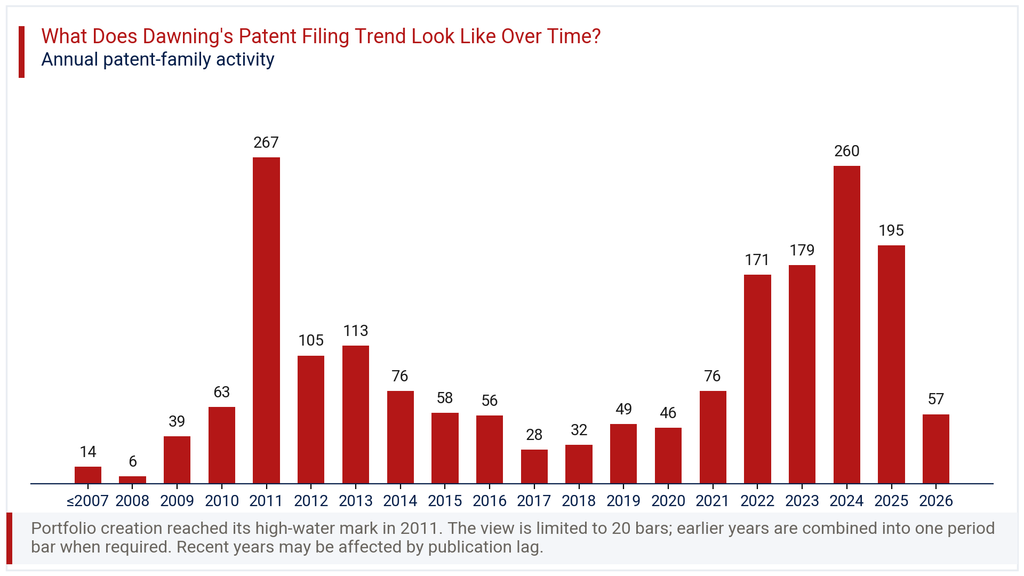
A second surge emerges from 2022 onward, with 171, 179, and 260 families filed in successive years through 2024. This recent run suggests renewed investment in IP protection, possibly tied to expanded product lines or research output. The year 2025 recorded 195 families, still a strong figure relative to most of the portfolio’s history. The apparent drop to 57 in 2026 reflects publication lag rather than an actual pullback in filing activity. Patent applications typically take twelve to eighteen months to appear in public records, so the most recent one to two years will always understate true filing volume until records catch up.
Where Does the Dawning Patent Portfolio Prioritize Patent Protection?
Patent geography within the Dawning Patent Portfolio is heavily concentrated in a single market. China accounts for 98.8% of all filings, equivalent to 1,868 families out of the portfolio’s total. This level of concentration confirms Dawning’s primary focus on securing domestic protection, consistent with its role serving mainly Chinese customers in high-performance computing.
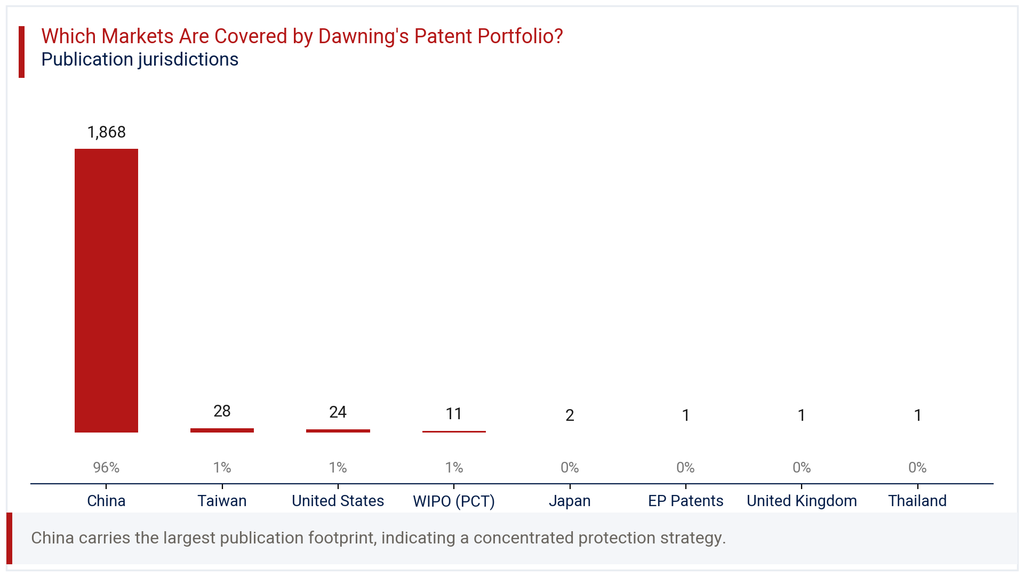
International filings remain thin by comparison. Taiwan holds 28 families, the largest filing destination outside mainland China, followed by the United States with 24. WIPO (PCT) applications, which can later extend into multiple national phases, total just 11 families. Japan, the European Patent Office, the United Kingdom, and Thailand each show only one or two filings. The geographic chart in this section visualizes just how lopsided this distribution is. For a company facing scrutiny in Western markets, including its listing on a U.S. defense-related watchlist, this limited international filing footprint is worth watching as a signal of where future legal and commercial exposure may or may not materialize.
Where is the Dawning Patent Portfolio Building Protection Across Key Technologies?
IPC analysis of the Dawning Patent Portfolio points to a strong concentration around computing infrastructure. The leading classification, G06F (Digital Data Processing), covers 1,167 families and represents 67.1% of the entire portfolio. This single category confirms that core computing architecture, likely tied to server and supercomputer design, is where Dawning places most of its protective effort.
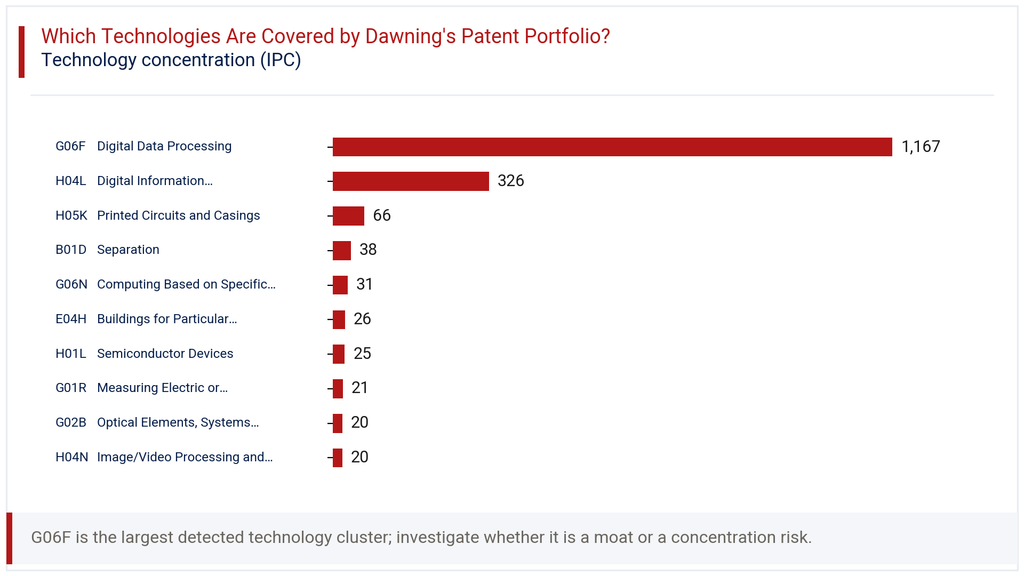
The second largest cluster, H04L (Digital Information Transmission), accounts for 326 families, or 18.7% of filings. Together, these two categories cover roughly 85% of the portfolio, leaving every other technology area as a minor share. H05K (Printed Circuits and Casings) follows with 66 families, relevant to physical hardware construction. Smaller clusters include B01D (Separation) with 38 families and G06N (Computing Based on Specific Models), an AI-adjacent category, with 31 families. The technology chart in this section shows this steep drop-off clearly. The narrow spread suggests Dawning’s research and development efforts remain tightly focused on computing and data transmission rather than diversified across unrelated fields.
How Has the Dawning Patent Portfolio Evolved Across Filing Geographies?
Viewing filings by year and jurisdiction together reveals that China has driven nearly every wave of patent activity. In 2011, China alone contributed 267 families, matching the portfolio’s overall peak that year. Taiwan and the United States saw small, short-lived upticks in the same period, with 5 and 4 families respectively, but neither sustained beyond the mid-2010s.
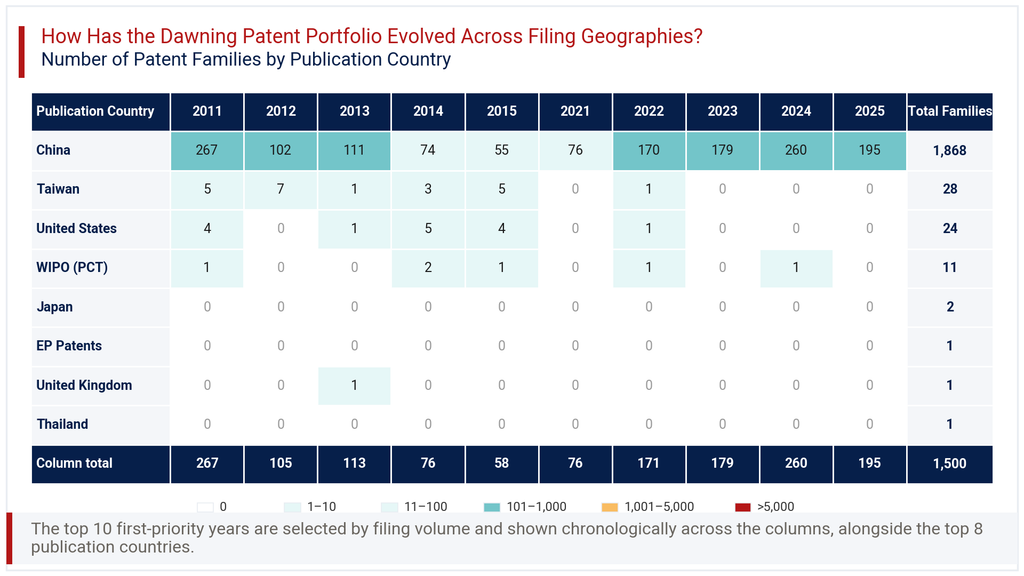
By 2021 onward, international filings outside China had all but disappeared from the yearly record. China recorded 76 families in 2021, climbing to 170 in 2022, 179 in 2023, and 260 in 2024, while other jurisdictions contributed close to nothing in those same years. The heatmap accompanying this section makes this narrowing trend visually obvious. What began as a modest, slightly more international filing pattern in the early 2010s has consolidated almost entirely into a domestic Chinese strategy, reinforcing the jurisdictional concentration discussed earlier in this report.
Consultant’s Perspective on Dawning Patent Portfolio
The Dawning Patent Portfolio reflects a filer deeply embedded in China’s domestic computing sector, with limited appetite for international protection. A grant rate of 46.8% and active rate of 80.6% indicate a functioning, reasonably well-managed filing program, even if the 11.7% revocation share warrants closer legal review. The technology concentration in G06F and H04L categories aligns tightly with the company’s stated business in supercomputers and servers.
What stands out most is the near-total absence of filing activity outside China after 2015. For a company named in U.S. defense-related lists and now navigating a terminated restructuring with Haiguang Information, this narrow geographic footprint could constrain its options in cross-border commercial or licensing discussions. The recent filing resurgence from 2022 to 2025 suggests continued domestic investment, but without a parallel push into other jurisdictions, international enforceability remains limited.
Organizations assessing competitive exposure to Dawning should treat its IP position as primarily a China-market consideration rather than a global one. Monitoring post-restructuring developments and any shift toward PCT filings would be a sensible next step for tracking strategic direction.
Explore Deeper Insights with Expertlancing Research
This overview only scratches the surface of what the Dawning Patent Portfolio reveals about competitive positioning in high-performance computing. Expertlancing Research helps organizations go further, with detailed family-level analysis, white space mapping, and competitor benchmarking tailored to specific business questions. Whether you are assessing licensing opportunities, tracking a competitor, or scoping a market entry decision, our analysts can build the evidence base you need. Reach out to Expertlancing Research to commission a custom patent intelligence study suited to your objectives.