


The Digital China Patent Portfolio offers a useful window into how one of China’s leading integrated IT service providers approaches invention protection. Across 7,353 total patent families, 73.0% remain active, a figure that covers both granted and pending filings. Of these, 2,040 patents have been granted while 3,327 are still pending examination, producing a grant rate of 27.7%. The remaining 1,986 families fall into lapsed, revoked, or expired status combined. These figures describe prosecution and maintenance outcomes only, not a verdict on patent quality or enforceability.
Filing activity peaked sharply in 2023, when the company filed 1,509 patent families, the highest count in its recorded history. China dominates the jurisdictional footprint, accounting for 99.9% of all filings across 10 jurisdictions tracked. On the technology side, G06F (Digital Data Processing) leads by a wide margin, with 3,515 families, making it the single largest cluster in the portfolio.
This report draws on structured patent filing data to map Digital China’s protection strategy across time, geography, and technology. Filing volume alone does not confirm market success, product adoption, or competitive edge over rivals. Readers evaluating specific families for licensing, litigation, or diligence purposes should verify details independently before relying on them externally.
About Digital China
Company Profile: Digital China is a Hong Kong listed company trading on the main board of the Stock Exchange of Hong Kong. Digital China was created from Legend Holdings, which became Lenovo in 2001. In 2001, it separated from the Legend Group.
The company focuses on providing e-business platforms, solutions and services, with integrated IT services spanning banking, telecommunications, government and public sectors. Partnering with over 100 major IT service providers worldwide, Digital China is one of the leading integrated IT service providers in China. For 2023, the company’s operating income was 55.601 billion yuan, with net profit of 433 million yuan, up 11.19% over 2022.
In 2024, Digital China Group signed an agreement with Thailand’s Ministry of Digital Economy and Society, through the Digital Economy Promotion Agency, to cooperate on digital economy development, cloud computing and big data infrastructure. This marks an expansion of its international partnerships beyond China.
How Healthy is Digital China Patent Portfolio?
Patent portfolio health depends on how filings move through the legal status lifecycle. Digital China shows 27.7% of families granted and 45.2% pending, together producing the 73.0% active rate cited earlier. The composition chart in this section shows a portfolio weighted toward pending examination rather than finalized grants, which is typical for a company still filing heavily in recent years.
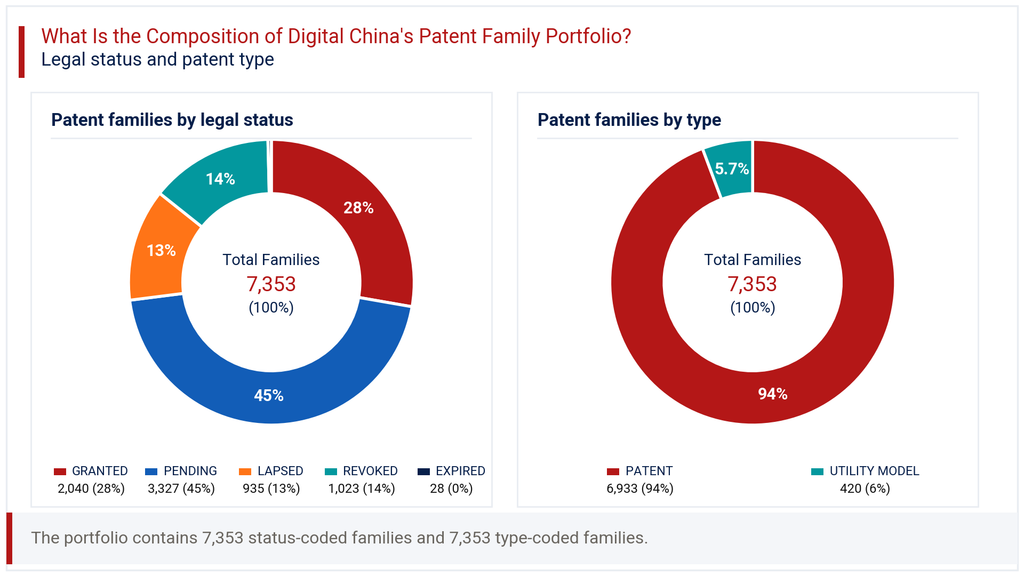
On the downside, 12.7% of families have lapsed and 13.9% were revoked, with a small 0.4% expired share. A revoked rate above 13% deserves attention, since it may reflect examination challenges or deliberate pruning of weaker filings. Patent type data shows 94.3% standard patents against 5.7% utility models, indicating the company favors full patent protection over the lighter utility model route common in China. This mix suggests a portfolio built for durability rather than speed, though the large pending pool means its final shape will only become clear over the next few years as applications are examined.
How Has the Digital China Patent Portfolio Evolved Over Time?
Patent filing trends at Digital China show long dormant stretches followed by sudden surges. Filings stayed modest through the 2013 to 2020 window, often below 120 families a year, before jumping to 410 in 2021. The filing-trend chart in this section captures a dramatic acceleration from there: 1,012 families in 2022, then a peak of 1,509 in 2023.
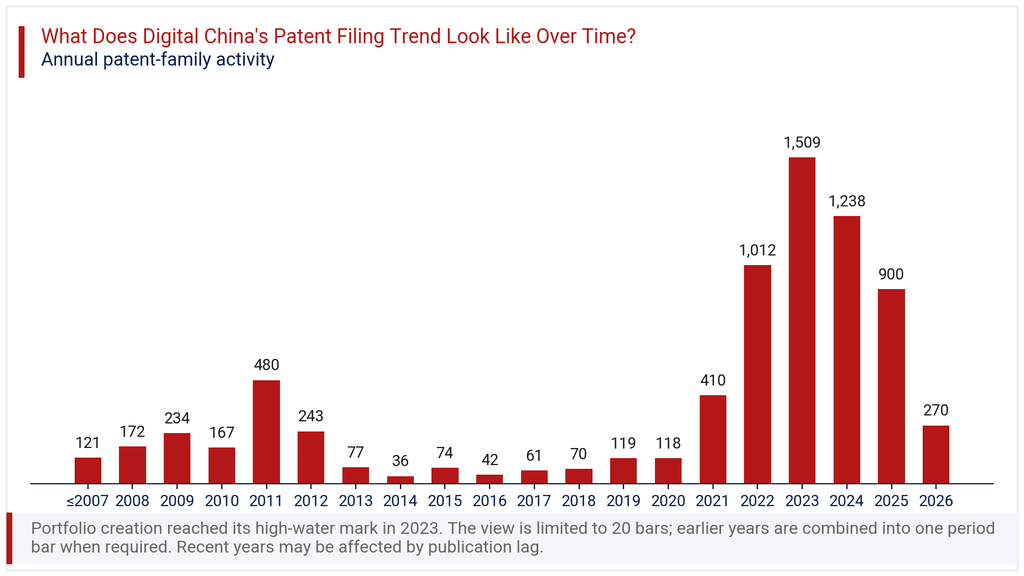
2024 held strong at 1,238, before 2025 recorded 900 and 2026 shows just 270. This tail reflects a -70.0% change in the latest year on record, a number that mostly signals publication lag rather than a genuine pullback. Patent applications typically take 18 months or longer to appear in public databases, so recent years are structurally undercounted. The real story here is the 2021 to 2024 surge, a four year stretch that reshaped the portfolio’s scale and suggests a deliberate push into intensive filing during that period.
Where Does the Digital China Patent Portfolio Prioritize Patent Protection?
Patent geography at Digital China is overwhelmingly domestic. China accounts for 99.9% of all filings, with the remaining activity spread thinly across 10 jurisdictions. The geographic chart in this section shows WIPO (PCT) filings at 1.3%, the largest non-China share, followed by Taiwan at 0.8% and the United States at 0.6%.
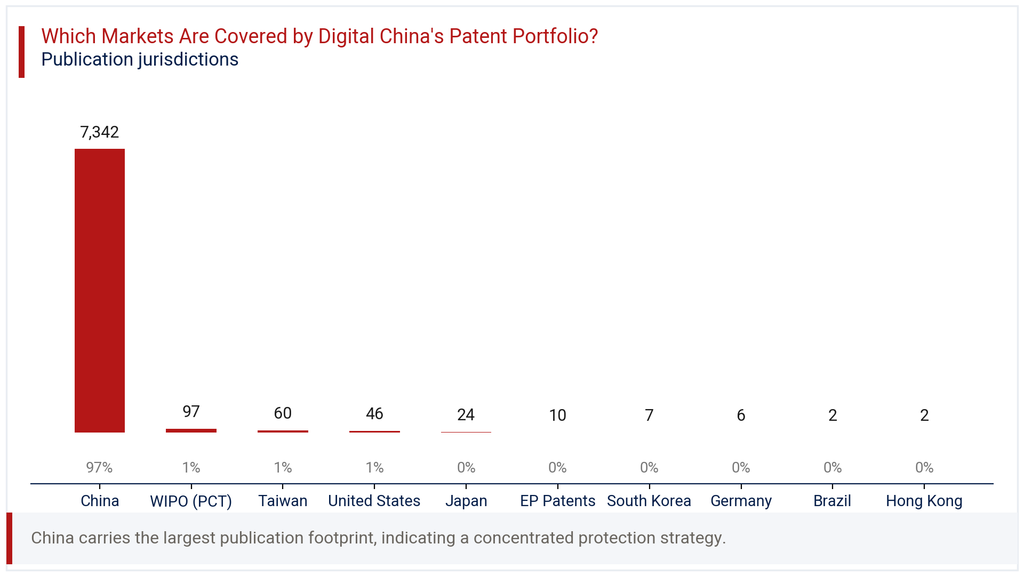
Smaller footprints appear in Japan, EP Patents, South Korea, and Germany, each under 0.3%, with Brazil and Hong Kong barely registering. This pattern points to a portfolio built primarily to protect domestic market position rather than to contest ground internationally. The modest PCT presence does signal some intent to preserve international filing options, but actual grants outside China remain rare. For a company with global partnership ambitions, including recent cooperation with Thailand’s digital economy agency, this gap between domestic filing density and international patent coverage is worth watching closely.
Where is the Digital China Patent Portfolio Building Protection Across Key Technologies?
IPC analysis of the portfolio reveals a clear concentration in core computing technologies. G06F, covering digital data processing, leads with 3,515 families, representing 36.9% of the entire portfolio. H04L, digital information transmission, follows at 1,640 families or 17.2%. The technology chart in this section shows these two classes alone accounting for over half of all filings.
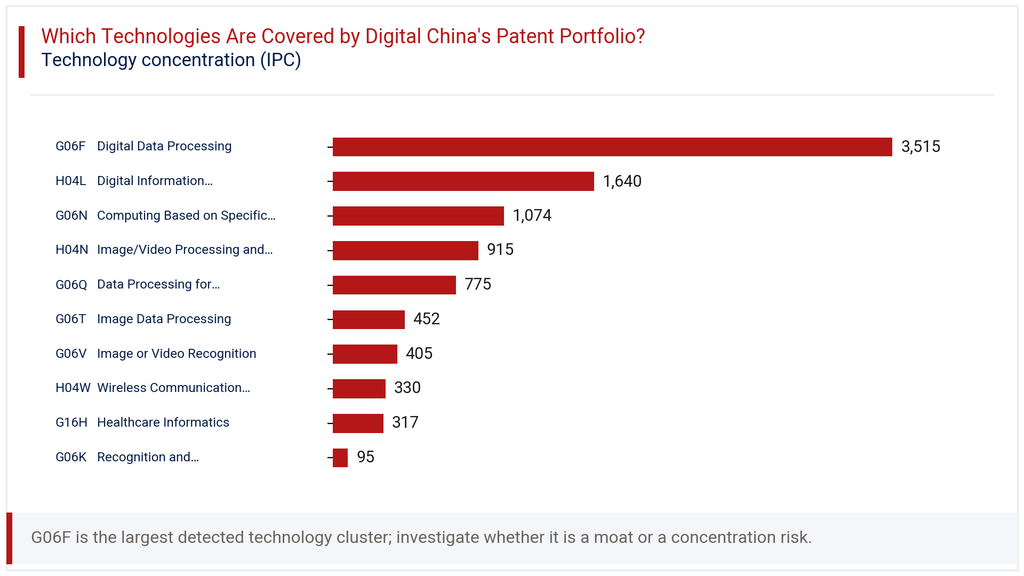
G06N, covering computing based on specific models, a category closely associated with artificial intelligence methods, holds 1,074 families at 11.3%. H04N (image and video processing) and G06Q (administrative and commercial data processing) contribute 9.6% and 8.1% respectively. Smaller but notable clusters include G06T image data processing, G06V image recognition, and G16H healthcare informatics at 3.3%. Together, this spread suggests Digital China is building depth in foundational computing and communications technology, while also placing smaller, deliberate bets on AI, image recognition, and healthcare informatics as adjacent growth areas.
How Has the Digital China Patent Portfolio Evolved Across Filing Geographies?
Viewing filing activity by year and jurisdiction together sharpens the domestic concentration story. The heatmap in this section shows China driving every major volume spike, including the 1,503 families filed there in 2023 alone. Non-China jurisdictions only begin appearing meaningfully from 2021 onward, with WIPO (PCT) reaching 27 families in 2022 and Taiwan reaching 32 in 2023.
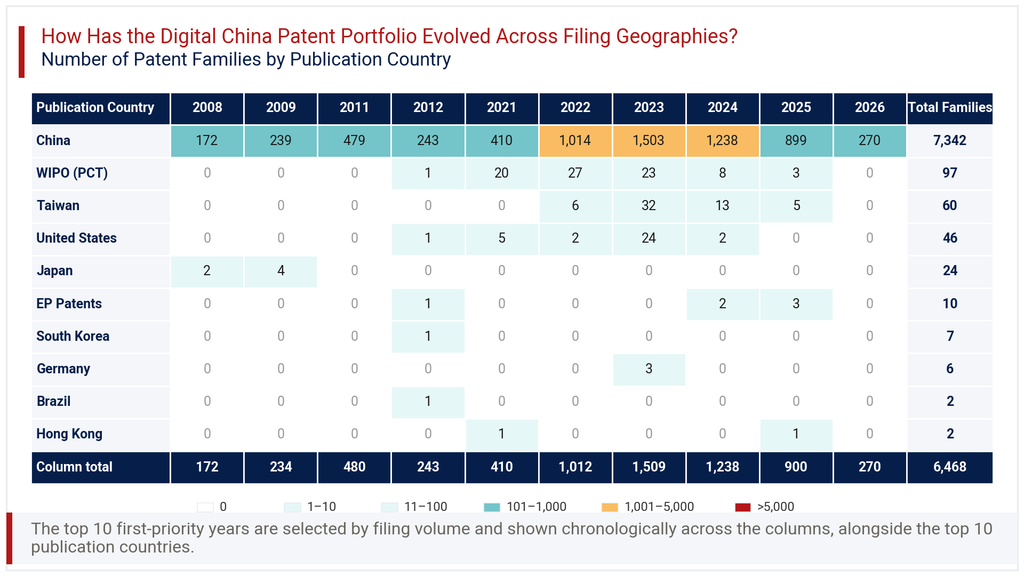
The United States recorded 24 families in 2023, its highest year, but volumes elsewhere stay in single digits throughout. This timing matters: international filing only began scaling once the broader domestic surge was already underway from 2021. It suggests international protection was treated as a secondary consideration, added once the core China-based portfolio had reached sufficient scale. Whether this international activity continues to grow or stays marginal will be a key indicator of Digital China’s ambitions beyond its home market.
Consultant’s Perspective on Digital China Patent Portfolio
The Digital China Patent Portfolio tells a story of concentrated, recent, and domestically anchored investment. A 27.7% grant rate combined with a 45.2% pending share suggests a company still in the middle of proving out a large wave of 2021 to 2024 filings. The outcome of that pending pool, whether it converts to grants or attrition, will meaningfully shift the portfolio’s long-term shape.
The technology concentration in G06F and H04L, backed by meaningful positions in G06N and G06Q, points to a company building protection around core digital infrastructure and emerging AI-adjacent capabilities. That is a sensible posture for an integrated IT services provider competing across banking, telecom, and government sectors. The weak spot is geography. With 99.9% of filings in China, the portfolio offers limited legal protection in markets like the US, Europe, or Southeast Asia, even as the company pursues partnerships such as its 2024 agreement with Thailand.
Companies evaluating Digital China as a partner, licensor, or competitor should treat the China concentration as a real constraint, not a formality. Monitoring whether international filings rise over the next two to three years will be the clearest signal of whether global ambitions are backed by legal substance.
Explore Deeper Insights with Expertlancing Research
Patent filing patterns rarely tell the full story on their own. Expertlancing Research helps technology buyers, investors, and competitive intelligence teams go beyond headline counts into family-level validation, claim analysis, and competitor benchmarking. If this overview of Digital China’s portfolio raised questions worth answering in more depth, our analysts can help. Reach out to Expertlancing Research to commission a tailored patent intelligence study built around your specific business decision, whether that involves licensing, diligence, or market entry planning.