
Honor’s patent filing record offers a useful window into how the company builds and defends its technology position. This review of the Honor Patent Portfolio draws on 19,384 total patent families, giving a sense of scale before any deeper reading begins. Of these, 92.9% remain active, a figure that covers both granted and pending cases together. Within that base, 11,889 families have been granted and 6,112 are still pending examination. The grant rate across the portfolio stands at 61.3%, while 1,383 families fall into lapsed, revoked or expired status combined. These are prosecution and maintenance figures only, not an assessment of patent quality or enforceability.
Filing activity peaked in 2024, when Honor filed 5,167 patent families, marking the busiest year in the company’s record. China dominates as the top jurisdiction, accounting for 95.7% of filings, and the portfolio spans 10 jurisdictions in total. On the technology side, G06F (Digital Data Processing) leads as the top cluster, with 5,774 families, well ahead of every other classification. These three data points together sketch a portfolio that is large, young and heavily China-centric.
This article is meant to help readers interpret what these filing patterns suggest about Honor’s technology priorities and global posture. Filing volume alone does not confirm commercial success, product differentiation or competitive strength in any market. Readers considering business or investment decisions should verify specific patent families independently before relying on them externally.
About Honor
Company Profile: Honor Device Co., Ltd., commonly known as Honor, is a Chinese consumer electronics company. It is majority-owned by Shenzhen Zhixin New Information Technology Co. Ltd. It was formerly a subsidiary of Huawei, which sold the brand in November 2020. Honor develops smartphones, tablet computers, wearable devices and mobile device software, and was founded in 2013 as a Huawei sub-brand.
Honor’s line of smartphones allowed Huawei to compete with mid-range online smartphone brands in China and globally, primarily selling products online, with some available in stores in selected markets. The company describes itself, per its official website, as a global leading AI device ecosystem company, committed to revolutionizing human-to-device interactions to bridge the AI ecosystem with all consumers in the agentic AI era and beyond. Its product portfolio spans AI phones, PCs, tablets, wearables and more. The company reports over 14,000 employees and over 61,800 retail stores globally.
How Healthy is Honor Patent Portfolio?
Patent portfolio health depends heavily on legal status mix, and Honor’s numbers tell a fairly reassuring story. Granted patents make up 61.3% of the total, while pending applications represent 31.5%. Together these account for the 92.9% active rate noted earlier. Lapsed families total 3.9%, revoked cases sit at 2.0%, and expired families account for just 1.3%. The composition chart in this section shows how small the non-active categories are relative to the granted and pending blocks.
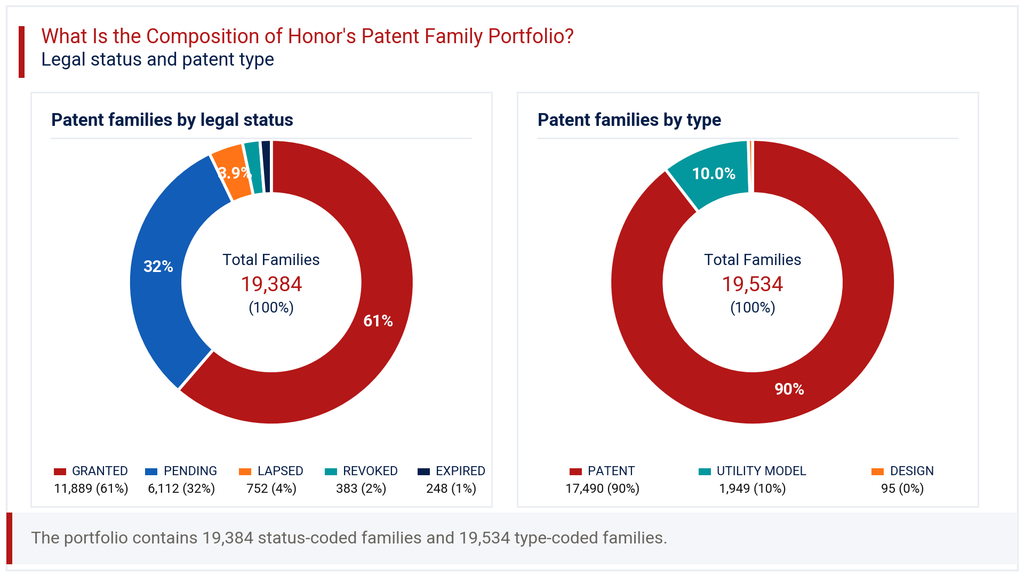
Looking at patent type, standard patents dominate at 89.5% of the portfolio, with utility models contributing 10.0% and design filings a minor 0.5%. This mix suggests Honor leans toward full invention patents rather than the shorter-protection utility model route common among Chinese electronics firms. A grant rate of 61.3% indicates a reasonably functional prosecution pipeline, neither unusually weak nor exceptionally strong. The low combined share of lapsed, revoked and expired cases, under 8% altogether, points to disciplined portfolio maintenance rather than neglect. For a company filing at this scale, this balance reflects a portfolio under active management rather than one accumulating dead weight.
How Has the Honor Patent Portfolio Evolved Over Time?
Patent filing trends at Honor show a long quiet period followed by sharp acceleration. Annual filings stayed below 500 every year from 2008 through 2020, with modest fluctuation around the 200 to 350 range. The shift began in 2021, when filings jumped to 1,947, nearly four times the prior year’s count. Growth continued through 2022 (3,670), 2023 (4,192) and peaked in 2024 at 5,167. The filing-trend chart in this section makes this inflection point clearly visible against the flatter years before it.
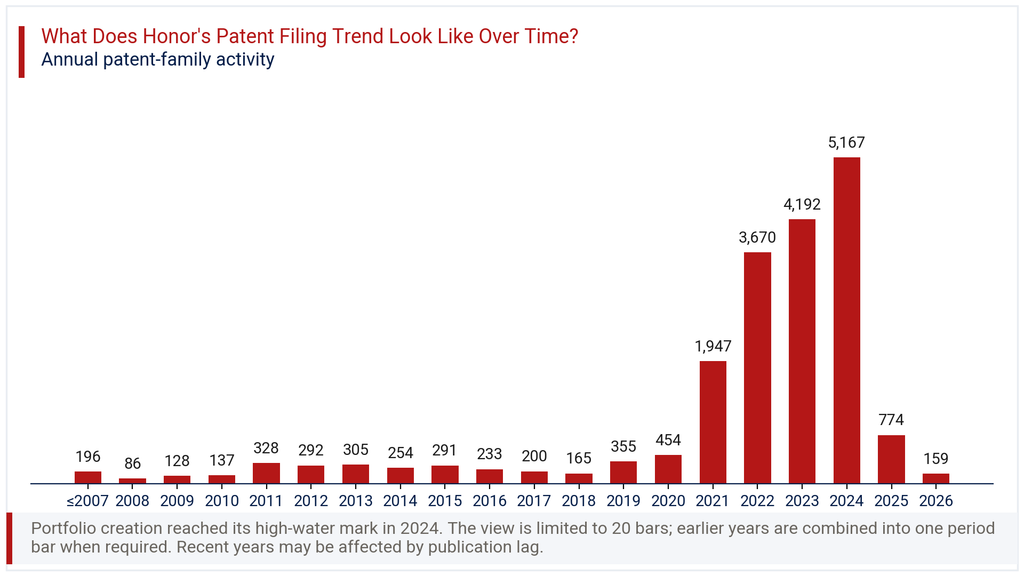
Filings for 2025 show just 774 families, and 2026 records only 159, representing a -79.5% change versus the prior year. This drop should not be read as a genuine pullback in Honor’s filing activity. Patent applications typically take 12 to 18 months to appear in public databases after filing, so the most recent one to two years are almost always undercounted. The true 2025 and 2026 figures will likely rise as records catch up. The multi-year pattern through 2024 is the more reliable signal of Honor’s filing trajectory, and it points toward sustained, heavy investment in securing patent rights.
Where Does the Honor Patent Portfolio Prioritize Patent Protection?
Patent geography within the Honor Patent Portfolio is heavily concentrated at home. China accounts for 95.7% of all filings, equivalent to 18,541 families, by far the dominant jurisdiction. WIPO’s PCT route follows at 25.2% (4,886 families), reflecting Honor’s use of international applications to preserve options across multiple markets later. The United States holds 12.4% share with 2,396 families, and European filings via the EP route stand at 11.5% (2,224 families). The geographic chart in this section shows just how steep the drop is after China.
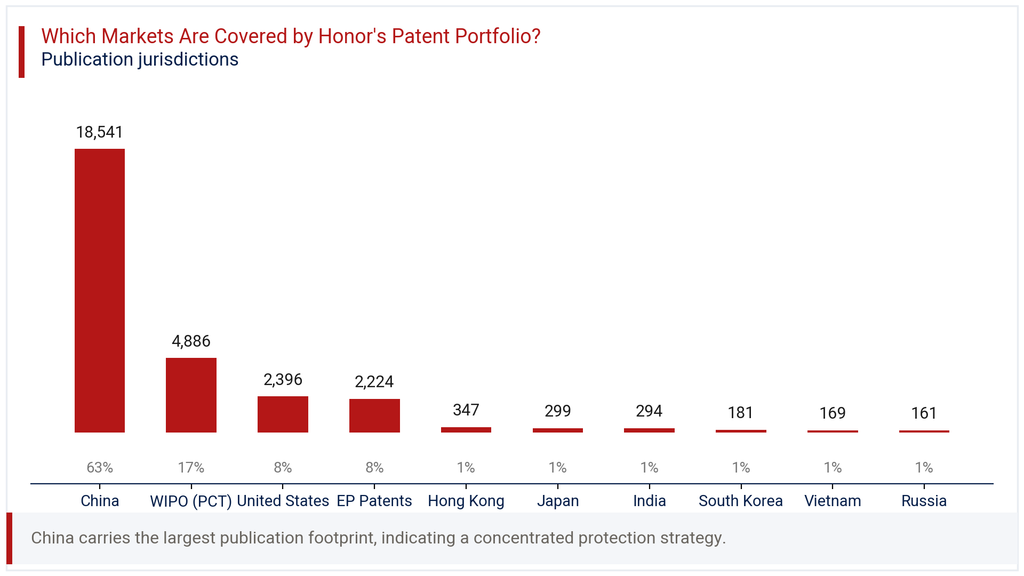
Smaller jurisdictions round out the picture: Hong Kong at 1.8%, Japan and India each near 1.5%, and South Korea, Vietnam and Russia each under 1%. In total, the portfolio spans 10 distinct jurisdictions. This pattern is typical of a Chinese electronics manufacturer whose primary market and R&D base remain domestic, while international filings serve defensive or market-entry purposes. The relatively modest U.S. and European shares, compared to China, suggest Honor’s overseas patent strategy is still maturing rather than matching its scale at home.
Where is the Honor Patent Portfolio Building Protection Across Key Technologies?
IPC analysis of the Honor Patent Portfolio points to a clear software and connectivity focus. G06F, covering digital data processing, leads with 5,774 families and 27.4% share, the single largest technology cluster by a wide margin. H04W, wireless communication networks, follows at 18.4% (3,884 families), and H04M, telephonic communication, holds 13.5% (2,849 families). The technology chart in this section shows these three clusters together forming more than half the portfolio.
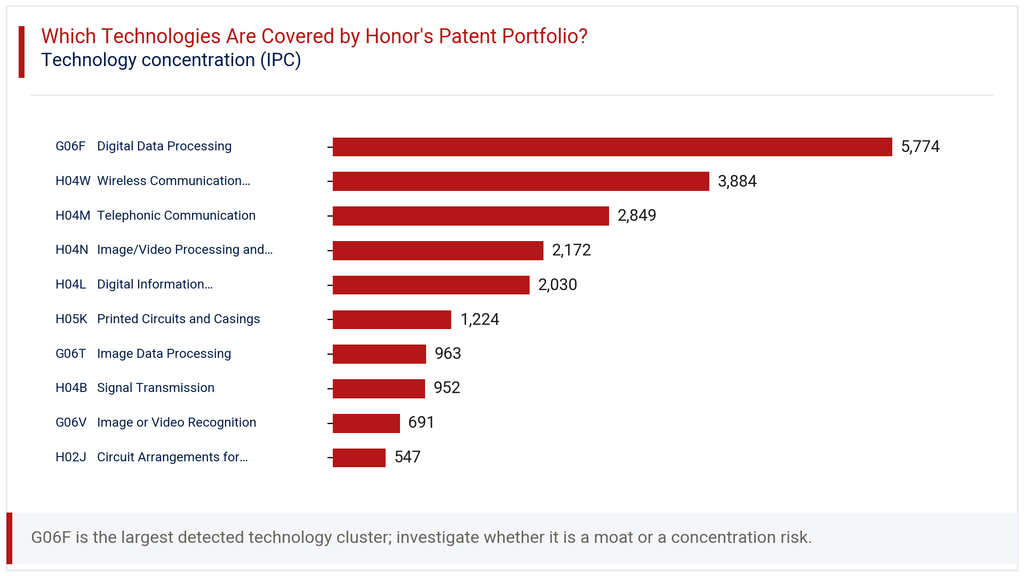
Further down the list, H04N (image and video processing) accounts for 10.3%, H04L (digital information transmission) for 9.6%, and H05K (printed circuits and casings) for 5.8%. Image-related classifications G06T and G06V add 4.6% and 3.3% respectively, while H04B and H02J close the top ten at 4.5% and 2.6%. This spread confirms Honor’s R&D priorities sit squarely in smartphone-adjacent domains: processing, connectivity, telephony and imaging. The strong presence of G06V, image and video recognition, hints at growing investment in AI-driven camera and device-interaction features, consistent with the company’s stated direction toward AI-enabled devices.
How Has the Honor Patent Portfolio Evolved Across Filing Geographies?
Viewing filing data by year and jurisdiction together reveals how Honor’s global footprint shifted during its growth phase. China scaled from 305 filings in 2011 to 5,063 in 2024, tracking the broader surge described earlier. The United States and EP Patents followed a similar uptick, peaking in 2021 and 2022 with 552 and 535 filings respectively, before falling sharply by 2023 and dropping close to zero in 2024. The heatmap in this section highlights this divergence between China’s steady climb and other jurisdictions’ sharper swings.
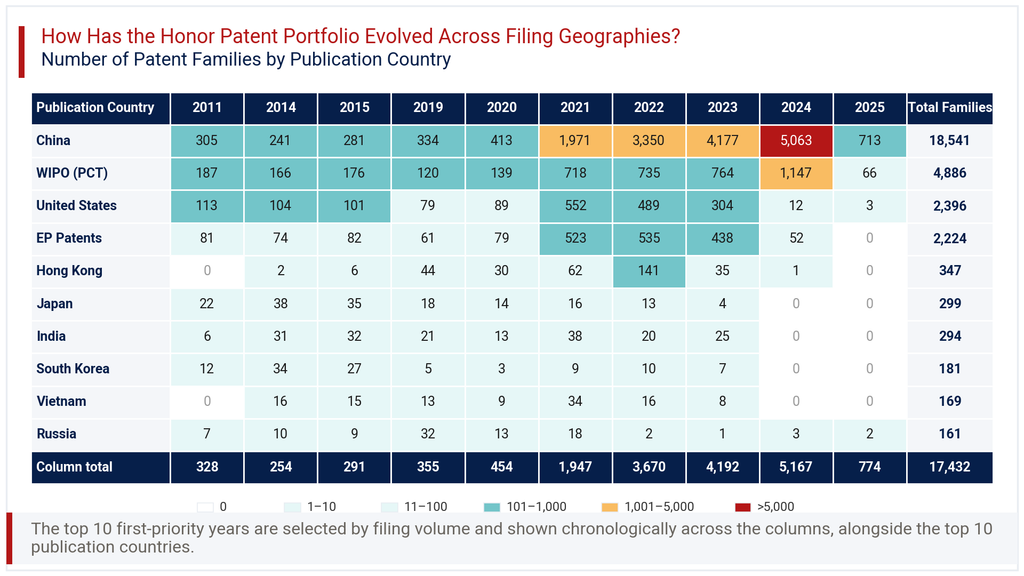
WIPO (PCT) filings moved in the opposite direction to the U.S. and EP trend, rising to 1,147 in 2024 even as direct U.S. and EP filings declined. This suggests Honor increasingly routes international protection through PCT applications rather than filing directly in each country. Smaller jurisdictions like Japan, South Korea and Vietnam show declining activity in recent years, with several reporting zero filings by 2024. The pattern indicates a narrowing of direct-filing geography even as overall volume through China and PCT channels keeps climbing.
Consultant’s Perspective on Honor Patent Portfolio
From an advisory standpoint, the Honor Patent Portfolio reflects a company scaling its IP activity in step with product ambitions. The jump from a few hundred annual filings to over 5,000 by 2024 signals a deliberate shift toward treating patents as a core business asset, not an afterthought. The heavy China concentration at 95.7% makes sense given Honor’s manufacturing and primary market base, but it also leaves the company more exposed outside its home jurisdiction compared to peers with broader international filing habits.
The technology concentration in digital data processing and wireless communication aligns well with Honor’s stated AI device direction. Investment in image recognition classifications further supports this reading. What deserves monitoring is the apparent pullback in direct U.S. and EP filings after 2022, alongside rising PCT usage. This could reflect a genuine strategy shift toward deferred market selection, or it could reflect filing data still settling due to publication lag. Either way, Honor’s reliance on PCT as a bridge to future national filings will be worth tracking over the next two to three years. Companies assessing Honor as a competitor, licensor or acquisition target should pay close attention to how this pending PCT volume converts into granted rights in key markets like the U.S., Europe and India.
Explore Deeper Insights with Expertlancing Research
This review only scratches the surface of what Honor’s patent activity reveals about its technology direction and competitive posture. Expertlancing Research helps clients go further, with family-level validation, competitor benchmarking and technology-specific deep dives tailored to business needs. Whether the goal is licensing due diligence, M&A screening or R&D positioning, our analysts can build on this foundation with precision. Reach out to Expertlancing Research to commission a custom patent intelligence study on Honor or any competitor in this space.