


The Huaqin Patent Portfolio spans 3,756 patent families, offering a window into how this Shanghai-based ODM protects its engineering output. Of this total, 54.8% remains active, combining both granted and pending matters that still carry legal weight. The portfolio includes 1,512 granted patents alongside 548 pending applications, producing a grant rate of 40.3%. A further 1,696 families sit in lapsed, revoked, or expired status, having fallen out of active protection. These figures describe prosecution and maintenance outcomes only, not a verdict on patent quality or enforceability.
Filing activity peaked in 2010, when Huaqin recorded 387 new families in a single year. China dominates the jurisdictional mix, accounting for 99.0% of all filings, with the portfolio spread across 10 jurisdictions in total. On the technology side, telephonic communication under H04M leads the pack with 729 families, making it the single largest cluster in the entire body of work. Together, these patterns point to a filing strategy built around home-market depth rather than broad international spread.
This article draws on IPC classifications, jurisdiction filings, and legal status records to assess portfolio health, not product-level performance. Filing counts alone cannot confirm commercial success, market dominance, or the strength of any individual claim. Readers evaluating specific families for licensing, litigation, or investment decisions should conduct independent due diligence. The analysis that follows is meant to orient business and IP teams, not replace legal verification of individual patents.
About Huaqin
Company Profile: Huaqin Technology, founded in 2005, is headquartered in Shanghai, China. The company is a globally leading, technology-driven smart product platform that provides end-to-end solutions across the entire value chain to its customers. With over 20 years of expertise, Huaqin has supported product development through the mobile communication, internet, cloud computing and AI eras. Every year, hundreds of millions of intelligent products including smartphones, tablets, laptops, wearables, AIoT products, IDC products, and automotive electronics are delivered worldwide in over 100 countries.
Its global layout includes R&D centers in Shanghai, Dongguan, Nanchang and Xi’an, domestic manufacturing in Nanchang and Dongguan, and overseas manufacturing bases in Vietnam, Mexico and India. Huaqin operates as an ODM, combining efficient operation, R&D, advanced manufacturing and precision mechanical components, supported by digital and automated transformation. The company is listed on both Shanghai and Hong Kong stock exchanges.
How Healthy is Huaqin Patent Portfolio?
Patent portfolio health depends on how many assets remain legally active versus how many have lapsed. Huaqin’s legal status breakdown shows 40.3% granted, 14.6% pending, 21.1% lapsed, 15.2% revoked, and 8.8% expired. The combined active rate of 54.8% suggests a little more than half the portfolio still offers enforceable or pending protection. The remaining share, spread across lapsed, revoked, and expired categories, reflects a mix of deliberate abandonment and failed prosecution over nearly two decades of filing.
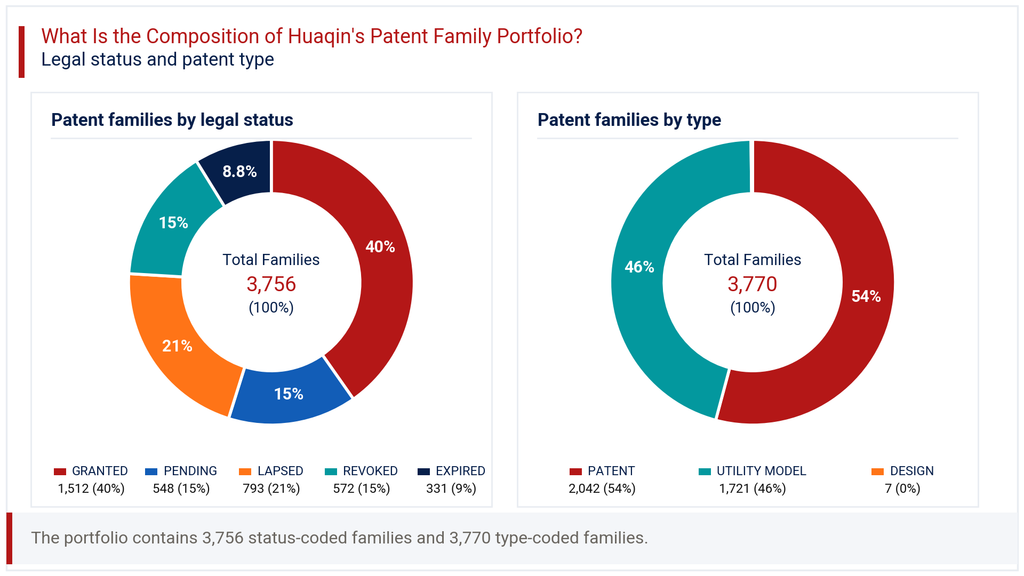
The composition chart in this section also breaks down patent types within the portfolio. Utility patents make up 54.2%, utility models account for 45.6%, and design filings are a marginal 0.2%. This split signals a practical, incremental approach to protection, typical of hardware-heavy ODM businesses. Utility models, common and faster to secure in China, support rapid iteration on mechanical and electronic components. The low revocation resistance implied by the 15.2% revoked share is worth watching, since it may point to challenges during examination or opposition. Taken together, the data shows a portfolio that is moderately healthy but carries meaningful legacy attrition.
How Has the Huaqin Patent Portfolio Evolved Over Time?
Huaqin’s patent filing trends show a volatile but generally upward trajectory since its early years. Filings surged to 387 in 2010, a standout year compared to the modest counts before it. Activity cooled through the early 2010s before rebuilding steadily from 2016 onward, reaching 319 in 2023 and 320 in 2025. The filing-trend chart in this section captures this long arc clearly, showing cycles of expansion tied likely to product cycles and R&D investment phases.
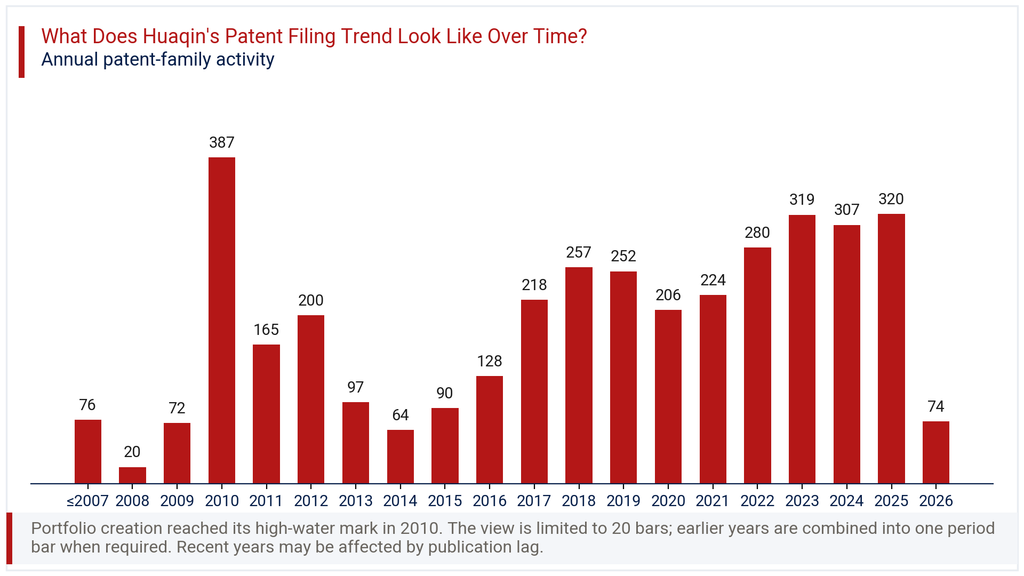
The apparent drop to 74 in 2026, a -76.9% change, should not be read as a real contraction. Patent publication typically lags actual filing by twelve to eighteen months, so recent years remain incomplete in any dataset. The more meaningful signal is the sustained filing volume between 2022 and 2025, consistently above 280 families annually. This suggests Huaqin has institutionalised patent filing as part of its product development cycle, rather than treating it as sporadic activity. The pattern aligns with a company scaling its device portfolio across smartphones, wearables, and AIoT categories.
Where Does the Huaqin Patent Portfolio Prioritize Patent Protection?
Patent geography data for Huaqin reveals an overwhelming concentration in its home market. China accounts for 99.0% of all filings, a figure that dwarfs every other jurisdiction combined. WIPO PCT filings follow at 1.4%, with the United States close behind at 1.3%. The geographic chart in this section shows how steeply filings drop beyond these top three, with Hong Kong, Germany, and other markets each holding shares below 0.3%.
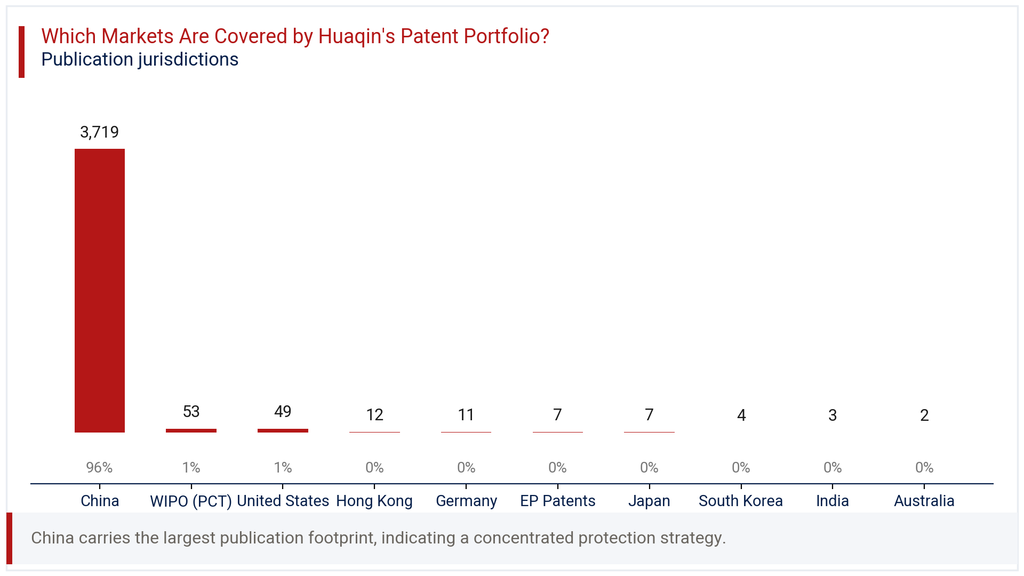
This pattern suggests Huaqin’s IP strategy centers on protecting manufacturing and design processes domestically, where its production base is strongest. The limited international filing, despite manufacturing operations in Vietnam, Mexico, and India, indicates that patent protection has not yet followed physical expansion into those markets. Countries like India and Australia each show only 0.1% share, with filings appearing sporadically rather than consistently. For a company delivering products to over 100 countries, this gap between commercial reach and international patent coverage is a notable structural feature worth tracking as the company’s overseas manufacturing matures.
Where is the Huaqin Patent Portfolio Building Protection Across Key Technologies?
IPC analysis of Huaqin’s filings points to telephonic communication as the dominant technology focus. H04M leads with 729 families, representing 33.2% of the entire portfolio tracked by IPC code. Digital data processing under G06F follows at 472 families, or 21.5%, reflecting software and computing investment alongside hardware. The technology chart in this section shows a steep drop after these two leaders, with printed circuits and casings under H05K at 8.2%.
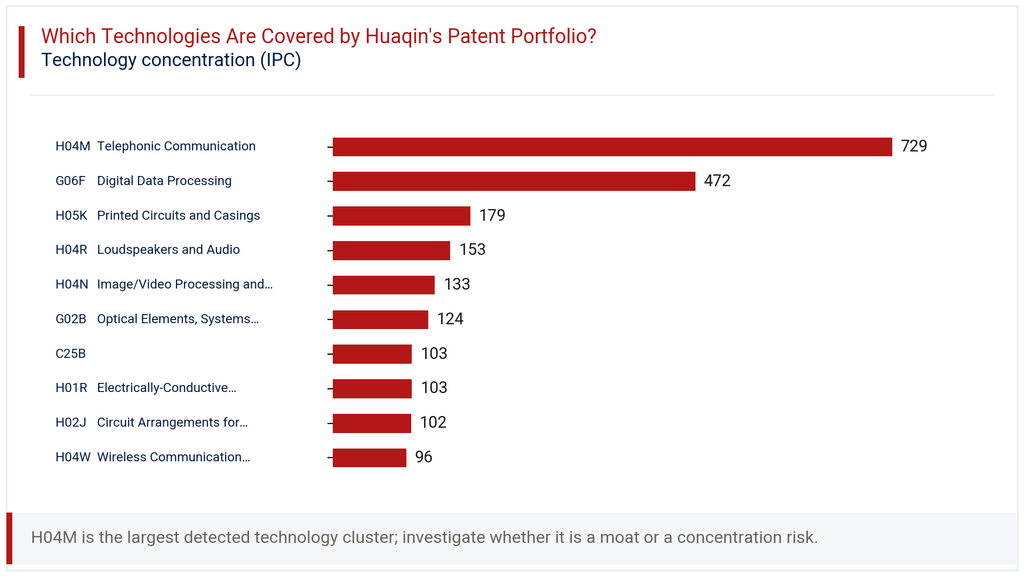
Audio technology under H04R holds 7.0% share, while image and video processing under H04N accounts for 6.1%. Optical elements under G02B and connector technology under H01R each sit near 4.7%, rounding out a portfolio clearly anchored in mobile device engineering. This distribution matches Huaqin’s core business as a smart device ODM, where communication hardware, processing capability, and physical assembly components all demand continuous protection. The relatively small presence of wireless network technology under H04W, at 4.4%, suggests this area may see growth as 5G and IoT connectivity become more central to Huaqin’s product lines.
How Has the Huaqin Patent Portfolio Evolved Across Filing Geographies?
Viewing filing activity by year and jurisdiction together reveals how concentrated Huaqin’s international effort really is. The heatmap in this section shows China holding steady triple-digit filings every year from 2017 through 2025, peaking at 387 back in 2010 alone. By contrast, the United States never exceeded 6 filings in any single year, recorded in 2021. WIPO PCT activity peaked modestly at 13 filings in 2017, then tapered sharply in subsequent years.
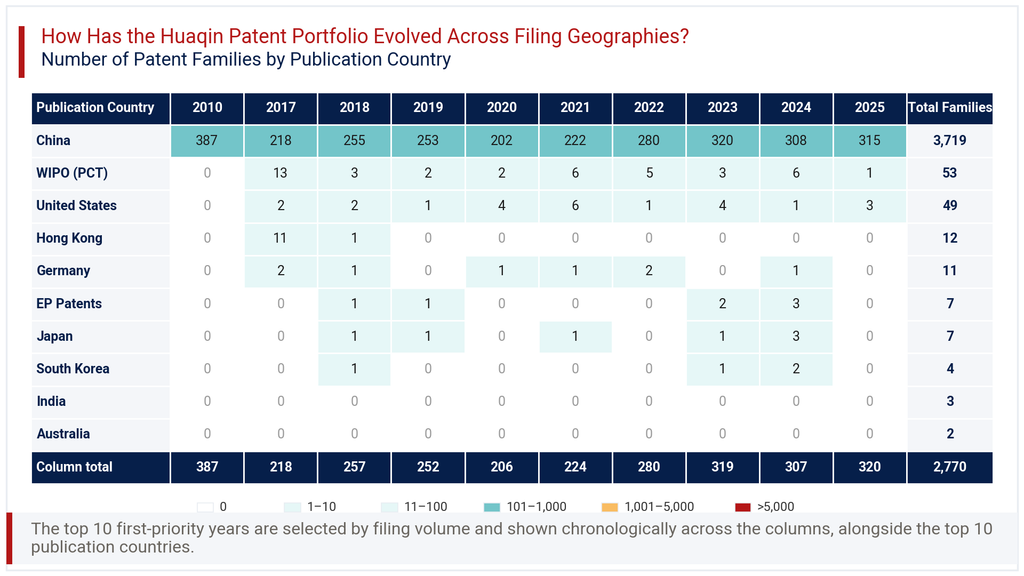
Markets like Japan, South Korea, and Germany show intermittent single-digit filings, appearing in some years and absent in others. Hong Kong filings stopped entirely after 2018, having only briefly appeared with 11 filings in 2017. India and Australia show no recorded filings across the matrix despite being part of Huaqin’s broader footprint. This year-by-year view confirms that international filing has been opportunistic rather than systematic, with no jurisdiction outside China showing a sustained, growing filing pattern over the period observed.
Consultant’s Perspective on Huaqin Patent Portfolio
The Huaqin Patent Portfolio reflects a company whose IP strategy mirrors its manufacturing identity, domestic, high-volume, and engineering-driven. With 3,756 families and an active rate of 54.8%, the portfolio is sizeable but not unusually concentrated in high-value granted assets. The 40.3% grant rate signals a reasonably standard prosecution outcome for a filer of this scale in China’s patent system.
The geographic skew toward China, at 99.0% of filings, stands out as the most consequential strategic gap. Given Huaqin’s manufacturing presence in Vietnam, Mexico, and India, the absence of meaningful patent coverage in those markets exposes the company to limited enforcement options abroad. As overseas production scales, competitors or local players could file around Huaqin’s innovations in those regions without resistance.
Technology concentration in telephonic communication and digital data processing, together exceeding half the portfolio by IPC share, confirms a tight focus on core smart device engineering. I would recommend Huaqin consider selective international filing in its manufacturing markets, particularly India and Vietnam, to align legal protection with physical operations. This would close the gap between global production footprint and global patent coverage, reducing freedom-to-operate risk over time.
Explore Deeper Insights with Expertlancing Research
Understanding a patent portfolio takes more than reading charts in isolation. Expertlancing Research helps technology companies, investors, and legal teams interpret filing patterns, benchmark competitors, and assess white space opportunities. If the Huaqin Patent Portfolio raises questions relevant to your business, licensing strategy, or competitive positioning, our analysts can provide tailored, deeper due diligence. Reach out to Expertlancing Research to commission a custom patent landscape study built around your specific decision-making needs.