


The Hytera Patent Portfolio spans 2,508 patent families, offering a useful lens into how this communications technology company builds and protects its inventions. Of these families, 67.0% remain active today, combining both granted and pending cases. The portfolio includes 1,419 granted patents and 261 pending applications awaiting examination. The grant rate stands at 56.6%, a figure that reflects prosecution outcomes over the years. Separately, 828 families fall into lapsed, revoked, or expired status, representing cases no longer in force. These figures describe prosecution and maintenance activity only, not a verdict on patent quality or enforceability.
Filing activity peaked in 2018, when Hytera filed 314 patent families, the highest single-year count in the portfolio. China dominates the filing geography, accounting for 83.2% of all families across a spread of 10 jurisdictions tracked in this analysis. The leading technology cluster is H04W (Wireless Communication Networks), covering 924 families, by far the largest concentration in the dataset. This combination of a dominant home jurisdiction and a wireless-focused technology base says a great deal about where Hytera channels its R&D investment and legal protection budget.
This report works from patent filing and legal status records to describe how the Hytera Patent Portfolio has formed and shifted over time. Filing volume alone does not confirm commercial success, product launch plans, or competitive superiority in any given market. Readers evaluating specific patent families for licensing, litigation, or investment due diligence should verify those records independently. The analysis that follows is meant to orient strategic thinking, not substitute for legal or technical verification of individual patents.
About Hytera
Company Profile: Hytera Communications Corporation Limited is a leading global provider of professional communications technologies and solutions. Founded in 1993, Hytera is a leading global provider of professional communications technologies and solutions, providing faster, safer, and more versatile connectivity for business and mission critical users. The company works across narrowband and broadband communication standards, including TETRA, DMR, PDT and LTE, serving Public Safety, Energy, Transportation, Utilities and Commercial sectors.
Hytera operates more than 100 offices worldwide, with over 40% of its workforce engaged in engineering and R&D, and maintains nine global innovation and development centres across China, Germany, UK, Spain and Canada. The company is headquartered in Shenzhen, Guangdong, and is publicly traded on the Shenzhen Stock Exchange. In 2012, Hytera acquired Germany’s Rohde & Schwarz Professional Mobile Radio GmbH , expanding its European manufacturing footprint. Its subsidiaries include Norsat and Sinclair Technologies in satellite and antenna communications.
How Healthy is Hytera Patent Portfolio?
Patent portfolio health depends heavily on legal status composition, and the numbers here tell a reasonably encouraging story. Granted patents make up 56.6% of the portfolio, totaling 1,419 families currently in force. Pending applications add another 10.4%, equivalent to 261 families still moving through examination. Together, these active cases bring the overall active rate to 67.0%, a healthy majority position. On the other side, lapsed filings account for 19.0%, revoked cases 9.6%, and expired patents 4.3%. The composition chart in this section lays out this split clearly across all five status categories.
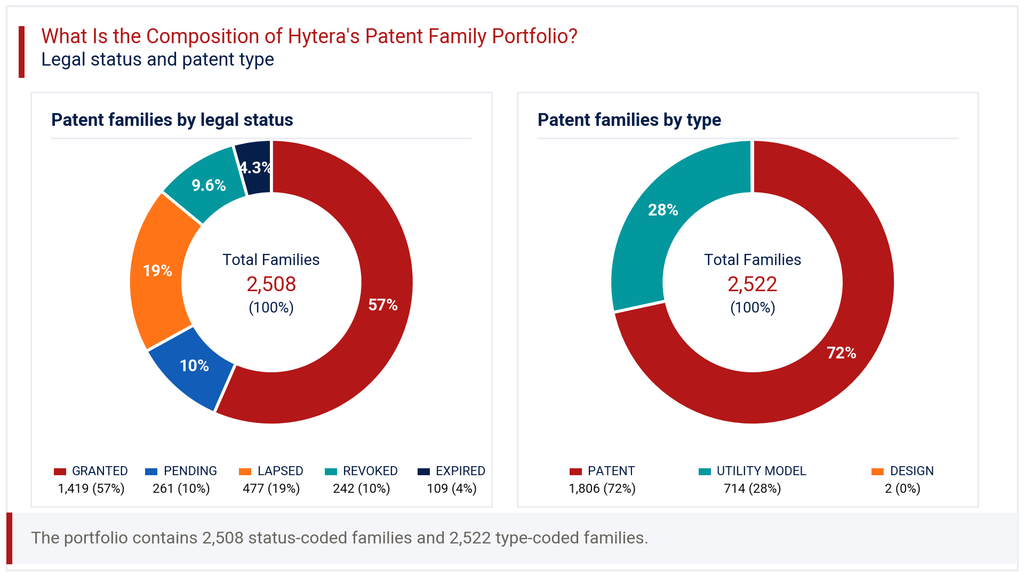
By patent type, traditional patents dominate at 71.6% of filings, with utility models contributing 28.3%. Design filings are negligible at just 0.1% of the total. This mix suggests Hytera leans toward full patent protection rather than the lighter utility model route common in Chinese filing strategy. The meaningful share of lapsed and revoked cases, nearly 29% combined, is not unusual for a portfolio of this scale and age. It does, however, point to active portfolio pruning, whether through deliberate non-renewal or contested validity challenges. A grant rate of 56.6% suggests Hytera’s applications clear examination at a reasonably consistent pace, supporting a workable foundation of enforceable rights.
How Has the Hytera Patent Portfolio Evolved Over Time?
Patent filing trends across the Hytera Patent Portfolio show a clear arc of acceleration, peak, and tapering. Early filings stayed modest, with just 17 families recorded through 2007 and single or double-digit annual counts through 2011. Momentum built sharply after 2012, when Hytera filed 78 families, climbing steadily to 197 in 2016 and 214 in 2017. The filing-trend chart in this section shows 2018 as the clear high point, with 314 families filed that year, Hytera’s strongest filing year on record.
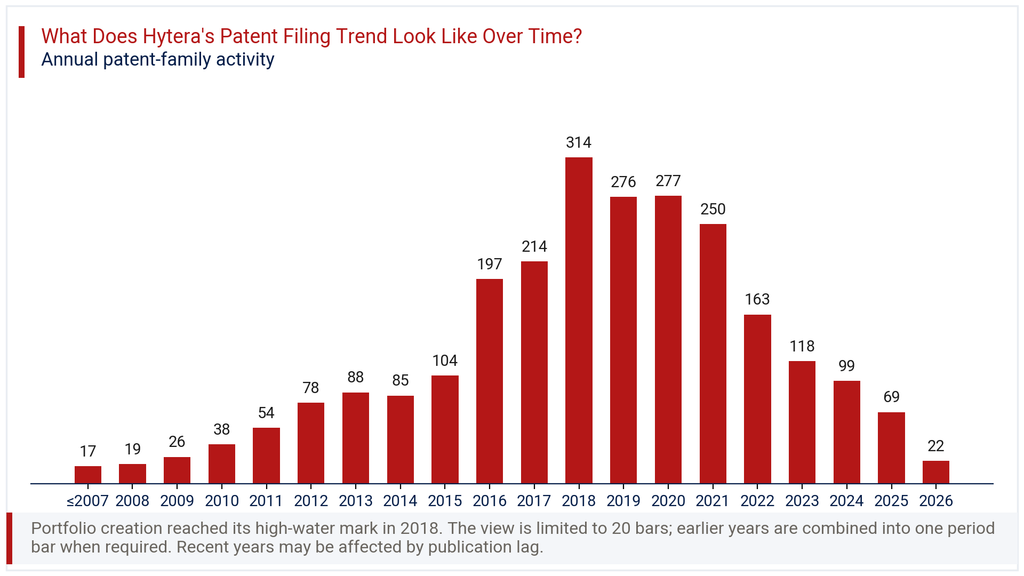
After 2018, volumes declined gradually through 2019 (276), 2020 (277), and 2021 (250), before dropping more noticeably to 163 in 2022 and 118 in 2023. The most recent two years, 2024 at 99 and 2025 at 69, should be read cautiously. Patent publication involves an inherent lag of 18 months or more between filing and public disclosure. The -68.1% change recorded in the latest year reflects this reporting gap rather than a genuine collapse in R&D or filing activity. The broader decade-long trend still points to a company that scaled its filing activity substantially before settling into a steadier, more selective pace after its 2018 peak.
Where Does the Hytera Patent Portfolio Prioritize Patent Protection?
Patent geography within the Hytera Patent Portfolio is heavily concentrated at home. China accounts for 83.2% of all filed families, a total of 2,086 patents, reflecting the company’s manufacturing and R&D base in Shenzhen. WIPO PCT filings represent the second-largest channel at 20.4%, covering 512 families used as a gateway to international markets. The geographic chart in this section shows a steep drop-off after these two categories, with no other single jurisdiction crossing even 3% of total share.
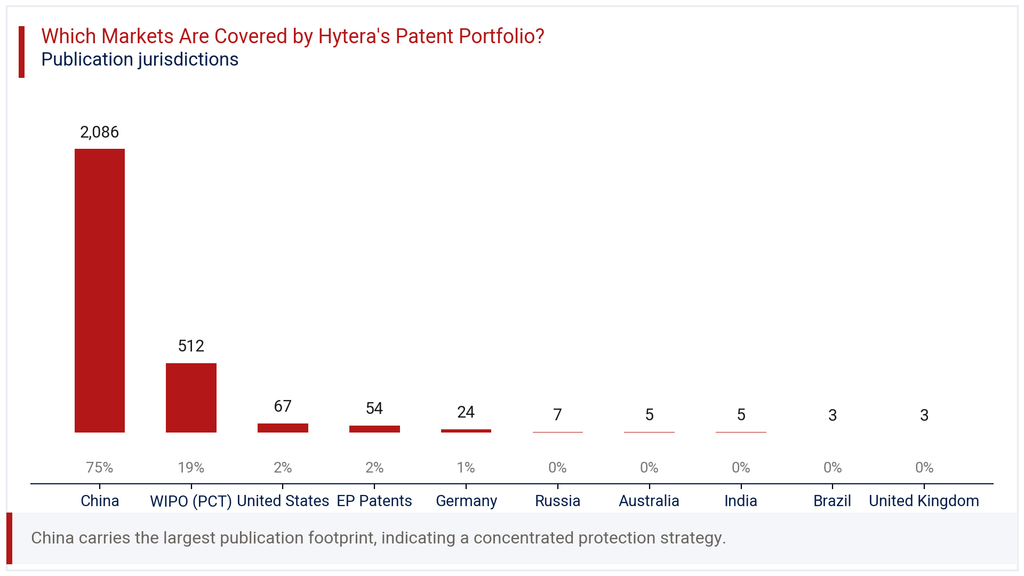
The United States holds 67 families, just 2.7% of the portfolio, while European filings sit even lower. EP Patents cover 54 families (2.2%), and Germany adds 24 families (1.0%), likely tied to Hytera’s 2012 acquisition of Rohde & Schwarz’s professional mobile radio business. Russia, Australia, India, Brazil, and the United Kingdom each register in the single digits. This pattern signals a filing strategy built primarily around domestic protection, with PCT applications serving as an option-preserving step rather than a guarantee of full international filing. Companies competing with Hytera outside China should note the comparatively thin direct patent coverage in Western jurisdictions.
Where is the Hytera Patent Portfolio Building Protection Across Key Technologies?
IPC analysis of the Hytera Patent Portfolio points firmly toward wireless communication as the technical core of the business. H04W (Wireless Communication Networks) leads with 924 families, representing 39.0% of all classified patents. H04L (Digital Information Transmission) follows at 16.5% with 391 families, and H04B (Signal Transmission) adds another 14.4%, or 341 families. Together, these three classes alone account for close to 70% of the entire portfolio. The technology chart in this section visualizes this concentration across the top ten IPC codes.
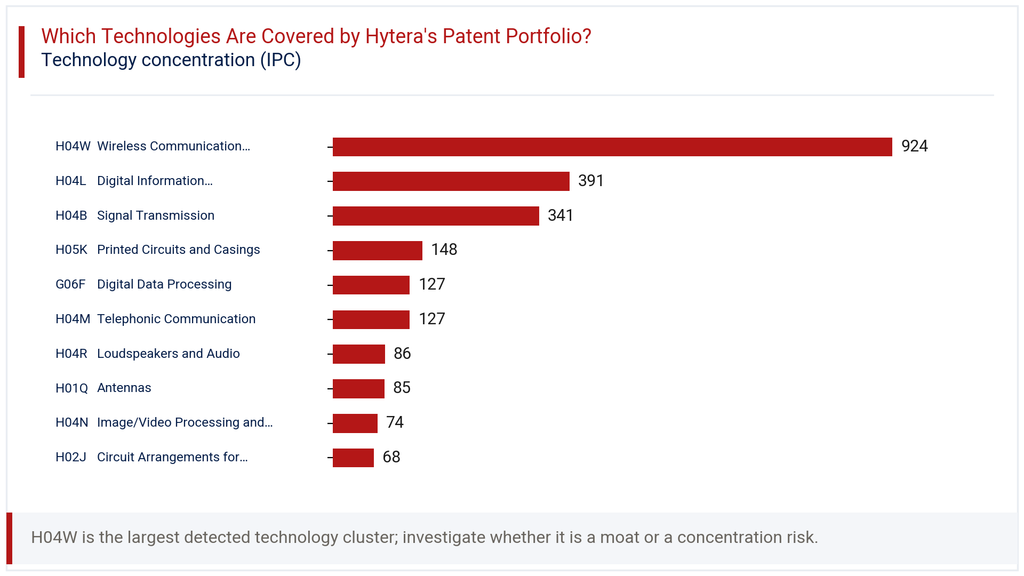
Beyond the core wireless classes, Hytera shows meaningful depth in supporting hardware categories. H05K (Printed Circuits and Casings) covers 148 families (6.2%), while G06F (Digital Data Processing) and H04M (Telephonic Communication) each hold 127 families (5.4% apiece). Smaller but notable clusters include H04R (Loudspeakers and Audio) at 86 families, H01Q (Antennas) at 85, and H02J (Power Supply Circuits) at 68. This spread confirms that Hytera’s engineering investment extends beyond network protocols into device-level hardware, audio systems, and power management, consistent with its positioning as a full-stack radio and communications equipment manufacturer.
How Has the Hytera Patent Portfolio Evolved Across Filing Geographies?
Viewing filing activity by year and jurisdiction together reveals how closely Hytera’s international ambitions tracked its domestic filing surge. China filings rose from 86 in 2015 to a peak of 245 in 2018, mirroring the portfolio’s overall high point that year. WIPO PCT filings followed a similar but smaller arc, peaking at 73 in 2018 before declining steadily to just 9 by 2023. The heatmap in this section makes this parallel timing pattern easy to spot across both leading jurisdictions.
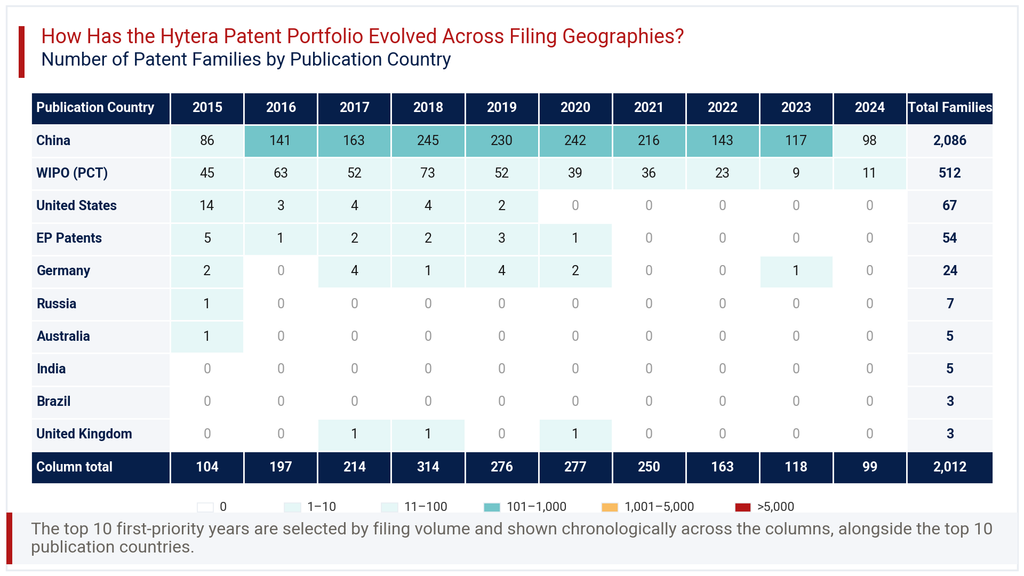
Western jurisdictions tell a starkly different story. United States filings peaked early, at 14 in 2015, then fell to single digits and reached zero from 2020 onward. EP Patent filings followed the same pattern, tapering from 5 in 2015 to zero after 2021. Germany saw sporadic small filings through 2019, with just 1 family recorded in 2023 and none since. India, Brazil, Australia, and Russia show negligible or zero activity across the entire ten-year window shown. This geographic time trend suggests Hytera’s international patent filing, outside PCT applications, has become increasingly rare over the past five years, even as domestic Chinese filing remained comparatively more resilient.
Consultant’s Perspective on Hytera Patent Portfolio
The Hytera Patent Portfolio reflects a company whose innovation strategy sits firmly anchored in its domestic market. With 83.2% of filings in China and a 39.0% concentration in wireless networking technology, the portfolio profile matches a vertically focused equipment manufacturer rather than a globally diversified IP holder. The 67.0% active rate indicates a workable, maintained asset base, though the declining Western filing trend deserves attention from competitors and partners alike.
What stands out most is the near disappearance of US, European, and other international direct filings after 2019 to 2021. Whether this reflects a shift toward licensing, a changed market strategy, or tighter R&D budget allocation is not something filing data alone can answer. Given Hytera’s acquisition history in Germany and Canada, a renewed push into Western jurisdictions would not be surprising if market conditions shift. Organizations assessing competitive risk from Hytera should track PCT filing trends closely, since that remains the company’s primary bridge to markets beyond China. Monitoring the next two to three years of publication data will clarify whether the recent decline is cyclical or structural.
Explore Deeper Insights with Expertlancing Research
This overview of the Hytera Patent Portfolio only scratches the surface of what a full competitive IP study can reveal. Expertlancing Research helps technology companies, investors, and legal teams dig deeper into specific patent families, citation networks, and competitor benchmarking. Whether you need freedom-to-operate analysis, licensing target identification, or ongoing patent monitoring, our analysts bring the technical and commercial context raw data cannot. Reach out to Expertlancing Research to turn these patent trends into decisions you can act on with confidence.