

The Inovance Patent Portfolio spans 3,489 patent families, offering a window into how one of China’s largest industrial automation makers protects its technology. Of these families, 71.1% remain active, a figure that covers both granted and pending cases. Granted families stand at 1,722, while 760 are still pending examination. The grant rate across the portfolio comes to 49.4%. The remaining families, totalling 1,007 when lapsed, revoked and expired cases are combined, have fallen out of active protection. These are prosecution and maintenance metrics, not a judgment on patent quality or enforceability.
Filing activity peaked sharply in 2023, when the company recorded 653 new families, part of a filing surge that began around 2021. China dominates the jurisdictional footprint, accounting for 99.8% of all filings, and the portfolio extends across 10 jurisdictions in total. On the technology side, the leading cluster is H02M (Conversion of Electric Power), carrying 552 families, consistent with Inovance’s core strength in power electronics and motor control.
This report draws on patent filing and legal status records to describe how Inovance has built its intellectual property position over time. Filing counts alone do not prove product success or confirm competitive advantage in any single market. Readers considering business, investment or partnership decisions should validate specific patent families before relying on them externally. What follows is a structured read of portfolio health, filing trends, geographic spread and technology focus.
About Inovance
Company Profile: Inovance, formally Shenzhen Inovance Technology Co., Ltd, is a publicly listed Chinese electrical equipment manufacturer. The company engages in the manufacture and sale of electrical equipment that includes industrial automation control products, as well as robotics. It is currently the largest industrial automation company in China as well as its second largest domestic producer of industrial robots. Its subsidiary Suzhou Inovance Automotive Co. produces electrical systems for the automotive industry.
Founded by a group of former Huawei engineers, the company has been dubbed “Little Huawei” in the industry, and was established in April 2003 by Zhu Xingming and several other engineers from Huawei. On 28 September 2010, Inovance held its initial public offering on the Shenzhen Stock Exchange, after which it expanded its product range from single frequency changers to other industrial control products such as programmable logic controllers and servomechanisms.
The company’s official site states it offers industrial automation, elevator, robotics, and digital energy solutions, with operations spanning China, Europe, and India.
How Healthy is Inovance Patent Portfolio?
Patent portfolio health for Inovance looks reasonably sound on the surface. Granted families make up 49.4% of the total, and pending applications add another 21.8%, pushing the active rate to 71.1%. That means roughly seven out of ten families remain legally alive today. The composition chart in this section shows a more cautious picture beneath that headline number. Lapsed families account for 21.7%, revoked cases sit at 4.8%, and expired families contribute 2.4%. Together these inactive categories touch nearly three in ten families, a share worth watching closely.
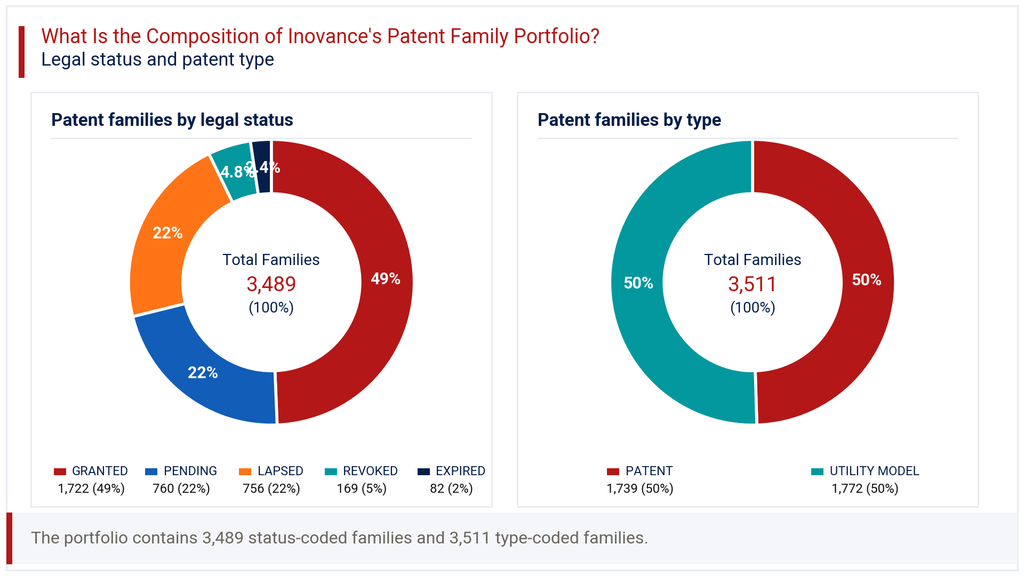
The split between patent and utility model filings is close to even, with utility models at 50.5% and patents at 49.5%. This balance reflects a common approach among Chinese manufacturers, where utility models offer faster, lower-cost protection for incremental engineering improvements. Patents, slower to grant but broader in scope, cover the more foundational innovations. For a reader assessing Inovance patent portfolio strength, this mix suggests a company protecting both quick product iterations and core technology platforms. The health picture is solid rather than exceptional, and the lapse rate deserves monitoring over coming renewal cycles.
How Has the Inovance Patent Portfolio Evolved Over Time?
Patent filing trends at Inovance show a long quiet build followed by a sharp climb. Filings stayed in double digits through most of the 2010s, with 117 families in 2012 and a dip to 35 by 2015. Momentum returned from 2017 onward, reaching 147 in 2018, before accelerating dramatically after 2020. The filing-trend chart in this section captures a clear inflection point starting in 2021, when counts jumped to 447.
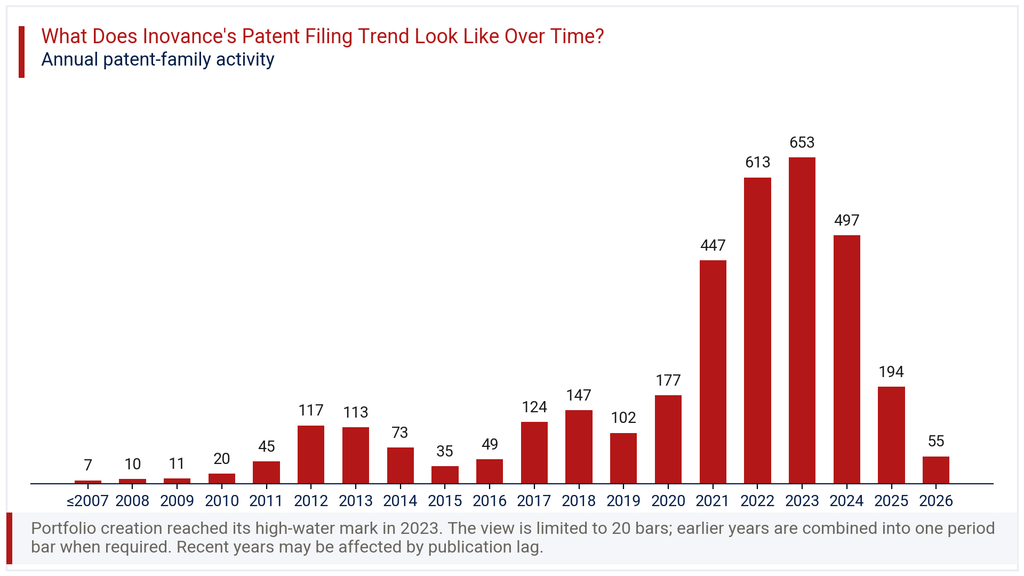
That acceleration peaked in 2023 at 653 families, the highest single-year count in the portfolio’s history. Counts for 2024 and 2025 show 497 and 194 respectively, a decline of -71.6% in the latest year-over-year comparison. This drop should be read carefully rather than taken as a real pullback in R&D activity. Patent applications typically take twelve to eighteen months to publish, so recent filing years are naturally undercounted in any dataset pulled today. The practical takeaway is that Inovance’s innovation output likely remained strong through 2024 and 2025, with the full picture to emerge only as pending applications publish.
Where Does the Inovance Patent Portfolio Prioritize Patent Protection?
Patent geography for Inovance is heavily concentrated at home. China accounts for 99.8% of all filings, underlining a company whose protection strategy centres almost entirely on its domestic market. The geographic chart in this section shows a steep drop after China to the next jurisdiction, WIPO’s PCT route, which carries 3.3% of filings and serves as the main bridge toward international markets.
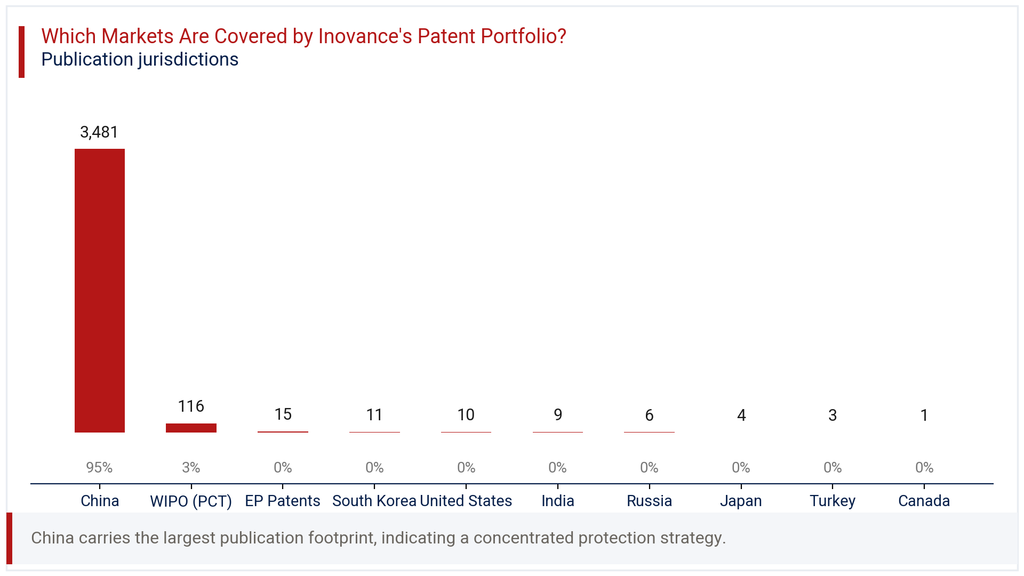
Beyond the PCT route, direct filings in other jurisdictions remain modest. Europe, South Korea, the United States, India, Russia, Japan, Turkey and Canada each hold small single-digit family counts, together spanning 10 jurisdictions in total. This pattern is typical of a company whose manufacturing base, customer concentration and legal enforcement priorities sit largely within China. For partners or competitors evaluating freedom to operate outside China, the exposure from direct Inovance filings looks limited today. The PCT filings, though small in absolute number, indicate the company is testing the waters for selective international protection, likely tied to export markets in automation and robotics equipment.
Where is the Inovance Patent Portfolio Building Protection Across Key Technologies?
Technology concentration in the Inovance Patent Portfolio points clearly toward power electronics. The leading IPC class, H02M (Conversion of Electric Power), holds 552 families, or 19.3% of the total. This is closely followed by H05K (Printed Circuits and Casings) at 494 families, representing 17.3%. The technology chart in this section shows these two classes well ahead of the rest, forming the structural core of Inovance’s engineering focus.
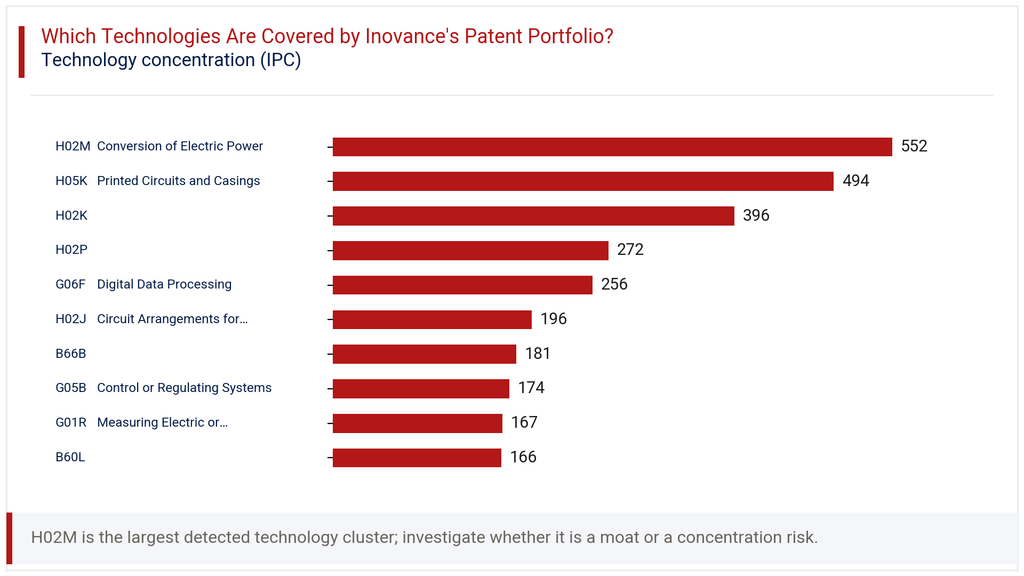
Further down, H02K motor-related technology contributes 13.9%, and H02P, covering control of electric motors, adds 9.5%. Digital processing under G06F holds 9.0%, reflecting growing software and control-system content inside automation products. Smaller but notable clusters include B66B elevator technology at 6.3% and G05B control systems at 6.1%, both consistent with Inovance’s stated elevator and industrial automation businesses. This IPC analysis shows a company whose patenting mirrors its product lines closely: power conversion, motor control, circuitry and control systems together account for the bulk of filings, with elevator and automotive-adjacent technologies appearing as secondary but deliberate investment areas.
How Has the Inovance Patent Portfolio Evolved Across Filing Geographies?
Reading filing activity by year and jurisdiction together tells a sharper story than either view alone. China’s filings mirror the overall trend precisely, rising from 117 in 2012 to a peak of 652 in 2023, then easing to 496 and 190 in the two following years. The heatmap in this section shows this domestic surge dwarfing every other jurisdiction throughout the entire period under review.
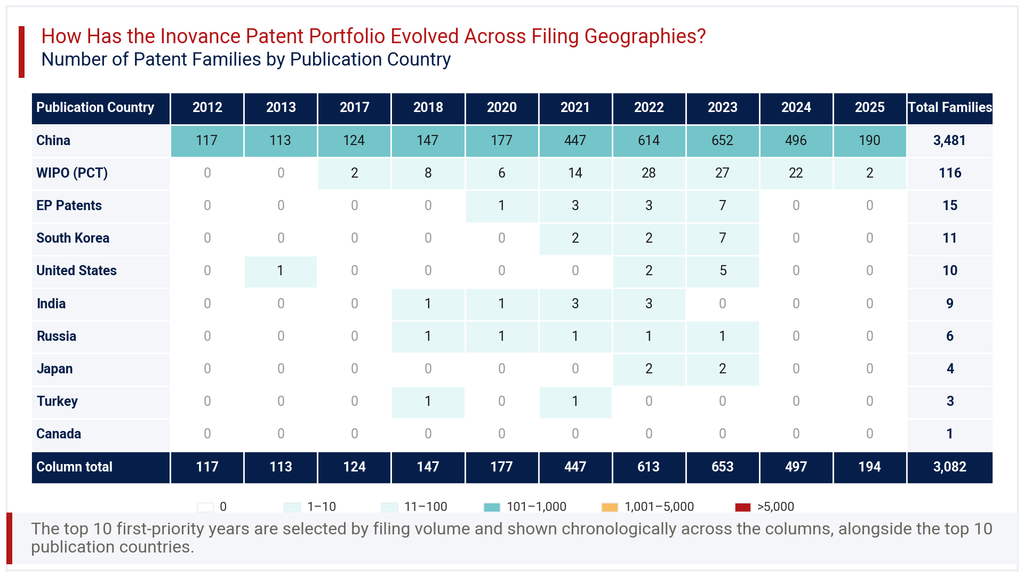
International filings, though small, follow the same timing. WIPO PCT filings rose from 2 in 2017 to 28 in 2022, then 27 in 2023, before tapering. South Korea, the United States, Japan and the European Patent Office all show their first meaningful activity only from 2021 onward, clustering around the same 2022 to 2023 window as the domestic peak. This timing suggests Inovance’s push into international protection was a deliberate extension of its domestic filing surge, not a separate or earlier strategy. The near-complete absence of pre-2020 international filings confirms that global protection is a recent, still-developing priority rather than an established pillar of the company’s approach.
Consultant’s Perspective on Inovance Patent Portfolio
Viewed as a whole, the Inovance Patent Portfolio reflects a company whose patenting has scaled in step with its business growth. The jump from under 50 annual filings before 2017 to over 600 at peak in 2023 tracks Inovance’s rise into China’s largest industrial automation player. A grant rate of 49.4% and an active rate of 71.1% suggest a portfolio under reasonably disciplined management, not one filed purely for volume.
The concentration risk is worth flagging plainly. With 99.8% of filings in China, Inovance carries limited patent cover in markets where it already states it operates, including Europe and India. As the company’s international business expands, this gap between physical presence and patent protection could matter more over time, particularly if competitors contest its automation or robotics products abroad. The technology mix, led by power conversion and printed circuit innovations, aligns well with core strengths, though software and digital control filings look proportionally smaller than one might expect for a modern automation company. My recommendation: monitor pending applications closely over the next two years, as they will clarify whether international filing intent is strengthening or remaining opportunistic.
Explore Deeper Insights with Expertlancing Research
This analysis only scratches the surface of what Inovance’s patent activity can reveal about its technology direction and market intent. Expertlancing Research helps organisations go deeper, mapping competitor portfolios, tracking emerging filing trends, and benchmarking technology investment across markets. Whether you are assessing a partner, a competitor or your own position, our analysts can build a tailored study around your specific business question. Reach out to discuss how a detailed patent intelligence engagement could support your next strategic decision.