


The Inspur Patent Portfolio offers a useful lens into how one of China’s largest IT conglomerates protects its innovation in computing, cloud, and AI technologies. Across 39,442 total patent families, 66.2% remain active, a figure that combines granted and pending filings still in force. Of these, 10,828 patents have been granted, while 15,269 applications sit pending before patent offices. The grant rate stands at 27.5%, and a combined 13,345 families fall into lapsed, expired, or revoked status. These figures reflect prosecution and maintenance activity, not a verdict on patent quality or enforceability.
Filing activity peaked in 2025, when Inspur recorded 7,329 new patent families, continuing a sharp multi-year climb. China dominates the filing geography, accounting for 100.0% of jurisdictional share across 10 jurisdictions where Inspur has sought protection. On the technology side, the leading cluster is G06F, covering Digital Data Processing, with 24,033 families, far ahead of every other classification tracked in this analysis.
This report is intended to help executives, investors, and IP professionals read the shape of Inspur’s filing behaviour at a glance. Filing counts alone do not prove commercial success, market dominance, or technical superiority over rivals. Readers evaluating specific patent families for licensing, litigation, or acquisition purposes should verify details independently before relying on them externally.
About Inspur
Company Profile: Inspur Group is a Chinese information technology conglomerate headquartered in Jinan, Shandong. The company is listed on the Shanghai Stock Exchange, Shenzhen Stock Exchange, and Hong Kong Stock Exchange, and changed its English name from Langchao to Inspur in 2006. It focuses on cloud computing, big data, key application hosts, servers, storage, artificial intelligence and ERP software. According to the company’s official website, the group comprises three listed companies, Inspur Information, Inspur Software, and Inspur Digital Enterprise, with core operations covering computing equipment, software, cloud computing services, next-generation communications, big data, and various application scenarios.
Inspur has delivered IT products and services to more than 120 countries and regions worldwide. Historically, Microsoft invested US$20 million in Inspur in 2005, and the company also entered agreements with VMware on cloud computing research and development. In 2009, Inspur acquired Qimonda AG’s Xi’an-based research and development facilities for about 30 million Chinese yuan.
How Healthy is Inspur Patent Portfolio?
Patent portfolio health depends on how many filings survive prosecution and stay enforceable. Inspur’s legal status breakdown shows 27.5% granted, 38.7% pending, 9.4% lapsed, 23.8% revoked, and 0.6% expired. The composition chart in this section makes clear that pending applications form the largest single bucket, ahead of granted patents. This signals a portfolio still working through examination queues rather than one dominated by settled rights. The revoked share of 23.8% deserves attention, since it is unusually high relative to the granted share and suggests meaningful attrition during prosecution or post-grant challenges.
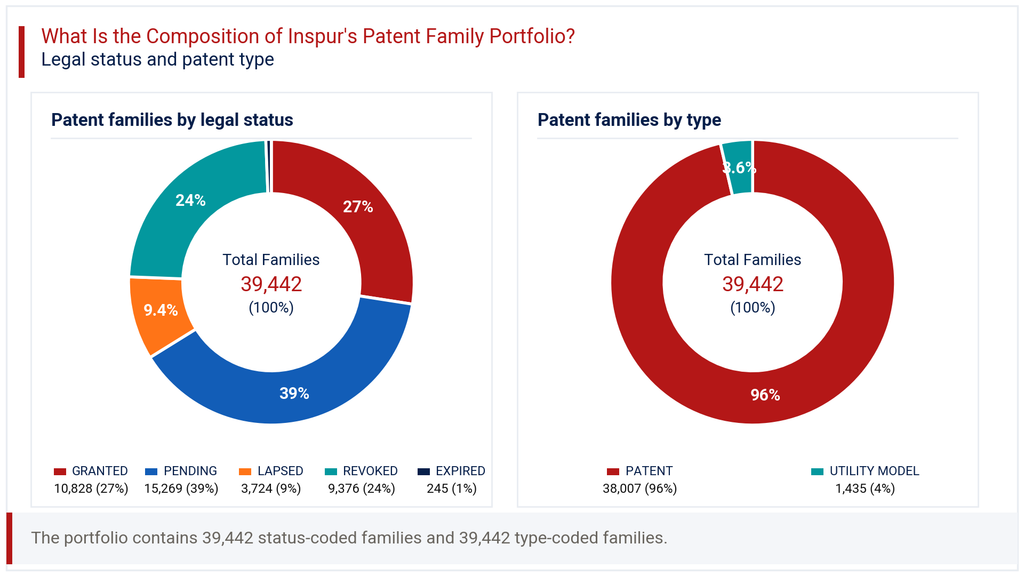
On patent type, utility models make up only 3.6% of filings, with standard patents at 96.4%. This mix points to a portfolio built mostly on full invention patents rather than the lighter-weight utility model route common in China. The active rate of 66.2% combines granted and pending families, giving a reasonable sense of what remains legally alive today. For a company operating in fast-moving computing and AI segments, a healthy pending pipeline is expected, but the elevated revocation figure is worth watching. Overall patent legal status here reflects an actively managed, still-maturing filing programme rather than a mature, fully settled one.
How Has the Inspur Patent Portfolio Evolved Over Time?
Patent filing trends at Inspur show a long, uneven build-up followed by a dramatic recent surge. Early years saw modest activity, with 90 families filed up to 2007 and gradual single and double-digit growth through 2013. A sharp jump appears from 2014 onward, when filings reached 951, followed by 1,810 in 2015 and 1,862 in 2016. The filing-trend chart in this section shows a brief dip in 2017 and 2018 before momentum resumes strongly from 2019.
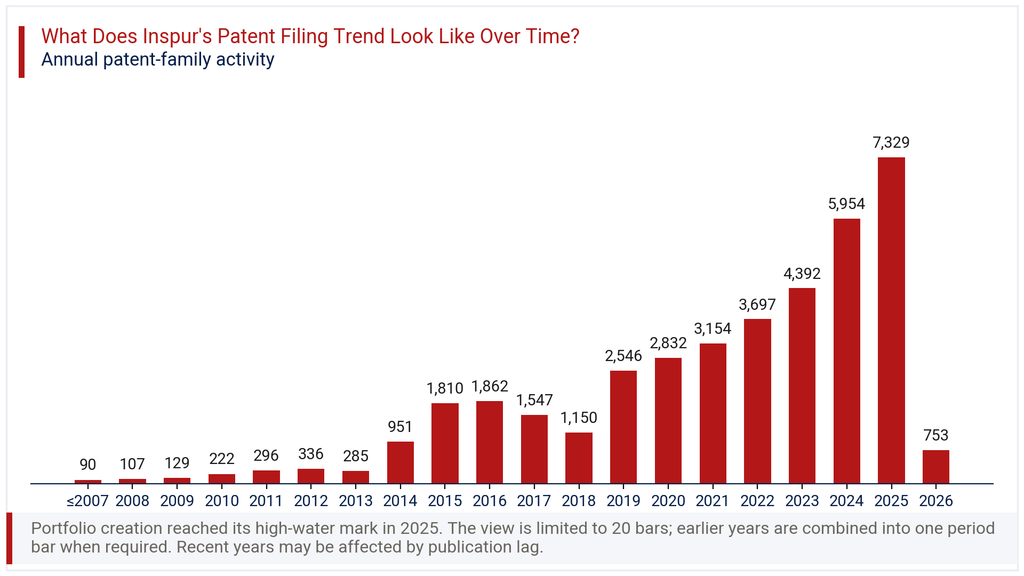
From 2019 through 2025, filings climbed almost every year, reaching 2,546, then 2,832, 3,154, 3,697, 4,392, 5,954, and finally 7,329 in 2025. This consistent multi-year acceleration suggests a deliberate, well-funded push into patenting as core strategy. The 2026 count of 753 and the latest_year_change_pct of -89.7% should not be read as a sudden collapse. Patent applications typically take many months to publish, so recent-year figures are structurally incomplete rather than genuinely declining. The real trend through 2025 points to sustained, aggressive filing growth rather than any slowdown.
Where Does the Inspur Patent Portfolio Prioritize Patent Protection?
Patent geography for Inspur is overwhelmingly domestic. China accounts for 100.0% of jurisdictional share, with 39,439 families filed there, the clear centre of the company’s IP strategy. The geographic chart in this section shows a steep fall after China, with WIPO PCT filings at 1,243 families and a 3.2% share. United States filings follow at 599 families, representing 1.5% of jurisdictional presence, trailing far behind the domestic base.
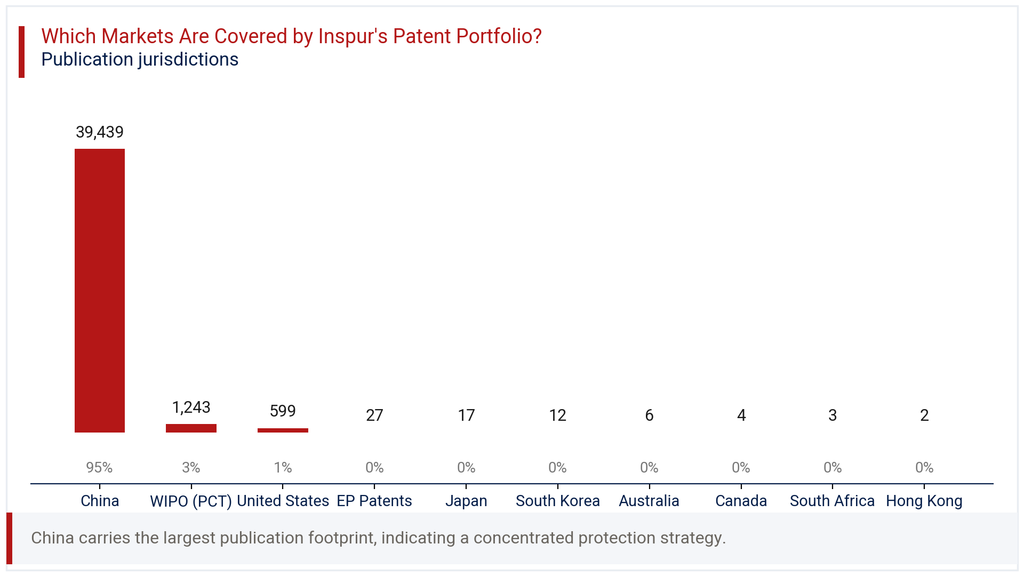
Other jurisdictions receive only token attention. EP Patents stand at 27 families and 0.1% share, while Japan, South Korea, Australia, Canada, South Africa, and Hong Kong each register single-digit counts. This pattern across 10 total jurisdictions indicates a company whose patent protection strategy centres on securing home-market rights first. International filing, where it exists, concentrates on PCT applications and the United States, likely reflecting commercial priorities in cloud computing and server hardware exports. For stakeholders assessing global enforceability, this concentration matters. Rights outside China remain thin, meaning competitors operating internationally face limited patent exposure from Inspur today.
Where is the Inspur Patent Portfolio Building Protection Across Key Technologies?
IPC analysis of the Inspur portfolio reveals heavy concentration in computing and data processing fields. The leading class, G06F (Digital Data Processing), accounts for 24,033 families and 49.0% of all classified filings, nearly half the entire portfolio. The technology chart in this section shows H04L (Digital Information Transmission) second, with 7,770 families and 15.9% share, followed by G06Q (Data Processing for Administrative or Commercial Purposes) at 5,830 families and 11.9%.
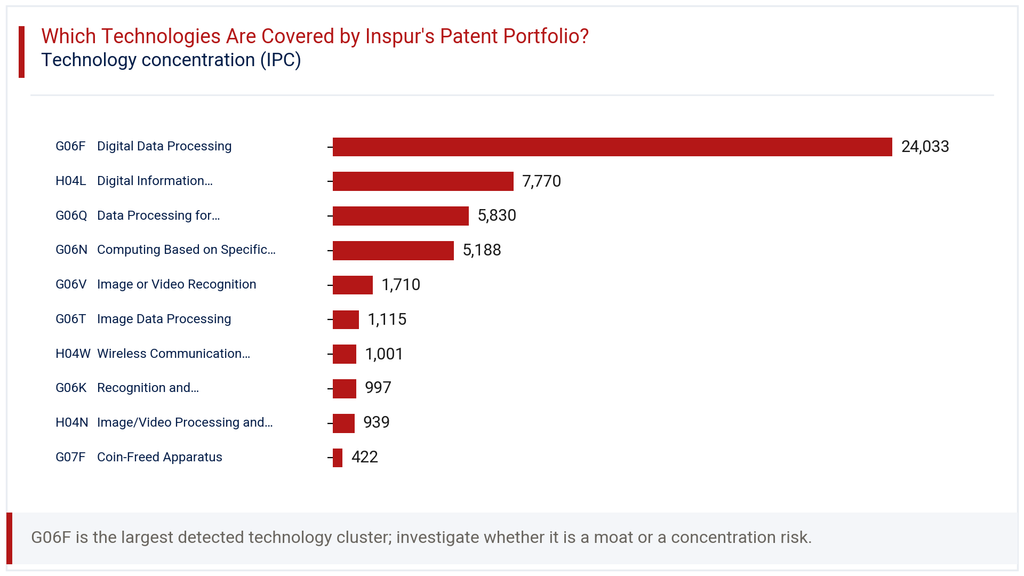
Artificial intelligence related filing also stands out, with G06N (Computing Based on Specific Models) contributing 5,188 families, or 10.6% of the portfolio. Supporting clusters include G06V (Image or Video Recognition) at 1,710 families and G06T (Image Data Processing) at 1,115 families. Smaller but notable areas include H04W wireless networks, G06K data recognition, and H04N image and video processing and display. This spread confirms Inspur’s core strength lies in foundational computing infrastructure, supplemented by meaningful investment in AI models, data processing for enterprise use, and network communication technologies that support its cloud and server business lines.
How Has the Inspur Patent Portfolio Evolved Across Filing Geographies?
Viewing filing activity by year and jurisdiction together adds texture to the geography story. The heatmap in this section shows China’s filings tracking the overall portfolio curve closely, rising from 1,810 in 2015 to 7,329 in 2025. This confirms China was always the primary filing venue, not just a recent shift.
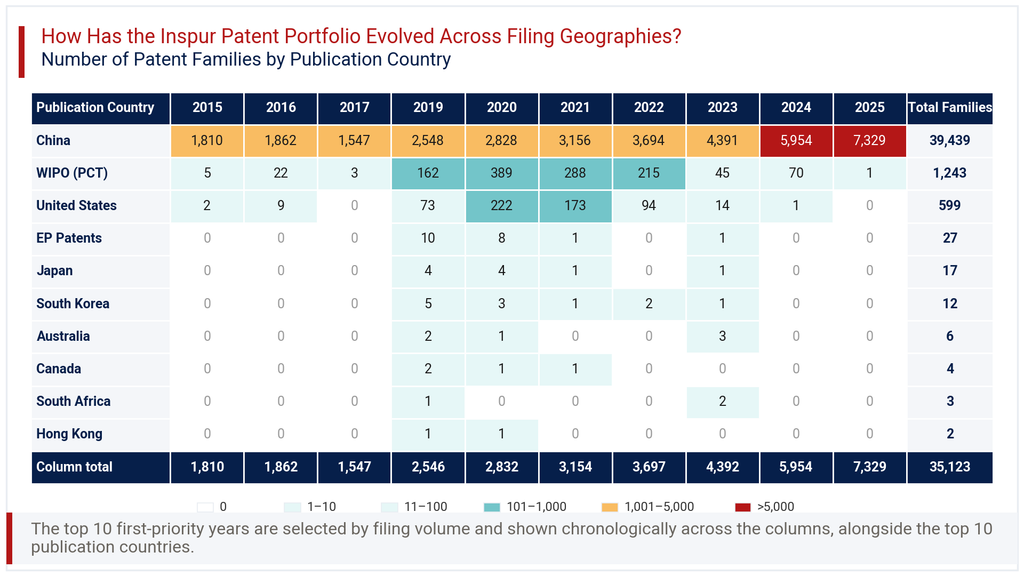
International activity tells a different story. WIPO PCT filings peaked in 2020 at 389, and United States filings peaked the same year at 222, both well before the 2025 domestic surge. By 2023 through 2025, overseas filings across PCT, United States, EP, Japan, and other jurisdictions had fallen to single digits or zero. This suggests Inspur’s recent growth phase has been almost entirely domestically oriented, even as total filing volume kept climbing. The earlier 2019 to 2022 window appears to have been the company’s most internationally active period. Stakeholders tracking competitive exposure outside China should note this shift, since recent filings imply reduced near-term interest in foreign patent protection relative to the domestic pipeline.
Consultant’s Perspective on Inspur Patent Portfolio
The Inspur Patent Portfolio reads as a textbook case of domestic-first IP strategy at scale. The sheer filing volume, over 39,000 families, signals serious institutional commitment to patenting as a business function. Concentration in G06F, H04L, and G06N aligns tightly with Inspur’s stated focus on computing, networking, and AI, which is reassuring from a coherence standpoint. The strategy looks deliberate rather than scattershot.
Two things stand out as areas for closer scrutiny. First, the 23.8% revocation rate is higher than one would expect from a well-managed portfolio and merits investigation into causes, whether procedural, examiner-driven, or substantive. Second, the near-total pullback from international filing after 2022 raises questions about global enforcement appetite, even as domestic volume keeps rising sharply.
For competitors or partners assessing Inspur, the practical takeaway is this: expect strong defensive density in China, but limited current patent exposure elsewhere. For Inspur itself, closing the gap between domestic filing intensity and shrinking international protection could matter as export markets for servers and AI infrastructure grow. Monitoring whether the 2025 PCT and US filings recover in coming years would be a sensible signal to track.
Explore Deeper Insights with Expertlancing Research
This overview only scratches the surface of what the Inspur Patent Portfolio can reveal about competitive positioning and technology direction. Expertlancing Research helps clients go further, with family-level validation, competitor benchmarking, and custom technology landscaping tailored to specific business questions. Whether you are assessing acquisition targets, licensing opportunities, or freedom-to-operate risk, our analysts can build the detailed picture you need. Reach out to Expertlancing Research to commission a deeper, decision-ready patent intelligence study.