

The Jiangsu Zhongtian Patent Portfolio spans 3,263 patent families, offering a window into how this Nantong based industrial group protects its technology. The portfolio shows an active rate of 75.5%, covering patents that are either granted or still pending, which signals a sizeable share of live intellectual property. Within this base, 1,860 families stand granted while 603 remain pending before patent offices. The grant rate sits at 57.0%, and a combined 800 families have lapsed, expired, or been revoked. These figures describe prosecution and maintenance status only, not a verdict on patent quality or enforceability.
Filing activity peaked in 2024 with 393 families filed, marking the highest single year on record for the company. China dominates the jurisdictional footprint, accounting for 99.4% of filings across 10 jurisdictions tracked in this analysis. On the technology side, G02B Optical Elements, Systems and Instruments leads with 578 families, making it the single largest cluster in the portfolio. This concentration points to optical and fibre related innovation as a core pillar of ZTT’s patenting effort.
This report reads the numbers as a lens on filing behaviour, not as proof of market success or technical superiority. Raw counts cannot confirm commercial traction, litigation strength, or competitive distance from rivals. Readers planning to cite specific families in deals, diligence, or competitor benchmarking should verify each record independently. The sections ahead unpack legal status, filing trends, geography, and technology depth in turn, giving context before conclusions.
About Jiangsu Zhongtian
Company Profile: Jiangsu Zhongtian Technology Co., Ltd., known as ZTT, is a Chinese manufacturing technology group. The company operates in renewable energy, submarine systems, power grids, telecommunications, and industrial internet, having been founded in 1992. ZTT has expanded its footprint to over 160 countries, with 80 subsidiaries, nearly 18,000 employees, and 8 overseas factories. Its telecom offerings include optical fibre, fibre optic cable, antennas, coaxial cable and 5G base station energy solutions.
The company also supplies submarine cables, EPIC systems, power transmission equipment and new energy products such as lithium batteries and solar components. ZTT is listed on the Shanghai Stock Exchange under ticker 600522. Its headquarters sit in Nantong, Jiangsu province, within China’s economic and technological development zone.
The group positions itself as a diversified industrial supplier spanning telecom, power, marine and renewable energy sectors, serving both domestic and international markets across multiple continents.
How Healthy is Jiangsu Zhongtian Patent Portfolio?
Patent portfolio health depends heavily on legal status composition, and here the numbers tell a fairly stable story. Granted families make up 57.0% of the total, with pending applications adding another 18.5%. Together they produce the 75.5% active rate cited earlier, meaning three in four families remain alive in some form. Lapsed families account for 11.4%, revoked ones for 8.7%, and expired ones for 4.5%. The composition chart in this section lays out this split clearly across all five status categories.
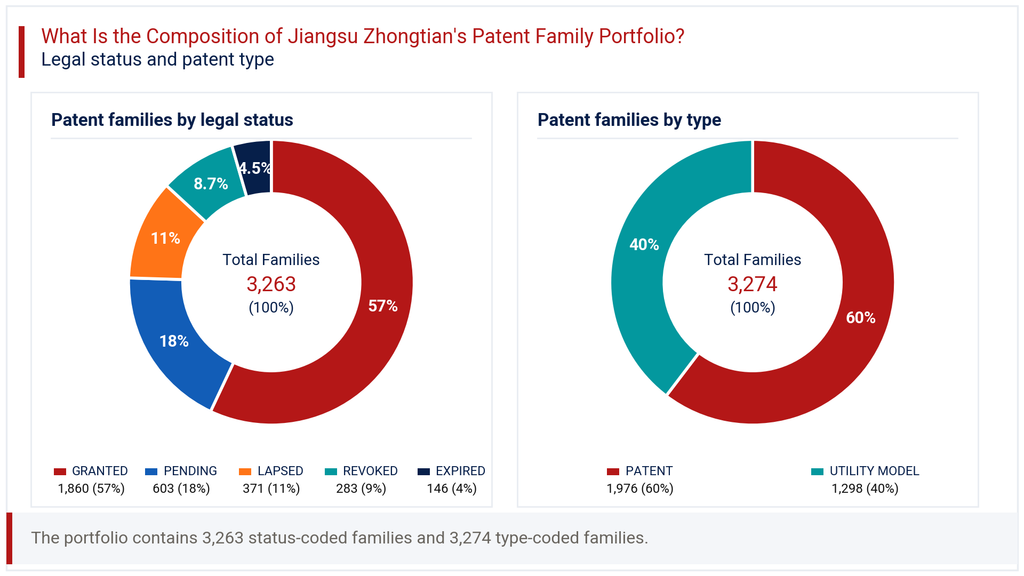
On patent type, the split between full patents and utility models adds further texture. Patents represent 60.4% of filings while utility models make up 39.6%, per the patent_type_pct figures. This mix is typical for a Chinese industrial filer, since utility models offer faster, cheaper protection for incremental improvements. The moderate revoked and lapsed share suggests normal portfolio pruning rather than systemic quality issues. Taken together, the legal status profile points to a portfolio that is maturing rather than stagnating, with meaningful pending volume still working through examination.
How Has the Jiangsu Zhongtian Patent Portfolio Evolved Over Time?
Patent filing trends for ZTT show a long runway of acceleration followed by a plateau. Filings held below 100 per year through 2014, then climbed steadily, crossing 200 by 2017 and reaching 393 in 2024, the peak year. The filing trend chart in this section traces this climb across two decades of activity. Growth was not perfectly linear, with a dip in 2019 to 193 after a strong 2018 of 233, but the broader direction stayed upward.
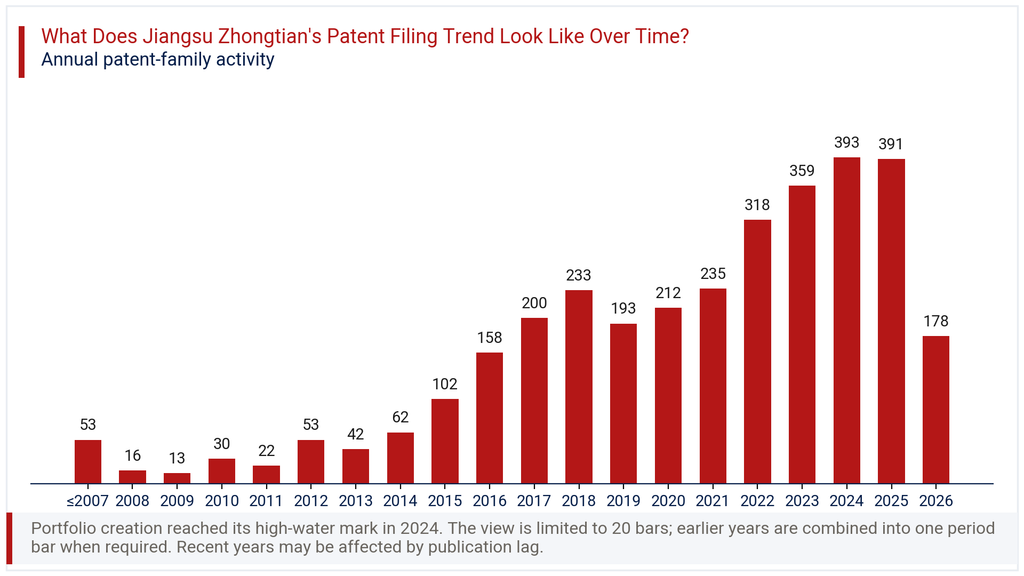
The most recent two years, 2025 and 2026, show 391 and 178 families respectively, a sharp apparent fall of -54.5% by the latest reading. This drop should be read cautiously, since patent publication typically lags actual filing by twelve to eighteen months. Recent year figures are therefore incomplete rather than evidence of a genuine slowdown. The underlying pattern through 2024 still points to sustained, rising investment in filing activity, consistent with a company scaling its telecom, cable, and energy technology lines across multiple product categories.
Where Does the Jiangsu Zhongtian Patent Portfolio Prioritize Patent Protection?
Patent geography for ZTT is heavily concentrated at home. China accounts for 99.4% of all filings, underscoring a domestic first filing strategy typical of large Chinese manufacturers. The geographic chart in this section shows just how dominant this single jurisdiction is relative to the rest. WIPO PCT filings follow at 5.7%, a route companies use to preserve international options before committing to specific national phases.
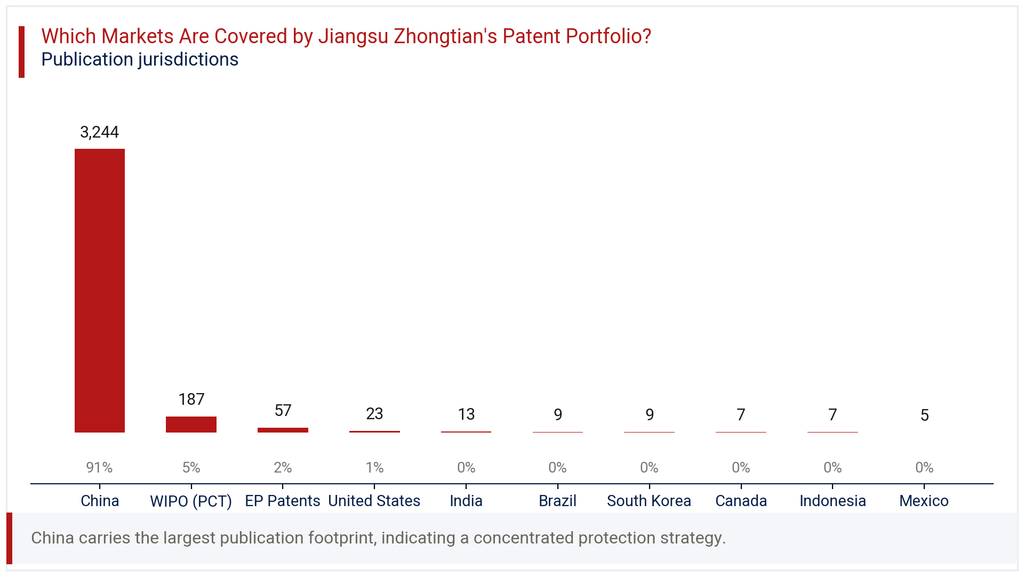
Beyond China and the PCT route, protection thins out quickly. European Patents sit at 1.7%, the United States at 0.7%, and India at 0.4%. Brazil, South Korea, Canada, Indonesia, and Mexico each register around 0.2% to 0.3% of total filings. This pattern suggests ZTT protects its core innovation pipeline domestically first, then selectively extends coverage to a handful of strategic markets. For a company active in over 160 countries commercially, this gap between market presence and patent geography is worth noting for partners assessing IP backing abroad.
Where is the Jiangsu Zhongtian Patent Portfolio Building Protection Across Key Technologies?
IPC analysis of the portfolio reveals a clear concentration around optical and cable technologies. G02B Optical Elements, Systems and Instruments leads with 578 families, or 27.5% of the total, the single largest technology cluster. H01B, covering conductors and cables, follows at 438 families and 20.8%. The technology chart in this section lays out all ten leading IPC classes side by side for comparison.
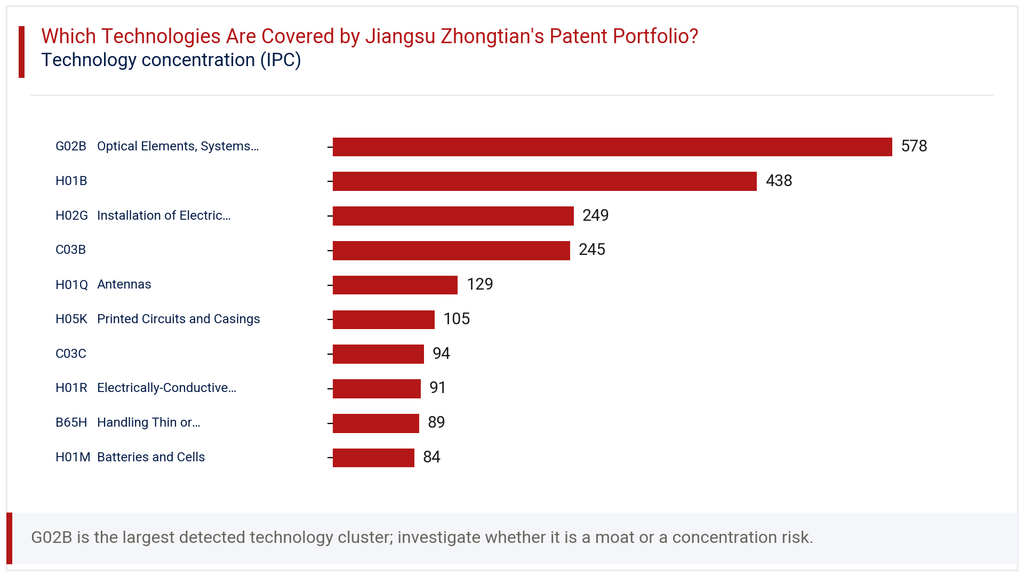
Further down the list, H02G Installation of Electric Cables or Lines holds 249 families at 11.8%, while C03B, linked to glass and fibre manufacture, sits at 245 families and 11.7%. Smaller but notable clusters include H01Q Antennas at 129 families and H01M Batteries and Cells at 84 families, reflecting diversification into telecom hardware and energy storage. Together, the top four classes account for over 70% of tracked filings, showing a portfolio built tightly around fibre optics, cabling, and power transmission, with batteries and antennas as adjacent growth areas rather than core pillars.
How Has the Jiangsu Zhongtian Patent Portfolio Evolved Across Filing Geographies?
The heatmap in this section maps filing volume by year against jurisdiction, and the pattern is unambiguous. China has driven almost every year of growth, rising from 153 filings in 2016 to 393 in 2024. No other jurisdiction comes close in scale across any single year tracked.
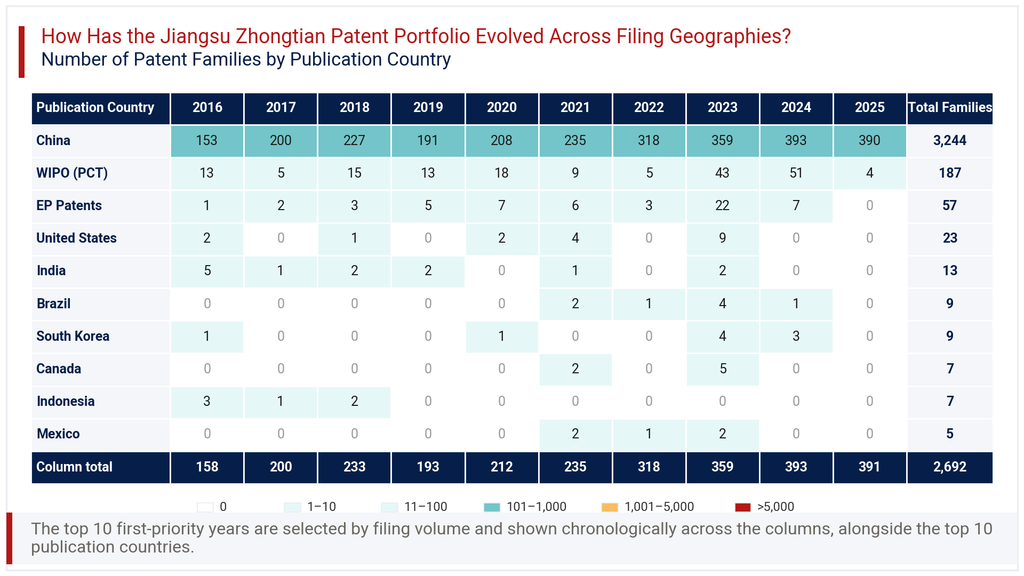
International filings show more variation and far smaller absolute numbers. WIPO PCT activity jumped to 43 in 2023 and 51 in 2024, well above its typical single digit yearly counts in earlier years. European Patent filings similarly spiked to 22 in 2023 before falling back to 7 in 2024. United States filings stayed thin throughout, peaking at just 9 in 2023 with several years showing zero activity. This pattern suggests international filing decisions follow specific product launches or contract wins rather than a steady annual programme, making overseas protection opportunistic rather than systematic across the period studied.
Consultant’s Perspective on Jiangsu Zhongtian Patent Portfolio
The Jiangsu Zhongtian Patent Portfolio reflects a company that files heavily and consistently, anchored in domestic protection. The 75.5% active rate and steady climb to 393 peak year filings in 2024 point to real, sustained investment in intellectual property. The technology concentration in optics, cabling, and power transmission lines up logically with ZTT’s stated business across telecom and energy infrastructure.
The gap between international commercial reach and international patent filing stands out as the most actionable observation. With operations across 160 countries but under 1% combined non-China, non-PCT filing share, ZTT appears to rely on manufacturing scale and relationships rather than patent barriers abroad. Competitors or partners evaluating ZTT’s overseas defensibility should factor this in directly. Looking forward, any acceleration in PCT or EP filings, as briefly seen in 2023, would signal a shift toward more deliberate international IP strategy. Until that trend repeats consistently, the portfolio should be read as a strong domestic shield with limited international reach. Organizations assessing partnership, licensing, or competitive risk with ZTT should weigh this geographic imbalance carefully before drawing conclusions about global market protection.
Explore Deeper Insights with Expertlancing Research
This overview only scratches the surface of what a detailed patent study can reveal. Expertlancing Research helps organizations go further, validating individual families, benchmarking competitors, and mapping white space across technologies and markets. Whether you are assessing a potential partner, tracking a competitor, or planning your own filing strategy, our analysts can build a tailored view suited to your decision. Reach out to discuss how a deeper study of patent portfolios like this one can support your next strategic move.