


The Lenovo Patent Portfolio spans 42,983 patent families, built up across decades of global filing activity. Of these, 69.9% remain active, a figure covering both granted and pending cases. The portfolio holds 21,016 granted families and 9,031 pending ones, giving a grant rate of 48.9%. A combined 12,936 families fall under lapsed, revoked, or expired status. These figures describe prosecution and maintenance outcomes only, not a verdict on patent quality or enforceability.
Filing activity peaked in 2014, when Lenovo recorded 3,463 new families, the single highest count in the dataset. China stands as the dominant jurisdiction, accounting for 77.5% of filings, across a spread of 10 jurisdictions tracked in this analysis. On the technology side, G06F Digital Data Processing leads the portfolio with 22,001 families, making it by far the most heavily populated technology cluster Lenovo has built around.
This report reads Lenovo’s filing behaviour through counts, timing, and jurisdictional spread, not through litigation outcomes or product-level performance. Filing volume alone does not prove market success or technical superiority over rivals. Readers considering licensing, acquisition, or competitive benchmarking should verify individual families directly before relying on them externally. What follows is a structured walk through portfolio health, filing trends, geography, and technology concentration, intended to orient rather than substitute for legal due diligence.
About Lenovo
Company Profile: Lenovo Group Limited is a Chinese multinational technology company, originally founded as Legend in Beijing in 1984. Lenovo originated as an offshoot of a state-owned research institute. Its global headquarters are in Beijing, China, and Morrisville, North Carolina, in the United States, with research centers in mainland China, Hong Kong, Taiwan, Stuttgart in Germany, and Yamato in Japan.
The company designs, develops, manufactures and sells personal computers, tablet computers, smartphones, workstations, servers, electronic storage devices, IT management software, and smart televisions. Lenovo acquired IBM’s personal computer business in 2005 and acquired mobile phone maker Motorola Mobility from Google in 2014. The company reports it is a US$83 billion revenue global technology powerhouse, serving customers across 180 markets. AI-related revenue grew 60% year-on-year to US$9.3 billion in a recent quarter, accounting for 35% of total Group revenue. Yang Yuanqing serves as chairman and CEO.
How Healthy is Lenovo Patent Portfolio?
Patent portfolio health for Lenovo looks reasonably sound on the numbers. 48.9% of families sit in granted status, and 21.0% remain pending, together producing an active rate of 69.9%. The composition chart in this section shows the remaining share split across lapsed (9.9%), revoked (13.4%), and expired (6.8%) categories. A revoked share above 13% deserves attention, since it points to contested or successfully challenged claims in some markets.
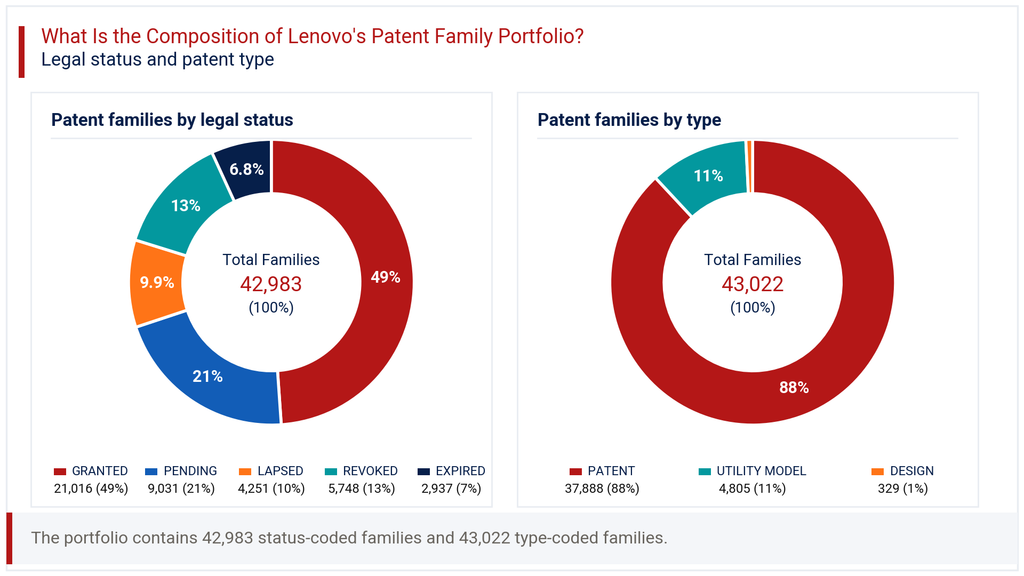
By patent type, the portfolio leans heavily toward standard patents, at 88.1% of filings. Utility models make up 11.2%, concentrated in jurisdictions like China where that filing route is common and faster to secure. Design filings are a small sliver, just 0.8%. This mix suggests Lenovo treats utility models as a tactical layer alongside full patent protection, rather than a primary strategy. For a portfolio of this scale, the legal status spread looks typical of a mature technology filer managing renewals across many markets simultaneously, rather than a sign of neglect or weak drafting.
How Has the Lenovo Patent Portfolio Evolved Over Time?
Patent filing trends at Lenovo show distinct phases rather than a single steady climb. Early filings before 2007 total 5,514 families, followed by a quieter period through 2009 at just 595. Activity then builds steadily, reaching 2,312 in 2012 and climbing to the portfolio’s peak of 3,463 in 2014, the same year Lenovo acquired Motorola Mobility. The filing-trend chart in this section captures this buildup clearly.
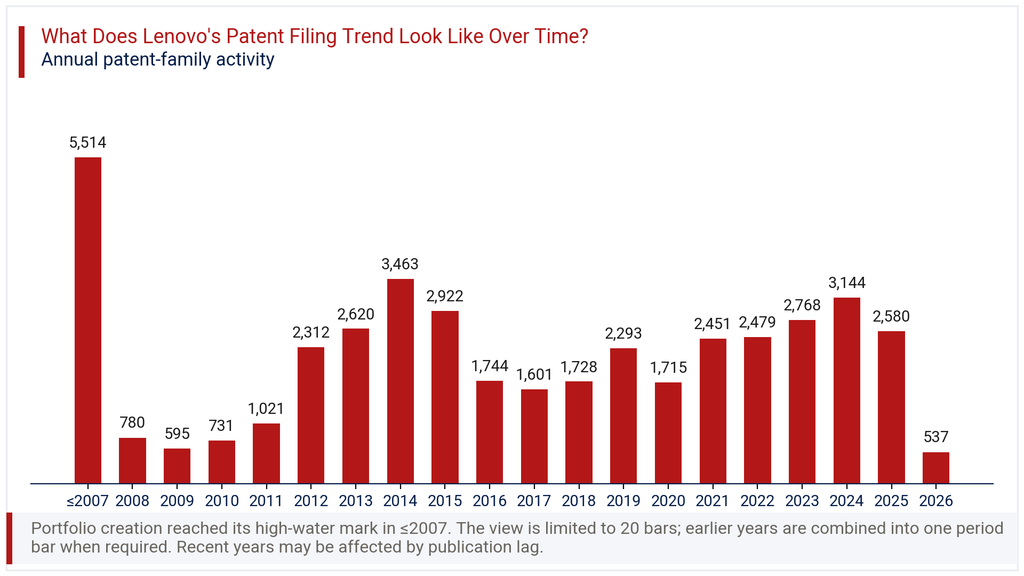
Filing counts eased after 2015, dropping to 1,601 by 2017, before recovering again through the early 2020s. By 2024, filings reached 3,144, close to the historic peak. The most recent two years, 2025 and 2026, show sharply lower counts, with the dataset recording a -79.2% change in the latest year. This drop reflects publication lag rather than an actual pullback in filing activity, since recently filed applications often take 18 months or longer to appear in public patent registers. Readers should treat the last two years as incomplete data, not as a real signal of declining investment.
Where Does the Lenovo Patent Portfolio Prioritize Patent Protection?
Patent geography within this portfolio points firmly toward China. The jurisdiction accounts for 77.5% of all filings, with 33,308 families, far ahead of any other market tracked. The United States follows at 30.0% share and 12,898 families, making it the clear second priority. The geographic chart in this section lays out this concentration across all 10 jurisdictions covered.
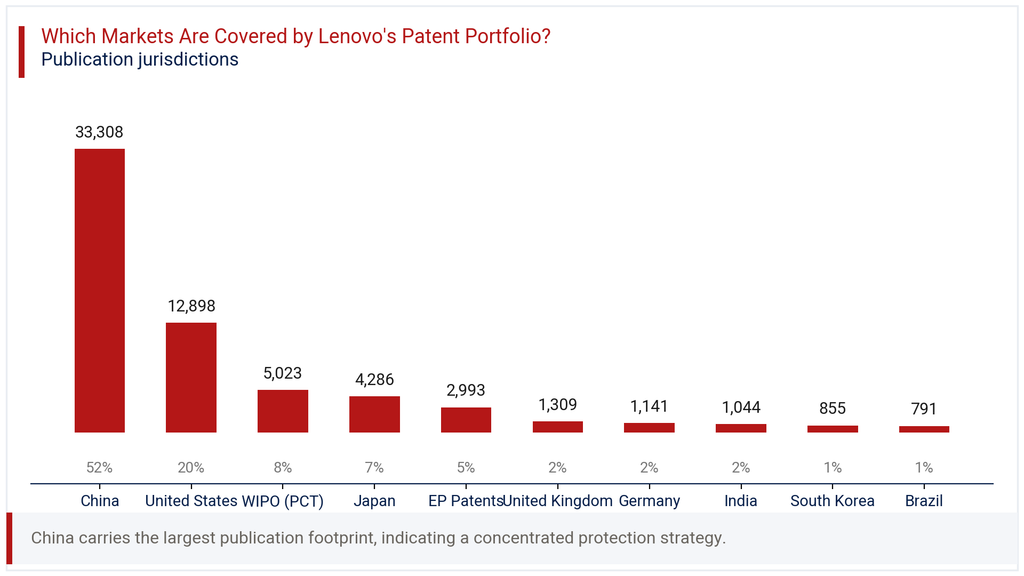
WIPO PCT filings, at 11.7% share and 5,023 families, indicate Lenovo uses international applications as a bridge toward multiple national phases later. Japan (10.0%), EP Patents (7.0%), and the United Kingdom (3.0%) round out the next tier. Germany, India, South Korea, and Brazil each hold smaller shares, between 1.8% and 2.7%. This spread suggests a filing strategy anchored in home-market protection first, with calculated expansion into large consumer electronics markets and innovation hubs where Lenovo manufactures, sells, or competes directly against global rivals.
Where is the Lenovo Patent Portfolio Building Protection Across Key Technologies?
IPC analysis of the portfolio shows a strong tilt toward computing infrastructure. G06F Digital Data Processing leads by a wide margin, with 22,001 families and a 46.1% share, nearly half the entire portfolio. H04W Wireless Communication Networks follows at 12.9%, and H04L Digital Information Transmission sits close behind at 11.5%. The technology chart in this section shows how dominant the top cluster is relative to everything else.
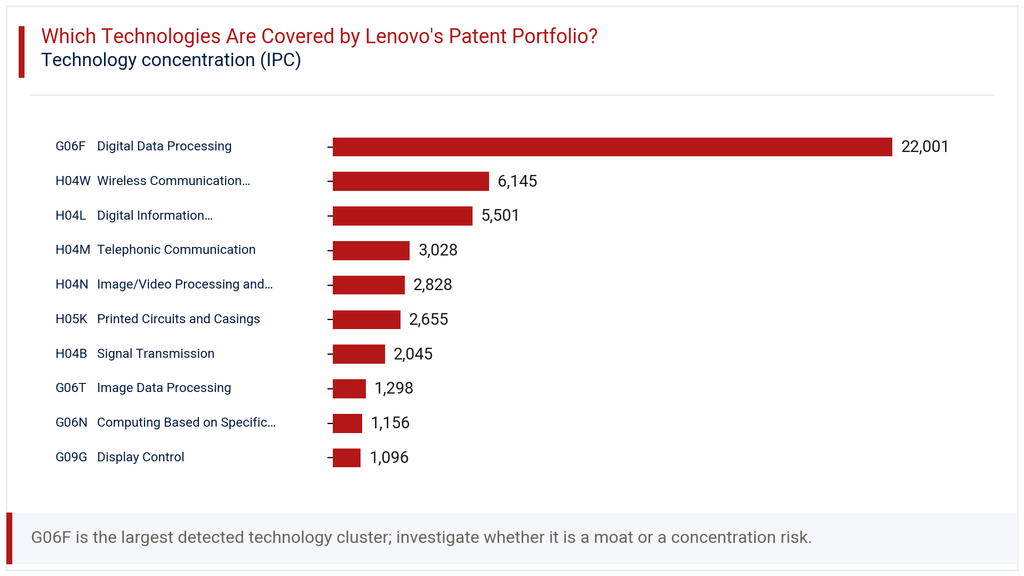
Beyond these three leaders, filing activity spreads across telephonic communication (H04M, 6.3%), image and video processing (H04N, 5.9%), and printed circuits and casings (H05K, 5.6%). Smaller but notable clusters include image data processing (G06T, 2.7%) and computing based on specific models (G06N, 2.4%), the latter pointing toward AI-adjacent filing activity. This technology mix lines up closely with Lenovo’s core product lines in computing hardware, mobile connectivity, and enterprise infrastructure, with early but visible investment building around machine learning and data processing techniques.
How Has the Lenovo Patent Portfolio Evolved Across Filing Geographies?
The heatmap in this section tracks how jurisdiction priorities shifted year by year. China remained the largest filer throughout, from 2,039 families in 2012 to 2,179 in 2024, with a visible peak of 2,887 in 2014. United States filings grew steadily too, moving from 411 in 2012 to 961 in 2022, before easing to 573 by 2024.
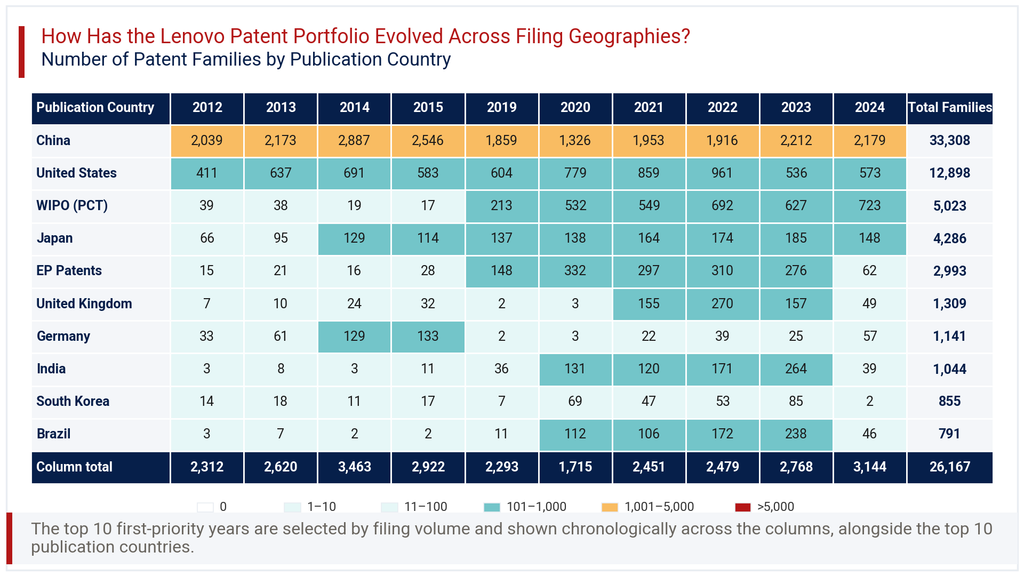
The more striking shift appears in WIPO PCT filings, which rose from near-negligible levels (19 to 39 families between 2012 and 2015) to 723 by 2024. This points to Lenovo increasingly using international applications as a filing gateway. European jurisdictions show similar patterns: the United Kingdom jumped from single digits in 2012-2015 to 270 in 2022, and India climbed from 3 in 2012 to 264 by 2023. These moves suggest a deliberate broadening of filing geography after 2019, likely tied to expanding manufacturing and sales footprints in these markets.
Consultant’s Perspective on Lenovo Patent Portfolio
Taken together, the Lenovo Patent Portfolio reflects a filer balancing home-market depth with selective global reach. The heavy concentration in China, at 77.5% share, is not unusual for a company headquartered there, but it does mean enforceability outside China depends on the smaller set of families filed in the US, Europe, and WIPO routes. The 48.9% grant rate and 69.9% active rate suggest a portfolio under active management rather than passive accumulation.
The technology concentration around G06F and wireless communication standards confirms Lenovo’s core identity as a computing and connectivity company, though the smaller but growing G06N cluster is worth watching. As AI becomes a bigger share of Lenovo’s reported revenue, this compute-focused filing base could matter for future licensing or defensive positioning. The recent rise in WIPO PCT and India filings also signals a broadening geographic ambition beyond legacy markets.
For any party evaluating this portfolio commercially, the recommendation is straightforward: validate specific high-value families directly, particularly around AI-adjacent IPC codes, rather than relying on aggregate counts alone.
Explore Deeper Insights with Expertlancing Research
This overview only scratches the surface of what the Lenovo Patent Portfolio can reveal. Expertlancing Research helps organizations go deeper, mapping specific families, tracking competitor filing moves, and assessing technology white space before key decisions. Whether the goal is licensing due diligence, M&A screening, or competitive benchmarking, our analysts can build a tailored view suited to the question at hand. Reach out to Expertlancing Research to commission a focused study on Lenovo or any portfolio relevant to your business.