

The Longcheer Patent Portfolio offers a useful window into how a major electronics ODM manufacturer protects its engineering output. Across 1253 total patent families, 74.4% remain active, covering both granted and pending cases. Of these, 585 patents have been granted and 347 applications are still pending, giving a grant rate of 46.7%. The remaining 321 families fall into lapsed, revoked, or expired status. These figures describe prosecution and maintenance outcomes only, not a verdict on patent quality or enforceability.
Filing activity peaked in 2022, when the company filed 221 patent families, the highest count in the entire portfolio. China dominates the filing geography, accounting for 99.9% of all families, across a total of 3 jurisdictions. The leading technology cluster is G06F, Digital Data Processing, with 245 families, making it the single largest area of invention activity within the portfolio.
This report draws on structured patent filing records to describe how Longcheer has built and managed its intellectual property position. Filing counts alone do not establish product success, market share, or competitive advantage in any given technology. Readers considering specific families for licensing, due diligence, or competitive benchmarking should independently verify those records before relying on them externally.
About Longcheer
Company Profile: Longcheer, formally Shanghai Longcheer Technology Co., Ltd., is a Chinese electronics company based in Shanghai. It is a Chinese electronics company headquartered in Shanghai, founded in 2002. It specializes in designing and manufacturing smartphones, tablets, wearable devices, and automotive electronics, with a product portfolio extending into AIoT. The company operates on an ODM model, manufacturing devices for other brands sold under various labels. According to a Frost & Sullivan report, in 2024 it ranked as the second largest consumer electronics ODM manufacturer by shipment volume, and the largest smartphone ODM manufacturer globally.
Since 2013, it has partnered with Xiaomi, handling design and production of several devices, while also serving Lenovo, Samsung, Amazon, Vivo, Oppo, and Motorola. It maintains R&D centres across several Chinese cities and branches in the United States, South Korea, Japan, Hong Kong, and Singapore.
How Healthy is Longcheer Patent Portfolio?
Patent portfolio health depends on how many filings survive prosecution and stay in force. Longcheer’s legal status composition shows 46.7% of families granted and 27.7% still pending examination. Together these account for the 74.4% active rate referenced earlier in this report. The remainder splits across 4.3% lapsed, 13.1% revoked, and 8.2% expired, as shown in the composition chart. A revoked share above the lapsed share suggests some contested or challenged filings rather than simple non-renewal.
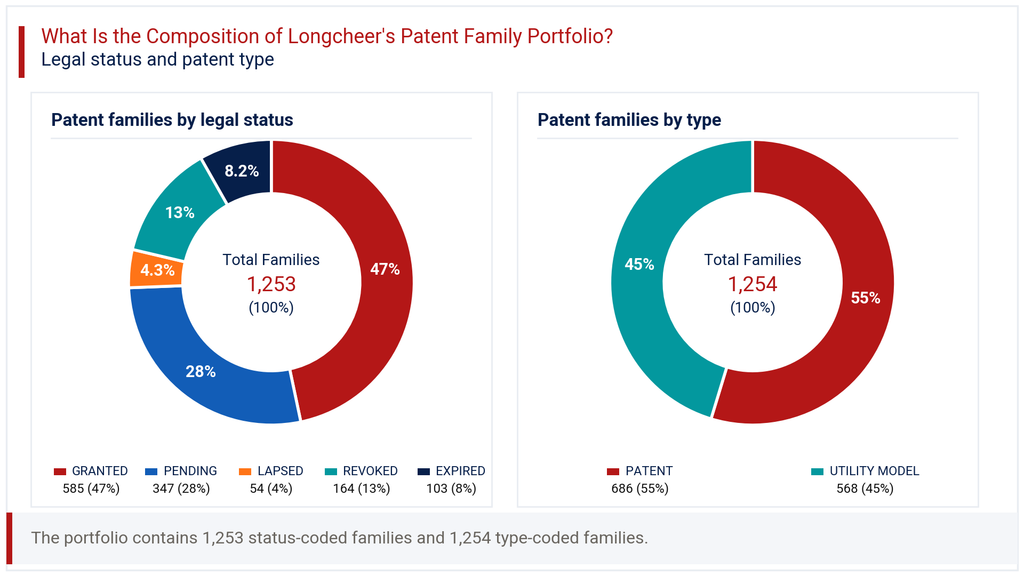
On patent type, the split between Patent and Utility Model filings is fairly even, at 54.7% and 45.3% respectively. This balance indicates Longcheer protects both substantive inventions and incremental design improvements, a common pattern for device manufacturers operating at high production volume. The sizeable pending share also points to an active prosecution pipeline rather than a portfolio in decline. For an ODM business competing on manufacturing speed and design iteration, this mix of protection types looks deliberate rather than incidental, and the legal status spread overall signals a reasonably well-managed, if not exceptionally clean, patent estate.
How Has the Longcheer Patent Portfolio Evolved Over Time?
Patent filing trends for Longcheer show a long build-up followed by a sharp acceleration. Early years saw modest activity, with 34 families filed in 2010 before a quiet stretch through 2012 to 2015. Filings picked up again from 2016 onward, climbing steadily to 81 in 2019 and 101 in 2020. The steepest rise came between 2020 and 2022, when annual filings roughly doubled to reach 221, the portfolio’s peak year, as the filing-trend chart illustrates.
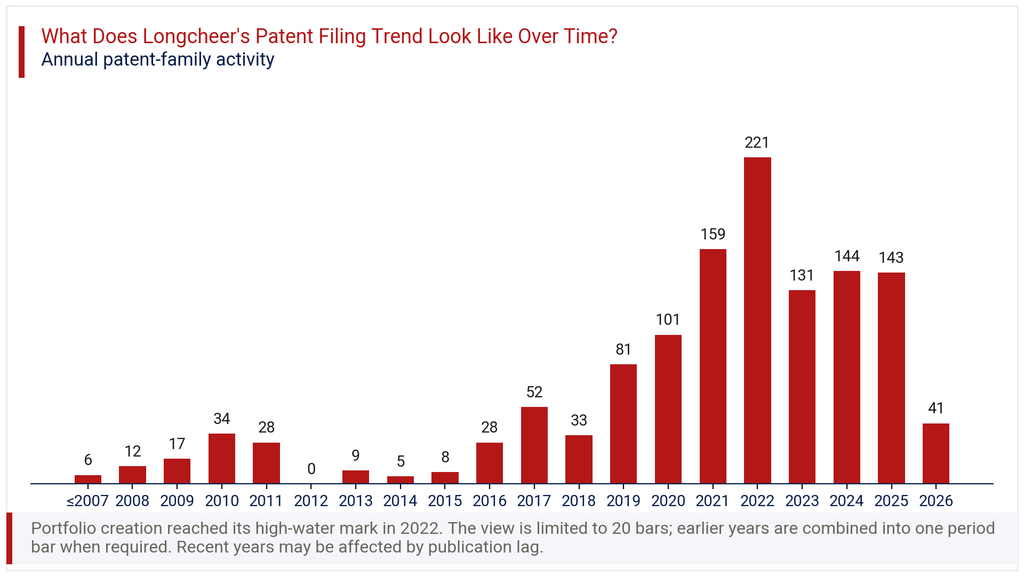
Activity has since moderated, with 131 families in 2023, 144 in 2024, and 143 in 2025. The 2026 count of 41 reflects a 71.3% drop from the prior year, but this should be read as publication lag rather than a genuine pullback. Patent applications typically take many months to surface in public records after filing. The more reliable signal is the sustained, elevated filing pace from 2020 through 2025, which marks a clear strategic shift from the company’s earlier, more sporadic filing behavior.
Where Does the Longcheer Patent Portfolio Prioritize Patent Protection?
Patent geography for Longcheer is heavily concentrated in a single market. China accounts for 99.9% of all filed families, a figure that dominates the geographic chart almost entirely. WIPO PCT filings make up just 0.5%, with Singapore contributing 0.1%. Across the full portfolio, filings span only 3 jurisdictions in total.
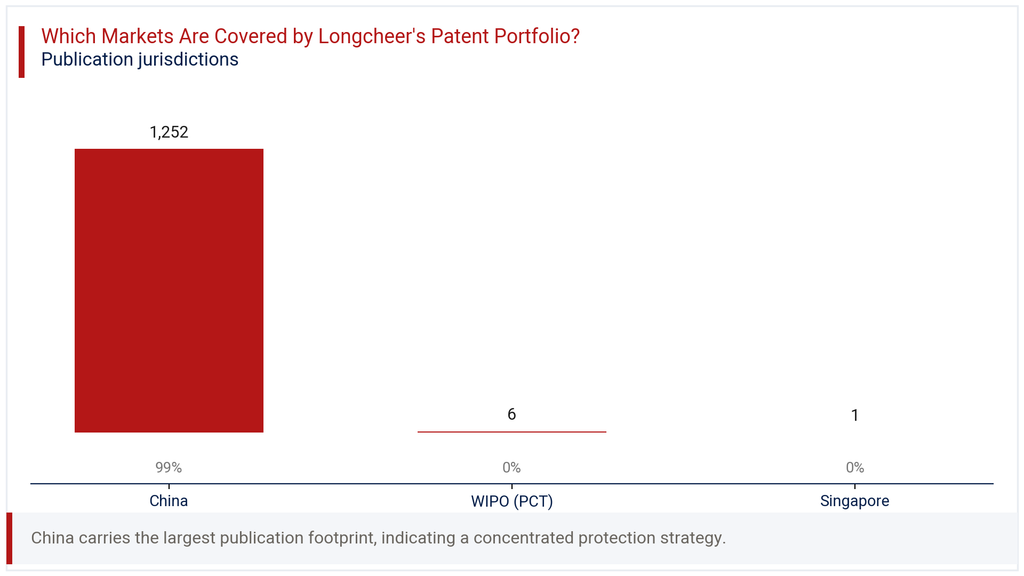
This concentration mirrors Longcheer’s operating model as an ODM manufacturer serving brand partners rather than selling under its own consumer-facing label. Domestic manufacturing and R&D operations based in China naturally generate domestic-first filing behavior. The limited PCT activity, appearing only in 2023 and 2024, hints at selective international interest rather than a broad global protection strategy. For stakeholders assessing competitive exposure outside China, this pattern matters. A portfolio this concentrated offers strong domestic coverage but limited enforceable protection in markets like the United States, Europe, or Southeast Asia, where Longcheer’s brand partners actually sell devices.
Where is the Longcheer Patent Portfolio Building Protection Across Key Technologies?
IPC analysis of the Longcheer patent portfolio points to a clear core competency. G06F, Digital Data Processing, leads with 245 families, or 25.5% of the total, as shown in the technology chart in this section. Close behind sits H04M, Telephonic Communication, at 189 families and 19.7% share, consistent with Longcheer’s smartphone ODM focus.
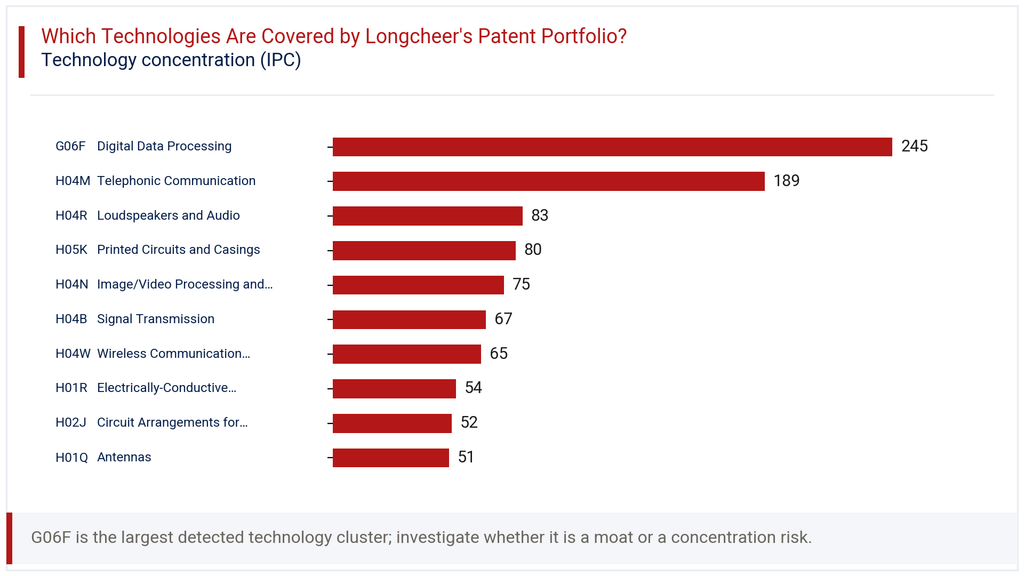
Beyond these two leading clusters, protection spreads across supporting hardware domains. H04R, Loudspeakers and Audio holds 83 families (8.6%), while H05K, Printed Circuits and Casings accounts for 80 families (8.3%). Image and video processing, wireless networking, connectors, power circuitry, and antennas each contribute between 5% and 8% of the portfolio. This spread reflects the full hardware stack needed to design and manufacture complete smartphones and connected devices. The concentration in computing and telephony confirms Longcheer’s innovation effort centers on core device functionality, with supporting technologies filling out a fairly complete component-level protection strategy.
How Has the Longcheer Patent Portfolio Evolved Across Filing Geographies?
The year-by-jurisdiction view, visible in the heatmap, confirms China has driven nearly every year of filing growth. From the earliest recorded filings through 2026, China’s annual counts track almost exactly with the portfolio’s overall totals, rising from 34 in 2010 to a peak of 221 in 2022. No other jurisdiction shows meaningful activity until 2023, when WIPO PCT filings appear for the first time with 2 families.
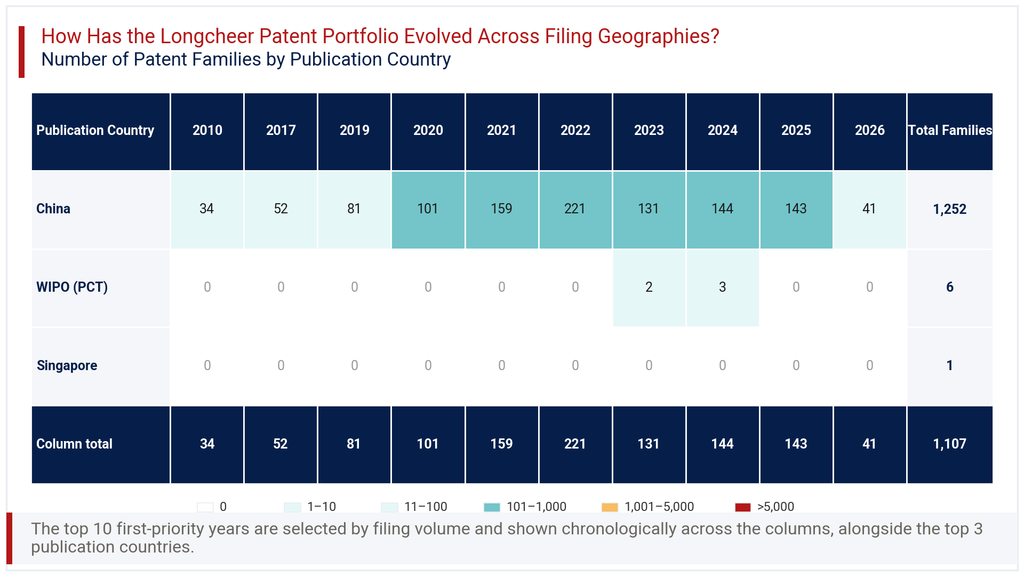
WIPO PCT activity continued modestly into 2024 with 3 families, but no further international filings appear in 2025 or 2026 based on current records. Singapore shows no filings in any year within this matrix despite appearing in the overall jurisdiction count. This pattern suggests Longcheer’s international filing interest, where it exists, is recent, small in scale, and possibly tied to specific partner requirements or product launches. The heatmap makes clear that any assessment of Longcheer’s global patent exposure must start from the understanding that its protection strategy remains, for now, a China-first approach.
Consultant’s Perspective on Longcheer Patent Portfolio
Looking at the Longcheer Patent Portfolio as a whole, the data tells a consistent story. A China-based ODM manufacturer has built a sizeable, technically focused patent estate concentrated almost entirely in domestic filings. The 46.7% grant rate and 74.4% active rate suggest reasonably sound prosecution management, though the 13.1% revoked share deserves closer scrutiny by anyone conducting due diligence.
The technology concentration in digital data processing and telephonic communication aligns well with Longcheer’s stated business as a smartphone and device ODM. This is not a scattershot portfolio; it reflects deliberate investment in core device engineering. What stands out, however, is the near-total absence of international filing activity relative to the company’s global customer base, which includes Xiaomi, Samsung, and Motorola.
My recommendation for any party evaluating this portfolio is to treat the domestic filings as a strong proxy for internal R&D intensity, but not as evidence of enforceable protection in export markets. Firms partnering with or competing against Longcheer in non-Chinese markets should watch for any expansion in PCT or direct foreign filings, as this would signal a meaningful strategic shift toward global IP protection.
Explore Deeper Insights with Expertlancing Research
This analysis only scratches the surface of what the Longcheer Patent Portfolio can reveal about competitive positioning in the ODM electronics space. Expertlancing Research helps technology companies, investors, and legal teams go deeper, mapping specific patent families, tracking competitor filing behavior, and assessing freedom-to-operate risk. If you need a tailored patent intelligence study on Longcheer or its peers, reach out to Expertlancing Research to discuss how we can support your next strategic decision.