


The Luxshare Patent Portfolio spans 3,886 total patent families, with an active rate of 81.5% covering both granted and pending filings. Of these families, 2,506 have been granted and 662 remain pending before patent offices worldwide. The grant rate stands at 64.5%, a figure that reflects prosecution outcomes across the portfolio. A combined 718 families fall into lapsed, revoked, or expired categories. These are prosecution and maintenance metrics only, and should not be read as a verdict on patent quality or enforceability.
Filing activity peaked in 2024, when Luxshare filed 640 patent families, the highest single-year count in the portfolio. China dominates as the top jurisdiction, accounting for 90.2% of filings, and the portfolio extends across 10 jurisdictions in total. The leading technology cluster is H01R, covering electrically conductive connections, with 1,278 families, making it by far the company’s deepest area of filing concentration.
This report draws on patent family data to map where Luxshare has built and maintained protection. Filing volume alone does not confirm commercial success, market dominance, or technical superiority over rivals. Readers considering business or investment decisions should validate specific patent families directly before relying on them externally.
About Luxshare
Company Profile: Luxshare Precision Industry Co. Ltd., also known as Luxshare-ICT, is a Chinese electronic components manufacturer headquartered in Bao’an, Shenzhen, Guangdong . Luxshare was founded in 2004 in Dongguan, China. It designs and manufactures computer cables and is also a key assembler of AirPods for Apple Inc.
The company has been listed publicly on the SME board of the Shenzhen Stock Exchange since 2010. In 2020, Luxshare became an iPhone assembler after acquiring two iPhone assembly plants. The official company website states the company was successfully listed on the Shenzhen Stock Exchange on September 15, 2010, and listed on the Hong Kong Stock Exchange on July 9, 2026, thereby establishing an A+H dual-capital platform. Luxshare reports it serves enterprise communication products, consumer electronic products, and automobile systems .
According to Wikipedia, revenue stood at US$32,759 million in 2023 , with net income of US$1,547 million and 232,585 employees that year .
How Healthy is Luxshare Patent Portfolio?
Patent portfolio health for Luxshare looks encouraging on paper. The active rate of 81.5% suggests most families remain either granted or still under examination. Granted patents make up 64.5% of the total, with 17.0% pending, as shown in the composition chart referenced in this section. Lapsed families account for 15.5%, while revoked and expired filings together add up to a small 1.7% and 1.3% respectively. This split points to a portfolio where maintenance decisions have largely favored keeping active rights rather than letting them lapse en masse.
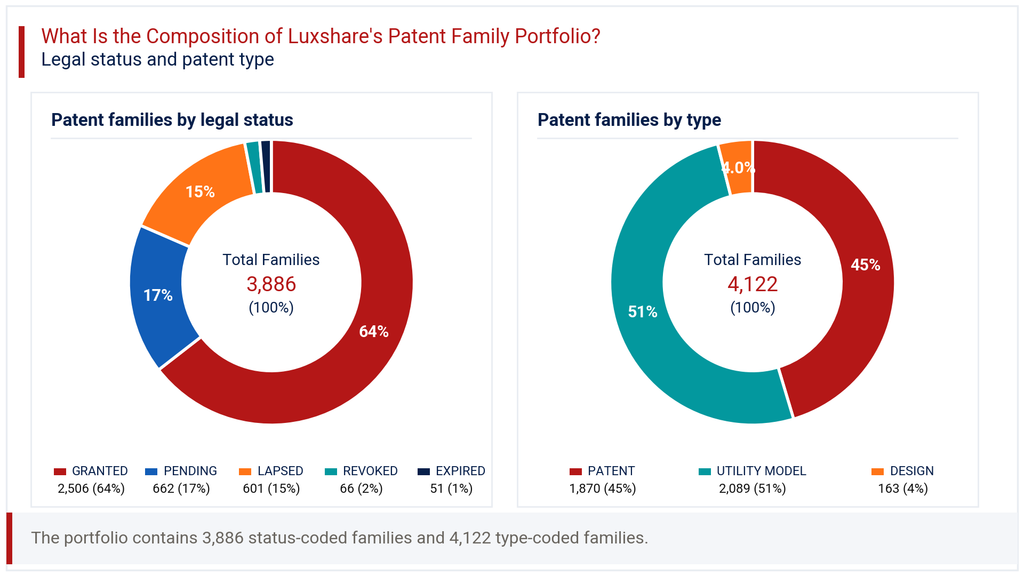
Looking at patent type, utility models lead at 50.7%, ahead of standard patents at 45.4%, with design filings at just 4.0%. This mix is typical for a Chinese electronics manufacturer, since utility models offer faster, cheaper protection for incremental engineering improvements. The relatively low share of design filings suggests Luxshare’s protection strategy centers on functional and mechanical innovation rather than aesthetics. Taken together, the legal status data indicates a portfolio under active management, not one accumulating dead weight.
How Has the Luxshare Patent Portfolio Evolved Over Time?
Patent filing trends for Luxshare show a long, slow build followed by a sharp acceleration. Filings stayed under 100 per year through most of the 2010s, climbing from 24 in 2011 to 105 by 2016. The real inflection arrives in 2020, when filings jumped to 392, then continued rising to 502 in 2021 and 551 in 2023. The filing-trend chart referenced in this section shows this shift clearly, marking a multi-year period of sustained expansion in patenting activity.
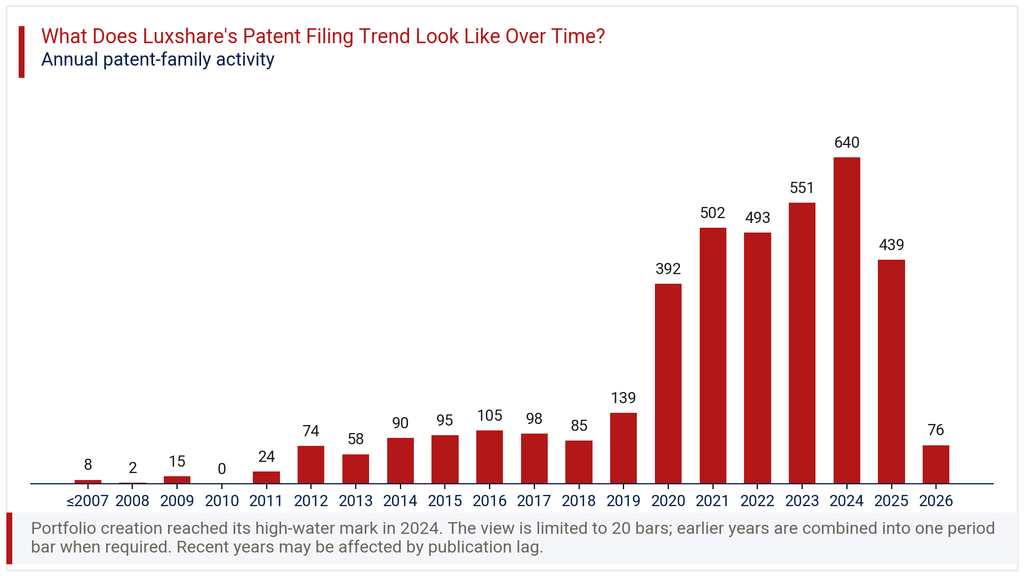
The portfolio reached its highest point in 2024 at 640 families, before dropping to 439 in 2025 and just 76 in 2026. The -82.7% change in the latest year looks dramatic, but this almost certainly reflects publication lag rather than a genuine pullback. Patent applications typically take 12 to 18 months to appear in public databases after filing. Recent-year figures should therefore be treated as incomplete rather than final, with the true 2025-2026 filing count likely to rise as records catch up.
Where Does the Luxshare Patent Portfolio Prioritize Patent Protection?
Patent geography within the Luxshare portfolio is heavily concentrated at home. China accounts for 90.2% of all filings, consistent with the company’s manufacturing base and domestic supply chain depth. Taiwan ranks second at 30.5%, reflecting proximity to electronics component production hubs. The United States follows at 18.5%, a meaningful share given its role as a major end market for consumer electronics. The geographic chart in this section lays out this concentration across all 10 jurisdictions covered by the portfolio.
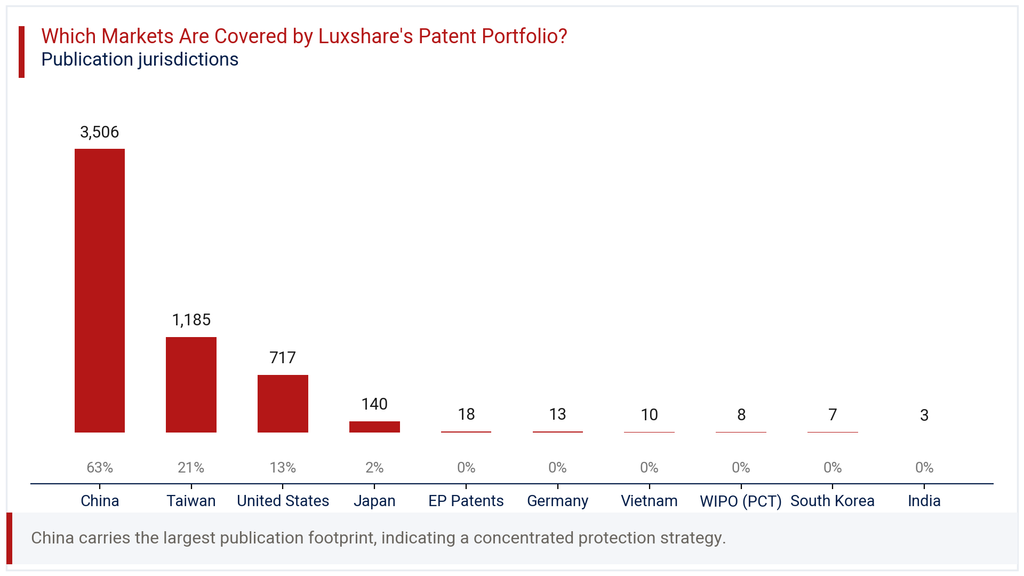
Beyond these three, filing activity thins out considerably. Japan holds 3.6%, while EP Patents, Germany, Vietnam, WIPO filings, South Korea, and India each represent well under 1%. This pattern suggests Luxshare treats international filing selectively, prioritizing markets tied closely to manufacturing partnerships or major customer relationships. The modest but present US and Japan filings likely track specific supply agreements with global electronics brands rather than broad international ambition. For a company of this scale, the filing footprint remains narrower than some multinational peers.
Where is the Luxshare Patent Portfolio Building Protection Across Key Technologies?
IPC analysis of the Luxshare portfolio reveals a clear technical center of gravity. H01R, covering electrically conductive connections, leads with 1,278 families, representing 42.5% of all classified filings. This aligns directly with Luxshare’s core business in connectors and cable assemblies. The technology chart in this section shows a steep drop after this top category, with H04R (loudspeakers and audio)次 next at 438 families and 14.6% share.
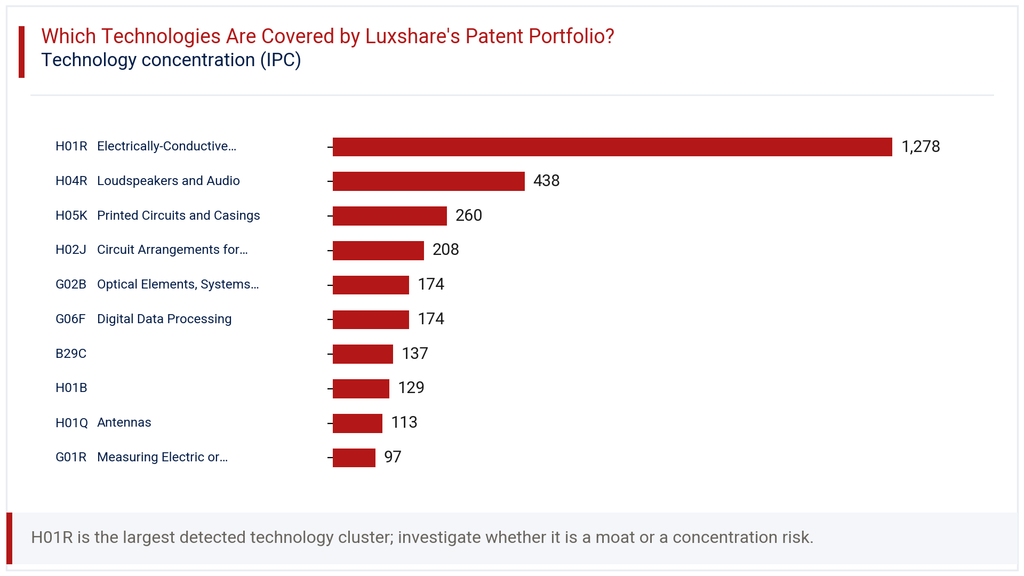
Other notable clusters include H05K for printed circuits and casings at 8.6%, and H02J covering power supply circuit arrangements at 6.9%. Optical elements (G02B) and digital data processing (G06F) each hold 5.8%, pointing to growing investment beyond pure connector hardware. Smaller categories like B29C, H01B, H01Q antennas, and G01R measuring instruments round out the top ten, together forming a technical base that supports Luxshare’s expansion into acoustic components, power systems, and precision measurement alongside its traditional connector strength.
How Has the Luxshare Patent Portfolio Evolved Across Filing Geographies?
The heatmap data tracing filings by year and jurisdiction shows China consistently as the backbone of Luxshare’s output. Domestic filings rose from 105 in 2016 to 593 in 2024, dwarfing every other market throughout the period. Taiwan’s growth tells a sharper story, moving from near-zero before 2018 to 264 filings in 2024, suggesting a deliberate expansion of regional protection alongside manufacturing investment there.
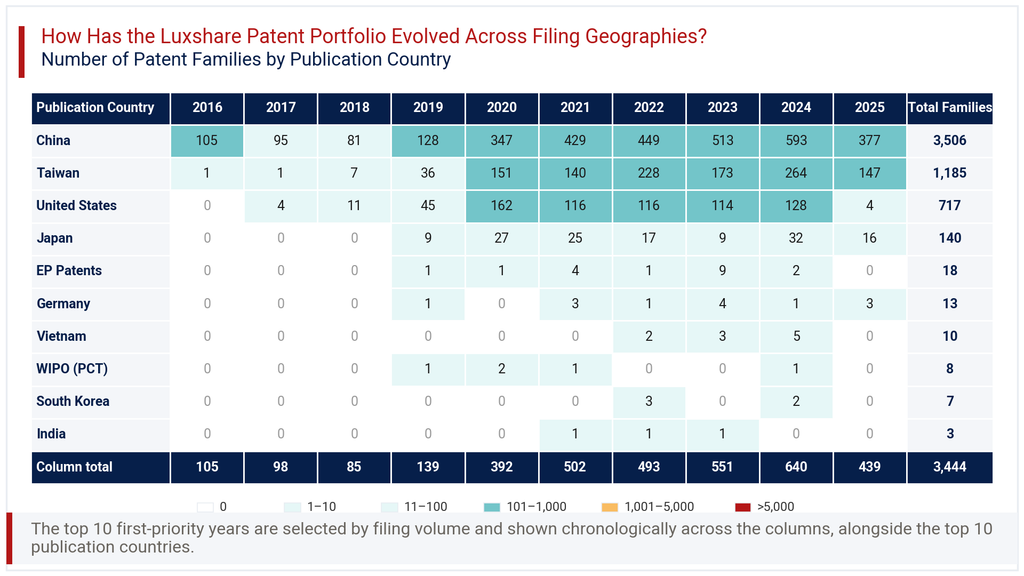
The United States shows a different pattern entirely. Filings rose from 11 in 2018 to a peak of 162 in 2020, then settled into a steadier range between 114 and 128 through 2023 and 2024. Smaller jurisdictions like Japan, Germany, and Vietnam show intermittent activity, often just single-digit filings in any given year. This uneven spread across geographies confirms that Luxshare calibrates its international filing closely to specific manufacturing or customer relationships, rather than pursuing uniform global coverage.
Consultant’s Perspective on Luxshare Patent Portfolio
The Luxshare Patent Portfolio tells a story of a manufacturer scaling intellectual property protection in step with its own industrial growth. The jump from double-digit annual filings a decade ago to 640 in 2024 mirrors Luxshare’s rise from a connector and cable specialist into a major assembler for global electronics brands. The heavy concentration in H01R connector technology, at 42.5% of classified filings, confirms this is a company protecting its core competency deeply rather than spreading thin.
What stands out is the filing concentration in China, at 90.2%, paired with selective but meaningful exposure in Taiwan and the United States. This looks like a company filing defensively near its factories and offensively near its largest customers, rather than building a sprawling global estate. The active rate of 81.5% suggests reasonably disciplined portfolio management, with limited drag from abandoned or revoked rights.
Going forward, the apparent drop in 2025-2026 filings deserves close monitoring once publication catches up, since it will clarify whether Luxshare’s patent intensity is plateauing or merely appears to pause. Companies evaluating partnerships or competitive exposure with Luxshare should examine specific families in the connector and audio clusters directly, rather than relying on aggregate counts alone.
Explore Deeper Insights with Expertlancing Research
Understanding a patent portfolio at this level of detail takes more than reading summary numbers. Expertlancing Research helps technology buyers, investors, and competitors move from raw filing data to decisions they can act on. Our team can benchmark specific patent families, assess freedom-to-operate questions, and track competitor filing patterns over time. If the Luxshare Patent Portfolio raises questions relevant to your business, reach out to Expertlancing Research for a tailored assessment built around your specific needs.