


The Midea Group Patent Portfolio offers a useful window into how one of China’s largest appliance makers protects its engineering output. Across 67,175 total patent families, 58.9% remain active, a figure covering both granted and pending cases. Of these, 33,227 families have been granted while 6,357 are still pending examination. The grant rate stands at 49.5%, a reasonably healthy conversion level for a filer of this scale. On the other side of the ledger, 27,591 families sit lapsed, revoked or expired, representing cases that fell out of force over time. These are prosecution and maintenance metrics only, and should not be read as a verdict on patent quality or enforceability.
Filing activity peaked in 2017, when Midea Group recorded 7,568 new families, the highest single-year count in the data. China dominates the jurisdictional footprint, accounting for 97.3% of all filings, with the portfolio spread across 10 distinct jurisdictions. The leading technology cluster is F24F Air-Conditioning, Air-Humidification, carrying 21,404 families, by far the largest concentration in the entire portfolio. This single IPC class alone signals where the company has placed its heaviest engineering and legal investment over the years.
This report reads the Midea Group Patent Portfolio as a lens into filing behaviour, not as proof of commercial success. Raw filing counts cannot, by themselves, confirm product traction or a durable competitive edge in any given market. Readers using this analysis for diligence, benchmarking or market entry decisions should verify specific patent families independently. Portfolio-level statistics are directional indicators meant to guide further inquiry, not substitutes for legal or technical due diligence on individual assets.
About Midea Group
Company Profile: Midea Group is a Chinese electrical appliance manufacturer. The company is headquartered in Beijiao town, Shunde District, Foshan, Guangdong, and listed on the Shenzhen Stock Exchange since 2013. As of 2021, the firm employed approximately 150,000 people in China and overseas with 200 subsidiaries and over 60 overseas branches.
Midea produces lighting, water appliances, floor care, small kitchen appliances, laundry, large cooking appliances, and refrigeration appliances, and is the largest microwave oven manufacturer, acting as an OEM for many brands. It also has a long history in producing home and commercial HVAC products, and in 2017 was reportedly the world’s largest producer of industrial robots and appliances. The company reports it operates across smart home, industrial technology, building technologies, robotics and automation, energy, healthcare and smart logistics segments, with R&D centres and manufacturing bases spanning multiple countries.
Midea describes itself as a publicly listed Fortune 500 company with more than 190,000 employees and the world’s leading manufacturer of home appliances. It has expanded operations to more than 200 countries and regions, per company sources.
How Healthy is Midea Group Patent Portfolio?
Patent portfolio health depends on how many assets remain enforceable versus how many have lapsed out of protection. For Midea Group, 49.5% of families hold granted status, while 9.5% sit pending in examination queues. Together these active cases drive the 58.9% active rate cited earlier. The remaining share splits across 18.9% lapsed, 11.6% revoked and 10.6% expired, as shown in the composition chart in this section. A near one-in-five lapse rate suggests a meaningful portion of filings were not renewed, often a sign of routine portfolio pruning rather than distress.
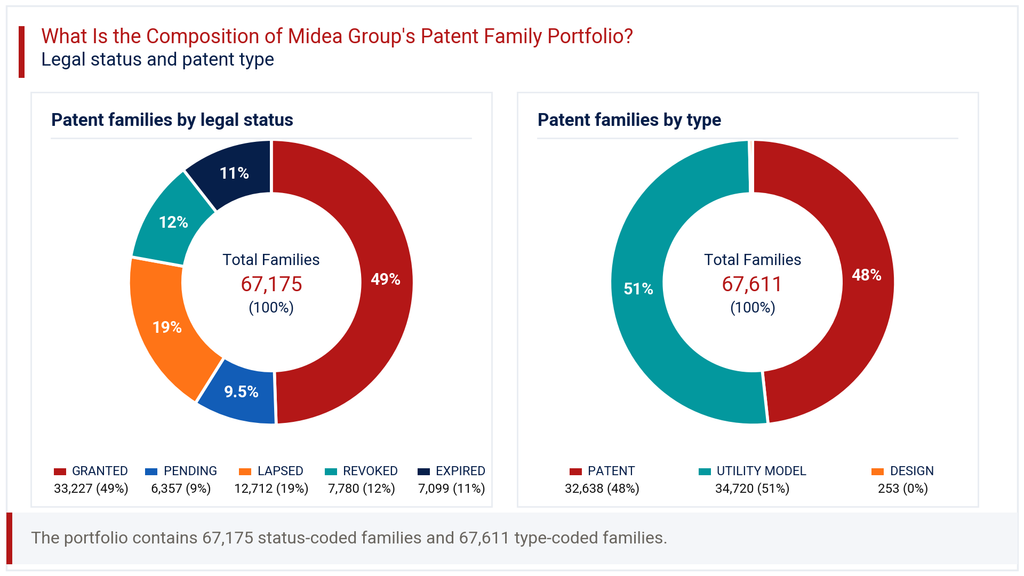
Patent type mix adds further texture to the legal status picture. Utility models make up 51.4% of the portfolio, slightly ahead of invention patents at 48.3%, with design rights a minor 0.4%. This split is typical for a Chinese appliance manufacturer, since utility models offer faster, cheaper protection for incremental engineering improvements. The heavier reliance on utility models over invention patents points to a filing strategy built around speed and volume. It favours broad coverage of product variations rather than concentrated bets on a few deeply examined inventions.
How Has the Midea Group Patent Portfolio Evolved Over Time?
Patent filing trends for Midea Group show a long build-up followed by a sharp acceleration. Filings stayed under 1,000 per year through 2011, then climbed steadily to 2,044 in 2013 and 3,239 in 2014. The real inflection came in 2015, when annual filings jumped to 7,260 and stayed above 7,000 through 2017, the peak year at 7,568. This four-year surge reflects a period of aggressive IP investment, likely tied to product diversification and HVAC expansion.
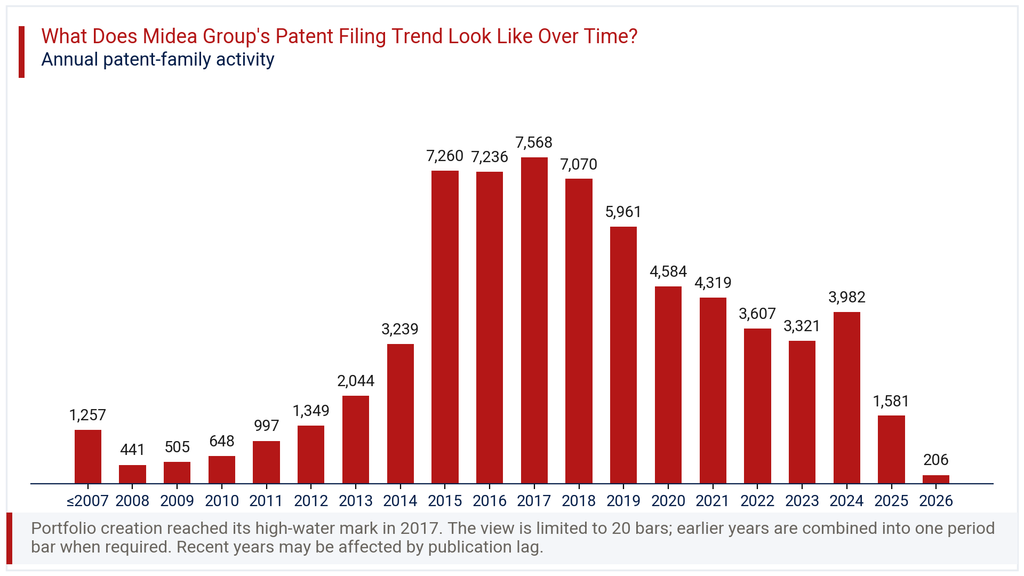
After 2018, filings declined gradually each year, reaching 3,321 by 2023 before ticking up to 3,982 in 2024, as seen in the filing-trend chart in this section. The sharpest apparent fall appears in 2025 and 2026, down 87.0% against the recent run rate. This drop should be read cautiously, since publication lag typically understates the most recent one to two years of filings. Patent applications take months to appear in public databases, so 2025 and 2026 figures are likely incomplete rather than a genuine pullback.
Where Does the Midea Group Patent Portfolio Prioritize Patent Protection?
Patent geography for Midea Group is heavily concentrated at home. China accounts for 97.3% of all filings, a dominant share that dwarfs every other jurisdiction, as the geographic chart in this section makes clear. This level of domestic concentration is common among large Chinese manufacturers whose primary production and sales base remains local, even as export volumes grow.
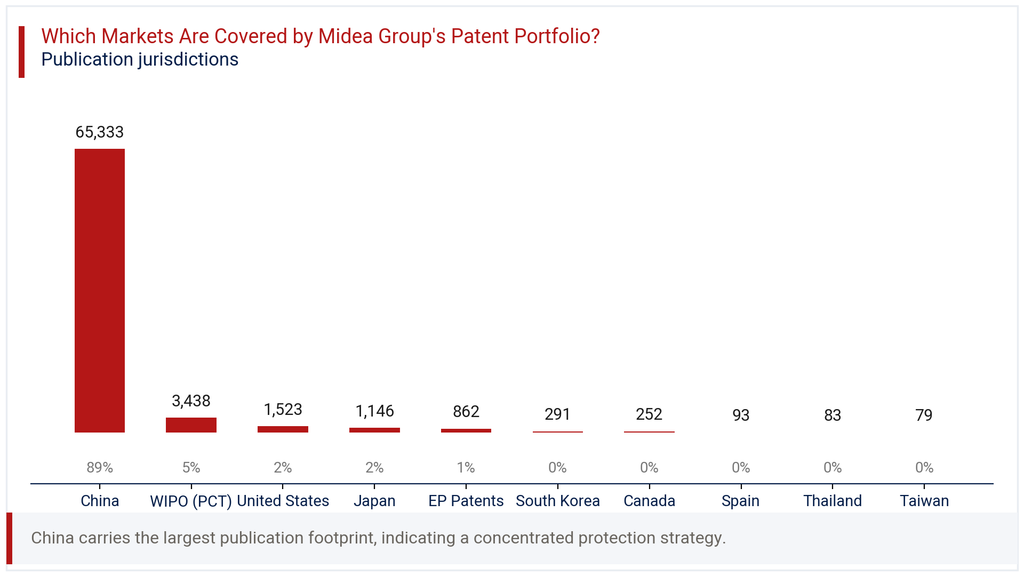
International filing is modest by comparison. WIPO PCT applications represent 5.1% of the portfolio, functioning as a bridge for later national-phase entry into other markets. The United States follows at 2.3%, with Japan at 1.7% and European filings at 1.3%. South Korea, Canada, Spain, Thailand and Taiwan each contribute well under 1% individually. Across all these destinations, the portfolio spans 10 distinct jurisdictions in total. This pattern suggests Midea Group treats overseas filing as selective, reserved for markets with meaningful commercial exposure rather than blanket global coverage.
Where is the Midea Group Patent Portfolio Building Protection Across Key Technologies?
IPC analysis of the Midea Group Patent Portfolio points clearly toward climate control technology. F24F Air-Conditioning, Air-Humidification leads with 21,404 families, or 36.8% of the entire portfolio, as the technology chart in this section illustrates. No other class comes close, confirming HVAC as the company’s core engineering focus.
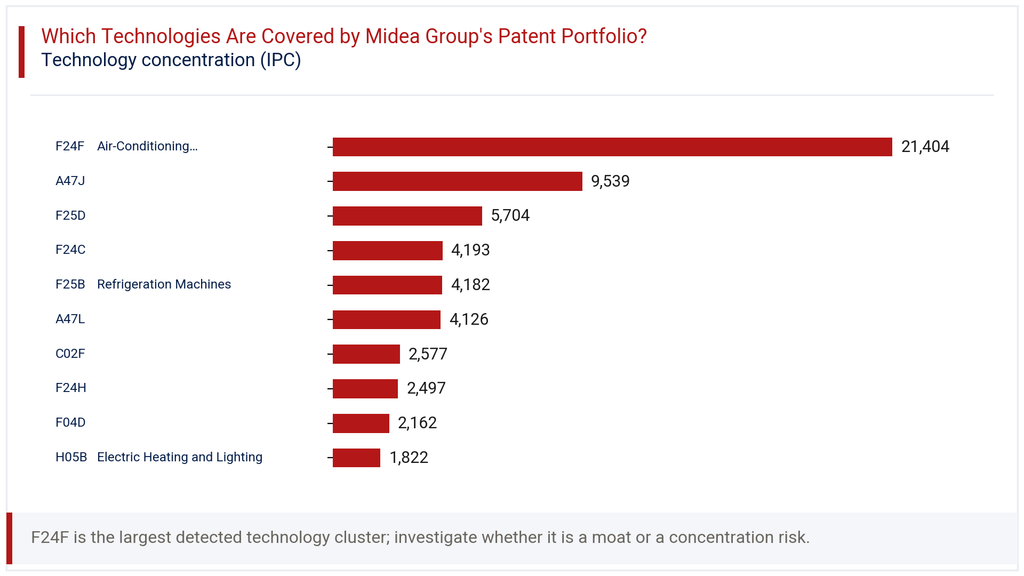
Kitchen appliance technology under A47J ranks second with 9,539 families, representing 16.4% of filings. Refrigeration-related classes follow, with F25D at 9.8% and F25B Refrigeration Machines at 7.2%, together reinforcing a strong cooling and thermal management theme. Cooking technology under F24C holds 7.2%, while cleaning appliances under A47L sit at 7.1%. Smaller but notable clusters include water treatment under C02F at 4.4%, water heating under F24H at 4.3%, fluid handling under F04D at 3.7%, and electric heating and lighting under H05B at 3.1%. This spread confirms a portfolio built around home comfort and thermal systems, with HVAC as the clear anchor category.
How Has the Midea Group Patent Portfolio Evolved Across Filing Geographies?
The heatmap in this section tracks how filing activity shifted across jurisdictions year by year. China’s filings rose from 7,166 in 2015 to a peak of 7,341 in 2017, then declined steadily to 3,829 by 2024. This mirrors the overall portfolio trend, since China drives the vast majority of total volume. The decline after 2018 across the domestic market suggests a maturing filing cadence rather than reduced business activity.
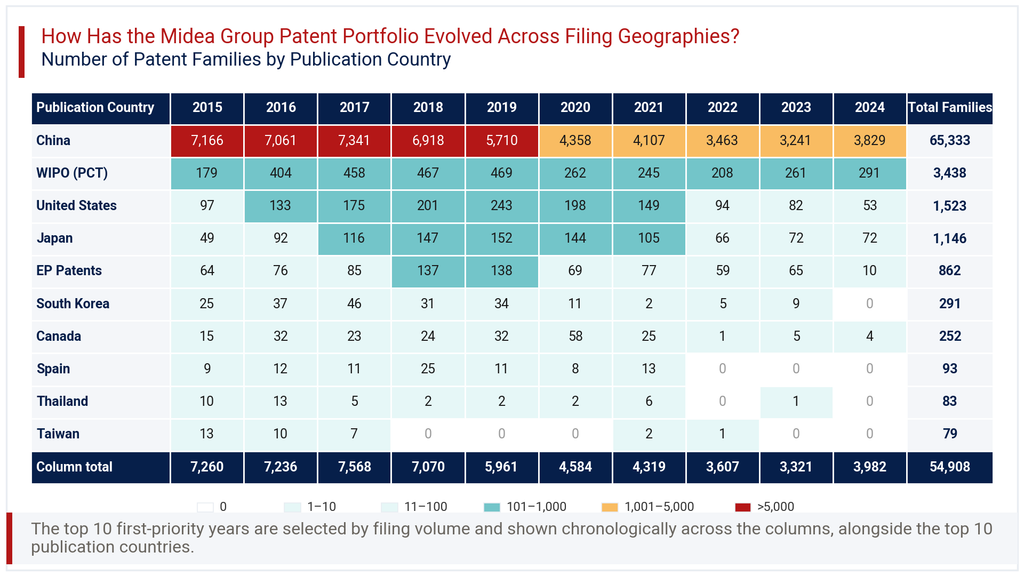
Overseas jurisdictions tell a more varied story. United States filings grew from 97 in 2015 to 243 in 2019, before falling to just 53 by 2024. Japan followed a similar arc, rising to 152 in 2019 and settling at 72 in 2024. European filings dropped sharply to 10 in 2024 after holding between 59 and 138 in prior years. South Korea, Canada, Spain, Thailand and Taiwan all show thin, uneven activity in recent years, with several reaching zero by 2024. This suggests Midea Group has been narrowing its international filing footprint to fewer, more selective markets.
Consultant’s Perspective on Midea Group Patent Portfolio
Taken together, the Midea Group Patent Portfolio reflects a domestically anchored, volume-driven filing strategy centred on HVAC and kitchen appliance engineering. The 97.3% China concentration, paired with a 36.8% weighting toward air-conditioning technology, confirms where the company’s innovation spend and legal protection genuinely sit. The heavy utility model share, at 51.4% against 48.3% for invention patents, points to a culture of fast, incremental filing rather than deep, singular technology bets.
The moderate 49.5% grant rate and 18.9% lapse share suggest a portfolio under active management, with older or lower-value assets allowed to expire. What stands out is the narrowing international footprint after 2019, visible across the United States, Japan and European filings. For a company describing itself as present in over 200 countries, this gap between commercial reach and overseas IP protection is worth watching. Competitors or partners engaging with Midea Group in non-Chinese markets should examine whether specific product lines carry matching patent coverage locally. The recommendation here is straightforward: track whether international filing picks up again as global HVAC and robotics competition intensifies, since current trends suggest a cautious, selective approach to protection outside China.
Explore Deeper Insights with Expertlancing Research
This overview only scratches the surface of what the Midea Group Patent Portfolio can reveal about competitive positioning and technology direction. Expertlancing Research helps clients go further, with family-level validation, competitor benchmarking and custom technology landscape studies. Whether you are assessing freedom to operate, scouting licensing opportunities, or evaluating a potential partner, our analysts can tailor the research to your specific question. Reach out to Expertlancing Research to turn these patterns into decisions you can act on with confidence.