


The Mindray patent portfolio offers a useful window into how one of China’s largest medical device makers protects its engineering and diagnostic work. Across its filing history, the company has built 7093 patent families, with 84.1% of these classified as active, covering both granted and pending cases. Of this total, 3705 families have been granted and 2258 remain pending, producing a grant rate of 52.2%. The remaining 1130 families fall into lapsed, revoked, or expired status. These figures describe prosecution and maintenance outcomes only, not a judgment on patent quality or enforceability.
Filing activity peaked in 2022, when Mindray recorded 816 new families, the highest single-year count in its history. China dominates the jurisdiction mix, accounting for 97.0% of filings, and the company has sought protection across 10 jurisdictions in total. On the technology side, the A61B classification, covering diagnosis, surgery, and identification, leads the portfolio with 3017 families, making it the single largest cluster by a wide margin.
This report draws on patent filing records to describe how Mindray has built and managed its intellectual property position over time. Filing counts alone do not establish product success, market share, or competitive advantage. Readers considering the Mindray patent portfolio for investment, partnership, or competitive assessment should verify specific families through primary patent registers before relying on them externally. The analysis that follows walks through legal status, filing trends, geographic spread, technology concentration, and the interaction between geography and time.
About Mindray
Company Profile: Mindray is a Chinese multinational health technology company headquartered in Shenzhen, Guangdong. The company designs and produces medical equipment and accessories for both human and veterinary use. Mindray is organized into three key business lines: Patient Monitoring and Life Support, In-Vitro Diagnostic Products, and Medical Imaging Systems.
Founded in 1991 in Shenzhen by seven former employees of Anke, the company grew by providing domestic patient monitoring, imaging, and other diagnostic products. By 2008, Mindray was recognized as China’s largest medical device manufacturer. Mindray maintains 41 subsidiaries and branch offices in 31 countries, along with 32 branch offices in China. Mindray listed on the NYSE in September 2006, delisted in March 2016, and later re-listed on the Shenzhen Stock Exchange in October 2018. Its products span patient monitors, ultrasound systems, anesthesia delivery systems, and hematology analyzers, among others. The company reports revenue of US$5.1 billion in 2024.
How Healthy is Mindray Patent Portfolio?
Patent portfolio health depends heavily on legal status distribution, and Mindray’s numbers tell a fairly balanced story. Of its 7093 families, 52.2% carry granted status, while 31.8% remain pending examination. A smaller share has exited the active pool: 3.8% lapsed, 5.2% were revoked, and 7.0% expired. Combined, these three categories account for a modest portion of the total, leaving 84.1% of the portfolio either granted or still in process.
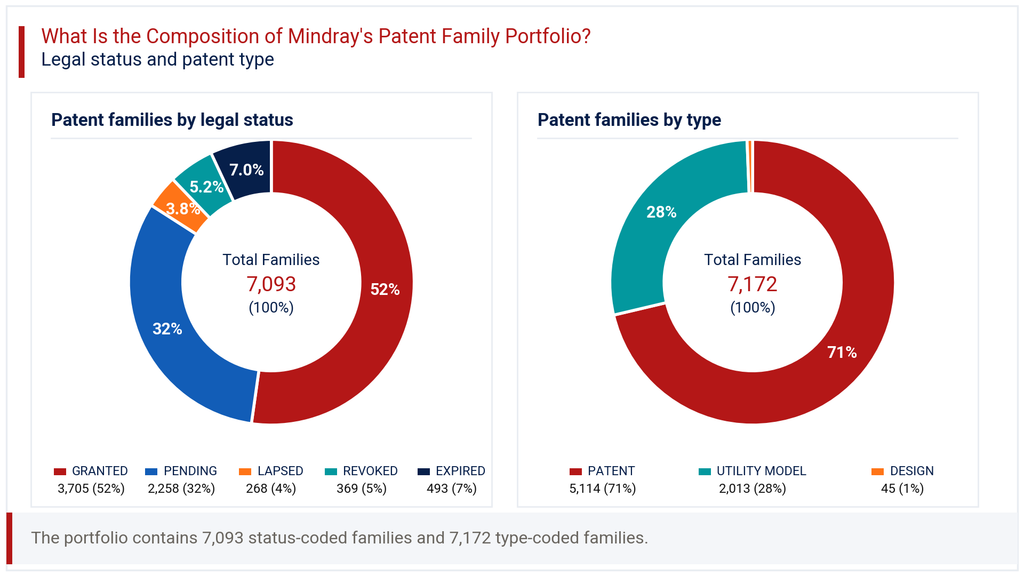
This composition points to a portfolio that is actively maintained rather than left to attrition. The patent type split reinforces this picture. Standard patents make up 71.3% of filings, utility models represent 28.1%, and design filings account for a negligible 0.6%. This mix suggests Mindray relies primarily on full patent protection, using utility models selectively, likely for incremental engineering improvements common in medical device manufacturing.
The composition chart in this section shows that revoked and expired families together remain smaller than the pending pool. That balance matters for anyone assessing patent legal status here. A portfolio with a high pending share, as Mindray shows, signals continued investment in new filings rather than a legacy book running down. It also means a meaningful share of claims have not yet reached final determination, which buyers or partners should factor into any near-term valuation work.
How Has the Mindray Patent Portfolio Evolved Over Time?
Patent filing trends for Mindray show a distinct inflection point starting in 2018. Annual filings jumped from 208 in 2017 to 633 in 2018, then continued climbing to 654 in 2019, 754 in 2020, and a peak of 816 in 2022. Before this period, yearly counts had moved in a narrower band, generally between 96 and 208 from 2008 through 2017. The shift from 2018 onward marks a clear change in filing strategy and resourcing.
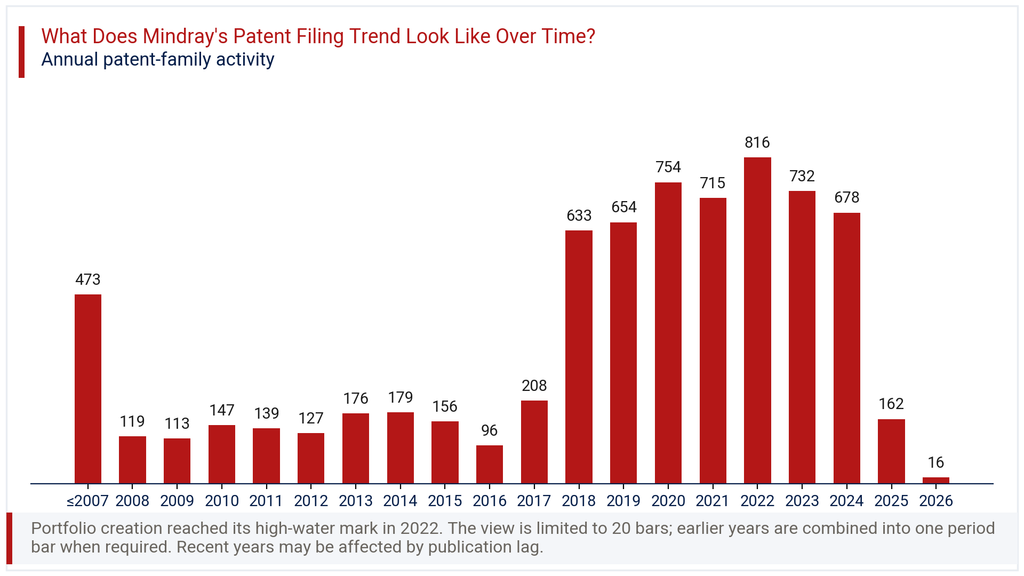
Filings eased slightly after the 2022 peak, falling to 732 in 2023 and 678 in 2024. The sharp drop recorded for 2025, down 90.1% against the prior year’s pace, reflects publication lag rather than an actual pullback in filing activity. Patent applications typically take 18 months or longer to appear in public databases, so the most recent one to two years will always understate real filing volume until records catch up.
The filing-trend chart in this section should be read with that lag in mind. The multi-year run above 700 annual filings from 2020 through 2023 indicates a sustained, well-resourced filing programme rather than a short burst. This pattern is consistent with a company scaling its research output alongside its growing device portfolio and global revenue base.
Where Does the Mindray Patent Portfolio Prioritize Patent Protection?
Patent geography for Mindray is concentrated overwhelmingly at home. China accounts for 97.0% of all filings, reflecting the company’s manufacturing base and primary commercial market. The World Intellectual Property Organization’s PCT route follows at 15.7%, used as a bridge toward international protection rather than a final destination. The United States ranks next at 11.3%, followed by European Patents at 4.1%.
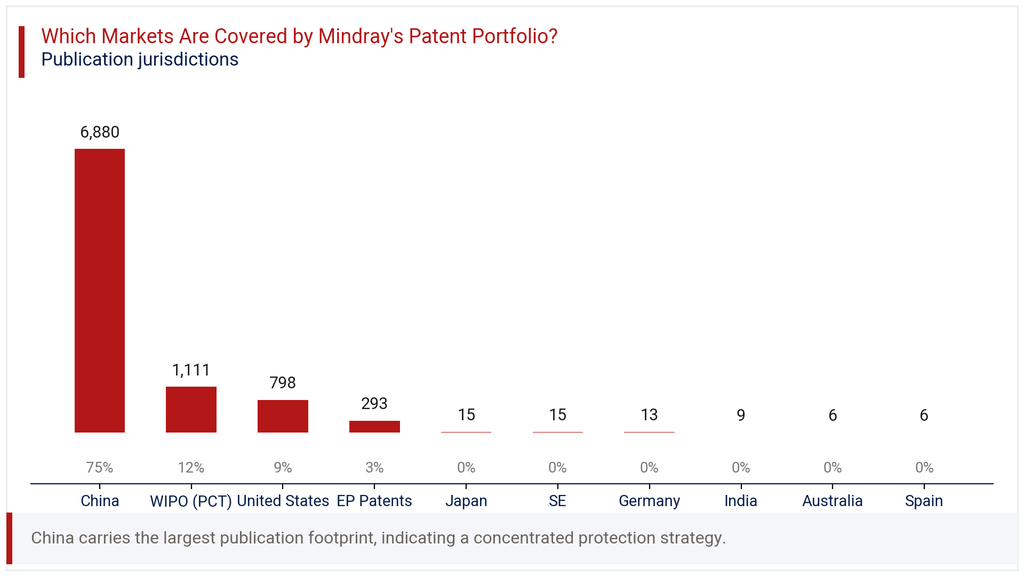
Beyond these four, filing activity drops sharply. Japan, Germany, India, Australia, and Spain each account for 0.2% or less of total filings, with India at 0.1% despite being a large medical device market. This distribution shows a company whose intellectual property strategy still centers on domestic protection first, with selective international filing concentrated in its largest export markets.
The geographic chart in this section makes the China-first pattern immediately visible. For a reader assessing competitive exposure, the modest Western filing share does not necessarily mean weak protection abroad. It may instead reflect selective filing, where only commercially significant innovations get pursued through the costlier US and European routes. Companies evaluating Mindray in markets like Germany or Australia should check family-level coverage directly rather than assuming gaps.
Where is the Mindray Patent Portfolio Building Protection Across Key Technologies?
IPC analysis of the Mindray patent portfolio points to a clear concentration in core diagnostic and monitoring technology. The A61B class, covering diagnosis, surgery, and identification, leads with 3017 families, or 40.2% of the total. G01N, covering investigation and analysis of materials, follows closely at 2107 families and 28.1% share. Together, these two classes account for well over two-thirds of all technology-classified filings.
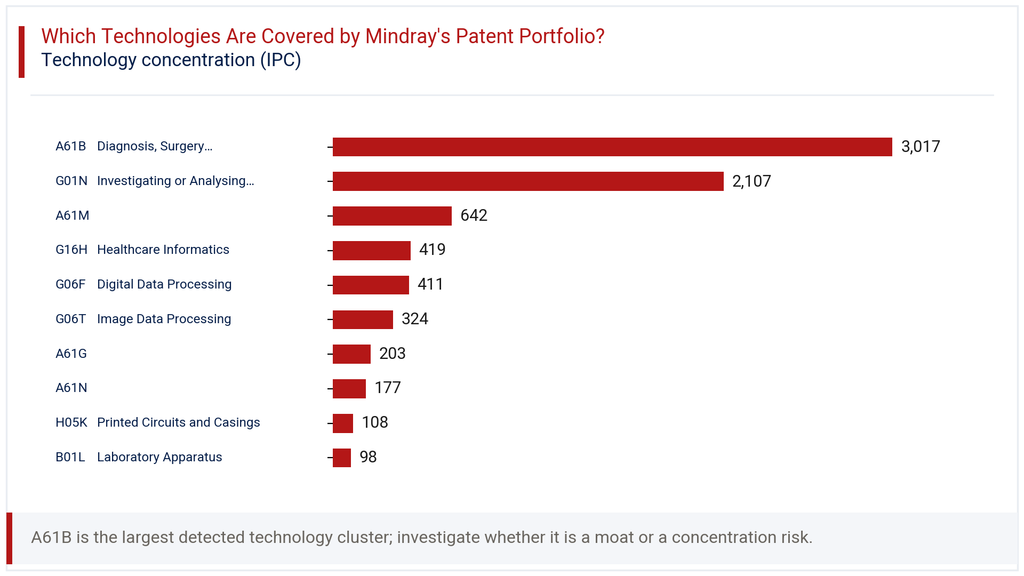
Beyond these leaders, A61M holds 642 families (8.6%), reflecting infusion and fluid delivery systems common in hospital settings. Healthcare informatics under G16H contributes 419 families (5.6%), and digital data processing under G06F adds 411 families (5.5%). Image data processing, G06T, accounts for 324 families (4.3%).
The technology chart in this section shows a long tail after these top clusters, with classes like H05K and B01L each under 2% share. This spread suggests Mindray’s research investment sits mainly in diagnostic instrumentation and materials analysis, with informatics and imaging software as growing but secondary areas. Competitors and partners assessing differentiation should watch whether the informatics share expands in future filing years, as that would signal a shift toward software-driven monitoring tools.
How Has the Mindray Patent Portfolio Evolved Across Filing Geographies?
Layering jurisdiction against filing year reveals how Mindray’s international push developed alongside its domestic growth. China filings rose from 170 in 2007 to 629 in 2018, then climbed further to 796 by 2022, before easing to 670 in 2024. This domestic trajectory closely mirrors the overall portfolio trend, confirming China as the consistent backbone of filing activity across every year shown.
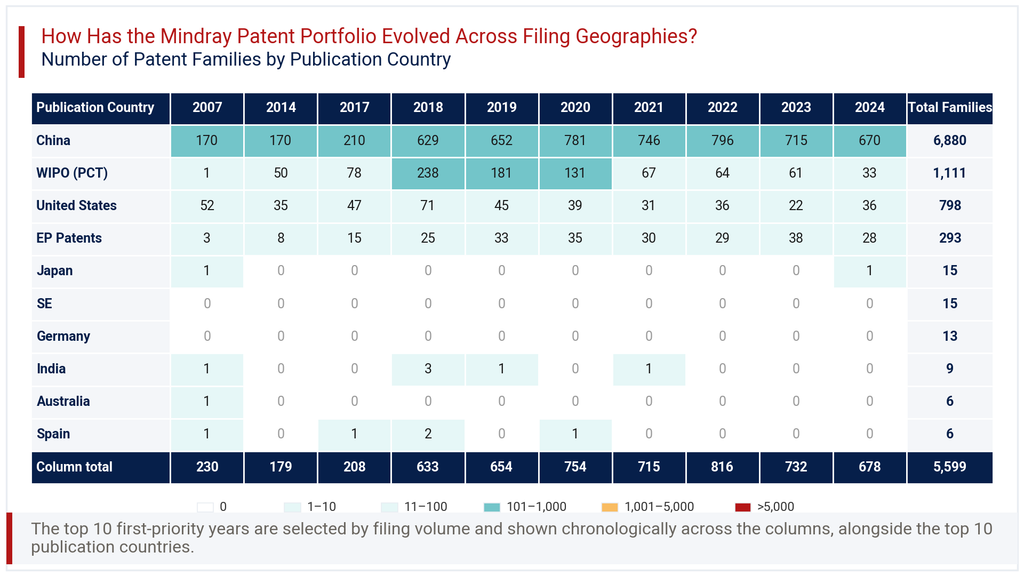
The WIPO PCT route tells a different story. Filings there rose from just 1 in 2007 to 238 in 2018, then declined steadily to 33 by 2024. This pattern suggests Mindray used PCT filings heavily during its 2018 international expansion push, then shifted toward direct national filings as it established more systematic market-specific protection.
The heatmap in this section shows United States filings holding in a fairly narrow band, from 47 in 2017 down to 36 in 2024, without the sharp swings seen in PCT numbers. European filings grew modestly, from 15 in 2017 to 28 in 2024. Smaller markets like Japan, India, and Spain show only intermittent single-digit activity across the full period, confirming these remain opportunistic rather than core filing destinations for Mindray.
Consultant’s Perspective on Mindray Patent Portfolio
Taken as a whole, the Mindray patent portfolio reflects a company that scaled its intellectual property programme deliberately rather than organically. The 2018 inflection point, where filings nearly tripled from the prior year, lines up closely with Mindray’s return to Chinese capital markets and continued global revenue growth. That timing is not coincidental in most cases of this kind.
The concentration in A61B and G01N technology classes, together accounting for 68.3% of filings when combined, confirms where Mindray’s core engineering investment sits. Diagnostic and materials analysis technology remains the foundation of its competitive position, well ahead of newer informatics and imaging categories. This is consistent with a company whose revenue still depends heavily on patient monitoring and diagnostic hardware.
The geographic concentration in China, at 97.0% of filings, is the single factor outside buyers should examine most carefully. Anyone assessing the Mindray patent portfolio for licensing, acquisition, or competitive benchmarking in Western markets should request family-level verification rather than relying on aggregate counts. My recommendation is to track whether PCT and direct US or EP filings recover in coming years, as that would signal a renewed international IP push.
Explore Deeper Insights with Expertlancing Research
This overview only scratches the surface of what a detailed patent study can reveal. Expertlancing Research helps technology buyers, investors, and corporate strategy teams go deeper, mapping specific patent families, tracking competitor filing behaviour, and assessing freedom-to-operate risk. If your team needs clarity on Mindray’s technology position or a comparable competitor analysis, reach out to Expertlancing Research for a tailored patent intelligence engagement built around your specific business question.