


The OnePlus Patent Portfolio offers a useful lens into how a leading smartphone brand builds and defends its technology base. Across its filing history, the company has built 1182 patent families worldwide, with an active rate of 60.9% covering patents that are either granted or still pending. Of this total, 621 families have been granted, while 99 remain pending before patent offices. The grant rate stands at 52.5%, a figure that reflects examination outcomes rather than portfolio quality on its own. Separately, 462 families fall into lapsed, revoked, or expired status, combining 153 lapsed, 303 revoked, and 6 expired cases. These figures describe prosecution and maintenance activity only, not a verdict on legal strength or commercial enforceability.
Filing activity tells its own story. OnePlus recorded its peak filing year in 2020, with 287 families filed, a surge that aligns with the company’s expansion into mid-range devices and camera technology. China dominates the filing map, accounting for 97.4% of the jurisdictions_pct share, while the portfolio spans 10 jurisdictions in total. On the technology side, the leading cluster is G06F Digital Data Processing, with 279 families, ahead of wireless communication and telephony-related classes. Together, these numbers sketch a portfolio concentrated heavily in one home market but technically diversified across computing and communication domains.
This report is meant to help readers interpret filing patterns, not to draw conclusions about product performance or market dominance. Patent counts alone cannot confirm whether a specific invention translates into commercial advantage or courtroom strength. Anyone relying on this analysis for investment, licensing, or competitive decisions should verify individual patent families directly through official patent office records before acting on them.
About OnePlus
Company Profile: OnePlus Technology (Shenzhen) Co., Ltd., trading as OnePlus, is a Chinese consumer electronics manufacturer headquartered in Shenzhen, Guangdong, China. It is a subsidiary of Oppo. The company was founded by Pete Lau and Carl Pei on 16 December 2013 to develop a high-end flagship smartphone that would come to be known as the OnePlus One. OnePlus continued releasing smartphones, and in 2020 launched the OnePlus Nord, its first mid-range smartphone since the OnePlus X in 2015.
Carl Pei oversaw design and marketing until his departure in October 2020, after which he founded the consumer electronics company Nothing. The official website states that OnePlus creates beautifully designed products with premium build quality and brings the best technology to users around the world. Its current product lineup, per its website, includes the OnePlus 13 series, Nord CE5, and Buds 4 audio devices. The company operates under the “Never Settle” brand philosophy.
How Healthy is OnePlus Patent Portfolio?
Patent portfolio health depends on how filings move through legal status categories over time. Within the OnePlus Patent Portfolio, 621 families stand granted, representing 52.5% of the total, while 99 remain pending at 8.4%. On the weaker side, 153 families have lapsed (12.9%), 303 have been revoked (25.6%), and 6 have expired (0.5%). The composition chart in this section shows this split visually, highlighting that revocations form a sizeable share of the inactive pool, larger than lapses alone.
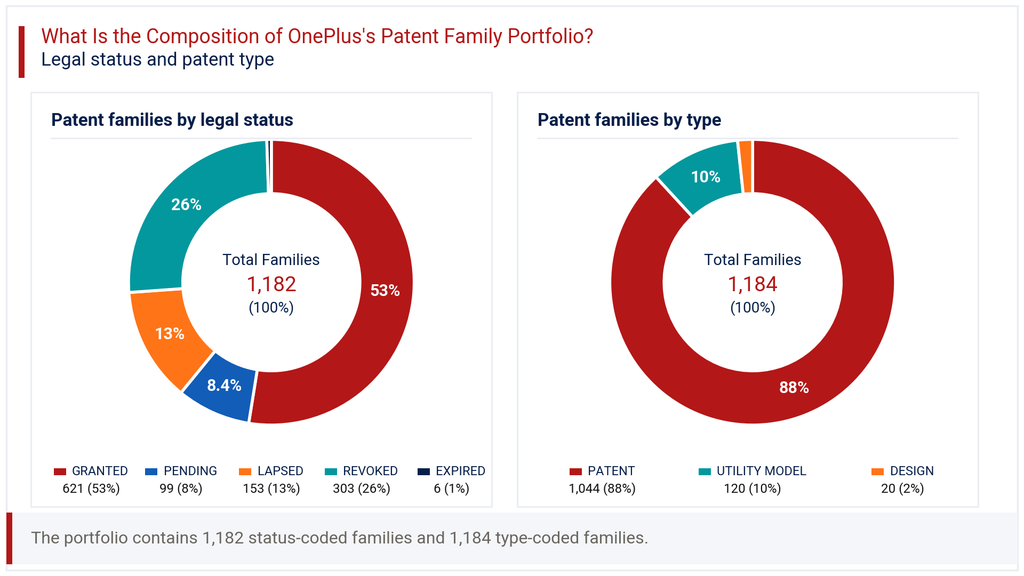
The patent type distribution adds further texture to this picture. Standard patents make up 88.2% of filings, utility models account for 10.1%, and design filings form a small 1.7% slice. This mix suggests OnePlus has prioritized full-term invention patents over shorter-protection utility models, a pattern typical of companies competing on core technology rather than incremental design tweaks. The relatively high revocation count, however, deserves attention from anyone assessing patent portfolio health here.
It points toward aggressive early-stage filing followed by selective pruning, rather than a weak examination process. Combined with an active rate of 60.9%, the portfolio shows a reasonably maintained base, though the revocation share means a meaningful chunk of filings did not survive opposition or maintenance requirements long term.
How Has the OnePlus Patent Portfolio Evolved Over Time?
Patent filing trends within the OnePlus Patent Portfolio show a distinct rise-and-plateau pattern. Filings stayed negligible before 2014, then jumped to 78 in 2015 as the company’s early smartphone lineup matured. Growth continued through 94 in 2016, dipped slightly to 70 in 2017, then climbed again to 108 in 2018 and 197 in 2019. The filing-trend chart in this section shows 2020 as the clear peak, with 287 families, coinciding with the OnePlus Nord launch and broader product diversification that year.
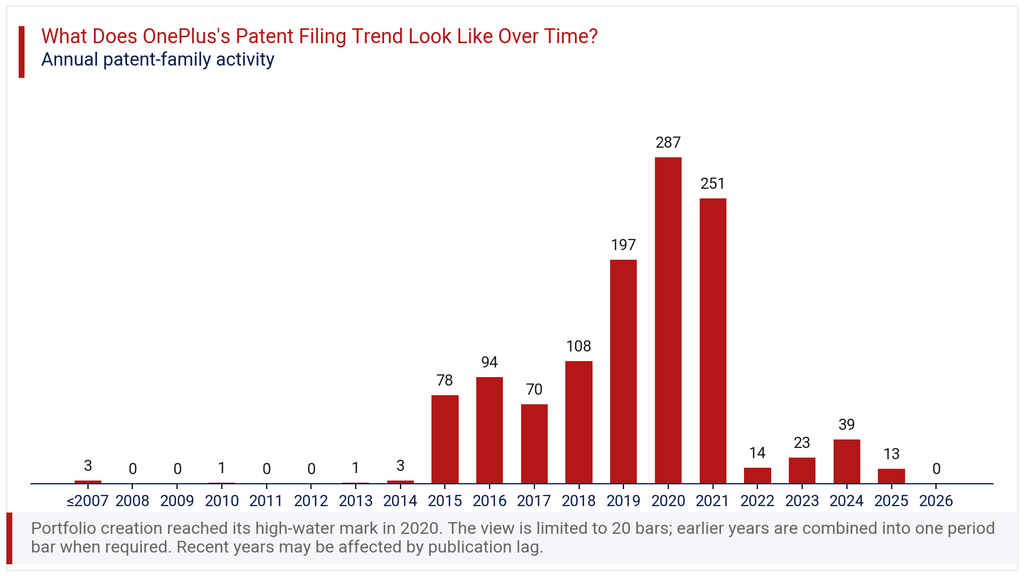
After 2020, filings dropped sharply to 251 in 2021, then fell further to just 14 in 2022 before a mild recovery to 23 in 2023 and 39 in 2024. The 2025 figure of 13 families, alongside a -100.0% latest year change, should not be read as a sudden collapse in invention activity. Patent applications typically take 18 to 24 months to publish, so recent years understate real filing volume. The steep decline visible from 2022 onward likely reflects this publication lag more than any genuine pullback in research investment by OnePlus.
Where Does the OnePlus Patent Portfolio Prioritize Patent Protection?
Patent geography within the OnePlus Patent Portfolio skews overwhelmingly domestic. China accounts for 97.4% of filings, by far the largest share, followed distantly by WIPO PCT applications at 18.9%. The geographic chart in this section makes this imbalance clear, with every other jurisdiction trailing far behind. The United States holds 5.8% of filings, European patents account for 3.4%, and India follows at 2.4%.
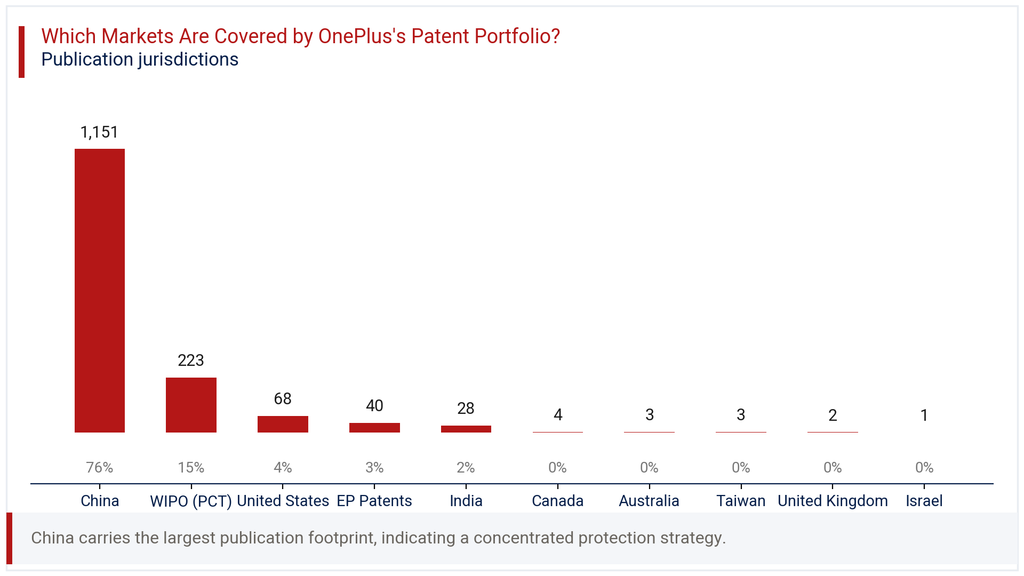
Smaller jurisdictions, including Canada, Australia, Taiwan, the United Kingdom, and Israel, together contribute a marginal share of overall activity, each under 0.5%. This filing pattern indicates OnePlus treats China as its primary protection base, likely reflecting both its manufacturing roots and its largest consumer market. The use of WIPO PCT filings suggests a deliberate pathway for selective international expansion rather than broad simultaneous filing.
For a company competing globally in smartphones, the comparatively thin presence in the United States and Europe is noteworthy. It may reflect reliance on parent company Oppo’s broader filing strategy, licensing arrangements, or a calculated choice to concentrate resources on markets with the highest direct commercial stakes.
Where is the OnePlus Patent Portfolio Building Protection Across Key Technologies?
Technology concentration within the OnePlus Patent Portfolio centers on computing and communication. The leading IPC class, G06F Digital Data Processing, holds 279 families and 23.9% of the portfolio. Close behind sits H04W Wireless Communication Networks with 227 families (19.5%), followed by H04M Telephonic Communication at 191 families (16.4%). The technology chart in this section shows these three classes forming the backbone of OnePlus’s IPC analysis.
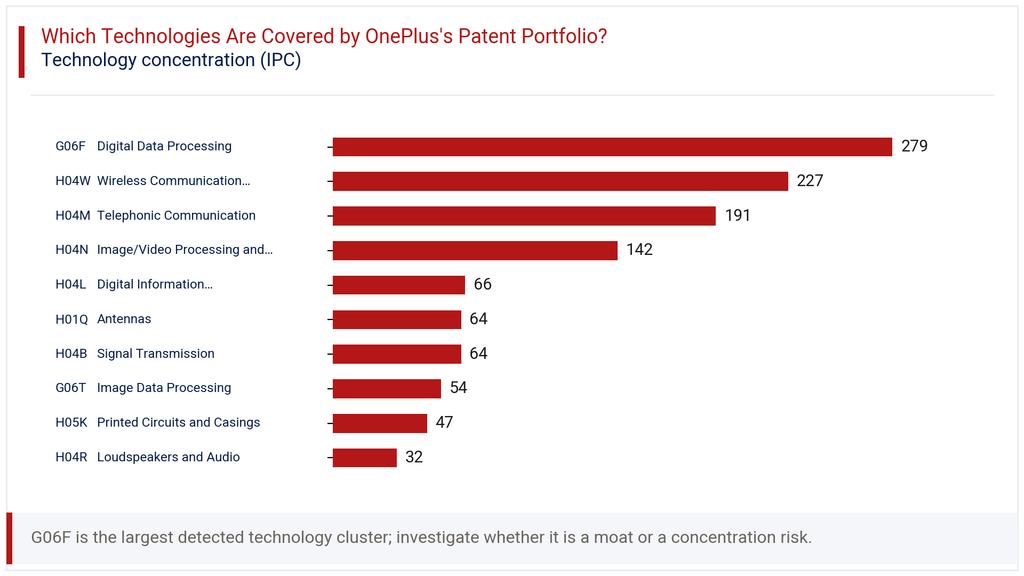
Imaging and display technology also feature prominently, with H04N Image/Video Processing and Display contributing 142 families, or 12.2% of filings. Supporting classes like H04L Digital Information Transmission (5.7%), H01Q Antennas (5.5%), and H04B Signal Transmission (5.5%) round out the communication-hardware cluster. Smaller but relevant categories include G06T Image Data Processing at 4.6%, H05K Printed Circuits and Casings at 4.0%, and H04R Loudspeakers and Audio at 2.7%. This spread indicates OnePlus invests heavily in the software and connectivity layers that differentiate smartphone experience, while still maintaining meaningful hardware-adjacent filings in antennas, circuits, and audio components.
How Has the OnePlus Patent Portfolio Evolved Across Filing Geographies?
Viewed year by year, the OnePlus Patent Portfolio shows China consistently leading every filing cohort since 2015. China’s filings rose from 78 in 2015 to a peak of 281 in 2020, before falling to 234 in 2021 and then dropping sharply in subsequent years. The heatmap in this section captures this dominant and sustained presence clearly across the full timeline.
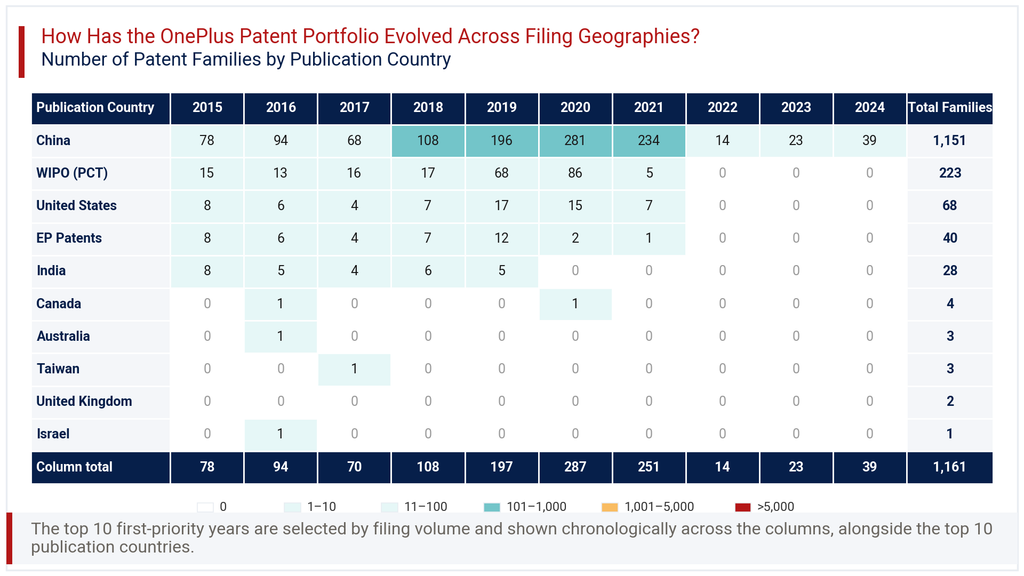
International filings followed a narrower window of activity. WIPO PCT filings grew from 15 in 2015 to 86 in 2020, then collapsed to just 5 in 2021 and effectively stopped afterward. The United States followed a similar arc, peaking at 17 in 2019 before tapering to 7 in 2021 and zero thereafter. India’s filings were modest throughout, peaking at 8 in 2015 and ceasing entirely after 2019. This pattern suggests OnePlus concentrated its international filing push into a defined five-year window, roughly 2015 to 2021, rather than sustaining parallel multi-jurisdiction filing indefinitely alongside its domestic program.
Consultant’s Perspective on OnePlus Patent Portfolio
Reading the OnePlus Patent Portfolio as a whole, two forces stand out distinctly. First, the company’s filing activity is heavily anchored to China, with international protection treated as a secondary, time-boxed exercise rather than a parallel priority. Second, the technology focus sits squarely in digital computing, wireless connectivity, and telephony, consistent with a smartphone manufacturer defending its core product category rather than diversifying into adjacent industries.
The sharp post-2021 decline in recorded filings, visible across nearly every jurisdiction, warrants a measured interpretation. Part of this reflects publication lag inherent to patent systems, but the magnitude of the drop also suggests a genuine shift in filing strategy, possibly tied to closer integration with Oppo’s broader intellectual property program. The revocation rate of 25.6% is worth monitoring closely, since it exceeds the lapsed share and may indicate contested or weaker claims in parts of the portfolio.
For stakeholders assessing competitive positioning, the practical takeaway is to track whether international filings resume, particularly in the United States and Europe, as that would signal renewed global ambition. Until then, the portfolio reads as a China-first defensive structure built around flagship smartphone technology.
Explore Deeper Insights with Expertlancing Research
Understanding a company’s patent position requires more than headline counts. It demands careful reading of legal status, technology clustering, and filing geography together. Expertlancing Research helps businesses, investors, and legal teams translate raw patent data into decisions they can act on. If this analysis of the OnePlus Patent Portfolio raised questions worth exploring further, our team can provide tailored due diligence, competitive benchmarking, and technology landscape studies suited to your specific objectives. Reach out to start a focused conversation.