


The OPPO Patent Portfolio offers a useful lens into how one of the world’s largest smartphone makers protects its technology investments. Across 59,403 total patent families, 53.9% remain active, a figure covering both granted and pending cases. Of these, 20,195 families have been granted and 11,795 are still pending examination. The grant rate stands at 34.0%, while 27,413 families fall into lapsed, revoked, or expired status combined. These numbers reflect prosecution and maintenance outcomes only, not a judgment on patent quality or enforceability.
Filing activity peaked in 2018, when OPPO filed 8,776 patent families in a single year. China remains the dominant jurisdiction, accounting for 94.6% of filings, with the portfolio spread across 10 jurisdictions tracked in this analysis. The leading technology cluster is G06F (Digital Data Processing), with 14,551 families, underscoring OPPO’s heavy investment in computing and data processing capabilities alongside its core telecommunications business.
This report draws on patent family data to frame how OPPO has built and distributed its intellectual property holdings. Filing counts alone do not establish product success, market dominance, or competitive advantage in any given technology area. Readers using this analysis for investment, licensing, or competitive benchmarking should validate specific patent families before relying on them externally. The sections that follow break down legal status, filing trends, geographic spread, and technology concentration in more detail.
About OPPO
Company Profile: OPPO is a private Chinese consumer electronics manufacturer and technology company headquartered in Shenzhen, Guangdong. Founded in 2004, its major product lines include smartphones, smart devices, audio devices, power banks, and other electronic products. The company is one of the largest smartphone manufacturers in the world, with around 9% of the global market share, and 600 million global monthly active users across more than 60 markets.
It ranks among the top three smartphone brands by sales in 20 regional markets, competing with major manufacturers like Samsung and Xiaomi. The company states it operates in over 90 countries. OPPO prioritizes intellectual property, ranking among the top globally in patents and licenses fields, and runs robust manufacturing capabilities with 9 manufacturing centres worldwide. It has collaborated with Hasselblad on mobile imaging systems and operates subsidiaries OnePlus and Realme. OPPO was previously owned by BBK Electronics until 2023.
How Healthy is OPPO Patent Portfolio?
Patent portfolio health depends on how filings move through the legal lifecycle, and OPPO’s numbers tell a layered story. Granted patents make up 34.0% of the total, pending applications account for 19.9%, and lapsed cases sit at 28.2%. Revoked families represent 17.1%, with expired cases forming a small 0.8% slice. The composition chart in this section shows this spread clearly, highlighting that over a quarter of the portfolio has lapsed rather than been actively maintained through to term.
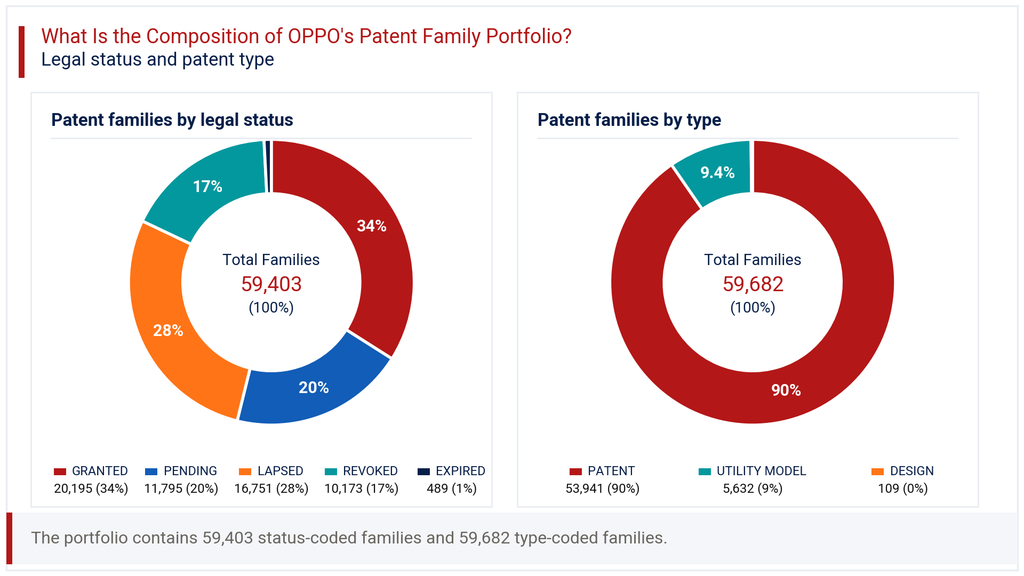
By patent type, standard patents dominate at 90.4%, utility models account for 9.4%, and design filings make up just 0.2%. This mix suggests OPPO leans heavily on full patent protection rather than the lighter utility model route common among Chinese filers. The 53.9% active rate indicates a portfolio where roughly half the families still carry enforceable or pending rights. The sizeable lapsed and revoked share is not unusual for a company filing at this volume, since large portfolios naturally shed weaker filings over time. Still, it points to selective maintenance decisions, where OPPO appears to prioritize renewal fees for families it considers commercially relevant and lets others expire.
How Has the OPPO Patent Portfolio Evolved Over Time?
Patent filing trends at OPPO show a clear arc of expansion followed by moderation. Filings were modest through the early 2010s, then jumped sharply from 1,282 in 2012 to 3,760 by 2015. Growth continued through 2017 (6,440) and peaked in 2018 at 8,776 families, the highest single year on record. The filing-trend chart in this section captures this rise and the subsequent pullback across later years.
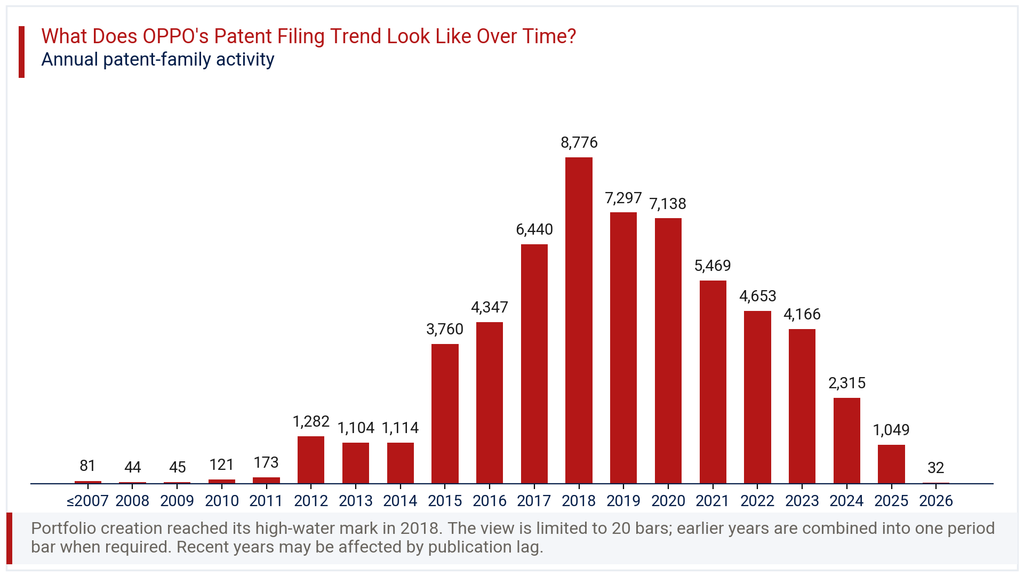
After 2018, filings declined steadily: 7,297 in 2019, 7,138 in 2020, and down to 4,166 by 2023. The most recent years, 2024 and 2025, show much lower counts, with a -96.9% change reflected in the latest year figures. This drop should be read cautiously, since patent publication typically lags actual filing by twelve to eighteen months or more. Recent-year numbers are almost certainly undercounted rather than indicating OPPO has scaled back innovation. The broader pattern still suggests OPPO’s filing pace has normalized after an aggressive expansion phase between 2015 and 2019, settling into a more measured, sustained filing rhythm.
Where Does the OPPO Patent Portfolio Prioritize Patent Protection?
Patent geography for OPPO is heavily concentrated at home. China accounts for 94.6% of all filings, by far the largest share, followed by WIPO’s PCT route at 26.0%. The United States holds 12.1%, European Patents sit at 10.2%, and India follows at 5.4%. The geographic chart in this section visualizes just how dominant the domestic China filing base is relative to every other market.
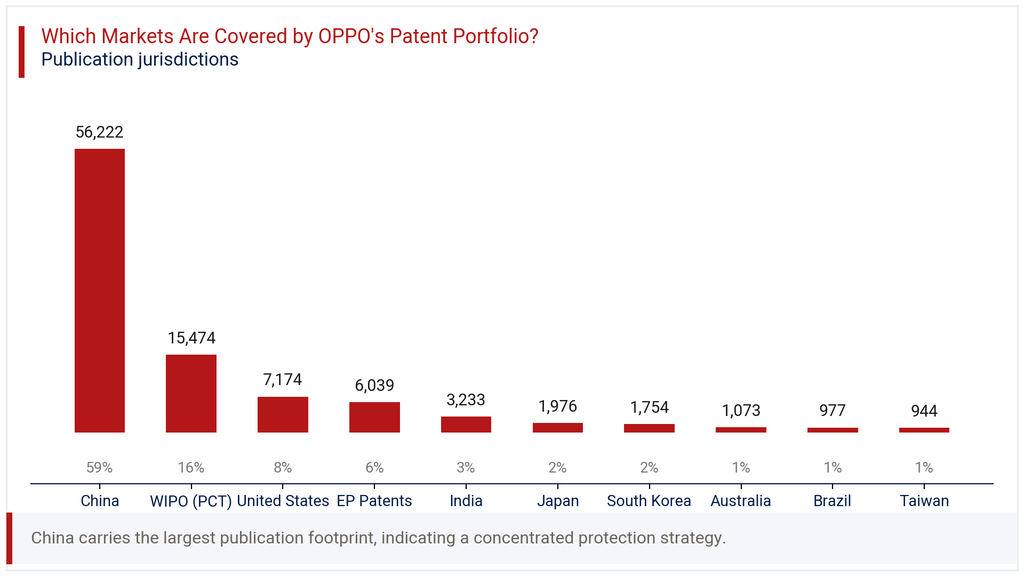
Beyond these top markets, Japan (3.3%), South Korea (3.0%), Australia (1.8%), Brazil (1.6%), and Taiwan (1.6%) round out the ten jurisdictions tracked. This spread reflects a filing strategy centered on securing home-market protection first, then selectively extending coverage through PCT applications into major trading economies. The relatively modest shares in the US and Europe, compared to China, suggest OPPO treats international filing as a targeted exercise rather than a blanket strategy. For a company competing globally in smartphones, this pattern indicates IP protection follows manufacturing and core R&D geography more closely than global sales presence across more than 90 countries.
Where is the OPPO Patent Portfolio Building Protection Across Key Technologies?
IPC analysis of the OPPO Patent Portfolio points to computing and communications as the twin pillars of innovation focus. G06F (Digital Data Processing) leads with 14,551 families, or 22.1% of classified filings. H04W (Wireless Communication Networks) follows at 18.7%, with H04M (Telephonic Communication) close behind at 16.4%. The technology chart in this section lays out how these top categories compare against the rest of the portfolio.
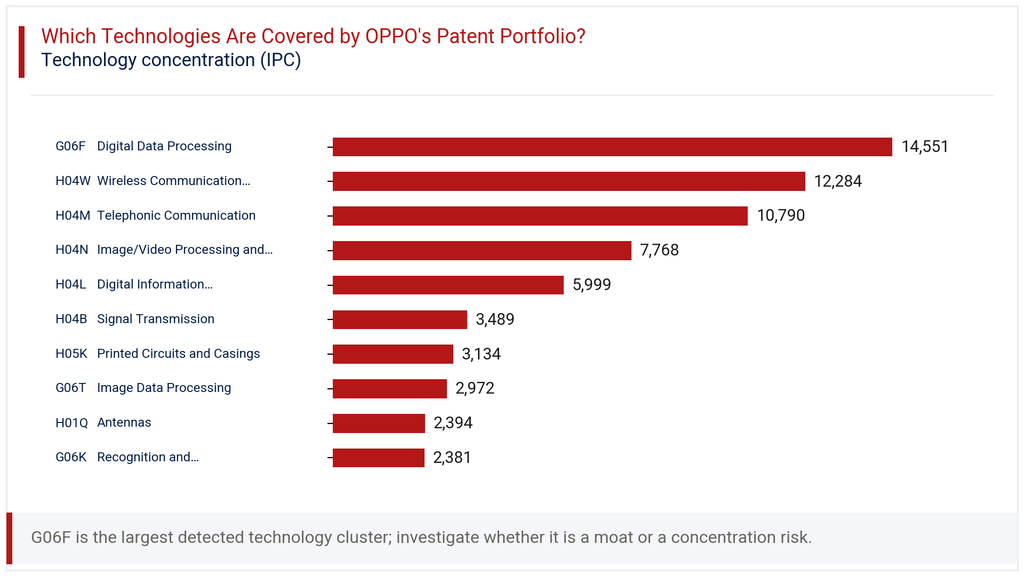
Image and video processing shows up strongly too, with H04N at 11.8% and G06T (Image Data Processing) adding another 4.5%, together reflecting OPPO’s investment in camera and imaging systems, likely tied to its Hasselblad collaboration. Digital transmission (H04L, 9.1%), signal transmission (H04B, 5.3%), antennas (H01Q, 3.6%), and printed circuits (H05K, 4.8%) fill out the remaining core clusters. This distribution confirms OPPO’s patent protection is not just about handset hardware but spans the full communication stack, from antenna design through network connectivity to on-device data processing and imaging software.
How Has the OPPO Patent Portfolio Evolved Across Filing Geographies?
The heatmap in this section tracks how filing volume shifted across jurisdictions year by year, and the pattern is instructive. China filings rose from 3,742 in 2015 to a peak of 8,501 in 2018, then declined to 1,357 by 2024. The same 2018 peak appears across nearly every other market, including the United States (1,088), EP Patents (1,023), and India (739), suggesting a company-wide filing surge rather than a single-market push.
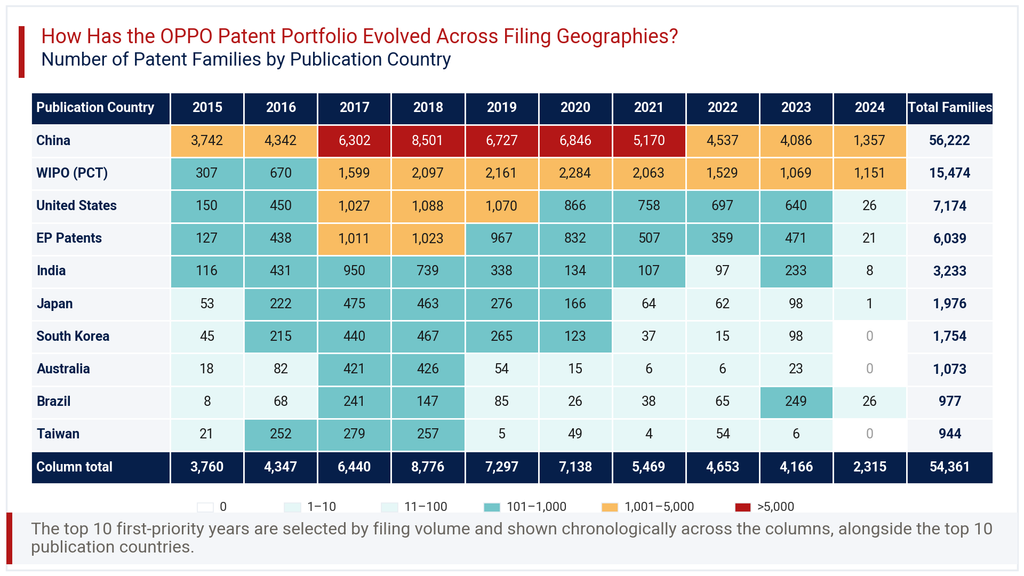
WIPO PCT filings followed a slightly different curve, staying elevated through 2020 at 2,284 before tapering off. Smaller markets like Australia and South Korea show sharper declines after 2018, falling to single digits by 2021 and 2022. Brazil stands out as an exception, actually rising to 249 filings in 2023 after years of lower activity. This divergence suggests OPPO has been recalibrating its international filing priorities, pulling back in some mature markets while sustaining or increasing presence in others like Brazil, where its consumer footprint may be growing.
Consultant’s Perspective on OPPO Patent Portfolio
From an advisory standpoint, the OPPO Patent Portfolio reflects a company that scaled its IP output rapidly to match product expansion, then entered a consolidation phase. The 2015 to 2018 filing surge, growing from 3,760 to 8,776 families, lines up closely with OPPO’s global smartphone push during that period. The subsequent decline is not necessarily a retreat from innovation; it more likely signals a shift toward quality over sheer volume, alongside tighter filing discipline across non-core markets.
The concentration in China (94.6%) alongside meaningful PCT and US presence suggests OPPO treats its domestic base as the anchor and expands internationally where commercial stakes justify the cost. The 34.0% grant rate and 53.9% active rate are reasonable for a portfolio of this scale, though the lapsed and revoked share warrants monitoring. Businesses assessing competitive exposure to OPPO, whether in imaging, wireless connectivity, or data processing, should track how filing volumes in the US and Europe recover once publication lag clears. Continued investment in G06F and H04W clusters suggests computing and connectivity will remain central to OPPO’s technology direction over the next several years.
Explore Deeper Insights with Expertlancing Research
This analysis only scratches the surface of what the OPPO Patent Portfolio reveals about competitive positioning in smartphones and connected devices. Expertlancing Research helps technology companies, investors, and legal teams go deeper, mapping specific patent families, tracking competitor filing behavior, and assessing freedom-to-operate risk. If your business needs a sharper view of OPPO’s IP strategy or that of its peers, our research team can build a custom analysis tailored to your decision. Reach out to start that conversation.