


The Sangfor Patent Portfolio offers a useful lens into how a major Chinese cybersecurity and cloud computing vendor builds legal protection around its technology. Across 2710 patent families, 72.1% remain active, a figure covering both granted and pending cases. Of this total, 1371 families have been granted and 584 are still pending examination, giving a grant rate of 50.6%. The remaining families, amounting to 755 cases, fall under lapsed, expired, or revoked status. These are prosecution and maintenance metrics only, not a verdict on patent quality or enforceability.
Filing activity peaked in 2021, when Sangfor filed 460 patent families in a single year. China dominates the filing geography, accounting for 100.0% of the jurisdictions_pct share, with the portfolio spread across 7 jurisdictions in total. The leading technology cluster is G06F, covering Digital Data Processing, with 1487 families, making it the single largest area of concentration in the entire portfolio.
This report draws on patent filing data to describe scale, timing, geography, and technical focus. Filing counts alone do not establish product success, market leadership, or competitive advantage. Readers considering business or investment decisions should treat these figures as a starting point. Specific patent families referenced here should be independently verified before being used in due diligence, licensing discussions, or competitor benchmarking exercises.
About Sangfor
Company Profile: Sangfor Technologies is a Chinese technology company working in cybersecurity, cloud computing, and enterprise IT infrastructure. The company operates in the fields of cybersecurity, cloud computing, and enterprise IT infrastructure. It was founded by He Zhaoxi and Xiong Wu, graduates of the University of Science and Technology of China, in 2000. The company began with a focus on network security technologies and later expanded into cloud-related and enterprise IT technologies.
On its official site, the company describes itself as a leading global vendor of IT infrastructure solutions, specializing in Cloud Computing and Network Security, with products including Hyper-Converged Infrastructure, Virtual Desktop Infrastructure, Next-generation Firewall, Endpoint Protection, Secure Web Gateway, Network Detection and Response, Secure Access Service Edge, Anti-Ransomware, eXtended Detection and Response and Managed Detection and Response. The company serves enterprise customers and is publicly listed on the Shenzhen Stock Exchange.
It has expanded operations outside China, entering international markets through regional partnerships, including a collaboration with Tech Data to distribute its cybersecurity offerings in Southeast Asia, including Indonesia. The company reports over 100,000 customers worldwide.
How Healthy is Sangfor Patent Portfolio?
Patent portfolio health depends on how many families remain enforceable versus how many have lapsed or been withdrawn. Sangfor’s legal status split shows 1371 granted families against 584 pending ones, together forming an active rate of 72.1%. The grant rate stands at 50.6%, which is a reasonable conversion figure for a technology company filing at this volume. However, 673 families have been revoked, representing 24.8% of the total portfolio, a proportion worth watching closely.
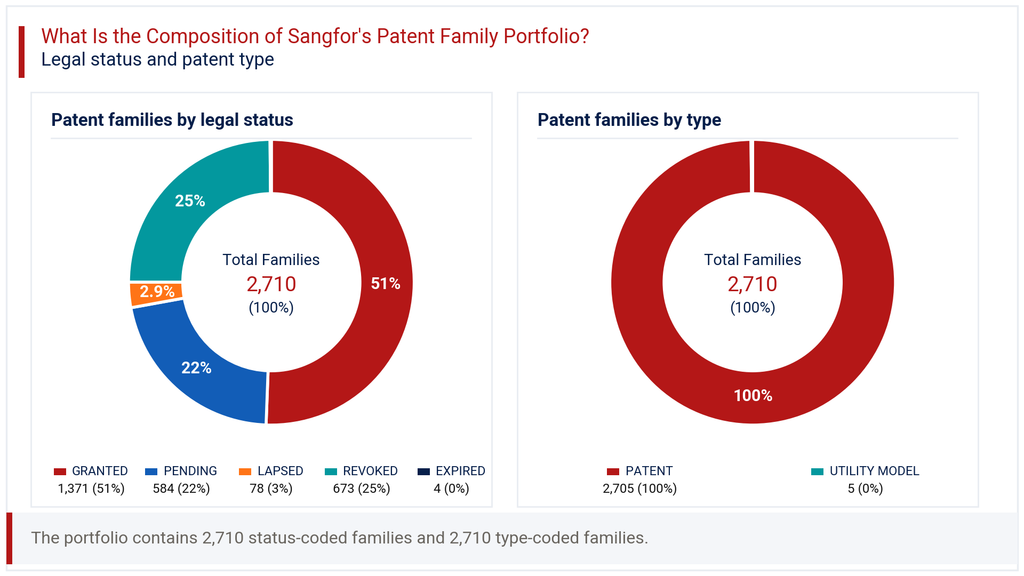
The composition chart in this section also shows a small lapsed category of 78 families, or 2.9%, and a negligible expired count of just 4 families. Patent type analysis confirms the portfolio is almost entirely composed of standard patents, at 99.8%, with utility models forming a marginal 0.2% share. This heavy tilt toward full patents rather than utility models suggests Sangfor pursues stronger, longer-duration protection rather than quicker, lower-bar filings. The relatively high revocation share, though, deserves attention from anyone assessing overall patent legal status and the durability of Sangfor’s claimed protection.
How Has the Sangfor Patent Portfolio Evolved Over Time?
Patent filing trends for Sangfor show a long, slow build followed by a sharp acceleration. Filings stayed in single or low double digits through the 2008 to 2016 window, rarely crossing 64 families a year. Momentum changed from 2017 onward, when annual filings jumped to 202, then climbed steadily to 413 in 2020 and peaked at 460 in 2021. This six-year stretch marks the company’s most aggressive period of patent activity by a wide margin.
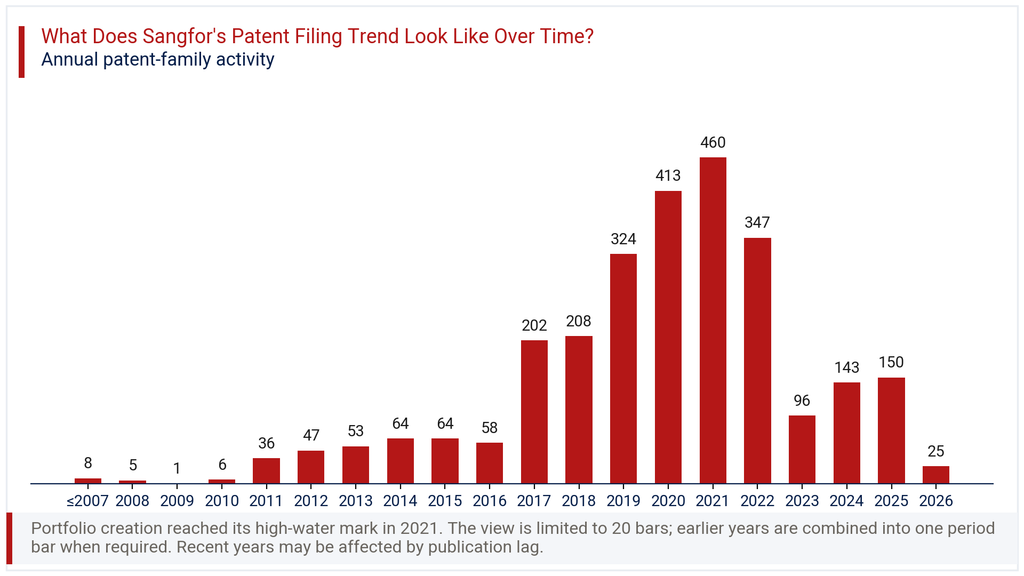
The filing-trend chart in this section also shows a drop after 2022, falling to 347 and then to just 96 in 2023, before recovering to 143 and 150 in the following two years. The latest year change stands at -83.3%, a figure that looks dramatic but needs context. Patent applications typically take 18 to 24 months to publish, so the most recent one to two years almost certainly understate actual filing activity. Readers should treat the apparent recent decline as a publication lag effect rather than a genuine pullback in research investment.
Where Does the Sangfor Patent Portfolio Prioritize Patent Protection?
Patent geography for Sangfor is heavily concentrated in its home market. China accounts for 2710 families, representing 100.0% of jurisdictions_pct share within this analysis. This single-country concentration reflects a company still building out its international filing strategy, even as its products reach customers in Southeast Asia and beyond. The remaining jurisdictions all register minor shares by comparison.
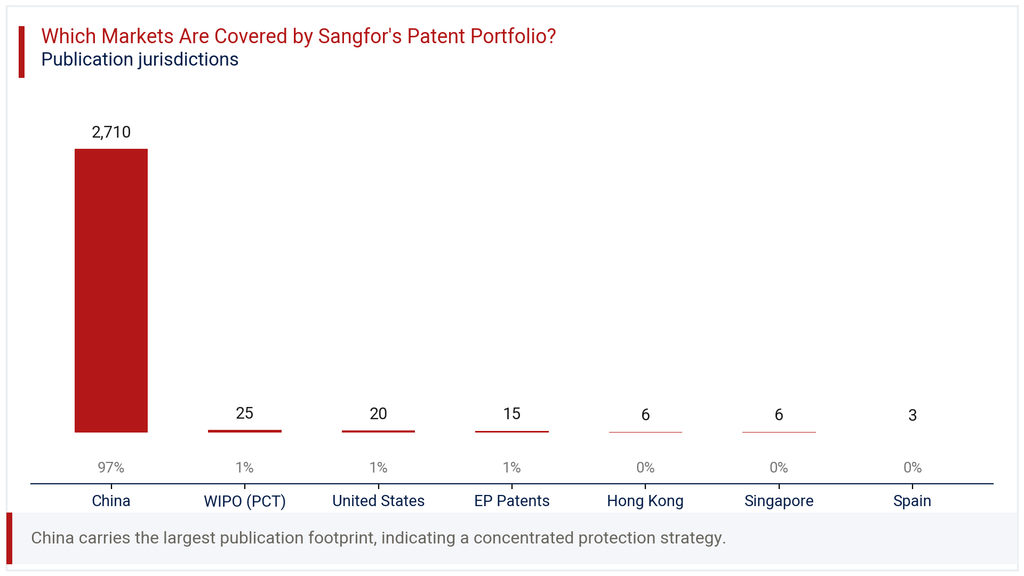
The geographic chart in this section shows WIPO PCT filings at 25 families, just 0.9% of the mix, followed by the United States at 20 families, or 0.7%. European Patents account for 15 families at 0.6%, while Hong Kong and Singapore each contribute 6 families, or 0.2% apiece. Spain closes the list with 3 families at 0.1%. Across all regions combined, Sangfor’s portfolio spans 7 distinct jurisdictions. This pattern suggests a filing strategy built primarily around domestic protection, with selective international filings reserved for markets of particular commercial interest rather than broad global coverage.
Where is the Sangfor Patent Portfolio Building Protection Across Key Technologies?
IPC analysis of the Sangfor portfolio points to two dominant technology clusters that together define the company’s core research direction. G06F, covering Digital Data Processing, leads with 1487 families, or 46.7% of the total. Close behind sits H04L, covering Digital Information Transmission, with 1364 families and a 42.8% share. Combined, these two classes account for the overwhelming majority of Sangfor’s technical filings.
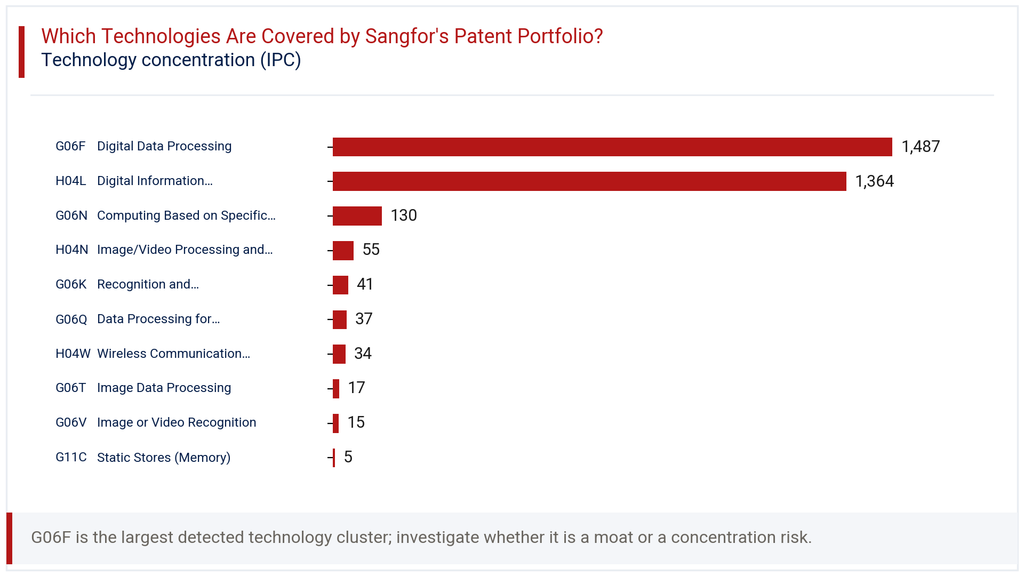
The technology chart in this section shows a long tail of smaller clusters trailing far behind these leaders. G06N, covering computing based on specific models, holds 130 families at 4.1%, reflecting growing work connected to artificial intelligence and modelling techniques. Image and video-related classes such as H04N, G06T, and G06V each contribute under 2% individually. G06Q, tied to administrative and commercial data processing, adds 37 families at 1.2%. This distribution confirms Sangfor’s technical identity sits firmly in core computing infrastructure and network data transmission, with security and cloud-adjacent innovation built around these two technical foundations.
How Has the Sangfor Patent Portfolio Evolved Across Filing Geographies?
Viewing filing geography alongside the filing-trend timeline reveals how closely Sangfor’s international activity tracked its domestic surge. China’s filings rose from 64 in 2014 to 460 by 2021, mirroring the overall portfolio trend almost exactly. International filings, by contrast, appeared briefly and only during the middle years of this expansion. WIPO PCT filings registered 9 in 2018, dipped to 5 in 2019, rose again to 9 in 2020, then disappeared from 2021 onward.
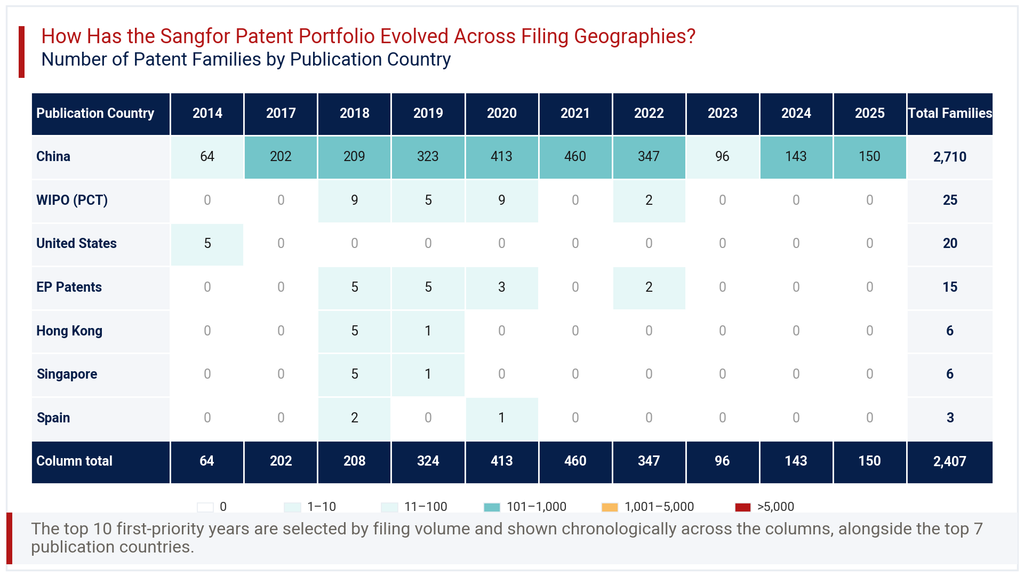
The heatmap in this section shows a similar pattern for other jurisdictions. The United States shows a single cluster of 5 families back in 2014, with no further filings recorded since. European Patents, Hong Kong, Singapore, and Spain each show brief activity windows concentrated around 2018 and 2019, contributing just a handful of families apiece. None of these jurisdictions show filings beyond 2022. This timeline suggests international filing was a secondary, time-bound exercise rather than a sustained parallel strategy running alongside the much larger domestic Chinese filing programme.
Consultant’s Perspective on Sangfor Patent Portfolio
Taken as a whole, the Sangfor Patent Portfolio tells the story of a company whose patenting behaviour tightly follows its domestic market growth rather than a deliberate global IP strategy. The dominance of China at 100.0% jurisdictions_pct share, paired with heavy filing concentration in G06F and H04L, confirms a company building deep, defensible positions in core computing and data transmission technologies close to home. The 24.8% revocation rate is the figure I would flag first to any client evaluating this portfolio for partnership, licensing, or acquisition purposes.
International filing activity, though present, looks opportunistic rather than systematic, clustered narrowly around 2018 to 2020 and largely absent since. For a company with stated ambitions in Southeast Asia and beyond, this gap between commercial reach and international patent protection is worth closer examination. My recommendation for anyone assessing Sangfor strategically is to pair this filing analysis with a family-level legal status check on the highest-value G06F and H04L patents. Understanding which specific claims remain enforceable, particularly outside China, will matter far more than aggregate counts when evaluating real competitive risk or opportunity.
Explore Deeper Insights with Expertlancing Research
This analysis only scratches the surface of what a detailed patent study can reveal. Expertlancing Research helps technology companies, investors, and legal teams go beyond headline numbers into family-level validation, claim mapping, and competitor benchmarking. If you are evaluating Sangfor, a competitor, or a potential acquisition target, our team can build a tailored patent intelligence report around your specific business question. Reach out to Expertlancing Research to commission a deeper, decision-ready analysis of any patent portfolio that matters to your strategy.