
The Shanghai Huali Patent Portfolio offers a useful window into how one of China’s leading semiconductor foundries protects its manufacturing know-how. Across 8,188 total patent families, the portfolio shows an active rate of 61.4%, covering both granted and pending cases still live in the system. Of these families, 3,686 have been granted and 1,345 remain pending before patent offices. The grant rate stands at 45.0%, while 3,157 families fall into lapsed, expired or revoked categories combined. These figures describe prosecution and maintenance activity only, not a verdict on patent quality or enforceability.
Filing activity peaked in 2014, when the company filed 710 patent families, the highest single-year count in the dataset. China dominates the geographic footprint, accounting for 99.9% of filings, with the portfolio spread across 10 jurisdictions in total. On the technology side, H01L Semiconductor Devices leads by a wide margin, with 3,828 families, making it the single largest cluster in the portfolio. This concentration points to a filing strategy anchored firmly in core semiconductor device engineering.
This report is designed to help business leaders, patent professionals and competitive intelligence teams understand the shape of Shanghai Huali’s filing activity. Filing counts alone do not establish product success, market share or competitive advantage in any direct sense. Readers evaluating specific families for licensing, litigation or investment purposes should independently verify those records before relying on them externally.
About Shanghai Huali
Company Profile: Shanghai Huali Microelectronics Corporation, known as HLMC, is a Chinese pure-play semiconductor foundry. It was founded in 2010 in Shanghai. Currently, Hua Hong’s most advanced node is achieved by its subsidiary Shanghai Huali (HLMC), which can manufacture 28/22-nm process. HLMC operates as a subsidiary of Hua Hong Group, itself owned by publicly listed Hua Hong Semiconductor Limited.
Hua Hong Semiconductor is a publicly listed Chinese pure-play semiconductor foundry company based in Shanghai, established in 1996 as part of China’s national efforts to boost its IC industry. It is currently mainland China’s second largest chip-maker behind rival SMIC and 6th largest globally, with a market share of 2.6% in 2021.
HLMC’s manufacturing base sits in Shanghai’s Zhangjiang Hi-Tech Park. The company focuses on advanced and specialty wafer fabrication for logic, RF and memory applications, supporting China’s broader semiconductor self-sufficiency push.
How Healthy is Shanghai Huali Patent Portfolio?
Patent portfolio health depends heavily on legal status composition, and the numbers here tell a layered story. Granted patents make up 45.0% of the portfolio, the single largest status category, followed by pending cases at 16.4%. Revoked families account for 27.0%, a notably high share that deserves attention from anyone assessing enforceability risk. Lapsed cases sit at 10.1%, with expired families contributing a small 1.4%. The composition chart in this section lays out this distribution clearly across all five status categories.
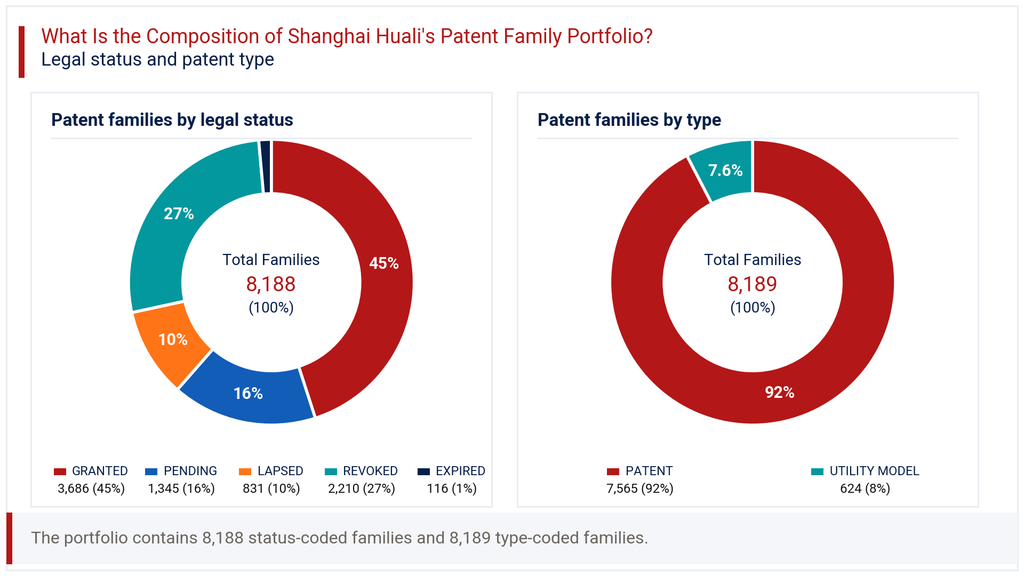
On patent type, the portfolio leans strongly toward standard patents, which represent 92.4% of filings, against 7.6% for utility models. This split suggests Shanghai Huali pursues formal, full-term protection for most of its inventions rather than relying on faster, shorter-term utility model routes. The active rate of 61.4% indicates that a majority of the portfolio remains legally alive, whether granted or still under examination. The elevated revocation share, however, warrants a closer look at which technology areas are most affected, since it may reflect aggressive early-stage filing followed by selective pruning during prosecution or opposition.
How Has the Shanghai Huali Patent Portfolio Evolved Over Time?
Patent filing trends at Shanghai Huali show a clear ramp-up starting in 2011, when filings jumped to 538 from single digits in prior years. Activity climbed steadily through 2014, the peak year with 710 families, before settling into a lower but sustained range through the late 2010s. Filings stayed strong from 2018 to 2021, each year recording above 560 families, reflecting a mature and consistent filing programme. The filing-trend chart in this section shows this full arc, from early build-up to sustained high-volume output.
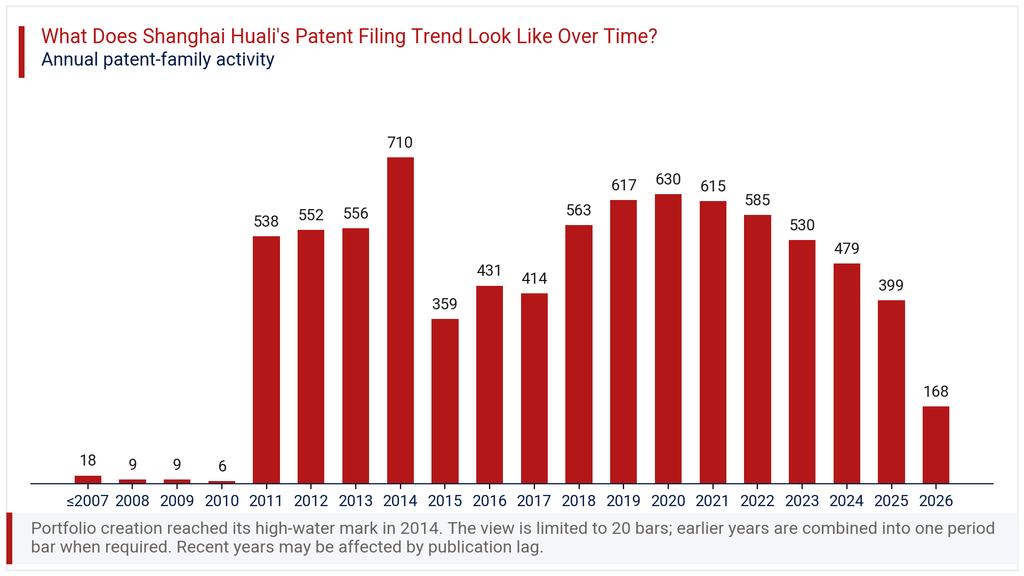
More recent years show a decline, with 2025 at 399 and 2026 at 168, representing a -57.9% change versus the prior comparison point. This drop should not be read as a genuine pullback in innovation activity. Publication lag typically affects the most recent one to two years of any patent dataset, since filings take time to become publicly visible. The true picture for 2025 and 2026 will likely firm up as more applications clear the publication queue.
Where Does the Shanghai Huali Patent Portfolio Prioritize Patent Protection?
Patent geography for Shanghai Huali is heavily domestic. China accounts for 99.9% of all filings, underscoring a strategy centred on protecting innovation within its home market first. The United States follows a distant second at 6.1%, reflecting a modest but deliberate push into the world’s largest technology and litigation market. The geographic chart in this section visualises just how concentrated this footprint really is.
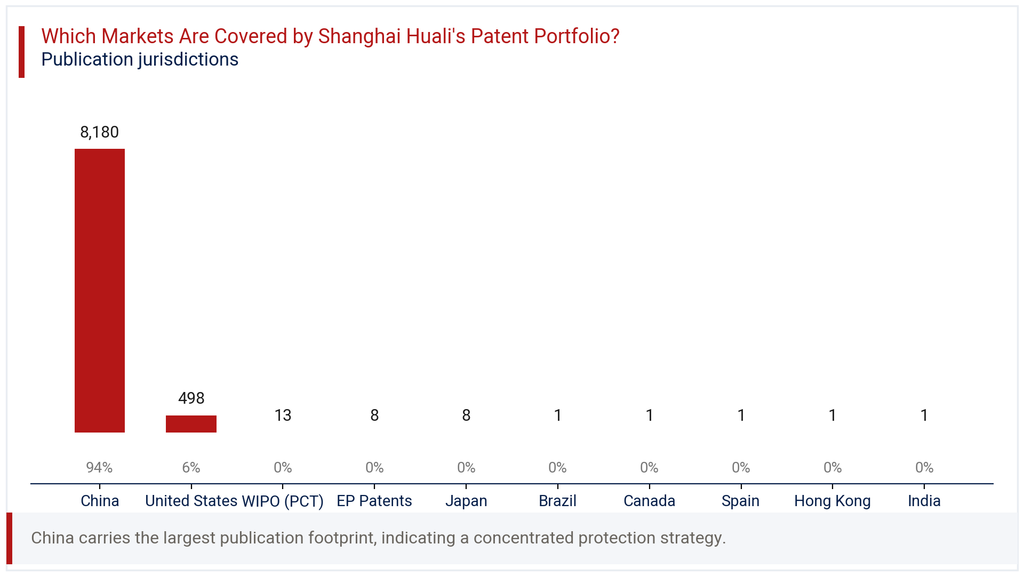
Beyond these two jurisdictions, filing activity thins out considerably. WIPO PCT filings sit at 0.2%, while Japan and the European Patent Office each account for 0.1%. Smaller jurisdictions, including Brazil, Canada, Spain, Hong Kong and India, show negligible but present filings, rounding out coverage across 10 jurisdictions overall. This pattern is typical of a foundry whose primary commercial and manufacturing base remains anchored in China. Expansion into secondary markets like the US suggests selective protection where export relationships or customer risk justify the added cost.
Where is the Shanghai Huali Patent Portfolio Building Protection Across Key Technologies?
IPC analysis shows semiconductor device engineering as the dominant technology pillar. H01L Semiconductor Devices leads with 3,828 families, representing 46.5% of the entire portfolio. This is followed by H10P Bulk Acoustic Wave Devices at 1,092 families, or 13.3%, and G03F Photomechanical Production of Patterns at 879 families, accounting for 10.7%. The technology chart in this section ranks these clusters side by side for quick comparison.
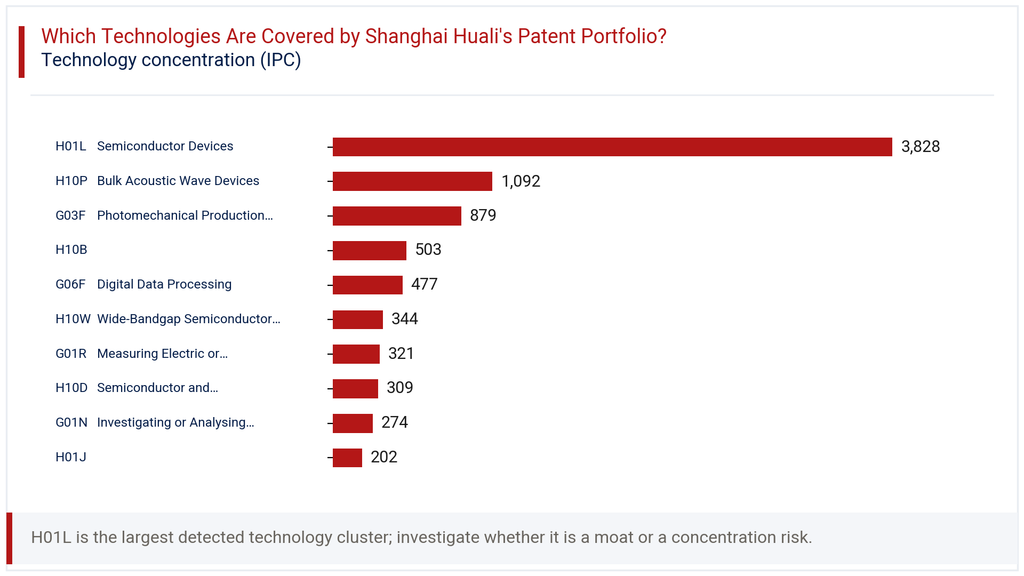
Further down the list, H10B contributes 503 families (6.1%), while G06F Digital Data Processing adds 477 families (5.8%). Wide-bandgap semiconductor devices under H10W account for 344 families (4.2%), and measurement-related technology under G01R contributes 321 families (3.9%). This spread shows Shanghai Huali investing well beyond core device structures, into lithography patterning, memory architectures and measurement tooling. Such breadth suggests a filing approach that protects the full manufacturing process chain, not just finished device designs.
How Has the Shanghai Huali Patent Portfolio Evolved Across Filing Geographies?
The heatmap in this section tracks filing behaviour by jurisdiction across years, and the pattern is unambiguous. China has carried the overwhelming bulk of annual filings since 2011, climbing from 536 that year to 710 by 2014. It then sustained output above 530 annually through 2023, confirming China as the constant backbone of the portfolio year after year.
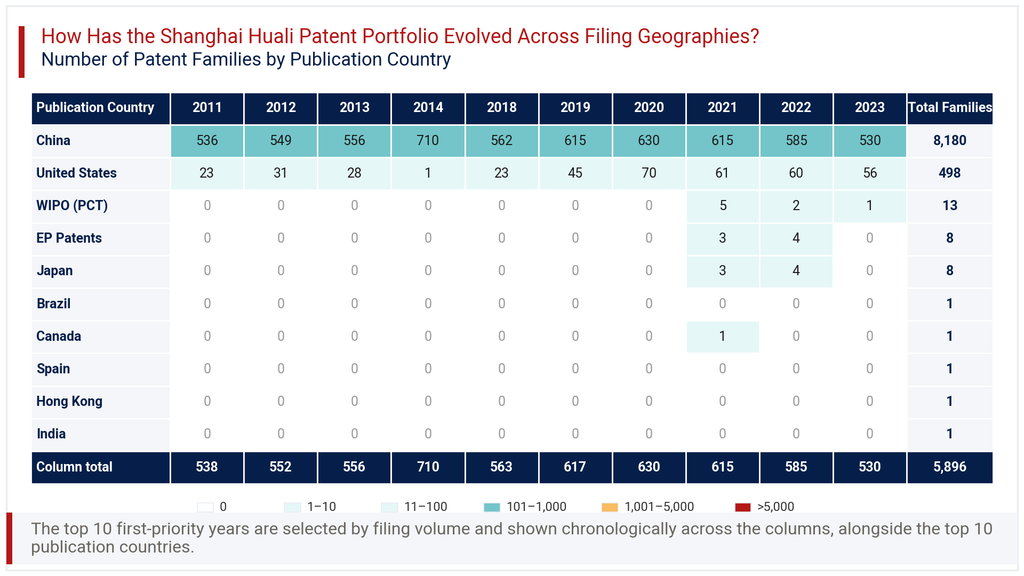
The United States tells a smaller but interesting story. Filings there stayed in single or low double digits through most years, before rising to 70 in 2020 and staying near 60 through 2022 and 2023. Other jurisdictions, including WIPO, the European Patent Office and Japan, only appear from 2021 onward, each contributing single-digit counts. This timing suggests a deliberate, fairly recent decision to test limited international filing, layered on top of an already mature domestic programme, rather than a long-running global strategy.
Consultant’s Perspective on Shanghai Huali Patent Portfolio
Taken together, the Shanghai Huali Patent Portfolio reads as a domestically focused, technically deep filing programme built to support foundry operations rather than broad global licensing ambitions. The concentration in H01L Semiconductor Devices, at 46.5% of filings, aligns closely with the company’s stated focus on advanced logic, RF and memory wafer fabrication. The near-total reliance on China, at 99.9% of filings, matches a business model centred on domestic manufacturing self-sufficiency rather than export-driven IP monetisation.
The elevated revocation share, at 27.0% of the portfolio, is worth monitoring closely. It may reflect normal opposition dynamics in a crowded semiconductor filing environment, but it could also signal quality or prosecution challenges in specific technology clusters. The modest but growing US filing activity, together with early PCT, European and Japanese entries from 2021 onward, hints at a cautious first step toward international protection. Companies competing with Shanghai Huali, or evaluating partnership and licensing opportunities, should track whether this international filing trend continues to build or remains a limited, one-off expansion into adjacent markets.
Explore Deeper Insights with Expertlancing Research
This analysis only scratches the surface of what a full patent review can reveal. Expertlancing Research helps technology leaders, investors and legal teams go deeper, validating specific families, tracking competitor filing moves and assessing freedom-to-operate risk. If the Shanghai Huali Patent Portfolio intersects with your business strategy, our analysts can help you build a sharper, evidence-backed view. Reach out to Expertlancing Research to commission a tailored patent intelligence study for your next decision.