


The SMEE patent portfolio offers a useful window into how a leading Chinese lithography equipment maker builds and defends its technology base. Across 3,311 total patent families, 79.0% remain active, combining both granted and pending rights. Of these, 2,476 patents have been granted and 141 are still pending before patent offices. The grant rate stands at 74.8%, a healthy conversion figure for a hardware-heavy portfolio. On the other side of the ledger, 694 families have lapsed, expired, or been revoked. These are prosecution and maintenance metrics, and they should not be read as a verdict on patent quality or enforceability.
Filing activity peaked in 2016, when SMEE filed 247 patent families, the highest single-year count in the dataset. China dominates the jurisdictional footprint, accounting for 97.1% of filings, out of 10 jurisdictions where SMEE has sought protection. On the technology side, photomechanical pattern production, classified under G03F, leads decisively with 1,779 families, confirming lithography as the company’s core engineering focus.
This report draws on structured patent filing data to map SMEE’s technology priorities and geographic strategy. Filing counts alone cannot confirm commercial success, product adoption, or competitive superiority in the market. Readers evaluating specific SMEE patent families for licensing, litigation, or investment decisions should verify those records independently. What follows is intended as a directional analysis of portfolio composition and evolution, not a substitute for legal or technical due diligence on individual patents.
About SMEE
Company Profile: Shanghai Micro Electronics Equipment, known as SMEE, is a Chinese semiconductor equipment manufacturer. The company is based in Shanghai, China. SMEE researches, develops, manufactures and sells lithography scanners and inspection tools for the semiconductor industry. It also offers customer support services.
SMEE was established in 2002 by He Rongming, a former vice president at Shanghai Electric. The company originated as a lithography machine technology research project under the 863 Program, and later launched the first domestically made lithography machine for commercial use. In December 2017, SMEE signed a contract with CSC Financial to prepare for a public listing, during which it secured funding from investors including China Everbright Limited.
Management changes followed, leading He to leave SMEE in early 2018. The company remains a key player in China’s push for semiconductor self-sufficiency.
How Healthy is SMEE Patent Portfolio?
Patent portfolio health depends on how many filings convert into enforceable rights and how many survive over time. For SMEE, 74.8% of filed families have been granted, while 4.3% remain pending decision. The active rate across the portfolio stands at 79.0%, meaning roughly four in five families carry either granted or pending status today. The composition chart in this section shows a clear majority skew toward granted patents rather than unresolved applications, which signals a mature prosecution pipeline rather than a backlog of untested filings.
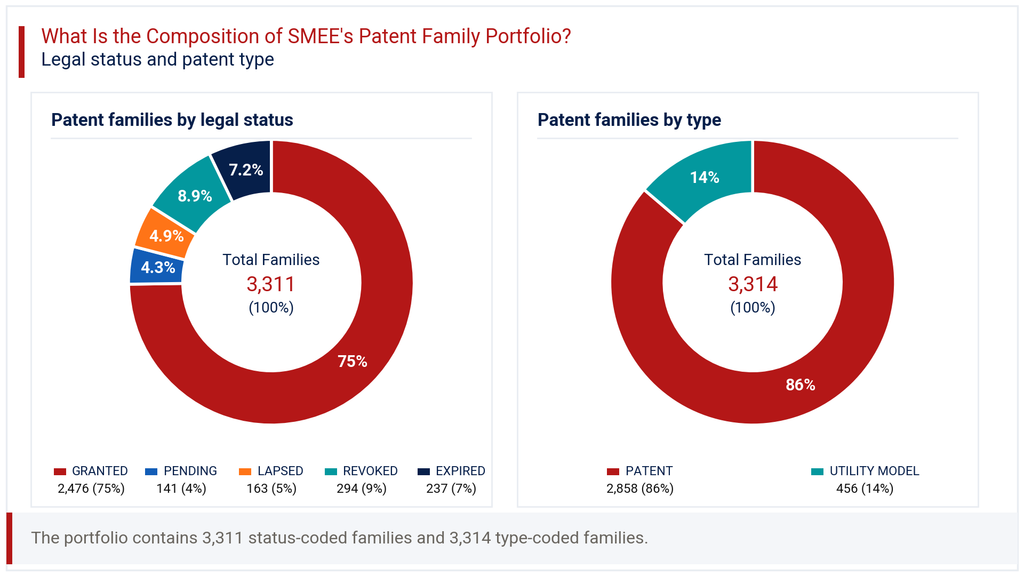
The remaining share tells a different story. 8.9% of families have been revoked, 7.2% have expired, and 4.9% have lapsed, together accounting for 694 families outside active status. By patent type, 86.2% of the portfolio consists of standard patents, with 13.8% filed as utility models, a category common in Chinese filing strategy for faster, lower-threshold protection. This mix suggests SMEE pursues both deep technical patents and quicker utility model filings to cover incremental improvements. The legal status split, taken together, points to a portfolio that is substantially active and reasonably well maintained, though a meaningful share of older filings has naturally fallen away through expiry or non-renewal.
How Has the SMEE Patent Portfolio Evolved Over Time?
SMEE’s patent filing trends show a long build-up phase followed by a sharp recent pullback. Filings rose from 115 in 2008 to a peak of 247 in 2016, with strong years also recorded in 2018 (238) and 2019 (239). The filing-trend chart in this section traces this rise and the plateau that followed through 2020 and 2021, before counts drop markedly from 2022 onward.
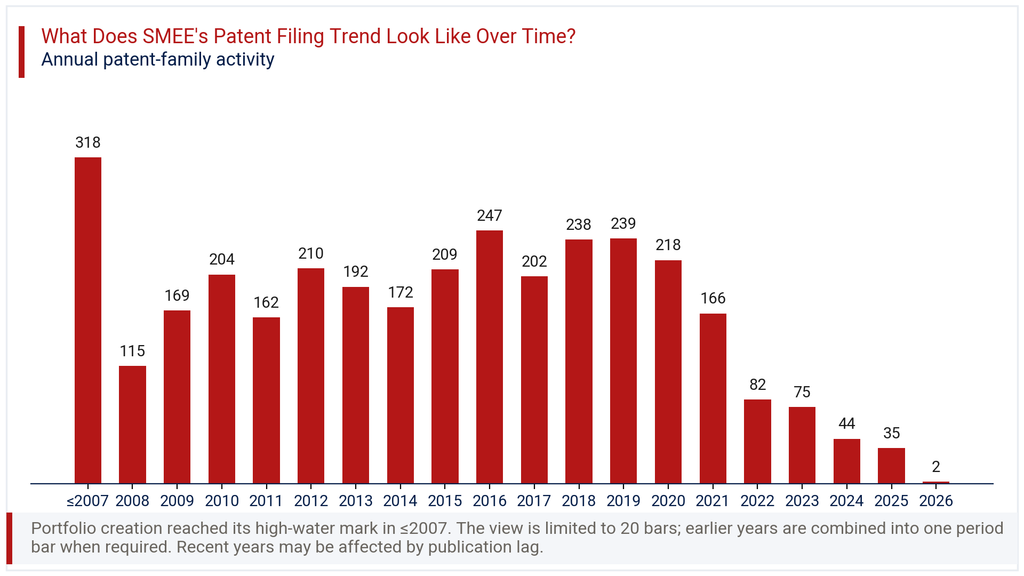
The sharpest decline appears in the most recent years, with just 44 families in 2024 and 35 in 2025, reflecting a 94.3% change versus the comparison period. This should not be read as a genuine collapse in innovation activity. Patent applications typically take 18 to 24 months to publish and appear in filing databases, so the most recent one to two years are structurally undercounted. The more reliable signal lies in the decade-long pattern: sustained, high-volume filing through the mid-2010s, consistent output through 2019, and a gradual tapering that began even before the publication lag sets in. That earlier tapering, visible from 2020 to 2021, is worth watching as filings from those years mature and settle into final counts.
Where Does the SMEE Patent Portfolio Prioritize Patent Protection?
Patent geography for SMEE is overwhelmingly domestic. China accounts for 97.1% of all filings, reflecting its position as both home market and primary regulatory priority. The geographic chart in this section shows a steep drop-off after China, with WIPO PCT filings at 12.0% share representing the next largest route, typically used as a gateway to multiple international markets.
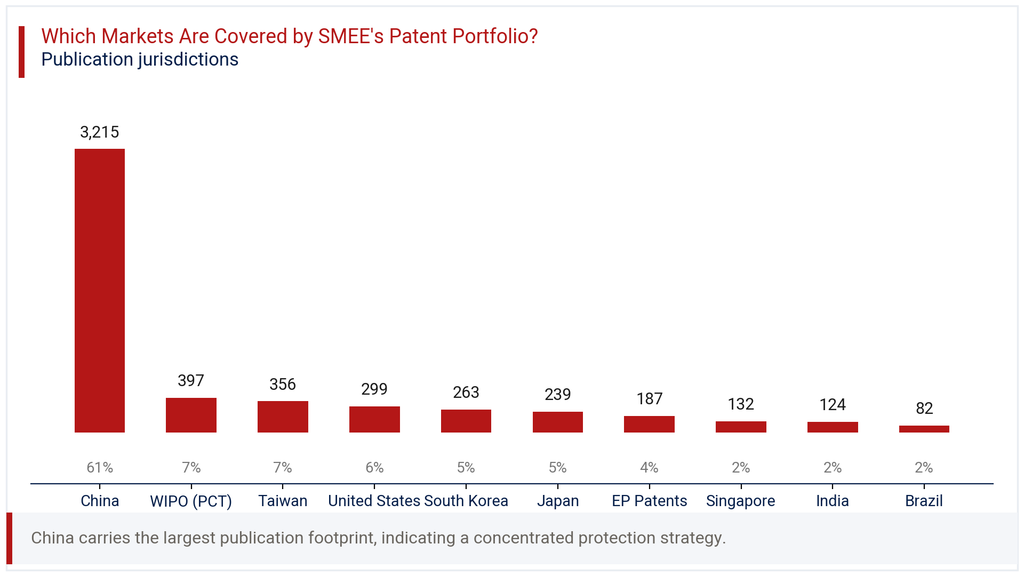
Beyond China and PCT filings, SMEE shows meaningful but modest presence in Taiwan (10.8%), the United States (9.0%), South Korea (7.9%), and Japan (7.2%). These are all significant semiconductor manufacturing or equipment hubs, suggesting deliberate protection in markets where competitors or customers operate. Smaller shares appear in EP Patents (5.6%), Singapore (4.0%), India (3.7%), and Brazil (2.5%), rounding out coverage across 10 jurisdictions total. This pattern is consistent with a company whose commercial base remains concentrated at home while it builds selective international protection around the semiconductor equipment supply chain. The relatively thin coverage outside China, Taiwan, and the United States suggests SMEE’s international patent strategy still trails its domestic filing intensity by a wide margin.
Where is the SMEE Patent Portfolio Building Protection Across Key Technologies?
IPC analysis of the SMEE patent portfolio reveals heavy concentration in a single technical domain. The G03F class, covering photomechanical production of patterns, accounts for 1,779 families, or 50.5% of the entire portfolio. The technology chart in this section shows this class standing well above every other category, confirming lithography pattern generation as SMEE’s defining technical strength.
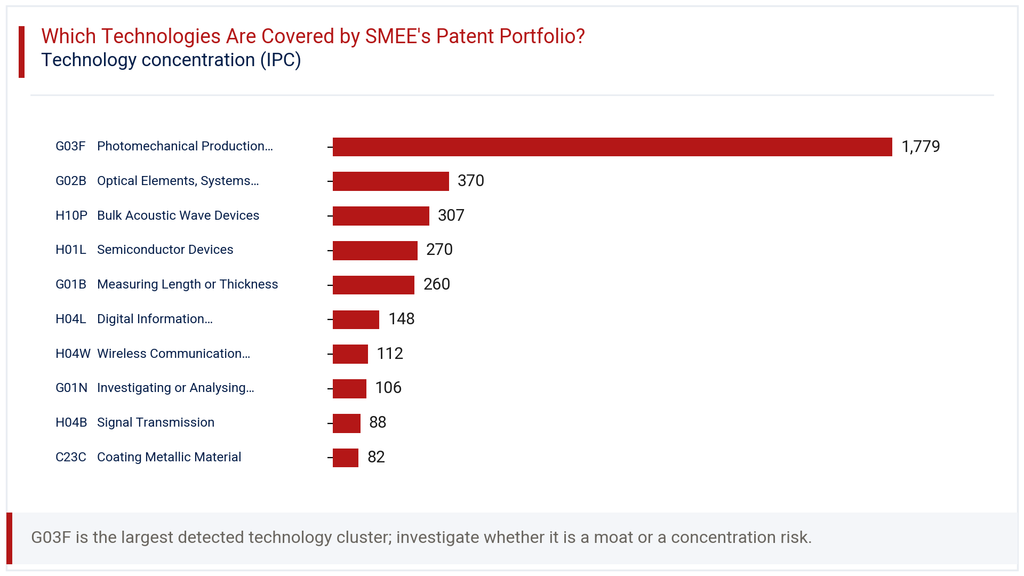
Supporting clusters reinforce this core focus. Optical elements and instruments (G02B) hold 10.5% share with 370 families, directly relevant to lithography scanner optics. Bulk acoustic wave devices (H10P) contribute 8.7%, while semiconductor devices (H01L) account for 7.7%, and measuring length or thickness technologies (G01B) represent 7.4%. Smaller shares appear in digital information transmission, wireless networks, materials analysis, signal transmission, and metallic coating, each below 5%. This distribution shows a portfolio built around one dominant engineering domain, lithography optics and pattern formation, surrounded by adjacent measurement and materials technologies that support scanner precision and semiconductor device manufacturing. Few equipment makers show this degree of thematic concentration.
How Has the SMEE Patent Portfolio Evolved Across Filing Geographies?
Viewing filing activity by year and jurisdiction together clarifies when SMEE’s international ambitions peaked. China filings stayed consistently high from 2010 through 2020, ranging between 190 and 242 annually, forming the stable backbone of the portfolio. The heatmap in this section shows international filings following a markedly different, bell-shaped pattern.
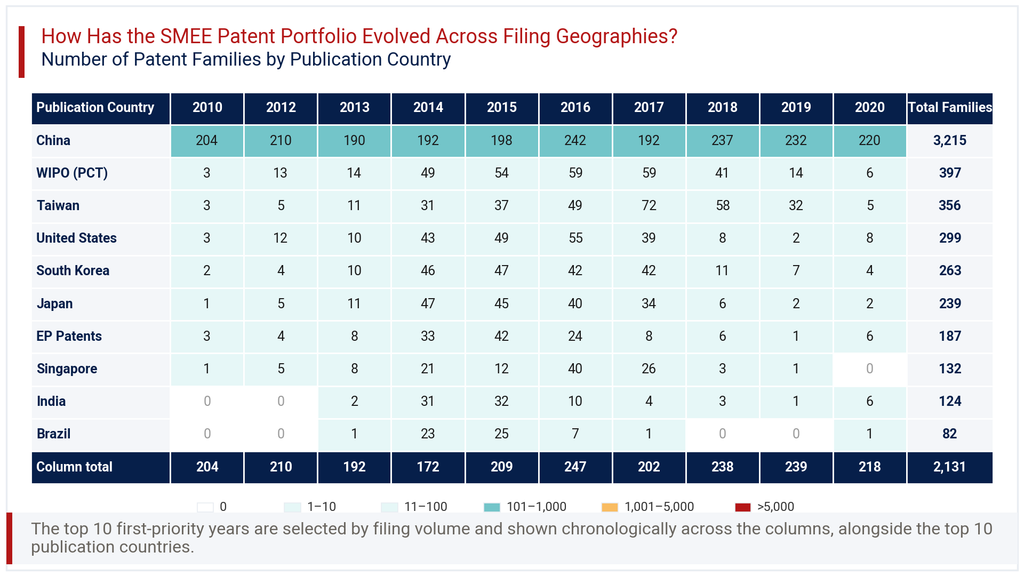
International jurisdictions like the United States, Japan, South Korea, and the EP Patents route all show their highest activity between 2014 and 2017. US filings rose from 3 in 2010 to 43 in 2014, peaking near 55 in 2016, then falling sharply to single digits by 2019. Japan and South Korea show nearly identical arcs, climbing through the mid-2010s and contracting after 2017. Taiwan stands apart, peaking later at 72 filings in 2017. India and Brazil saw brief activity concentrated almost entirely in 2014 and 2015, with negligible filings before or after. This pattern suggests a defined window, roughly 2014 to 2018, when SMEE pursued coordinated multi-country filing, likely tied to specific product launches or export ambitions, followed by a retreat back toward domestic-first filing.
Consultant’s Perspective on SMEE Patent Portfolio
The SMEE patent portfolio tells a coherent story of a domestic champion building deep technical moats around lithography. The 50.5% concentration in photomechanical pattern production is not accidental. It reflects sustained, focused investment in the single most difficult technology China needs to master for semiconductor self-sufficiency. The grant rate of 74.8% and active rate of 79.0% indicate the portfolio is being prosecuted and maintained with discipline, not filed opportunistically.
What stands out, though, is the geographic imbalance. With 97.1% of filings concentrated in China, SMEE’s international patent presence remains thin relative to the global ambitions often associated with Chinese semiconductor equipment makers. The 2014 to 2018 window of international filing activity has not been sustained, and recent year counts, while affected by publication lag, suggest a broader slowdown worth monitoring closely.
For stakeholders assessing SMEE, the practical takeaway is this: technical depth in lithography is well established, but international legal protection has not kept pace. Any competitor, investor, or partner evaluating freedom-to-operate risk outside China should weigh this gap carefully rather than assume broad global coverage exists.
Explore Deeper Insights with Expertlancing Research
This analysis offers a starting point, not the final word, on SMEE’s technology position. Expertlancing Research helps clients go deeper, mapping specific patent families, tracking competitor filing behavior, and assessing freedom-to-operate risk across jurisdictions. Whether you are evaluating a licensing opportunity, conducting competitive intelligence, or preparing an investment thesis around semiconductor equipment, our analysts can build a tailored patent intelligence report. Reach out to Expertlancing Research to commission a detailed study suited to your specific business question.