


The Sugon Patent Portfolio spans 2,998 patent families and offers a useful lens into how this Chinese supercomputing major builds and defends its technology position. Of this total, 62.8% remain active, a figure covering both granted and pending cases. The portfolio includes 1,078 granted patents and 806 pending applications, translating into a grant rate of 36.0%. The remaining families fall into lapsed, expired or revoked categories, together accounting for 1,114 families. These are prosecution and maintenance metrics, not a judgment on patent quality or enforceability.
Filing activity peaked in 2024, with 354 families filed that year, the highest point across the entire observed period. China dominates the filing geography, holding 97.8% of all filings across a portfolio that spans 6 jurisdictions. On the technology side, digital data processing under G06F leads by a wide margin, accounting for 1,909 families, more than any other classification tracked in this analysis.
This report draws on structured filing data to help readers assess the shape and direction of Sugon’s patent activity. Filing counts alone do not establish product success, market share, or competitive advantage in any given technology. Readers evaluating specific families for licensing, investment, or competitive benchmarking should validate those records independently before relying on them for business decisions. What follows breaks down portfolio health, filing trends, geographic concentration, and technology focus in turn.
About Sugon
Company Profile: Sugon, officially Dawning Information Industry Company Limited, is a supercomputer manufacturer based in the People’s Republic of China. The company traces its roots to research work done under the Chinese government’s 863 Program. The group launched their first supercomputer, Dawning No. 1, in 1993. In 1996 the group launched the Dawning Company to allow transfer of research computers into the market.
The company is a spin-off from research done at the Chinese Academy of Sciences, and still has close links to it. Its core products include supercomputers and x86 servers, covering rack, blade and high-density server lines. It was tasked with developing further supercomputers under the 863 program, which led to the Dawning 5000A and 6000 computers. The company was listed on the Shanghai Stock Exchange in 2014. Sugon is an investor in technology company GoLaxy. In October 2022, Sugon was added by the U.S.
Department of Defense to its list of Chinese military companies.
How Healthy is Sugon Patent Portfolio?
The legal status composition chart in this section shows a portfolio that is granted-heavy but not without friction. Granted patents make up 36.0% of the total, while pending applications represent 26.9%, pointing to a steady pipeline still moving through examination. Revoked families stand at 28.5%, a notably high share that deserves attention from anyone assessing patent portfolio health here. Lapsed and expired families add a further 2.2% and 6.5% respectively, rounding out the picture of a portfolio with meaningful attrition.
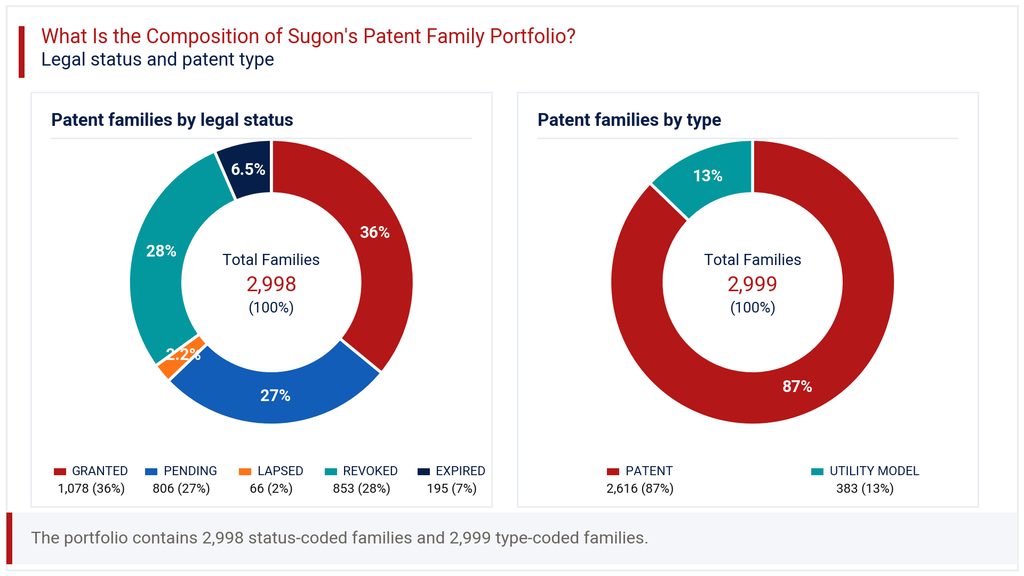
Looking at patent type, utility patents account for 87.2% of filings, with utility models making up the remaining 12.8%. This split suggests Sugon leans toward full invention patents rather than the shorter-protection utility model route common among Chinese filers. The 62.8% active rate confirms a majority of families still carry live rights, whether granted or pending. The revoked share, however, signals that a substantial slice of filings did not survive challenge or examination scrutiny. For stakeholders assessing competitive risk, this mix of strength and attrition calls for case-by-case diligence rather than reliance on headline totals.
How Has the Sugon Patent Portfolio Evolved Over Time?
The filing-trend chart in this section traces a portfolio that moved through distinct phases rather than a single steady climb. Early filings before 2008 totaled 111, followed by a dip to 11 in 2008 and a rebound to 90 in 2009. Activity then rose sharply through 2010 to 2013, peaking at 223 and 231 families in those two years. A pullback followed from 2014 through 2019, with annual counts settling between 92 and 148.
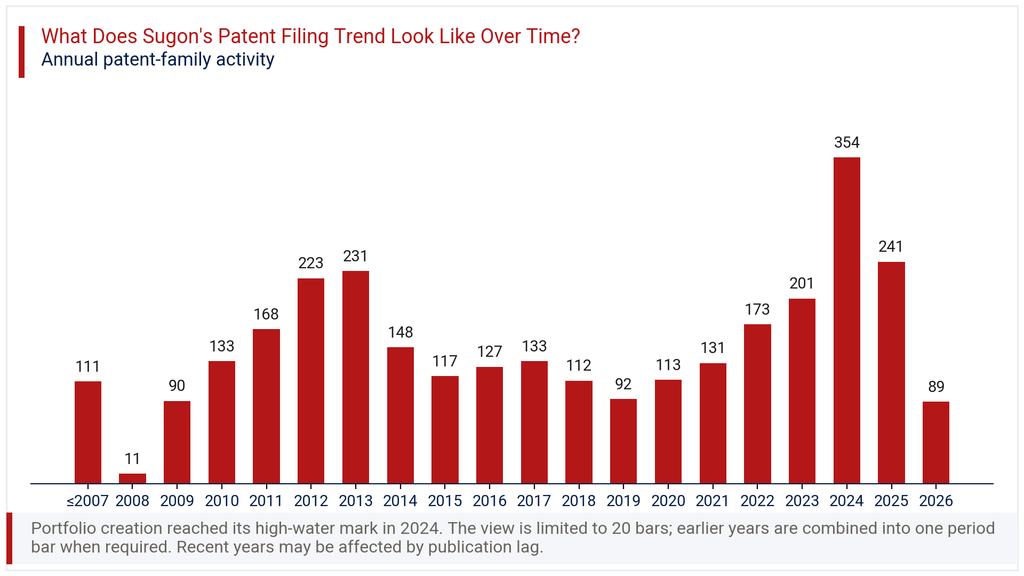
A second growth wave began in 2020, climbing from 113 that year to 354 in 2024, the highest annual count recorded. The year 2025 shows 241 families, and the latest_year_change_pct figure of -63.1% reflects the sharp drop into 2026 at just 89 families. This decline is best read as a publication lag rather than a genuine fall in filing activity. Patent applications typically take twelve to eighteen months to appear in public databases after filing. The 2024 and 2025 surge still points to an active, reinvesting innovation effort, with the apparent recent slowdown largely an artifact of reporting timelines rather than reduced filing behavior.
Where Does the Sugon Patent Portfolio Prioritize Patent Protection?
The geographic chart in this section makes Sugon’s filing priorities unmistakable. China accounts for 97.8% of all filings, equivalent to 2,932 families out of the total portfolio. No other jurisdiction comes close. South Korea holds the next largest share at 2.1%, equal to 62 families, while the United States and WIPO’s PCT route each carry just 10 families, a 0.3% share apiece.
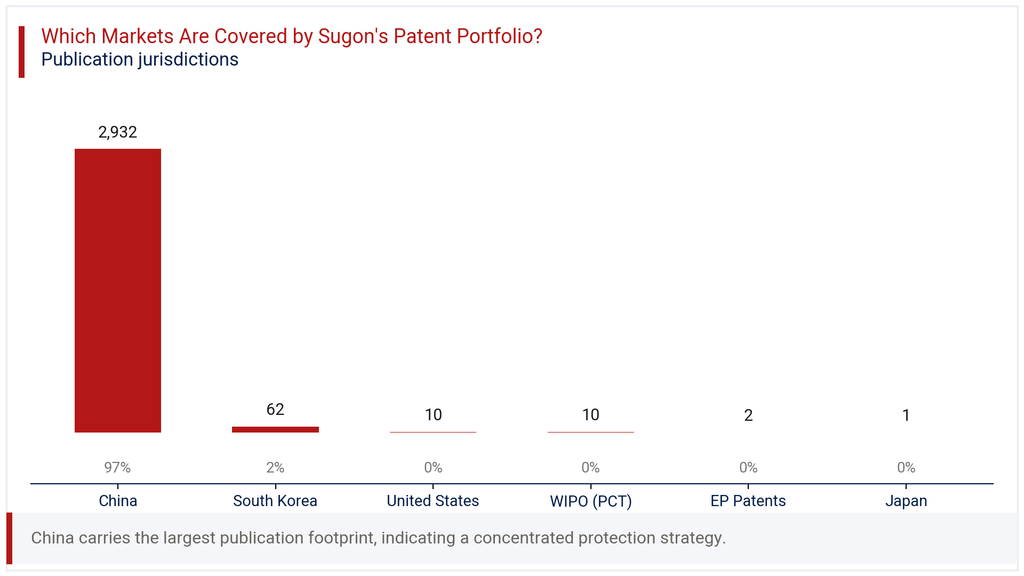
European Patents and Japan trail further behind, with 2 and 1 families respectively, each under a tenth of one percent. This pattern of patent geography reflects a company whose commercial and regulatory priorities sit overwhelmingly within its home market. Supercomputing and server hardware sold primarily to domestic government and enterprise buyers would naturally draw this kind of filing behavior. The limited international footprint may also reflect export control considerations given Sugon’s designation by the U.S. Department of Defense. For competitors or partners operating outside China, this concentration limits the direct patent risk from Sugon’s portfolio in markets outside its home jurisdiction, though licensing and freedom-to-operate checks remain advisable wherever joint ventures or imports are involved.
Where is the Sugon Patent Portfolio Building Protection Across Key Technologies?
The technology chart in this section highlights a clear concentration around computing infrastructure. Digital data processing under G06F leads with 1,909 families, representing 62.4% of the entire portfolio. Digital information transmission under H04L follows at 680 families, or 22.2%, reflecting strong investment in networking and data transfer technologies alongside core computing.
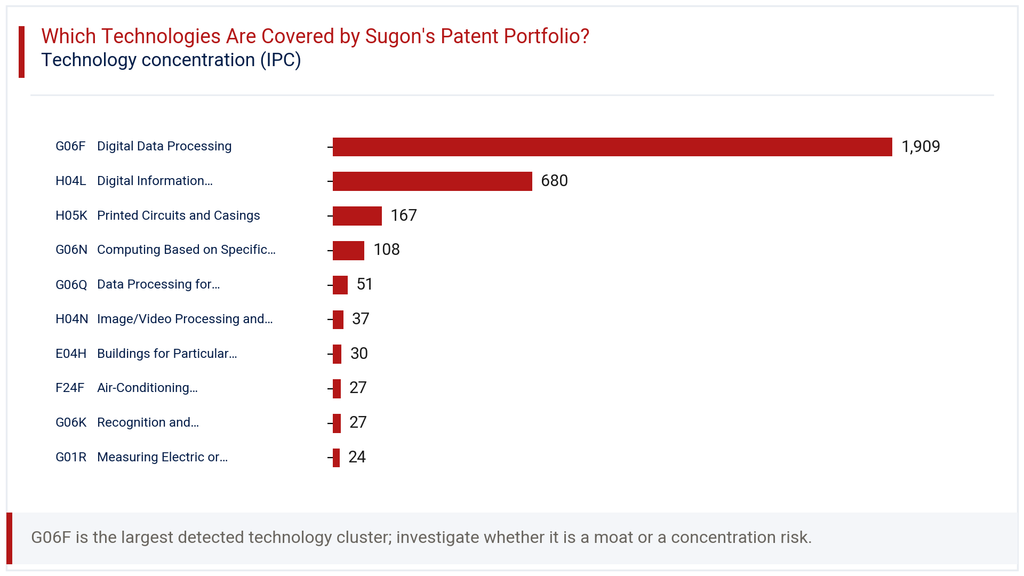
Printed circuits and casings under H05K account for 167 families, a 5.5% share tied to the physical hardware side of server and supercomputer manufacturing. Computing based on specific models under G06N, which covers artificial intelligence and machine learning architectures, holds 108 families at 3.5%. Smaller clusters appear in data processing for administrative purposes (G06Q, 51 families), image and video processing (H04N, 37 families), and niche areas like air-conditioning systems for data centers (F24F, 27 families). This IPC analysis confirms that Sugon’s innovation effort centers heavily on core computing architecture and data transmission, with secondary investment in physical infrastructure and emerging AI-adjacent computing models, consistent with its position as a hardware and systems manufacturer.
How Has the Sugon Patent Portfolio Evolved Across Filing Geographies?
The heatmap in this section lays out how Sugon’s jurisdiction mix shifted year by year. China has consistently carried the overwhelming majority of filings in every year with available data, rising from 130 in 2010 to 354 in 2024. Other jurisdictions appear only sporadically and in small numbers by comparison.
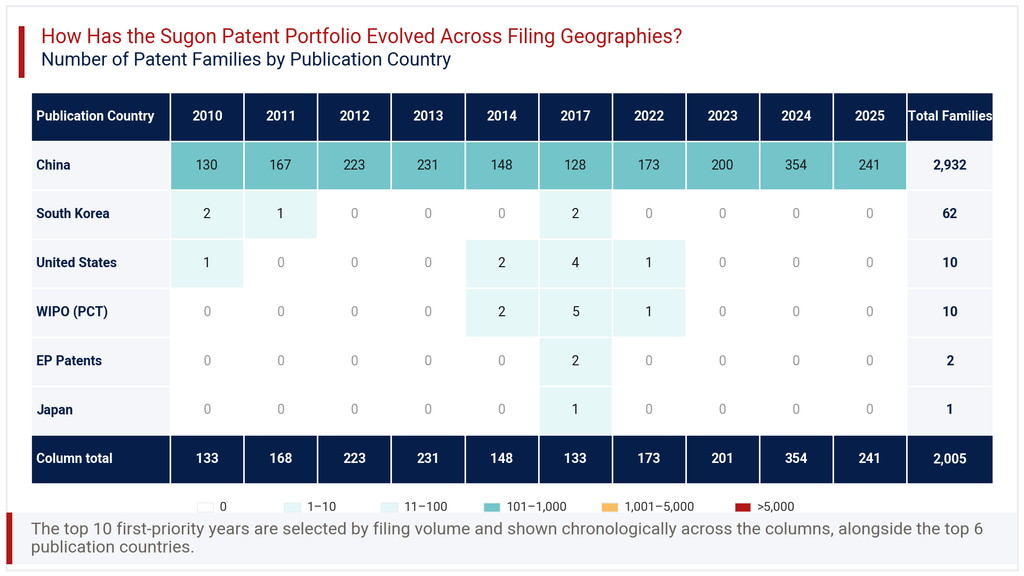
South Korea shows filings in 2010 (2), 2011 (1), and 2017 (2), with no recorded activity in the years after. The United States appears in 2010, 2014, 2017, and 2022, never exceeding 4 families in any single year. WIPO’s PCT route shows a similar pattern, with a small cluster of 5 filings in 2017 and minimal activity elsewhere. EP Patents and Japan each appear only in 2017, with 2 and 1 families respectively. This timeline suggests a brief window around 2017 when Sugon tested a slightly wider international filing strategy before returning to an almost entirely China-centric approach in subsequent years.
Consultant’s Perspective on Sugon Patent Portfolio
The Sugon Patent Portfolio tells a story of a company deeply committed to its domestic technology base. The concentration in G06F and H04L classifications aligns well with its core business in supercomputing and server hardware. The near-total reliance on Chinese filings, at 97.8% of the portfolio, is consistent with a company whose primary customer base sits within China’s state and enterprise computing sectors.
What stands out most is the 28.5% revocation rate sitting alongside a healthy 36.0% grant rate. This combination suggests a filing strategy that casts a wide net, accepting that a meaningful share of applications will not survive challenge. The 2020 to 2024 filing surge, culminating in 354 families in the peak year, points to renewed R&D investment, likely tied to domestic semiconductor and AI computing priorities following export restrictions from Western suppliers.
Going forward, stakeholders should watch whether Sugon begins filing more broadly outside China, particularly if its supercomputing exports expand into new markets. A continued narrow jurisdiction footprint would reinforce a domestic-first strategy, while any shift toward PCT or EP filings would signal international ambition. Monitoring the G06N cluster around AI computing models is also worthwhile, given its strategic relevance to China’s broader technology self-sufficiency goals.
Explore Deeper Insights with Expertlancing Research
Understanding a patent portfolio at this level of detail takes more than reading raw counts. Expertlancing Research helps technology companies, investors, and legal teams translate filing data into practical competitive intelligence. Whether you need a deeper dive into Sugon’s specific patent families, a freedom-to-operate assessment, or a comparative study against industry peers, our analysts can build the evidence base you need. Reach out to Expertlancing Research to commission a tailored patent intelligence study for your next strategic decision.