
The Sunwoda Patent Portfolio offers a useful window into how a major Chinese battery maker protects its engineering output. Across all jurisdictions, the company holds 6,116 patent families, with 94.1% of them still active between granted and pending status. Of this total, 4,464 families have been granted while 1,293 remain pending before patent offices worldwide. The grant rate stands at 73.0%, a reasonably strong conversion figure for a filer of this scale. A further 359 families fall into lapsed, revoked, or expired categories combined. These are prosecution and maintenance metrics only, not a verdict on patent quality or enforceability.
Filing activity peaked in 2024, when Sunwoda recorded 1,419 new families, the highest of any year in the dataset. China dominates the jurisdictional spread, accounting for 99.7% of all filings across 10 jurisdictions tracked. This concentration reflects a filing strategy anchored heavily in the domestic market. On the technology side, H01M, covering batteries and cells, leads decisively with 4,207 families, confirming where Sunwoda’s innovation energy is spent.
This report is meant to help readers interpret filing patterns, not to pronounce judgment on commercial outcomes. A high filing count does not automatically translate into market leadership or technical superiority. Readers evaluating Sunwoda for partnership, investment, or competitive benchmarking should validate specific patent families independently. What follows is a structured read of legal health, filing trends, geography, and technology focus, built entirely from the data at hand.
About Sunwoda
Company Profile: Sunwoda Electronic Co., Ltd. is a Chinese lithium-ion battery manufacturer headquartered in Shenzhen. The company was established in 1997 and was listed on the Shenzhen Stock Exchange in 2011 under stock code 300207. It successfully issued Global Depository Receipts on the SIX Swiss Exchange in 2022. The company operates across six business segments: 3C battery, power battery, energy storage battery, energy service, smart hardware, and ecological innovation of industry.
It has established multiple production bases across several Chinese provinces, as well as in India, Vietnam, Hungary, Morocco, and Thailand. It also has branches in the U.S., France, Germany, Israel, South Korea, and Japan. Sunwoda’s EV battery unit supplies products to automakers such as Dongfeng Motor Group, Geely, Volkswagen, Volvo Cars, and Li Auto. It is one of the largest EV battery suppliers in China. In 2022, Sunwoda was listed in Benchmark’s Tier 1 of Automotive-grade Battery Producers.
How Healthy is Sunwoda Patent Portfolio?
Patent portfolio health starts with legal status, and Sunwoda’s numbers look fairly solid. Granted families make up 73.0% of the total, while pending applications add another 21.1%, pushing the active rate to 94.1%. Lapsed families sit at a modest 1.9%, revoked at 3.3%, and expired at just 0.6%. This combination suggests the company maintains most of its filings through to grant rather than abandoning them mid-process. The composition chart in this section shows this balance visually, with granted and pending segments clearly dominating the overall pie.
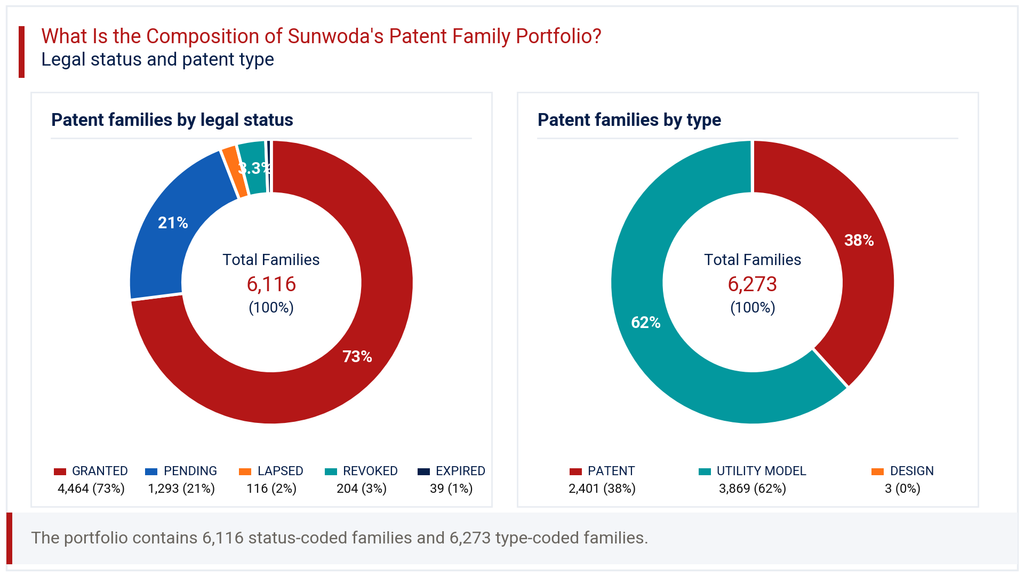
Patent type adds another layer to this picture. Utility models account for 61.7% of filings, compared to 38.3% for standard patents, with design filings negligible at effectively 0.0%. This tilt toward utility models is typical for Chinese electronics and battery manufacturers, since utility models grant faster and demand lower inventive thresholds. It points to a filing strategy built for speed and volume rather than exclusively for deep technical novelty. Taken together, the legal status and patent type mix indicate a portfolio actively managed rather than left to decay. The revocation share, while small, is worth periodic monitoring as the portfolio matures.
How Has the Sunwoda Patent Portfolio Evolved Over Time?
Sunwoda’s patent filing trends show a long, slow build followed by a sharp climb. Early years through 2016 saw single or low double-digit filings annually, rarely exceeding 42 families. The real inflection begins in 2017, with 131 families, and accelerates through 2019 at 289, then 2020 at 450. The filing-trend chart in this section captures this curve clearly, showing a steep upward slope from 2019 onward.
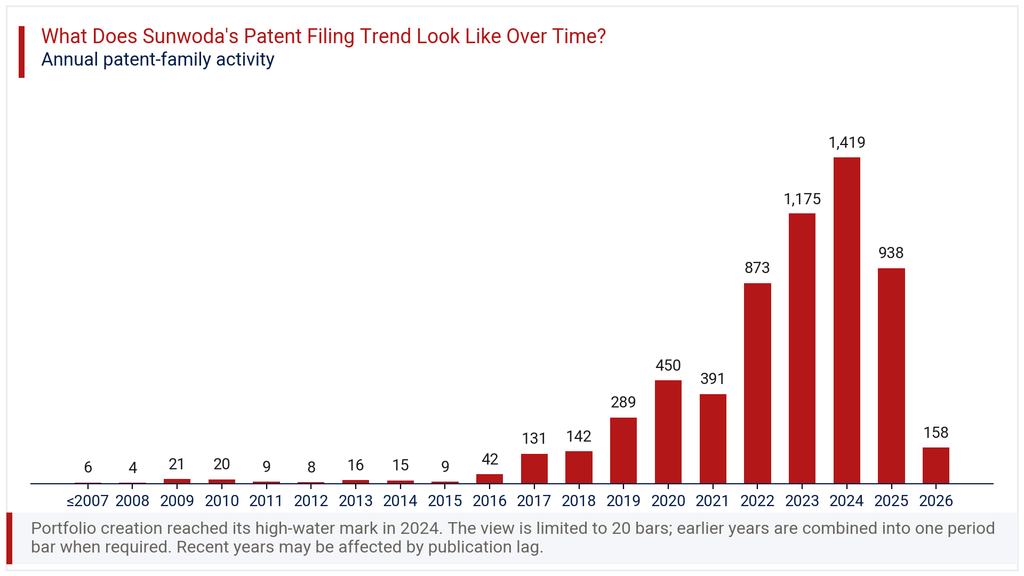
The growth peaks in 2022 through 2024, with 873, 1,175, and 1,419 families respectively, the strongest three-year run in the company’s filing history. The year 2025 shows 938 families, and 2026 records just 158. These later-year dips should not be read as a genuine slowdown. Patent applications typically take twelve to eighteen months to publish, so recent filings are undercounted in any dataset pulled before that window closes. The -83.2% change marked for the latest year reflects this publication lag rather than an actual retreat in R&D filing activity. The underlying trajectory, from under 50 families a year to well over a thousand, signals a sustained and deliberate expansion in Sunwoda’s patenting effort through the last decade.
Where Does the Sunwoda Patent Portfolio Prioritize Patent Protection?
Patent geography for Sunwoda is overwhelmingly domestic. China accounts for 99.7% of all filings, a near-total concentration that leaves little room for ambiguity about where the company protects its core inventions first. The geographic chart in this section makes this dominance immediately visible, with China towering over every other jurisdiction tracked. WIPO PCT filings, the next largest category, represent only 5.8% of the portfolio, used mainly as a staging mechanism for eventual international entry.
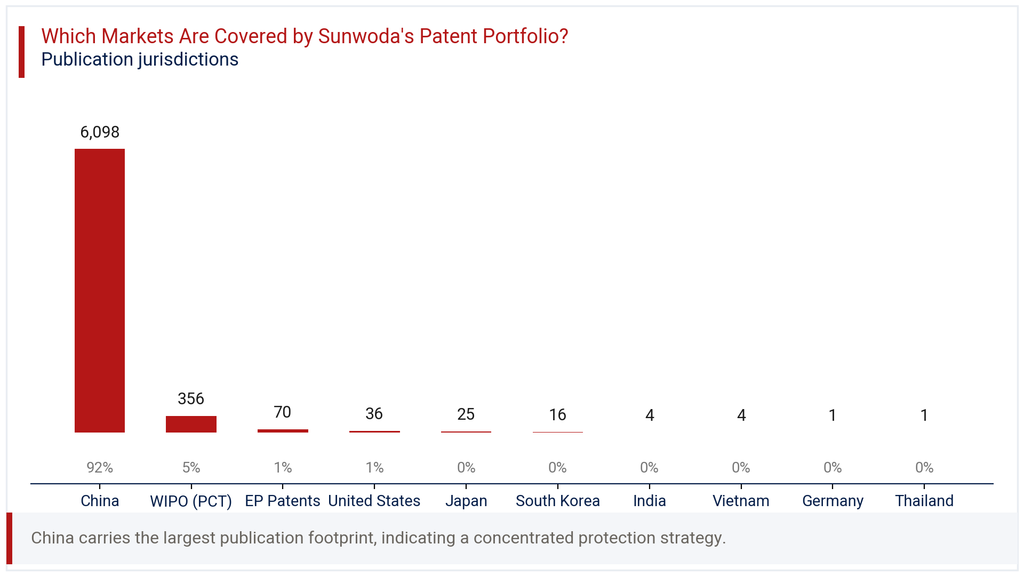
Beyond China and PCT routes, protection thins out quickly. EP Patents hold 1.1% share, the United States 0.6%, and Japan 0.4%, with South Korea, India, Vietnam, Germany, and Thailand all registering under 0.3% individually. In absolute terms, filings reach 10 distinct jurisdictions, a reasonably broad net for a company whose production footprint spans India, Vietnam, Hungary, Morocco, and Thailand. Yet the gap between manufacturing presence and patent filing presence in those countries is notable. This pattern suggests Sunwoda treats overseas patent protection as a selective, case-by-case decision rather than a default accompaniment to plant expansion.
Where is the Sunwoda Patent Portfolio Building Protection Across Key Technologies?
An IPC analysis of the portfolio points to one clear center of gravity. H01M, the classification for batteries and cells, accounts for 70.2% of all filings, with 4,207 families, by far the largest technology cluster. The technology chart in this section shows just how far ahead this category sits compared to every other classification tracked. This concentration aligns tightly with Sunwoda’s core identity as a lithium-ion battery manufacturer.
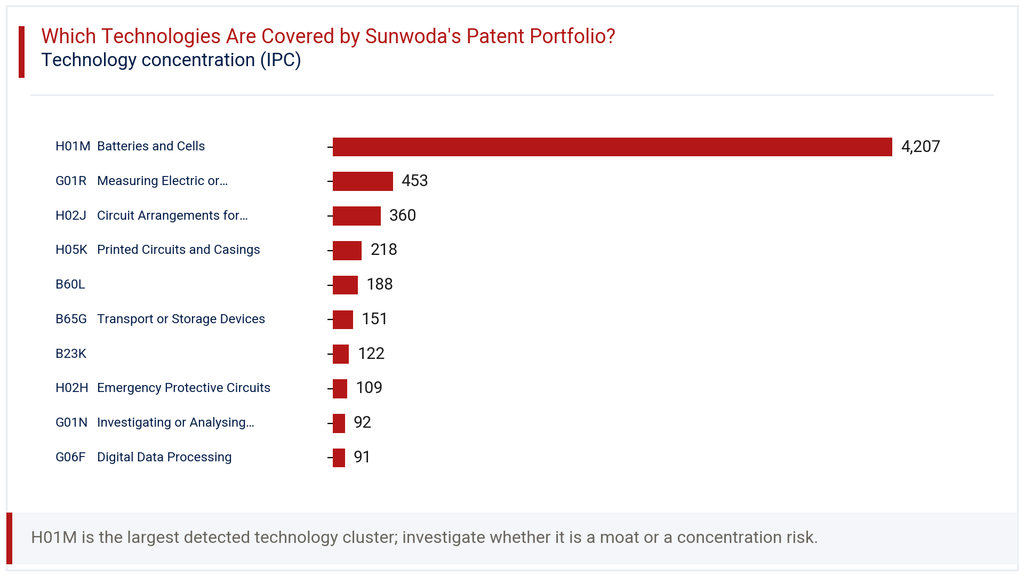
Secondary clusters trail at a considerable distance. G01R, covering measurement of electric and magnetic variables, holds 7.6% share with 453 families, likely tied to battery testing and diagnostics work. H02J, power supply circuit arrangements, follows at 6.0% and 360 families. Smaller clusters include H05K for printed circuits at 3.6%, B60L at 3.1%, and B65G for transport and storage devices at 2.5%. Categories like B23K, H02H, G01N, and G06F each contribute under 2.0%. This spread shows Sunwoda investing modestly in adjacent fields such as power management, materials testing, and digital data processing, but always in support of its central battery technology focus rather than as independent growth areas.
How Has the Sunwoda Patent Portfolio Evolved Across Filing Geographies?
Layering filing years against jurisdictions in the heatmap reveals how closely international filing tracks the overall growth curve. China scales up in near-lockstep with total filings, reaching 1,415 families in 2024 alone, consistent with its 99.7% overall share. The heatmap shows this single column overwhelming every other jurisdiction row across nearly every year recorded.
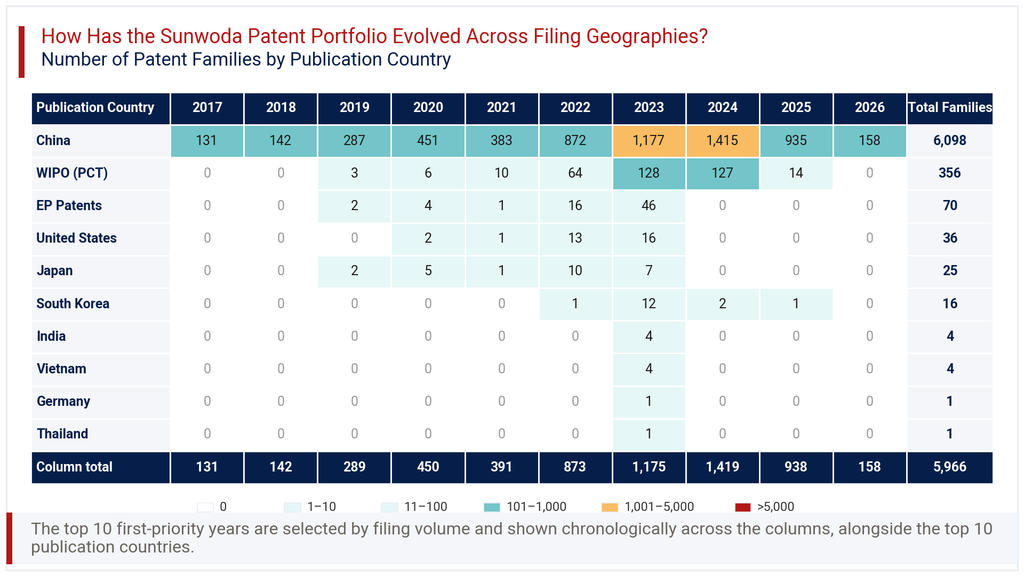
International activity, while small in absolute terms, follows its own rhythm. WIPO PCT filings stay at zero through 2018, then rise steadily to 64 in 2022 and peak at 128 in 2023. EP Patents show a similar late arrival, with 46 families in 2023 after years of single digits. The United States, Japan, and South Korea each show brief bursts, like South Korea’s 12 families in 2023, rather than sustained year-on-year presence. India, Vietnam, Germany, and Thailand appear only in 2023, with just one to four families each. This pattern suggests 2022 and 2023 marked a deliberate, if short-lived, push toward broader international filing, one that has not yet repeated at the same intensity in subsequent years shown.
Consultant’s Perspective on Sunwoda Patent Portfolio
Reading the Sunwoda Patent Portfolio end to end, the signal is consistent: a company filing with discipline, heavily concentrated in its core battery technology, and overwhelmingly domestic in scope. The 73.0% grant rate and 94.1% active status indicate a filing operation that converts applications efficiently rather than filing speculatively and letting cases lapse. The utility model tilt at 61.7% fits a strategy built for rapid, incremental protection across a high-volume product line.
The geographic imbalance deserves attention from anyone assessing Sunwoda’s global competitive position. With 99.7% of filings in China and under 6% even through PCT channels, the company’s international patent coverage lags its international manufacturing footprint in India, Vietnam, and Europe. For a business supplying automakers like Volkswagen and Volvo Cars, this gap carries real exposure if competitors file aggressively in those same overseas markets.
My recommendation: treat the 2022 to 2023 international filing push as a template, not an anomaly, and scale it further. Expanding PCT and direct EP or US filings in step with manufacturing expansion would better align Sunwoda’s protection posture with its actual commercial footprint. The underlying technology depth in H01M is strong; the task now is geographic follow-through.
Explore Deeper Insights with Expertlancing Research
This overview only scratches the surface of what the Sunwoda Patent Portfolio can reveal. Expertlancing Research helps technology leaders, investors, and legal teams go further, with family-level validation, competitor benchmarking, and custom technology landscape studies. If you are assessing Sunwoda for partnership, investment, or competitive tracking, our analysts can build a tailored brief around your specific questions. Reach out to Expertlancing Research to turn these patterns into decisions you can act on with confidence.