
The Taikai Patent Portfolio spans 4,027 patent families, with an active rate of 51.9% covering both granted and pending cases. Of this total, 1,635 families stand granted, while 457 remain pending before patent offices. The grant rate works out to 40.6%, a figure that reflects prosecution outcomes rather than innovation quality. Meanwhile, 1,935 families fall into lapsed, expired, or revoked status, combining the 1,697 lapsed, 55 expired, and 183 revoked cases. These numbers describe prosecution and maintenance activity only, not a verdict on legal strength or market relevance.
Filing activity peaked in 2024, when the portfolio recorded 443 new families, the highest single-year count in this dataset. China dominates the filing geography, accounting for 99.7% of all families across a spread of 9 jurisdictions worldwide. The leading technology cluster is H01H, covering electric switches and relays, with 921 families, the single largest concentration in the portfolio. This cluster alone signals where the company has chosen to build its deepest technical moat.
This report draws on patent family counts, legal status, and classification data to map where Taikai has concentrated its filing effort. Filing volume alone does not confirm commercial success, market dominance, or enforceable rights. Readers considering business decisions based on this analysis should verify specific patent families directly before relying on them externally. The intent here is to offer a grounded, evidence-based starting point for further diligence.
About Taikai
Company Profile: TAIKAI operates an online platform for hosting hackathons and open innovation challenges. The company describes itself with the legal name TAIKAI, SA. The platform hosts online, virtual hackathons and open innovation challenges, helping users discover the best hackathons to engage with through an all-in-one solution.
TAIKAI connects companies with developers to solve real business problems through structured competitions. The platform hosts hackathons that attract participants from a community of over 100,000 builders worldwide. Beyond the core hackathon tool, TAIKAI offers features for organisers.
The platform offers customizable landing pages, livestreaming for webinars and Q&As, configurable evaluation criteria, and webhook integrations for automation. The company emphasises platform security. It states its web application has been audited and approved by Hacken, a blockchain security auditing firm, with a perfect score. TAIKAI positions itself within the web3 and blockchain innovation space, engaging enterprise clients for corporate innovation initiatives.
How Healthy is Taikai Patent Portfolio?
The patent legal status breakdown offers a direct read on portfolio health. 40.6% of families hold granted status, while 11.3% remain pending examination. On the other side, 42.1% have lapsed, 4.5% stand revoked, and 1.4% have expired. The composition chart in this section lays out this split clearly, showing a portfolio where lapsed families nearly match granted ones in volume. That balance matters for anyone assessing the strength of current, enforceable rights within this patent portfolio.
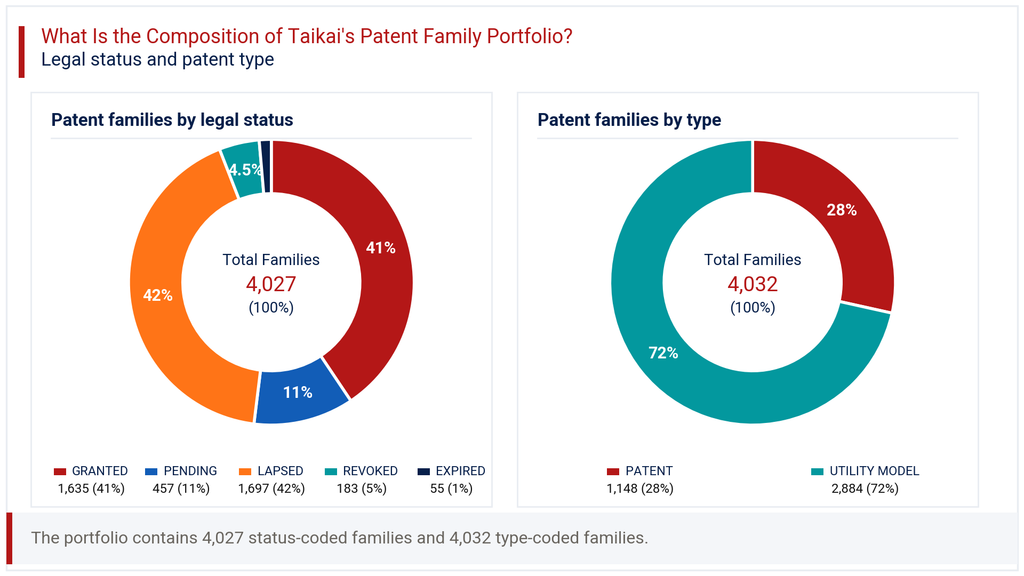
Looking at patent type, utility models make up 71.5% of the Taikai Patent Portfolio, with standard patents comprising the remaining 28.5%. This utility model concentration is typical of Chinese-filed portfolios, where utility model registration offers a faster, less rigorous path to protection. It also means a meaningful share of these rights carry shorter statutory terms and lighter substantive examination. Combined with the 42.1% lapsed rate, the picture suggests a portfolio built for speed and volume rather than long-term global exclusivity. Buyers or licensing partners should treat the active, granted subset as the core value, and examine the rest with caution before assuming broad coverage.
How Has the Taikai Patent Portfolio Evolved Over Time?
Patent filing trends across the Taikai Patent Portfolio show steady, almost uninterrupted growth from 2008 onward. Filings moved from 32 in 2008 to 154 by 2010, then climbed through the 2010s with only minor dips, such as 2011‘s 112 families. The filing-trend chart in this section captures this long upward arc, culminating in a peak of 443 families in 2024. That peak marks the single strongest filing year across the entire period tracked.
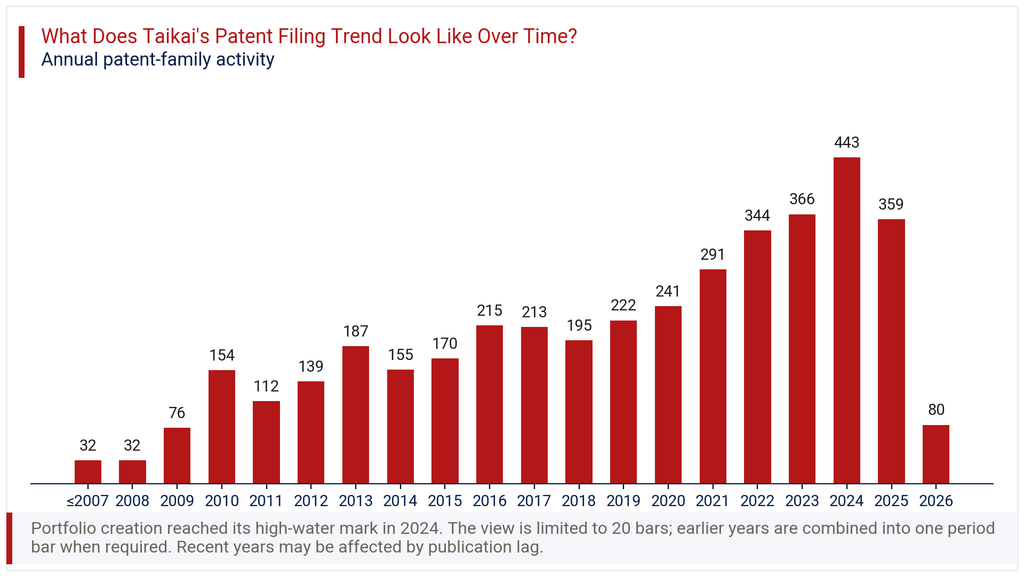
The years 2025 and 2026 show 359 and 80 families respectively, numbers that might look like a sharp pullback. The data confirms a 77.7% drop in the latest year change, but this reflects publication lag rather than a genuine retreat from filing. Patent applications often take 18 months or longer to publish, so recent years will always appear understated until records catch up. Readers should treat 2024 as the most reliable recent indicator of filing momentum, with 2025 and 2026 figures expected to rise as data updates. The underlying trend through 2023 and 2024 points to sustained, even accelerating, investment in patent protection.
Where Does the Taikai Patent Protection Portfolio Prioritize Patent Protection?
Patent geography within the Taikai Patent Portfolio is heavily concentrated in one market. China accounts for 99.7% of all filed families, a dominant share by any measure. Japan follows a distant second at 0.3%, with WIPO’s PCT route and the United States each contributing 0.1%. India, the United Kingdom, South Korea, Thailand, and South Africa round out the remaining jurisdictions, each with minimal representation. The geographic chart in this section visualizes just how lopsided this spread really is.
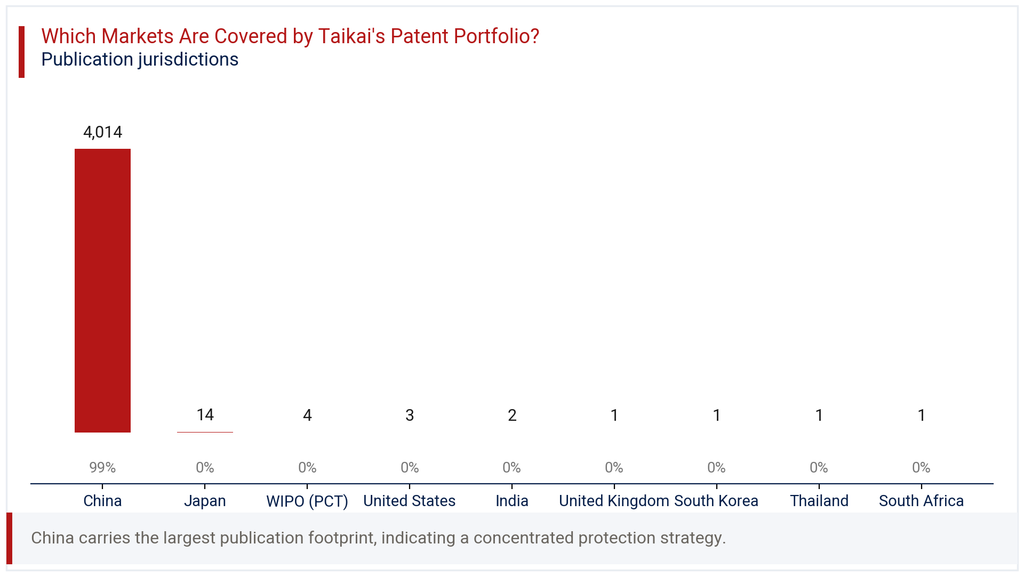
This concentration tells a clear story about where the company sees its primary commercial interest. Filing almost exclusively in China, across 9 total jurisdictions, suggests a domestic-first strategy rather than a global enforcement plan. The near absence of filings in major markets like the United States or across Europe limits the portfolio’s reach for international licensing or litigation. Companies evaluating this portfolio for cross-border deals should weigh this geographic imbalance carefully. Protection outside China remains minimal, which narrows the practical scope of enforceable rights internationally.
Where is the Taikai Patent Portfolio Building Protection Across Key Technologies?
The IPC analysis behind the Taikai Patent Portfolio points to a strong electrical engineering focus. The top class, H01H covering electric switchgear and relays, holds 921 families, or 26.6% of the total. Close behind sits H02B, covering boards, switchgear, and substations, with 839 families at 24.3%. H01F, related to magnets and inductors, contributes 656 families, or 19.0%. The technology chart in this section shows these three classes forming the clear backbone of the portfolio.
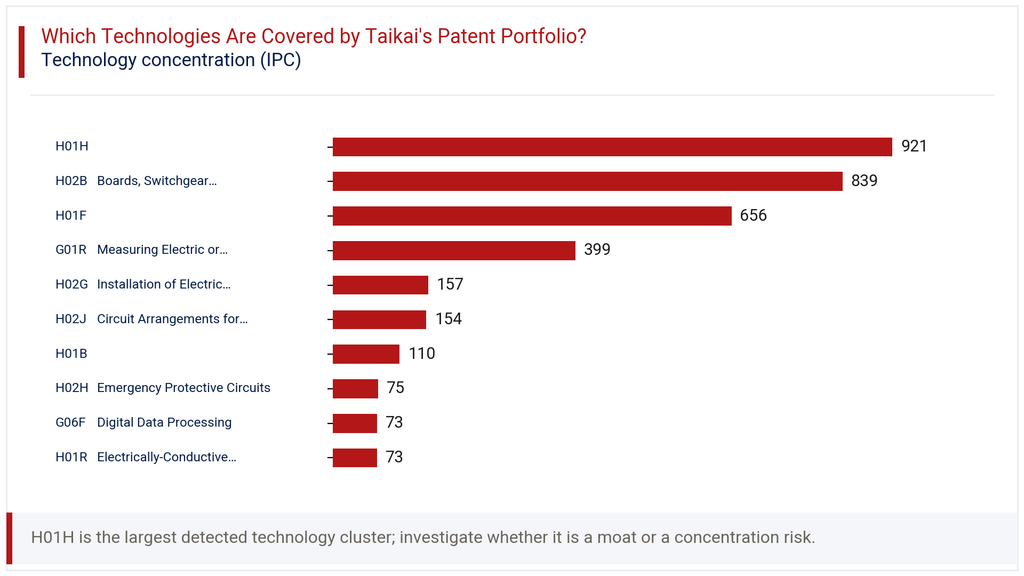
Further down the list, G01R for measuring electric or magnetic variables adds 399 families at 11.5%, while H02G, covering cable installation, and H02J, covering power supply circuits, each hold 4.5%. Smaller contributions come from H01B conductors, H02H protective circuits, and even G06F digital data processing at 2.1%. This spread confirms the company’s technical identity sits firmly in power switching, distribution hardware, and electrical measurement. The limited presence of software-related classes like G06F suggests digital capability remains a minor, supporting theme rather than a core filing priority.
How Has the Taikai Patent Portfolio Evolved Across Filing Geographies?
The year-by-jurisdiction heatmap for the Taikai Patent Portfolio confirms what the geographic figures suggest, China drives nearly all growth. From 2016 through 2025, Chinese filings rose from 215 to a peak of 443 in 2024, before settling at 359 in 2025. Every other jurisdiction appears only sporadically across this same window, often contributing a single family in a single year.
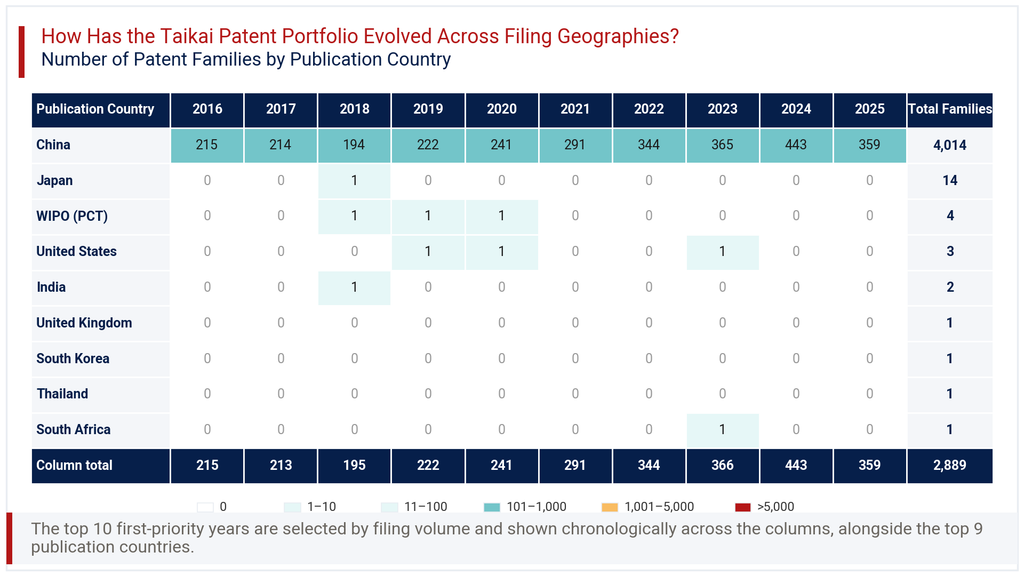
Japan shows just 1 family in 2018, while the WIPO PCT route appears with 1 family each in 2018, 2019, and 2020. The United States registers isolated single filings in 2019, 2020, and 2023. India and South Africa each show one isolated filing, in 2018 and 2023 respectively. This pattern confirms that international filing activity has never developed into a consistent strategy, remaining opportunistic at best. The heatmap makes clear that any meaningful shift in Taikai’s global filing behavior would represent a significant strategic change from its established pattern of domestic concentration.
Consultant’s Perspective on Taikai Patent Portfolio
Viewed as a whole, the Taikai Patent Portfolio reflects a domestically focused, technically concentrated filing strategy. The heavy reliance on utility models, at 71.5% of all filings, points to speed and cost efficiency over rigorous examination. Combined with a 42.1% lapsed rate, this suggests a portfolio optimized for short-term market signaling rather than durable global rights. The electrical switchgear and power distribution focus, led by H01H and H02B, indicates genuine technical depth in a specific industrial niche.
That said, the near total absence of filings outside China, at 99.7% concentration, limits this portfolio’s relevance for companies seeking international licensing or cross-border enforcement. Any partner or competitor assessing this patent portfolio for acquisition or benchmarking should treat the China-only footprint as a structural constraint, not an oversight. The recommendation here is straightforward: monitor whether international filings increase in coming years, as that would signal a genuine shift toward global ambition. Until then, this portfolio’s value sits mainly within the Chinese market, and decisions should be calibrated accordingly.
Explore Deeper Insights with Expertlancing Research
This analysis offers a starting point, not a complete diligence report. Specific patent families, claim scope, and competitive overlaps deserve closer examination before any licensing, investment, or litigation decision. ExpertLancing Research helps clients go beyond headline figures, with tailored patent landscape studies, freedom-to-operate reviews, and competitive benchmarking. Reach out to our team to commission a deeper, customized study of this portfolio or any adjacent technology space relevant to your business goals.