


The Tencent Patent Portfolio offers a useful lens into how one of China’s largest technology groups protects its innovation across gaming, cloud, AI and digital infrastructure. Across a total of 74,756 patent families, 92.7% remain active, covering both granted and pending cases still under prosecution. Of these, 47,556 families have been granted while 21,755 sit pending before various patent offices. The grant rate stands at 63.6%, a reasonably strong conversion figure for a portfolio of this scale. A combined 5,445 families fall into lapsed, expired or revoked status. These figures reflect prosecution and maintenance outcomes only, not a judgment on patent quality or enforceability.
Filing activity peaked in 2020, when Tencent filed 11,027 patent families, a surge that reshaped the entire portfolio’s profile. China remains the dominant jurisdiction, accounting for 83.4% of filings, and the portfolio spans 10 jurisdictions globally. On the technology side, G06F Digital Data Processing leads all IPC classes with 37,295 families, confirming core software and computing infrastructure as the anchor of Tencent’s filing strategy.
This report draws on structured patent filing data to describe scale, timing, geography and technology concentration within Tencent’s portfolio. Filing counts alone do not establish product success, market dominance or competitive advantage in any given business line. Readers using this analysis for diligence, benchmarking or investment screening should treat it as a directional starting point. Specific patent families of interest ought to be verified independently before being cited externally or relied upon for business decisions.
About Tencent
Company Profile: Tencent is a Chinese multinational technology conglomerate headquartered in Shenzhen. The company reports it was founded in 1998 and operates with the mission of being technology for good. It develops internet related products in gaming, social networking, entertainment, fintech and cloud computing. Tencent owns Weixin/WeChat, QQ, and Qzone, supporting messaging, payments and daily services. It publishes popular video games and offers video, live streaming, music and digital literature.
Its subsidiaries include Tencent Cloud, founded in 2013, which provides cloud computing, AI, computer vision and natural language processing services to domestic and global clients. Tencent is considered the world’s largest company in the video game industry based on its equity investments. Its stock-market-listed entity, Tencent Holdings Ltd, is incorporated in the Cayman Islands and has been listed on the Hong Kong Stock Exchange since 2004.
The company has business presence across North America, Asia-Pacific and Europe, with branch offices in multiple Chinese cities plus the United States and South Korea.
How Healthy is Tencent Patent Portfolio?
Patent portfolio health starts with legal status, and Tencent’s numbers look encouraging on that front. Granted patents make up 63.6% of the total, pending applications contribute 29.1%, and together these push the active rate to 92.7%. The composition chart in this section shows a comparatively thin slice for lapsed cases at 1.7%, revoked cases at 4.9%, and expired cases at just 0.6%. This distribution suggests Tencent manages renewal and prosecution with discipline rather than letting families drift into unintended loss.
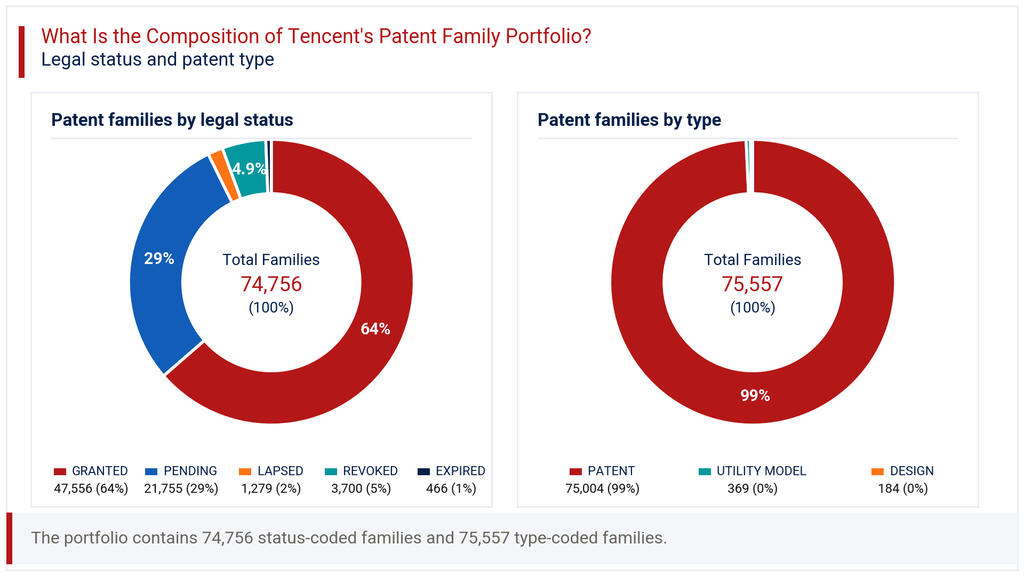
Patent type adds another dimension to this picture. Standard patents dominate at 99.3% of the portfolio, with utility models at 0.5% and design filings at just 0.2%. This heavy tilt toward full patents, rather than utility models or design rights, points to a filing strategy built around technical substance. For a company operating across software, AI and hardware adjacent fields, this composition aligns with how mature technology portfolios typically evolve. The low revocation and lapse figures also indicate that Tencent’s legal teams keep active oversight over maintenance deadlines, a detail worth noting for anyone assessing portfolio legal status before a transaction or licensing conversation.
How Has the Tencent Patent Portfolio Evolved Over Time?
Patent filing trends across the Tencent Patent Portfolio reveal a sharp inflection point around 2019. Filings jumped from 2,948 in 2018 to 6,188 in 2019, then nearly doubled again to 11,027 in 2020, the highest count in the dataset. Filing volumes stayed elevated through 2021 at 10,622 and 2022 at 8,705, before settling to 9,341 in 2023. The filing-trend chart in this section shows this five-year surge clearly against a much flatter pre-2019 baseline.
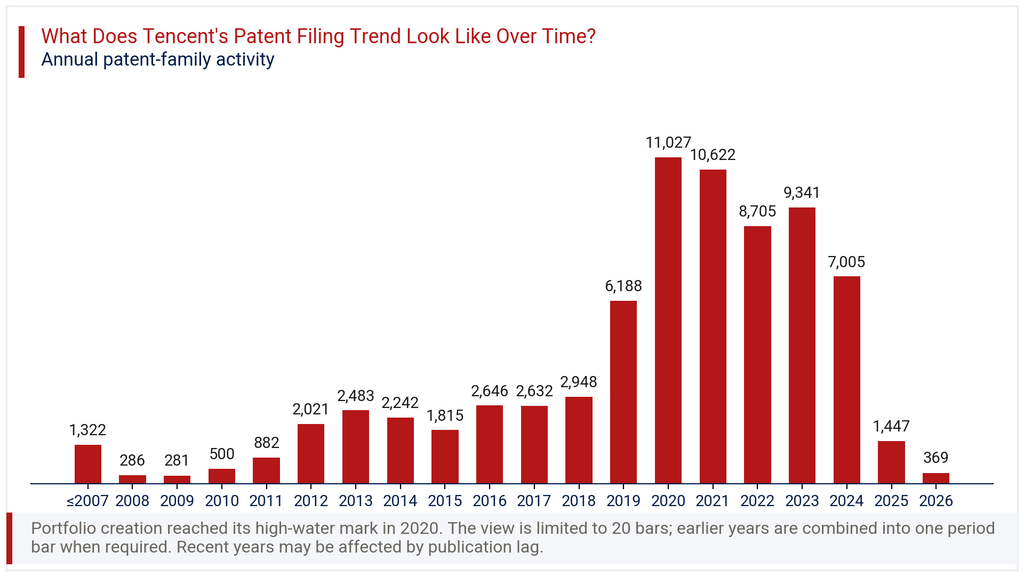
Numbers for 2024 and 2025 show 7,005 and 1,447 respectively, with data.percentages confirming a -74.5% change in the latest year tracked. Readers should treat this apparent decline cautiously. Patent applications typically take 18 months before publication, so recent filing years are structurally undercounted at the time any dataset is compiled. Rather than reading 2024 and 2025 as genuine retreat, the more reasonable interpretation is publication lag still working through the system. The real signal lies in the 2019 to 2023 stretch, which marks a genuine step change in Tencent’s filing intensity compared to the prior decade.
Where Does the Tencent Patent Portfolio Prioritize Patent Protection?
Patent geography within this portfolio tilts heavily toward home ground. China accounts for 83.4% of all filings, built on 62,338 families, reflecting Tencent’s primary commercial base and regulatory environment. Hong Kong follows at 16.9% share with 12,620 families, a jurisdiction often used as a bridge for Chinese filers seeking a separate common law filing route. WIPO’s PCT system carries 14.3% share, representing 10,670 families routed through international applications before national phase entry.
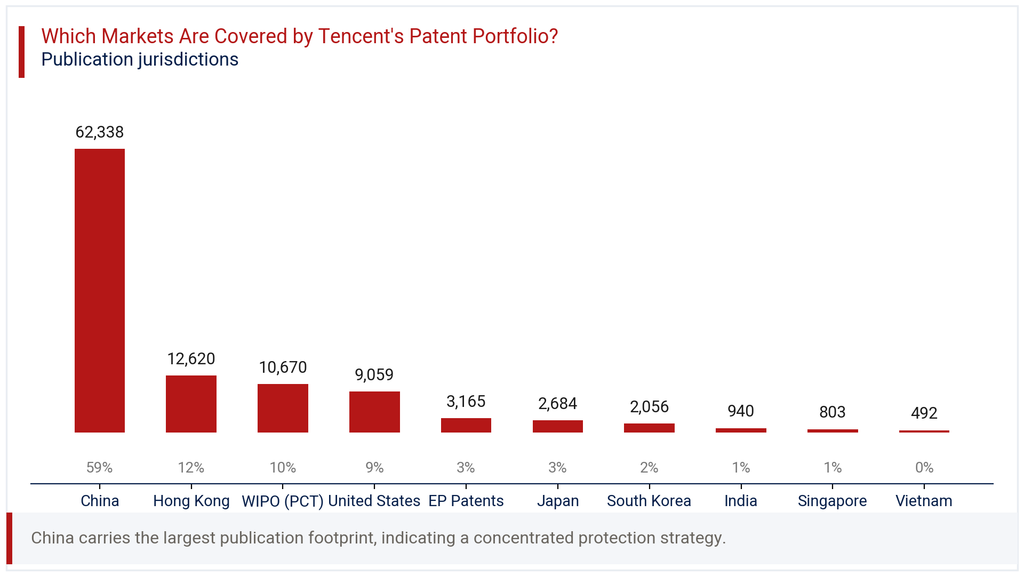
Beyond Greater China, the United States holds 12.1% share with 9,059 families, the largest protection base outside Tencent’s home region. The geographic chart in this section shows meaningfully smaller shares for Europe at 4.2%, Japan at 3.6%, and South Korea at 2.8%. India, Singapore and Vietnam round out the remaining spread, each under 2% share. This pattern confirms a filing strategy anchored domestically, with selective international protection concentrated in the largest technology and consumer markets rather than broad global coverage.
Where is the Tencent Patent Portfolio Building Protection Across Key Technologies?
IPC analysis of the Tencent Patent Portfolio points clearly toward software and data processing as the technical core. G06F Digital Data Processing leads with 37,295 families, representing 35.9% share, well ahead of any other classification. H04L Digital Information Transmission follows at 14.0% share with 14,527 families, consistent with Tencent’s networking and communication infrastructure needs.
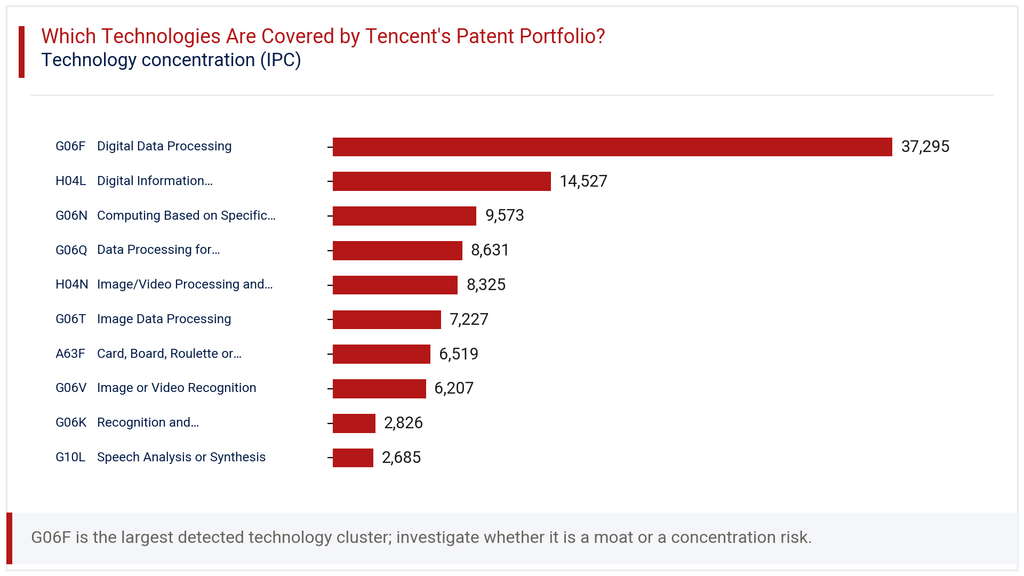
The technology chart in this section also highlights G06N Computing Based on Specific Models at 9.2% share with 9,573 families, a strong signal of continued AI and machine learning investment. G06Q Data Processing for Administrative/Commercial Purposes holds 8.3% share, while image and video related classes, namely H04N and G06T, together account for a meaningful portion of filings tied to media processing. Notably, A63F Card, Board, Roulette or Video Games appears at 6.3% share with 6,519 families, a distinct technology cluster tied directly to Tencent’s gaming business and rarely seen at this scale in general technology portfolios.
How Has the Tencent Patent Portfolio Evolved Across Filing Geographies?
The heatmap in this section tracks how jurisdiction mix shifted alongside the broader filing surge. China filings grew from 2,099 in 2012 to 7,015 by 2020, then stayed above 7,000 through 2023 at 7,317. Hong Kong tells a sharper story, jumping from near negligible levels to 4,170 in 2020 alone, before easing to 2,029 in 2023, suggesting a burst of Hong Kong filing activity tied to the same 2019 to 2021 window.
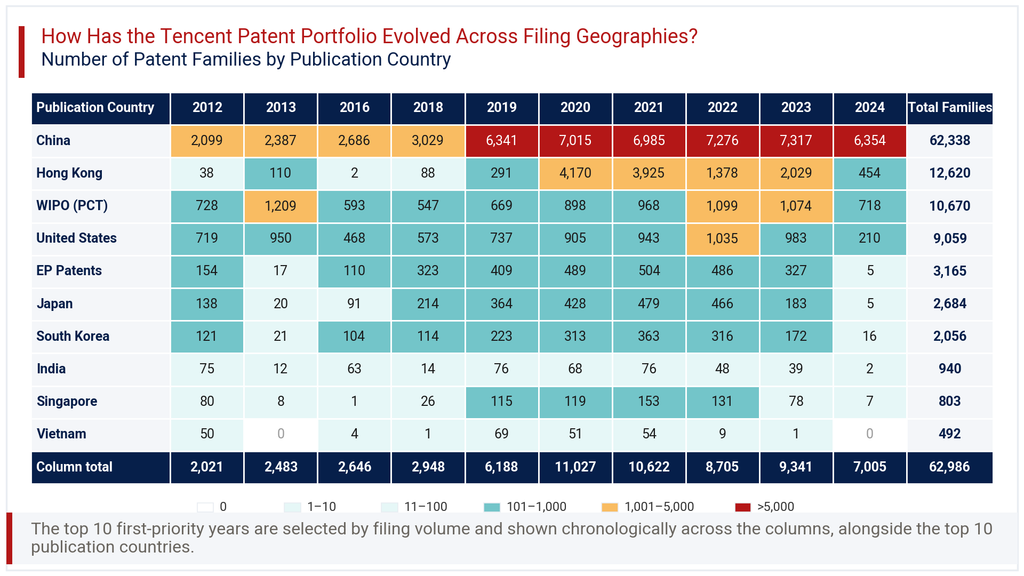
International jurisdictions moved more steadily. The United States rose from 719 families in 2012 to 1,035 in 2022, a gradual climb rather than a sudden spike. Europe, Japan and South Korea each show modest peaks around 2021 and 2022, followed by declines into 2023 and near zero figures by 2024, again consistent with publication lag rather than an actual pullback. Vietnam and India show thin, inconsistent filing across the period, indicating these remain opportunistic rather than core jurisdictions within Tencent’s international filing approach.
Consultant’s Perspective on Tencent Patent Portfolio
From an advisory standpoint, the Tencent Patent Portfolio reads as a textbook case of domestic-first, technology-led filing discipline. The 92.7% active rate and 63.6% grant rate suggest a portfolio managed with care rather than filed defensively and abandoned. The concentration in G06F and H04L classes confirms Tencent’s innovation engine sits firmly in software, data processing and communication infrastructure, with gaming-specific filings under A63F adding a distinctive layer few peers can match.
The 2019 to 2023 filing surge deserves attention from competitors and partners alike. It likely reflects both internal R&D scaling and possibly a sharpened IP strategy coinciding with China’s broader push toward domestic patent filing. For businesses evaluating partnership, licensing or competitive positioning against Tencent, the geographic concentration in China and Hong Kong, alongside selective United States and European coverage, should inform where freedom to operate analysis gets prioritized. Going by current evidence, any firm operating in AI, cloud infrastructure or interactive entertainment should track this portfolio’s technology clusters closely, since they signal where Tencent intends to defend its commercial ground over the coming years.
Explore Deeper Insights with Expertlancing Research
This overview only scratches the surface of what the Tencent Patent Portfolio reveals about competitive positioning and technology direction. Expertlancing Research helps businesses go further, through custom patent landscape studies, freedom to operate assessments, and competitive benchmarking tailored to specific markets or technologies. Whether you are evaluating a partnership, assessing litigation exposure, or building an R&D roadmap, our analysts can translate raw patent data into decisions you can act on. Reach out to Expertlancing Research to commission a deeper, customized study built around your specific business question.