


The TP-Link Patent Portfolio offers a useful lens into how a leading networking and smart home equipment maker protects its technology investments. Across 1987 total patent families, 82.5% remain active when granted and pending cases are counted together. The portfolio holds 1033 granted patents alongside 607 pending applications, giving a grant rate of 52.0%. The remaining families fall into lapsed, revoked or expired status, totaling 347 cases combined. These figures reflect prosecution and maintenance outcomes only, not a judgment on patent quality or enforceability.
Filing activity peaked in 2024, when the company filed 282 new families, the highest single-year count in the dataset. China dominates as the top jurisdiction, accounting for 94.5% of filings, and the portfolio spans 10 jurisdictions in total. The leading technology cluster is H04L, Digital Information Transmission, with 449 families, making it the single largest area of concentration. This pattern signals where TP-Link channels most of its protection effort today.
This report draws on patent filing and legal status records to map where TP-Link concentrates its intellectual property effort. Filing counts alone do not confirm product success or market leadership in any segment. Readers considering business decisions based on specific families should verify current legal status independently before relying on them.
About TP-Link
Company Profile: TP-Link is a technology company that designs and manufactures networking equipment and smart home products. The company reports it was established in 1996 in Shenzhen, China. In October 2024, TP-Link Global and TP-Link USA merged to form TP-Link Systems Inc., headquartered in Irvine, California.
The company reports it manufactures products in-house rather than outsourcing to original design manufacturers. Its brand portfolio includes Deco, Tapo, Omada, VIGI, Aginet, Kasa Smart and Mercusys, covering routers, mesh Wi-Fi, switches, IP cameras and smart home devices. TP-Link reports operating in over 170 countries, with 1.7 billion global users, 42 subsidiaries, four R&D centres and three manufacturing bases.
Since 2018, the company reports manufacturing US-destined networking products at a TP-Link-owned factory in Vietnam. Jeffrey Chao serves as founder and CEO. According to Wikipedia, TP-Link has faced government investigations in India and the United States over national security concerns.
How Healthy is TP-Link Patent Portfolio?
Patent portfolio health depends on how many filings remain enforceable versus how many have lapsed or been withdrawn. The composition chart shows 1033 granted patents and 607 pending applications, together forming an active rate of 82.5%. That is a strong proportion for a portfolio of this size. The grant rate stands at 52.0%, meaning a little over half of examined families reach full grant.
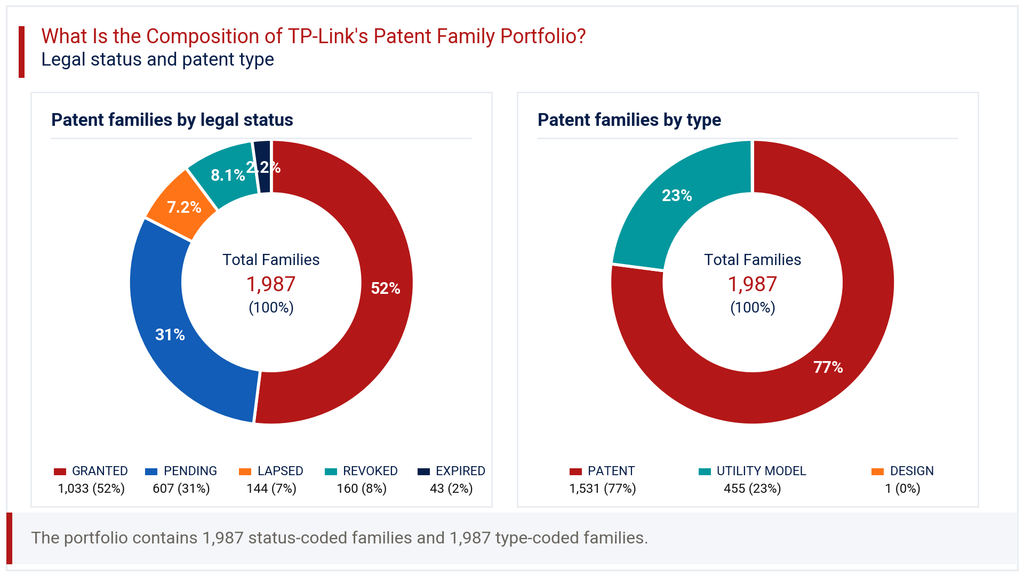
On the other side, 144 families have lapsed, 160 were revoked, and 43 have expired, totaling 347 inactive cases. Revoked filings deserve particular attention, since they indicate challenges that succeeded during or after examination. By patent type, standard patents make up 77.1% of the portfolio, utility models account for 22.9%, and design filings are negligible at 0.1%. This mix suggests TP-Link favors full patent protection over the shorter-term utility model route common in China, pointing to a portfolio built for longer-term defensibility rather than quick, narrow coverage.
How Has the TP-Link Patent Portfolio Evolved Over Time?
Patent filing trends for TP-Link show a long period of modest activity followed by sharp acceleration. Filings stayed in single or low double digits through most years before 2017, then jumped to 74 that year. Growth continued through 2018 (98), 2019 (167), and 2020 (216), before peaking further at 245 in 2021.
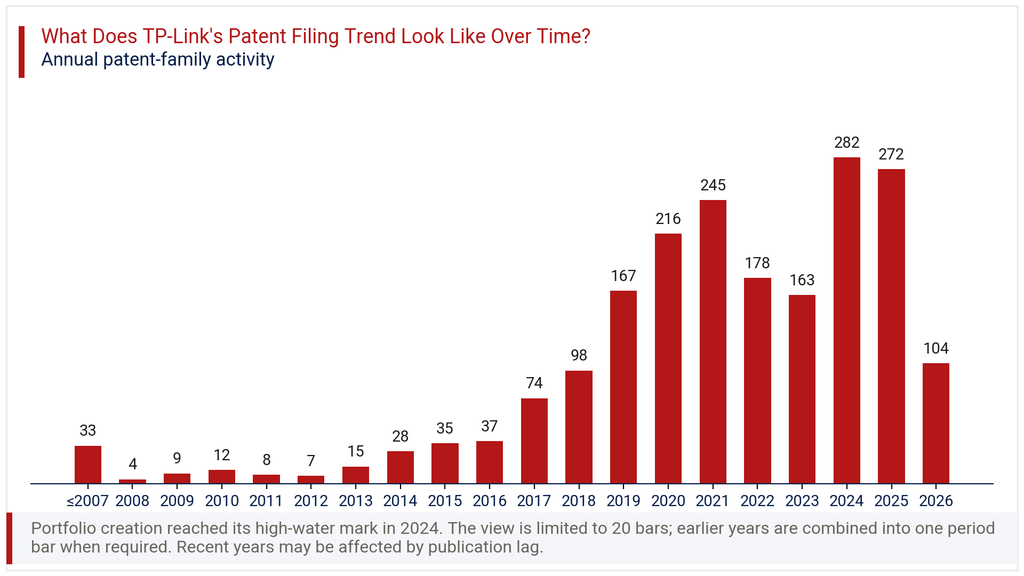
A dip to 178 in 2022 and 163 in 2023 preceded a rebound to the portfolio’s highest point, 282 families in 2024. The filing-trend chart shows 2025 close behind at 272, while 2026 shows just 104, a decline of 61.8% against the prior year. This drop should not be read as a genuine pullback in R&D activity. Patent applications typically take 18 to 24 months to publish, so the most recent one to two years almost always appear understated until records catch up. The underlying trajectory still points toward sustained, high-volume filing by TP-Link.
Where Does the TP-Link Patent Portfolio Prioritize Patent Protection?
Patent geography for TP-Link is heavily concentrated in its home market. China accounts for 94.5% of all filings, reflecting the company’s manufacturing base and domestic R&D centres. The United States follows at a distant second with 7.6%, and WIPO PCT filings represent 3.2% of the portfolio, used for international filing flexibility.
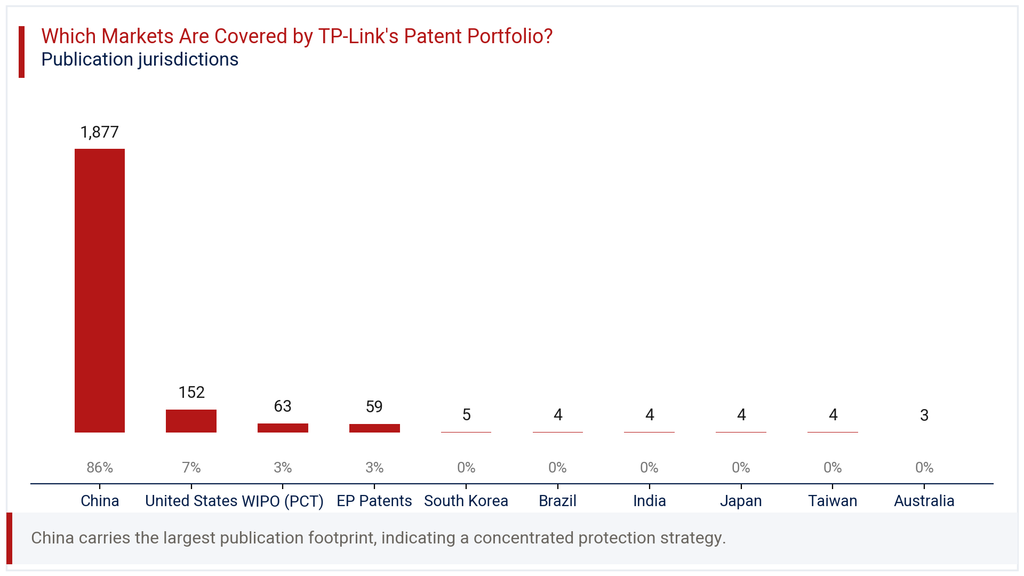
European Patent filings sit close behind at 3.0%, while South Korea, Brazil, India, Japan, Taiwan and Australia each hold minor shares around 0.2% to 0.3%. The geographic chart highlights this imbalance clearly. For a company reporting operations in over 170 countries, this filing pattern suggests patent protection trails far behind commercial reach. It may reflect a deliberate choice to protect core innovation domestically while relying on trademark and design rights elsewhere, or it may signal room to expand filing strategy into faster-growing markets like India, where TP-Link already faces regulatory scrutiny.
Where is the TP-Link Patent Portfolio Building Protection Across Key Technologies?
IPC analysis of the TP-Link patent portfolio points to networking and connectivity as the clear technology core. H04L, Digital Information Transmission, leads with 449 families, or 23.6% of the total. H04W, Wireless Communication Networks, follows closely with 381 families at 20.0%, confirming wireless infrastructure as a second pillar.
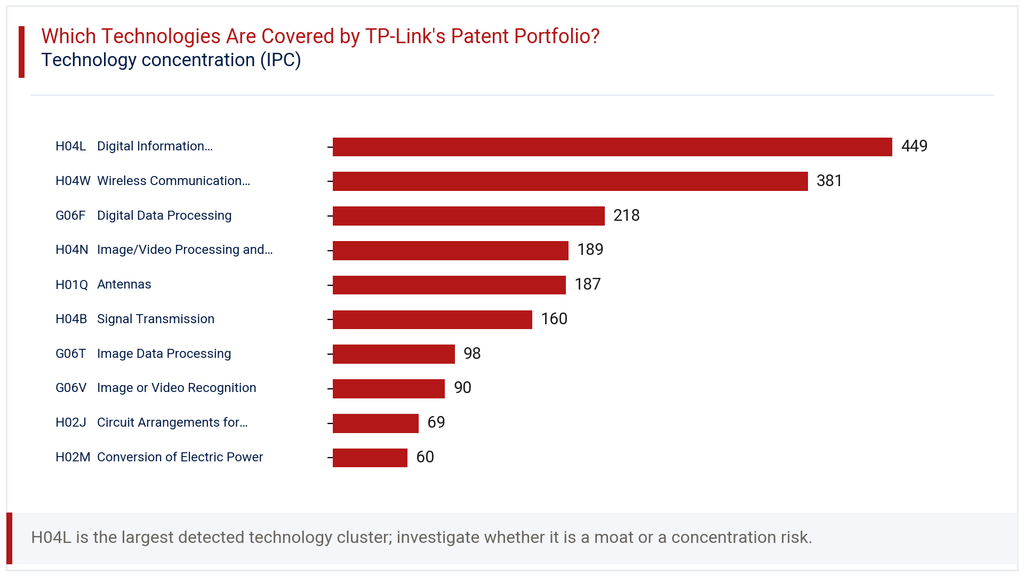
G06F, Digital Data Processing, holds 218 families (11.5%), while H04N, Image/Video Processing and Display, accounts for 189 families (9.9%). H01Q, Antennas, contributes 187 families (9.8%), rounding out the top five. The technology chart in this section also shows meaningful activity in H04B Signal Transmission, G06T Image Data Processing, and G06V Image or Video Recognition, together reflecting growing investment in camera and smart-device intelligence. This distribution tells a clear story: TP-Link’s innovation spans traditional router and signal technology plus a rising focus on vision-based smart home products like VIGI and Tapo cameras.
How Has the TP-Link Patent Portfolio Evolved Across Filing Geographies?
The heatmap view of filings by year and jurisdiction reinforces how closely China tracks the portfolio’s overall growth curve. Chinese filings rose from 72 in 2017 to 216 in 2020, then to 244 in 2021, mirroring the global trend almost exactly. The 2024 peak of 237 China filings aligns with the portfolio’s highest overall year.
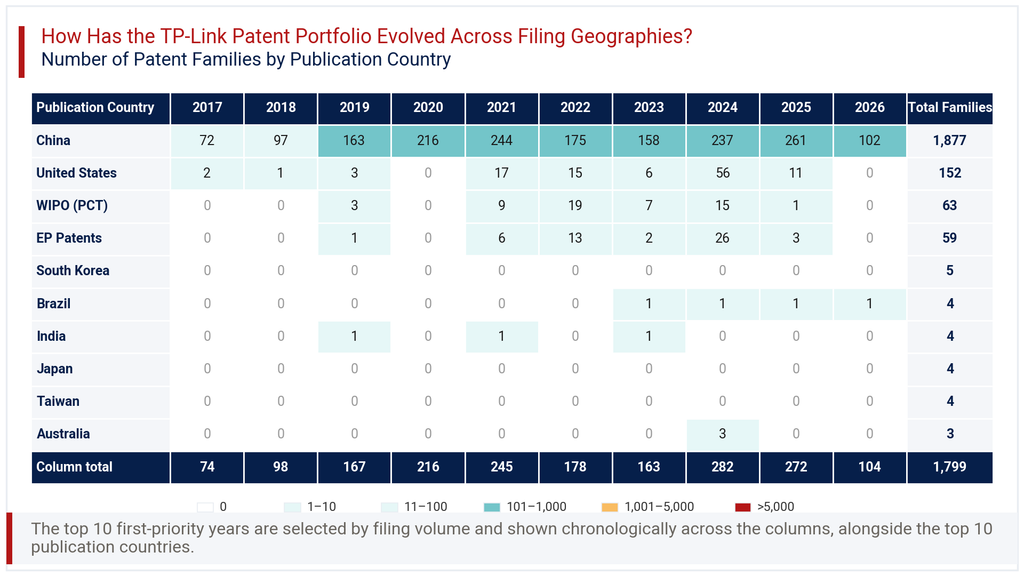
International filing remains thin by comparison but shows occasional spikes worth noting. US filings jumped to 56 in 2024, up sharply from single digits in prior years. EP filings similarly rose to 26 in 2024, and WIPO PCT filings reached 19 in 2022. These spikes suggest selective international pushes tied to specific product launches rather than a steady annual strategy. India recorded only small, intermittent filings, with just 1 family in 2019, 2021, and 2023 each. This pattern indicates TP-Link treats non-China markets as secondary filing destinations, activated selectively rather than continuously.
Consultant’s Perspective on TP-Link Patent Portfolio
The TP-Link Patent Portfolio reflects a company whose intellectual property strategy still mirrors its manufacturing and domestic market roots. With 94.5% of filings concentrated in China, the portfolio’s international footprint remains thin relative to the company’s reported global user base of 1.7 billion. The strong active rate of 82.5% and grant rate of 52.0% indicate a portfolio under active management, not a dormant filing archive.
What stands out most is the shift in technology focus. Core networking classes like H04L and H04W still dominate, but rising filings in image recognition and video processing point to TP-Link building defensibility around its camera and smart home lines, not just routers. This diversification matters as competition in IP cameras and mesh Wi-Fi intensifies globally.
Given the national security scrutiny TP-Link faces in India and the United States, a thin international patent footprint could become a strategic vulnerability. Competitors with denser US and EP filings may gain leverage in disputes or licensing negotiations. Expanding filing activity outside China, particularly in markets where TP-Link already sells heavily, would strengthen its negotiating position and reduce exposure as scrutiny grows.
Explore Deeper Insights with Expertlancing Research
Understanding a patent portfolio takes more than reading charts. It requires connecting filing patterns to business strategy, competitive risk, and market opportunity. Expertlancing Research helps technology companies, investors, and legal teams interpret patent data like this with precision and context. If you need a deeper study of TP-Link, its competitors, or any other company’s patent position, reach out to Expertlancing Research for a tailored analysis built around your specific decision needs.