


The Transsion Patent Portfolio offers a useful window into how one of the world’s largest smartphone makers for emerging markets protects its engineering work. Across 3,906 patent families, 72.6% remain active, a figure that covers both granted and pending cases. Of these, 1,722 patents have been granted while 1,112 applications are still pending examination, giving a grant rate of 44.1%. The remaining families sit in lapsed, expired or revoked status, totalling 1,072 cases. These figures reflect prosecution and maintenance outcomes only, not a verdict on patent quality or enforceability.
Filing activity peaked sharply in 2017, when Transsion filed 1,004 patent families in a single year, far above any other year on record. China dominates the jurisdiction mix, accounting for 88.1% of all filings across a spread of 10 jurisdictions worldwide. On the technology side, digital data processing under G06F leads the portfolio with 1,423 families, ahead of telephonic communication and wireless networking categories. This concentration says much about where Transsion channels its research investment.
This article uses patent filing data to map how Transsion builds and manages its intellectual property position. Filing counts alone do not prove commercial success or confirm a lasting competitive edge in any market. Readers considering business decisions based on specific patent families should verify those records independently before relying on them.
About Transsion
Company Profile: Transsion is a Chinese manufacturer of mobile phones headquartered in Shenzhen, founded as Transsion Technology in Hong Kong in 2006 . The company focuses on development, manufacturing, sales, and services of mobile communication products . Its brands include phone brands such as itel, TECNO, and Infinix, an after-sales service brand Carlcare, and accessories brands Oraimo and Syinix . It was the largest smartphone manufacturer by sales in Africa in 2017, and also sells mobile phones in the Middle East, Southeast Asia, South Asia, and Latin America .
Transsion manufactures phones in Bangladesh, China, Ethiopia, India, Indonesia, and Pakistan . Manufacturing is spread across multiple emerging markets to serve local demand efficiently. The company reported revenue of US$9.62 billion in 2024, with net income of US$777 million, according to Wikipedia’s company infobox. Transsion’s subsidiaries operate as distinct brands targeting different price segments, particularly entry-level and budget smartphones in developing economies.
Its diversified portfolio now extends into mobile accessories and home appliances alongside its core phone business.
How Healthy is Transsion Patent Portfolio?
Patent portfolio health depends heavily on legal status distribution, and Transsion’s numbers tell a mixed story. Granted patents make up 44.1% of the portfolio, while pending applications account for 28.5%, pointing to a fairly active pipeline still under review. The composition chart in this section shows revoked cases at 16.9%, a share worth watching since it is notably higher than the lapsed rate of 8.6%. Expired families form a small tail at 1.9%, which is typical for a portfolio with a long filing history.
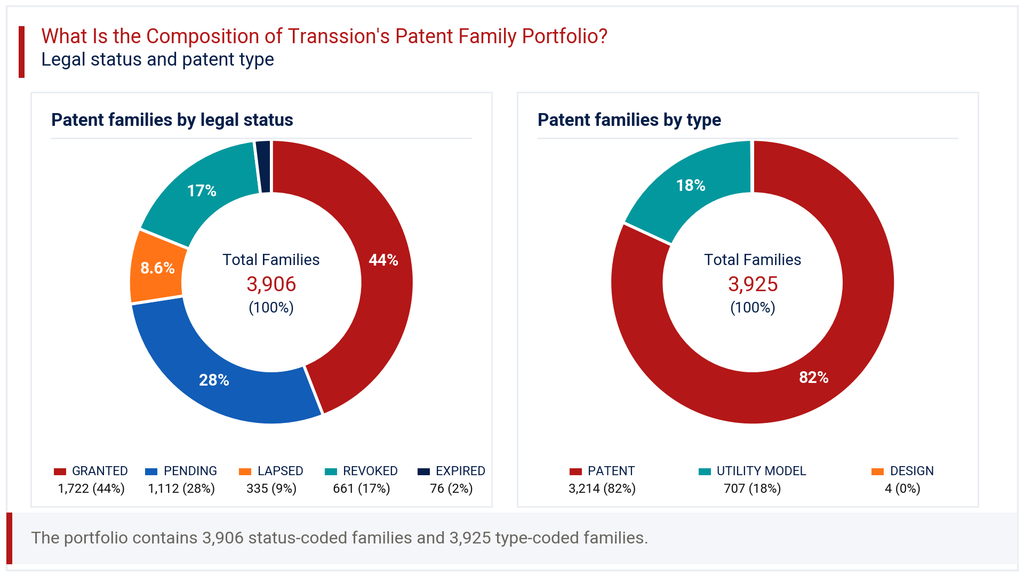
Looking at patent type, utility models represent 18.0% of filings against 81.9% for standard patents, with design filings nearly negligible at 0.1%. This mix suggests Transsion relies mainly on full patent protection rather than the shorter, lighter-touch utility model route common in China. The active rate of 72.6% indicates most of the portfolio remains either enforceable or still in prosecution. That said, the revocation share deserves scrutiny, since it may reflect opposition activity or validity challenges in certain markets. Prospective partners or competitors should examine individual family status before drawing conclusions about specific technology areas.
How Has the Transsion Patent Portfolio Evolved Over Time?
Patent filing trends at Transsion show a dramatic spike in 2017, when the company filed 1,004 families, dwarfing every other year. Before that spike, filings grew steadily from 20 families in years up to 2007 to 117 in 2016, reflecting gradual scale-up. The filing-trend chart in this section shows a sharp drop to 62 in 2018, followed by a rebound to 403 in 2019 and sustained activity through 2022 at 390.
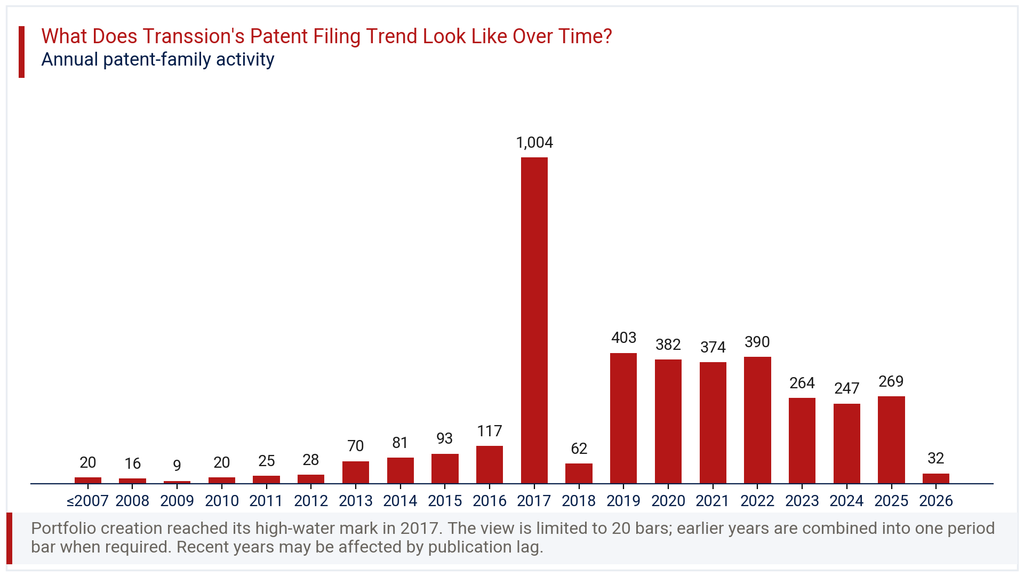
Filings then eased to 264 in 2023 and 247 in 2024, before ticking up again to 269 in 2025. The most recent year, 2026, shows only 32 families, a decline of 88.1% against the prior year. This drop should not be read as a genuine pullback in research output. Patent applications typically take many months to appear in public databases, so the newest filing years are almost always undercounted at the time of reporting. The broader pattern still points to a company that scaled filing activity substantially after 2017 and has maintained a meaningfully higher baseline since then compared to its pre-2017 years.
Where Does the Transsion Patent Portfolio Prioritize Patent Protection?
Patent geography for Transsion is heavily concentrated in its home market. China accounts for 88.1% of all filings, by far the largest share among the 10 jurisdictions represented. WIPO’s PCT route follows at 26.1%, which signals a reasonably sized international filing strategy funnelled through a single international mechanism. The geographic chart in this section shows every other jurisdiction trailing well behind these two.
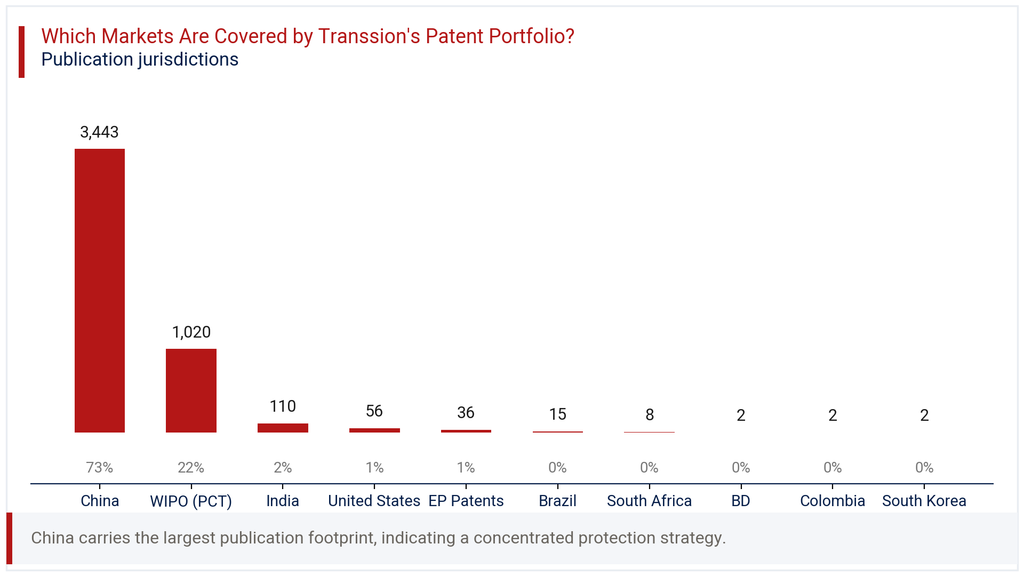
India holds 2.8% of the portfolio, followed by the United States at 1.4% and European Patent filings at 0.9%. Smaller shares appear in Brazil, South Africa, Bangladesh, Colombia and South Korea, each under 0.5%. This pattern fits a company whose core manufacturing and sales strength lies in emerging markets, particularly Africa and South Asia. Yet the thin presence in the United States and Europe is notable for a global smartphone brand of this scale. It suggests Transsion prioritizes defensive protection in its home jurisdiction and selected growth markets over broad Western filing coverage, at least based on current patent geography.
Where is the Transsion Patent Portfolio Building Protection Across Key Technologies?
IPC analysis of the Transsion portfolio points clearly toward digital data processing. The G06F category leads with 1,423 families, representing 33.3% of the entire portfolio. Telephonic communication under H04M follows with 911 families at 21.3%, and wireless communication networks under H04W add another 13.8% with 588 families. The technology chart in this section shows these three categories forming the backbone of Transsion’s filing activity.
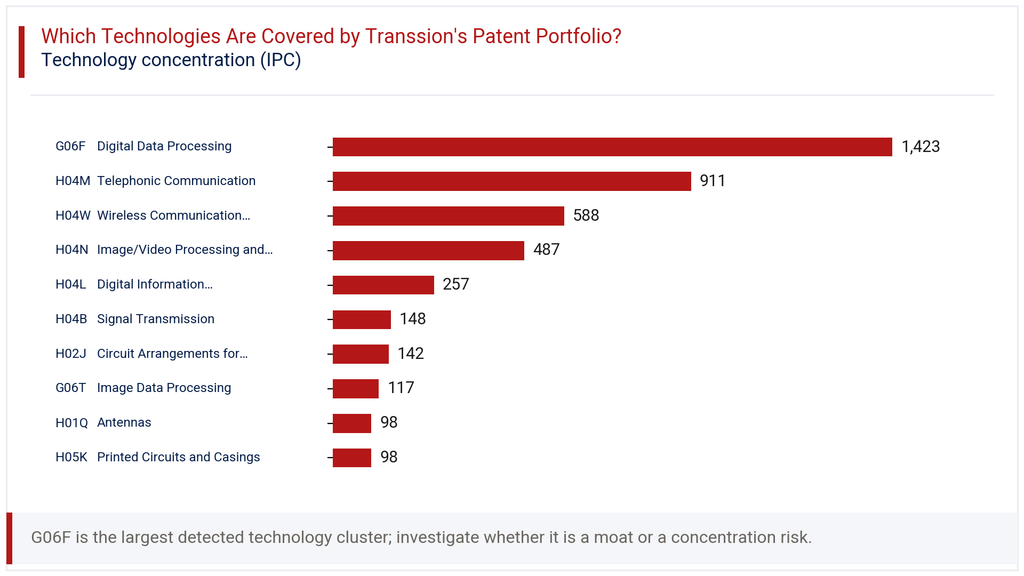
Image and video processing under H04N contributes 487 families, or 11.4%, while digital information transmission under H04L adds 6.0%. Smaller but still meaningful clusters appear in signal transmission, power supply circuits, image data processing, antennas, and printed circuits and casings. Together these categories describe a portfolio built around smartphone core functions: computing, connectivity, communication, and imaging. The heavy weighting toward G06F and communication-related classes aligns naturally with Transsion’s device-centric business. It also suggests the company treats software and connectivity features as central differentiators, not peripheral additions to its hardware lineup.
How Has the Transsion Patent Portfolio Evolved Across Filing Geographies?
Viewing filings by year and jurisdiction together adds useful texture to the overall trend. The heatmap in this section shows China’s filings rising from 93 in 2015 to a peak of 698 in 2017, then settling around 350 to 400 per year through 2022. WIPO PCT filings show an even sharper 2017 spike, jumping to 493 from just 4 the year before.
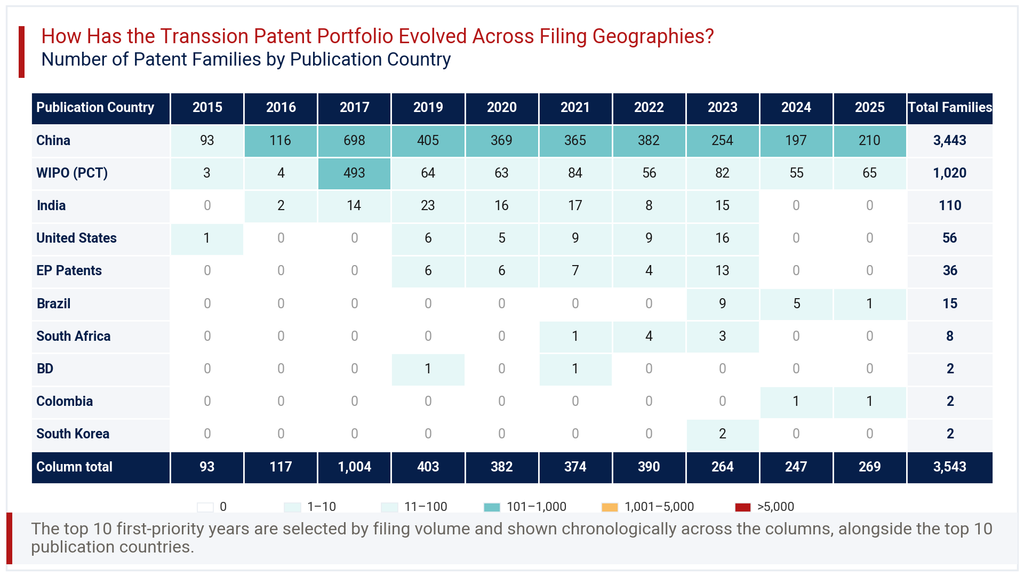
After 2017, PCT filings settled into a lower, steadier band, ranging between 55 and 84 annually through 2025. India’s filings appeared from 2016 onward, peaking at 23 in 2019 before tapering to zero by 2024. The United States and European Patent filings followed a similar late-arriving, modest pattern, with the US reaching 16 filings in 2023. Brazil emerged as a new jurisdiction only from 2023, reaching 9 filings that year. This progression suggests Transsion added jurisdictions incrementally as its international footprint expanded, rather than filing broadly from the outset.
Consultant’s Perspective on Transsion Patent Portfolio
The Transsion Patent Portfolio reflects a company whose intellectual property strategy mirrors its commercial footprint closely. Heavy concentration in China, supported by a meaningful PCT filing channel, suggests a deliberate choice to protect core markets first. The 2017 filing surge likely corresponds to a period of rapid product or technology expansion, though the dataset cannot confirm the exact driver.
What stands out is the comparatively light presence in the United States and Europe, markets Transsion does not prioritize commercially. The technology mix, dominated by digital data processing and communication-related classes, confirms the company invests where its product line demands it, in core smartphone functionality. The revoked patent share, at 16.9%, merits closer review by anyone assessing portfolio strength for partnership or competitive purposes.
Going forward, Transsion would benefit from expanding filing coverage in high-growth markets like Southeast Asia and Latin America, where its devices already sell well. Strengthening protection outside China could also reduce exposure as competitors enter its traditional strongholds. For now, the portfolio supports a regionally focused growth strategy rather than a globally defensive one, which fits the company’s current business priorities reasonably well.
Explore Deeper Insights with Expertlancing Research
This overview only scratches the surface of what the Transsion Patent Portfolio reveals about the company’s technology priorities and market strategy. Expertlancing Research helps businesses go deeper, mapping specific patent families, tracking competitor filing behaviour, and assessing freedom-to-operate risks. Whether you are evaluating a partnership, assessing competitive threats, or planning your own filing strategy, our analysts can build a tailored patent intelligence report. Reach out to Expertlancing Research to turn this data into a decision you can act on with confidence.