

The Tsinghua Unigroup_Unisoc Patent Portfolio spans 1,872 patent families, offering a clear window into how this Chinese semiconductor design house protects its technology. Of this total, 90.9% remain active, a figure covering both granted and pending filings. Granted families stand at 915, while 786 remain pending before patent offices. The grant rate across the portfolio sits at 48.9%, and a combined 171 families fall into lapsed, expired, or revoked status. These figures describe prosecution and maintenance activity only, not a verdict on patent quality or enforceability.
Filing activity peaked in 2020, when the company recorded 271 new families in a single year. China dominates the jurisdictional spread, accounting for 99.6% of filings across 10 jurisdictions tracked in this analysis. On the technology side, wireless communication networks under H04W lead the portfolio with 973 families, the single largest cluster by a wide margin. These three data points, peak year, jurisdictional concentration, and technology focus, frame much of what follows in this report.
This article uses patent filing data to assess where Tsinghua Unigroup_Unisoc has placed its research bets and how its protection strategy has shifted over time. Filing counts alone do not establish product success, market share, or competitive advantage in any given segment. Readers considering business or investment decisions should validate specific patent families independently before relying on these figures externally.
About Tsinghua Unigroup_Unisoc
Company Profile: UNISOC (Shanghai) Technologies Co., Ltd. is a Chinese fabless semiconductor company headquartered in Shanghai. It designs semiconductor products for smartphones, Internet of Things devices, automotive electronics and other connected devices. UNISOC is part of Tsinghua Unigroup. UNISOC started in 2001 as Spreadtrum Communications, and Tsinghua Unigroup integrated Spreadtrum and RDA Microelectronics under the UNISOC brand in 2018.
The company describes itself as a globally leading chip design company specializing in communication semiconductors, mastering full-scenario technologies including 2G/3G/4G/5G, Wi-Fi, and Bluetooth. UNISOC has established 19 R&D centers and 8 sales and customer support centers worldwide. Since the early 2020s, UNISOC has become one of the world’s largest suppliers of smartphone systems-on-chip, ranking fourth globally in early 2026. UNISOC Revenue: CN¥14.5 billion (2024).
How Healthy is Tsinghua Unigroup_Unisoc Patent Portfolio?
Patent portfolio health for Tsinghua Unigroup_Unisoc looks reasonably sound on current numbers. Granted families make up 48.9% of the total, pending applications account for 42.0%, and the remainder splits across lapsed (0.3%), revoked (7.4%), and expired (1.4%) status. The active rate of 90.9% suggests most of the portfolio remains either enforceable or still moving through examination. The composition chart in this section shows this split clearly, with granted and pending filings forming the overwhelming majority of the stock.
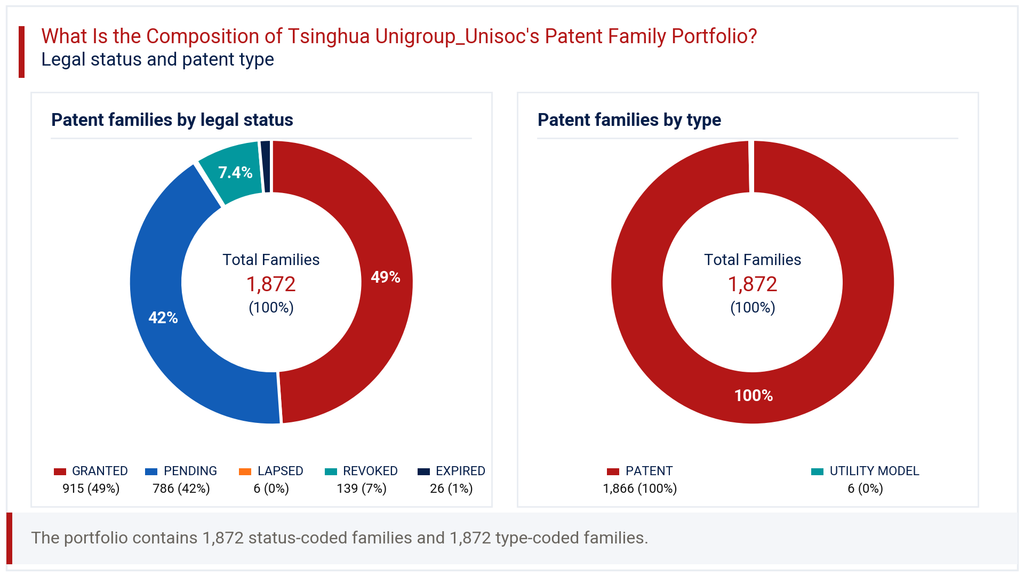
Patent type data adds a further layer. Standard patents account for 99.7% of filings, with utility models at just 0.3%. This near-total reliance on standard patents points to a deliberate choice to pursue fuller examination rather than faster, lighter protection routes. The relatively low revocation share, at 7.4%, indicates that challenged patents have not significantly eroded the stock. Taken together, the legal status mix reflects a portfolio still in active build mode, with a sizeable pending queue yet to convert into granted rights. This pending volume will shape grant rate trends over the next few years.
How Has the Tsinghua Unigroup_Unisoc Patent Portfolio Evolved Over Time?
Patent filing trends for Tsinghua Unigroup_Unisoc show a slow start followed by a sharp climb. Filings stayed in single or low double digits through the early 2010s, then rose from 23 in 2015 to 63 in 2016 and 89 by 2018. The real inflection came in 2019 and 2020, when annual filings jumped to 124 and then 271, the portfolio’s peak year. The filing-trend chart in this section captures this build-up clearly across nearly two decades of activity.
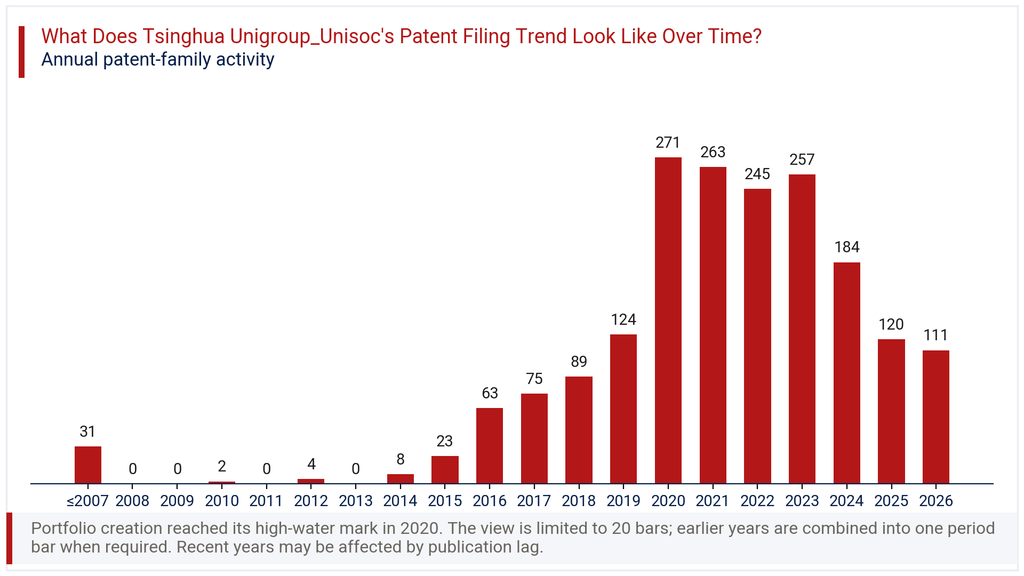
Volumes have eased since the 2020 peak, settling at 245 in 2022 and 257 in 2023, before declining to 184 in 2024 and 120 in 2025. The latest_year_change_pct figure of -7.5% reflects this softer recent trend. Much of this apparent drop in 2025 and 2026 likely reflects publication lag rather than a genuine pullback in R&D output, since recently filed applications often take time to appear in public databases. The broader pattern across 2016 to 2023 still points to a company that scaled its filing activity substantially during its most active innovation years.
Where Does the Tsinghua Unigroup_Unisoc Patent Portfolio Prioritize Patent Protection?
Patent geography for this portfolio is heavily concentrated in one market. China accounts for 99.6% of filings, by far the dominant jurisdiction, consistent with a company whose primary commercial base sits domestically. The geographic chart in this section shows a steep drop-off after China, with WIPO PCT filings at 21.2% forming the next largest share. This filing route suggests the company uses international applications as a bridge toward selected overseas markets rather than filing nationally everywhere at once.
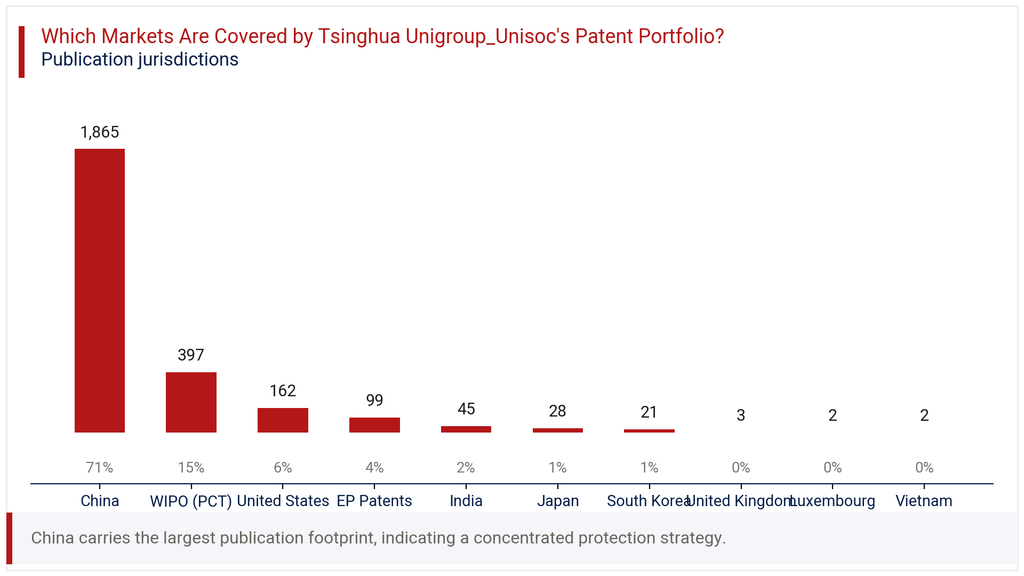
Beyond China and PCT routes, the United States holds 8.7% of filings, followed by European Patents at 5.3% and India at 2.4%. Japan and South Korea each carry small but notable shares, at 1.5% and 1.1% respectively. The United Kingdom, Luxembourg, and Vietnam register minimal activity. This pattern indicates a filing strategy built around protecting the home market first, with selective international filings aimed at key semiconductor and smartphone markets. Businesses assessing competitive exposure outside China should weigh this concentration carefully.
Where is the Tsinghua Unigroup_Unisoc Patent Portfolio Building Protection Across Key Technologies?
IPC analysis of this portfolio reveals a strong tilt toward communications technology. Wireless Communication Networks (H04W) leads with 973 families, representing 38.4% of the total. Digital Information Transmission (H04L) follows with 653 families at 25.7%, and Digital Data Processing (G06F) ranks third with 337 families, or 13.3%. The technology chart in this section shows these three classes alone accounting for well over three-quarters of all filings.
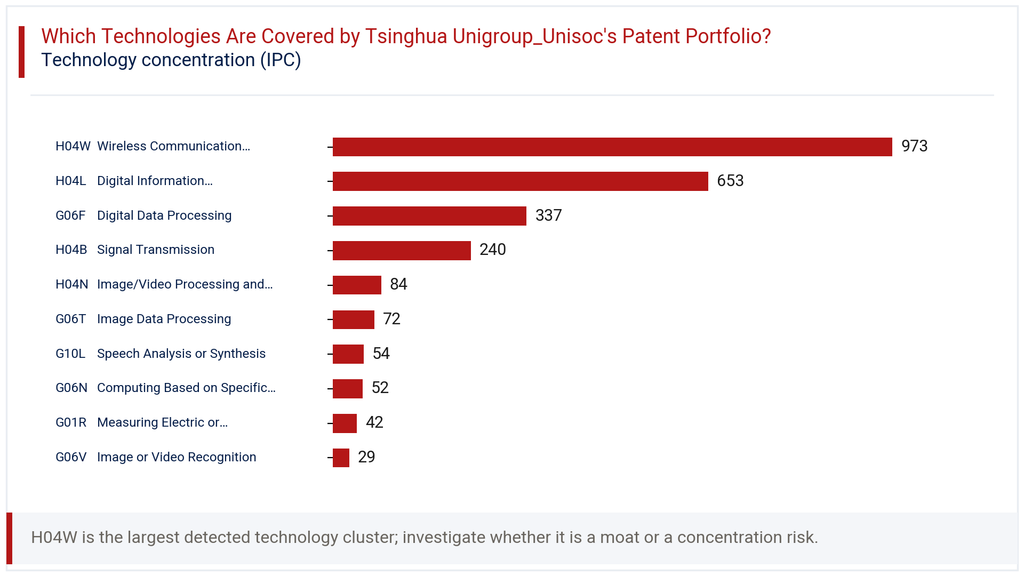
Signal Transmission (H04B) adds a further 9.5% share with 240 families, reinforcing the communications focus. Smaller clusters appear in image and video processing (H04N, 3.3%), image data processing (G06T, 2.8%), and speech analysis (G10L, 2.1%). Computing based on specific models (G06N) and image recognition (G06V) each hold modest shares around 2.1% and 1.1%. This spread suggests the company is extending its core wireless and transmission expertise into adjacent areas like multimedia processing and machine learning applications, likely in support of smartphone chipset features.
How Has the Tsinghua Unigroup_Unisoc Patent Portfolio Evolved Across Filing Geographies?
The heatmap in this section lays out filing activity by year and jurisdiction, and the pattern is instructive. China’s filings track the overall portfolio trend closely, rising from 75 in 2017 to a peak of 271 in 2020, then easing toward 111 by 2026. WIPO PCT filings follow a similar arc, climbing from just 1 in 2017 to 92 in 2020, before tapering sharply to 0 by 2026.
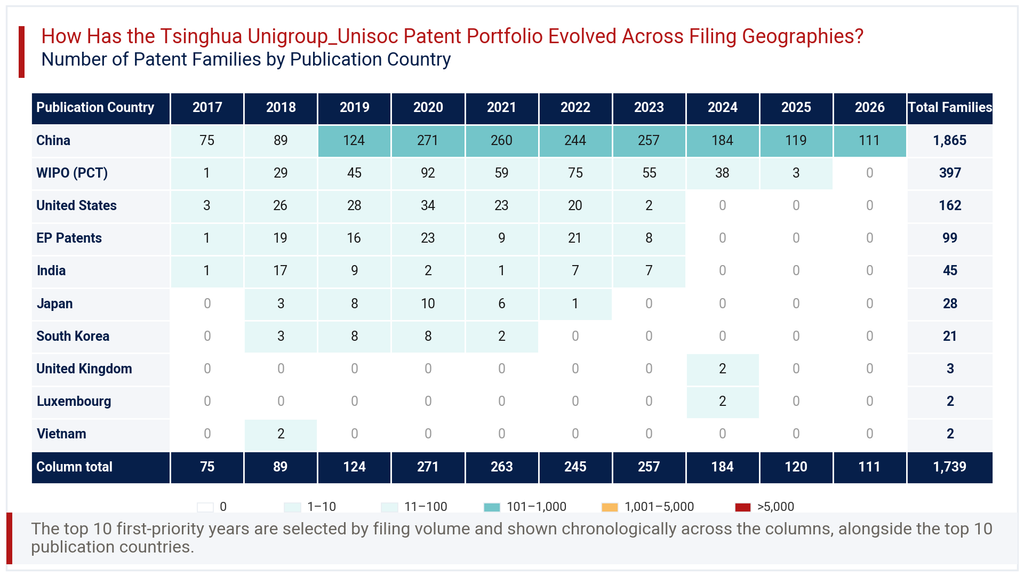
International jurisdictions outside PCT show a narrower, earlier window of activity. United States filings ran from 3 in 2017 up to 34 in 2020, then fell away entirely by 2024. European Patent filings followed a near-identical curve, peaking at 23 in 2020 and disappearing by 2024. India, Japan, and South Korea show smaller, similarly front-loaded patterns concentrated between 2018 and 2022. This timing suggests that Tsinghua Unigroup_Unisoc pursued a deliberate international filing push during its peak R&D years, which has since cooled outside its home jurisdiction.
Consultant’s Perspective on Tsinghua Unigroup_Unisoc Patent Portfolio
Viewed as a whole, the Tsinghua Unigroup_Unisoc Patent Portfolio reflects a company whose patenting mirrors its commercial trajectory as a domestic chipset supplier scaling into global smartphone markets. The heavy concentration in wireless and transmission technologies, at 38.4% and 25.7% respectively, aligns naturally with UNISOC’s position as a systems-on-chip supplier. The near-total reliance on China for filings, at 99.6%, is not unusual for a company whose primary customer base remains domestic, but it does raise questions about enforceability reach in markets like the United States and Europe where filing activity has fallen to zero in recent years.
The grant rate of 48.9% and pending share of 42.0% suggest a portfolio still working through examination backlogs rather than one in decline. The apparent slowdown after 2020 looks more like a return to sustainable filing volumes after an unusually active peak, compounded by publication lag in the newest data. Companies tracking competitive dynamics in mobile chipset IP should watch whether international filings resume, particularly in the United States and Europe. A renewed push there would signal ambitions beyond the domestic market that current data does not yet fully support.
Explore Deeper Insights with Expertlancing Research
This analysis offers a starting point for understanding how Tsinghua Unigroup_Unisoc protects its technology investments. Patent data alone cannot answer every question a business decision requires, particularly around enforceability, licensing exposure, or competitive overlap. Expertlancing Research helps clients go beyond headline figures with tailored patent landscape studies, competitive benchmarking, and technology scouting support. Reach out to our team to commission a deeper, customized review of this portfolio or any related technology space relevant to your business.