


The United Microelectronics Patent Portfolio spans 14,444 patent families, giving analysts a wide base to assess the company’s innovation activity. Of this total, 37.3% remains active, a figure covering both granted and pending cases. Granted families number 4,675, while pending applications stand at 709, producing a grant rate of 32.4%. The remaining families, totalling 9,060 across lapsed, expired and revoked status, represent a substantial share of the portfolio. These figures describe prosecution and maintenance outcomes only, not a judgment on patent quality or enforceability.
Filing activity peaked in the pre-2008 period, with 8,970 families recorded under the “≤2007” bucket, reflecting decades of accumulated filings. Among recent single years, filings have moderated considerably compared to that historical peak. The United States leads as the top jurisdiction, holding 53.5% share of filings, out of 10 jurisdictions tracked in total. On the technology side, H01L Semiconductor Devices dominates the classification mix, accounting for 9,348 families, the largest technology cluster by a wide margin.
This report is intended to help readers understand how United Microelectronics has built and maintained its patent position over time. Filing volume alone does not establish commercial success or market leadership for any specific technology. Readers evaluating particular patent families for licensing, litigation, or investment purposes should verify details independently. The analysis that follows uses legal status, filing trends, jurisdiction spread and technology classification to build a rounded picture. Treat it as a starting point for deeper due diligence, not a final verdict on competitive strength.
About United Microelectronics
Company Profile: United Microelectronics Corporation, known as UMC, is a Taiwanese semiconductor foundry headquartered in Hsinchu. The company reports it is a leading global semiconductor foundry company that provides high quality IC fabrication services, focusing on logic and various specialty technologies. Its process portfolio includes Logic/Mixed-Signal, embedded High-Voltage, embedded Non-Volatile-Memory, RFSOI and BCD technologies.
UMC maintains a wide geographic footprint, with headquarters in Hsinchu, Taiwan, plus local offices in United States, Europe, China, Japan, Korea and Singapore, employing 20,000 people worldwide. According to Wikipedia, UMC was founded as Taiwan’s first semiconductor company in 1980 as a spin-off of the government-sponsored Industrial Technology Research Institute. It is best known for its semiconductor foundry business, manufacturing integrated circuit wafers for fabless semiconductor companies, ranked behind competitor TSMC. Wikipedia also notes UMC reported revenue of US$7.565 billion in 2025, with net income of US$1.329 billion. UMC operates fabs across Taiwan, Singapore, China and Japan.
How Healthy is United Microelectronics Patent Portfolio?
Patent portfolio health depends heavily on legal status distribution, and United Microelectronics shows a mixed but workable picture. Granted patents make up 32.4% of the total, while pending applications add another 4.9%, giving an active rate of 37.3%. On the other side, lapsed cases account for 27.9%, expired cases 32.9%, and revoked cases a smaller 1.9%. The composition chart in this section illustrates how these categories sit against each other across the full portfolio.
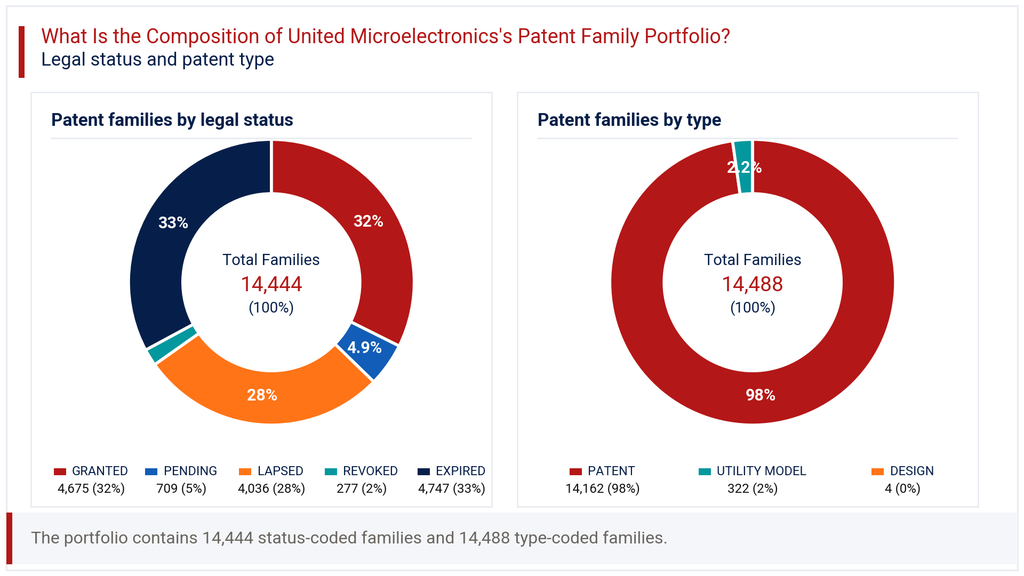
This split suggests a maturing portfolio, where a large share of older filings have already run their course or been allowed to lapse. Patent type analysis reinforces this picture further. Standard patents dominate at 97.7% of filings, utility models contribute 2.2%, and design patents are negligible at 0.0%. This heavy tilt toward utility patents fits a semiconductor foundry business, where core process and device innovations warrant full patent protection rather than lighter utility model filings. For a company at UMC’s scale, the legal status spread signals disciplined portfolio management rather than neglect, though the high lapsed and expired share warrants monitoring over coming renewal cycles.
How Has the United Microelectronics Patent Portfolio Evolved Over Time?
Patent filing trends for United Microelectronics show a long historical tail, with 8,970 families bundled into the “≤2007” category. This points to decades of sustained filing before the available year-by-year data begins. After this point, annual filings settled into a range mostly between 200 and 525 per year, with 2011 marking a notable high point at 525 families. The filing-trend chart in this section traces this pattern across each tracked year, showing relative stability post-2008.
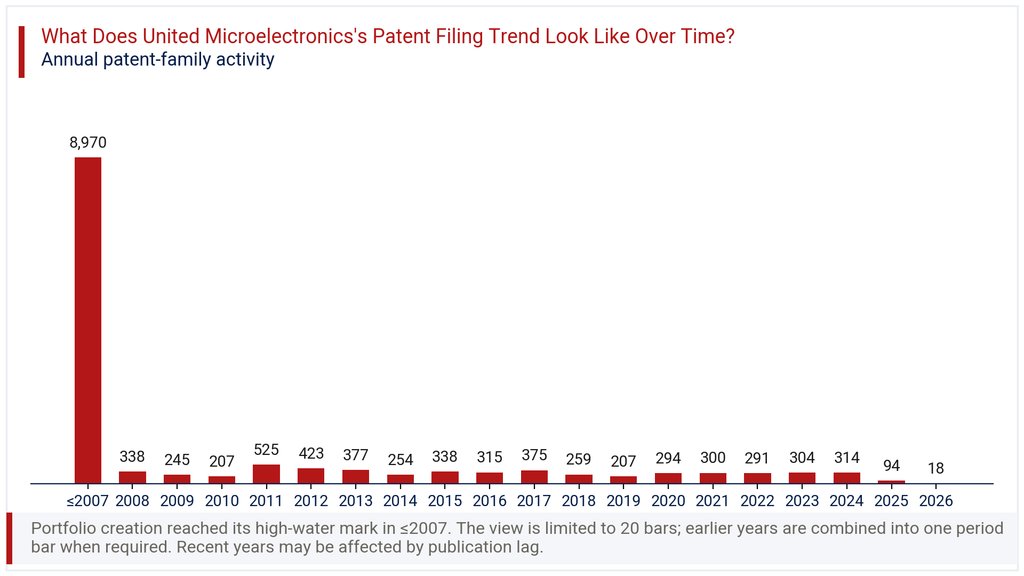
Recent years deserve a careful read. The 2025 figure shows just 94 families, and 2026 only 18, representing a latest_year_change_pct decline of -80.9% against the prior year. This drop almost certainly reflects publication lag rather than a genuine pullback in R&D activity, since patent applications typically take 18 months or more to appear in public databases. Readers should treat the last one to two years as provisional and incomplete. The more informative signal comes from 2019 through 2024, where filings held fairly steady between 207 and 314 annually, indicating consistent investment in patent protection.
Where Does the United Microelectronics Patent Portfolio Prioritize Patent Protection?
Patent geography for United Microelectronics centres heavily on two jurisdictions. The United States accounts for 53.5% of filings, the single largest share, followed closely by Taiwan at 45.8%. China ranks third with 22.6%, a meaningful share given the company’s manufacturing footprint across the region. The geographic chart in this section lays out all 10 jurisdictions captured in the portfolio, from these top three down to smaller markets.
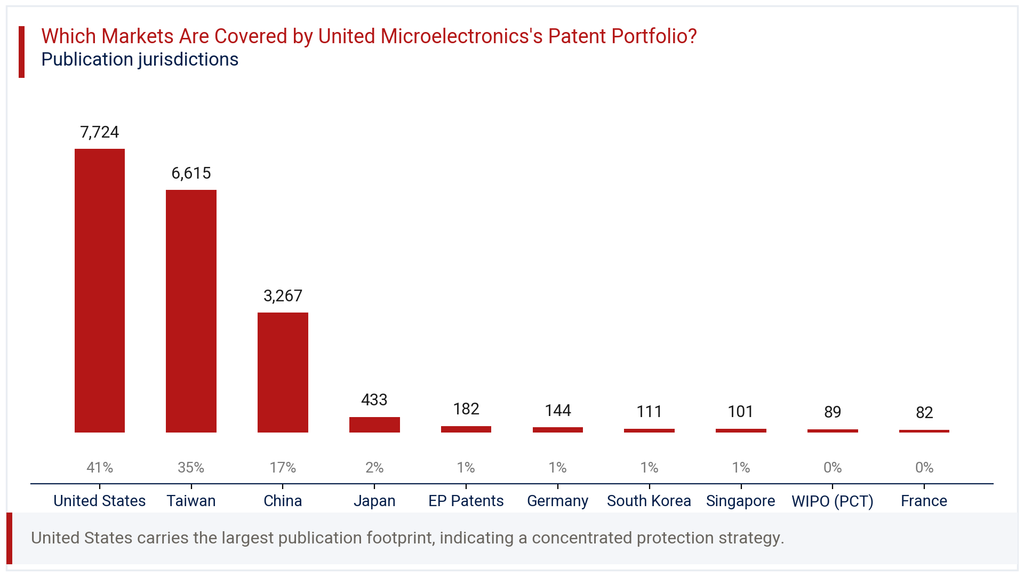
Japan holds 3.0% share, while EP Patents, Germany, South Korea, Singapore, WIPO (PCT) filings and France each sit below 1.5%. This filing pattern tells a clear story: United Microelectronics prioritizes protection in its home market of Taiwan and its largest commercial market, the United States, while treating other jurisdictions as secondary. The relatively thin presence in Europe and Korea may reflect licensing arrangements, market size considerations, or deliberate cost management in patent prosecution. For competitors or partners assessing freedom to operate, this concentration matters. Risk exposure is highest precisely where UMC has filed most densely, in the US and Taiwan.
Where is the United Microelectronics Patent Portfolio Building Protection Across Key Technologies?
IPC analysis of the United Microelectronics portfolio reveals a strong concentration in core semiconductor device technology. H01L Semiconductor Devices leads by a wide margin, covering 53.9% of all classified families, equivalent to 9,348 filings. This single classification dwarfs every other category, confirming that foundational semiconductor device structures remain the company’s central area of protection. The technology chart in this section breaks down the remaining classification spread.
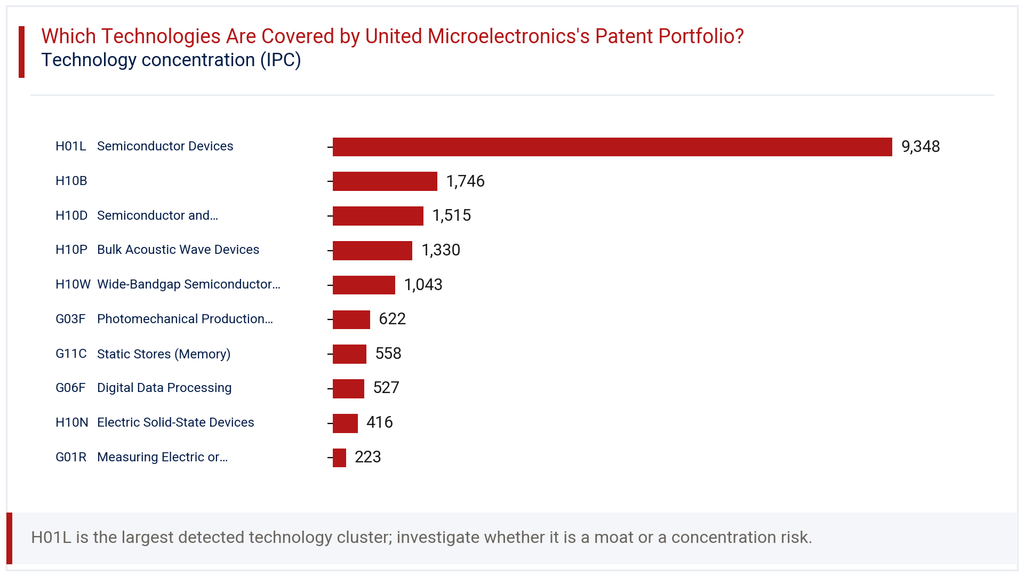
Beyond H01L, the next tier includes H10B at 10.1%, H10D Semiconductor and Solid-State Devices at 8.7%, and H10P Bulk Acoustic Wave Devices at 7.7%. H10W Wide-Bandgap Semiconductor Devices follows at 6.0%, pointing to investment in power and compound semiconductor applications. Smaller clusters include G03F Photomechanical Production of Patterns at 3.6%, G11C Static Stores at 3.2%, and G06F Digital Data Processing at 3.0%. This spread shows a portfolio built primarily around manufacturing process and device architecture, with supporting filings in memory, lithography and measurement technologies that complement the core foundry business.
How Has the United Microelectronics Patent Portfolio Evolved Across Filing Geographies?
Looking at jurisdiction activity by year reveals shifting priorities over three decades. In the mid-1990s, Taiwan and the United States both saw strong filing volumes, with Taiwan reaching 891 families in 1998 and the US reaching 601 in the same year. China’s presence was minimal through this period, registering single digits or low double digits most years. The heatmap in this section shows this early imbalance clearly across the earliest tracked years.
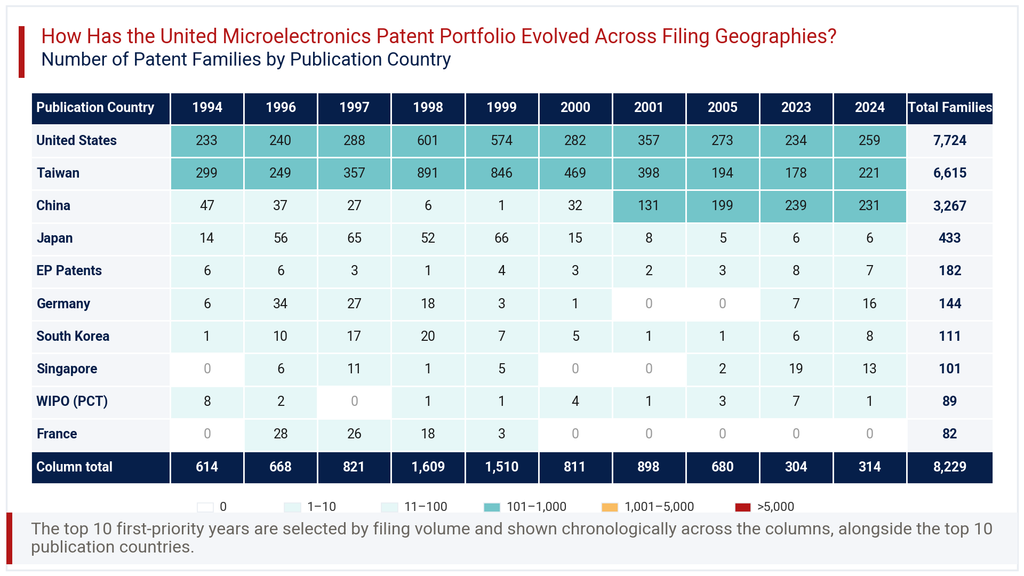
By 2023 and 2024, the pattern had shifted meaningfully. China’s filings rose to 239 and 231 respectively, approaching the levels seen in the US (234, 259) and Taiwan (178, 221) during the same years. Japan, Germany, South Korea and France all show much lower activity in recent years compared to their 1990s levels. This shift suggests United Microelectronics has recalibrated its filing geography toward China as a growing market and manufacturing base, while maintaining steady commitment to its traditional US and Taiwan strongholds.
Consultant’s Perspective on United Microelectronics Patent Portfolio
Taken as a whole, the United Microelectronics Patent Portfolio reflects a mature, foundry-focused filing strategy rather than an aggressive expansion play. The heavy concentration in H01L Semiconductor Devices, at 53.9% of the portfolio, confirms that core process technology remains the company’s central defensive asset. The 37.3% active rate is reasonable for a company with filings stretching back decades, though the expired and lapsed share combined above 60% suggests significant churn in older technology generations.
The rising China filing share stands out as the most actionable signal. It points to a deliberate recalibration toward a market where UMC operates fabs and faces growing competitive and regulatory complexity. Companies partnering with or competing against UMC in China should factor this filing growth into their own freedom-to-operate assessments. The apparent 2025-2026 decline should not be read as reduced R&D commitment, given known publication lag in patent data.
Going by the available evidence, UMC appears to be consolidating protection around its core logic and specialty process technologies rather than chasing new domains. Stakeholders should watch renewal patterns in the US and Taiwan closely over the next two to three years, as these will indicate whether the company sustains or reduces its historical filing intensity.
Explore Deeper Insights with Expertlancing Research
This overview of the United Microelectronics Patent Portfolio offers a starting point, not a complete picture. Readers considering licensing decisions, competitive benchmarking, or technology scouting need deeper, validated analysis tailored to their specific questions. Expertlancing Research works with technology companies, investors and legal teams to turn patent data into decision-ready intelligence. Reach out to our team to commission a custom study on UMC or any competitor in the semiconductor foundry space, built around your specific business questions and timeline.