


The Wingtech Patent Portfolio spans 3,298 patent families, offering a window into how this Chinese semiconductor and communications integration company protects its engineering output. Of these families, 49.6% remain active, a figure covering both granted and pending cases. The portfolio holds 1,243 granted patents and 393 pending applications, with a grant rate of 37.7%. The remaining families, totaling 1,662, have lapsed, expired, or been revoked. These figures reflect prosecution and maintenance status only, not a judgment on patent quality or enforceability.
Filing activity peaked in 2022, when Wingtech filed 558 patent families, marking its most active year on record. China dominates the filing geography, accounting for 99.6% of all filings across a portfolio that spans 10 jurisdictions worldwide. On the technology side, telephonic communication under H04M leads the pack with 819 families, making it the single largest cluster in the company’s innovation focus.
This article draws on patent filing data to map how Wingtech has built and managed its intellectual property position over nearly two decades. Filing volume alone does not establish commercial success, product adoption, or competitive superiority in any given market. Readers using this analysis for diligence, benchmarking, or investment purposes should independently verify specific patent families before relying on them externally.
About Wingtech
Company Profile: Wingtech Technology is a Chinese partially state-owned, publicly-traded semiconductor and communications product integration company. The company is based in Jiaxing, Zhejiang, and operates as a semiconductor and communications product integration business. It has been listed on the Shanghai Stock Exchange since 2015. The company was founded as an original design manufacturer in 2006 by a former STMicroelectronics engineer, Zhang Xuezheng. Wingtech’s main business includes semiconductor chip design, wafer manufacturing, optical imaging and communication product integration.
The company is partially owned by several state-owned enterprises under the direction of SASAC. In 2019, Wingtech acquired Nexperia, a semiconductor subsidiary originally from Royal Philips, which manufactures wafers. In 2021, Wingtech acquired Ofilm Group, a former iPhone camera module supplier. According to GlobalData, the company reported 2024 revenue of approximately 4.3 billion dollars, a decline from the previous year.
How Healthy is Wingtech Patent Portfolio?
Patent portfolio health depends on how many filings remain enforceable versus how many have fallen away through lapse or revocation. Wingtech’s legal status breakdown shows 37.7% granted, 11.9% pending, 36.1% lapsed, 13.1% revoked, and 1.2% expired. The composition chart in this section captures this spread clearly, and it reveals a portfolio roughly split down the middle. Just under half the families, at 49.6%, remain active today, while the other half has exited the enforceable pool through various routes.
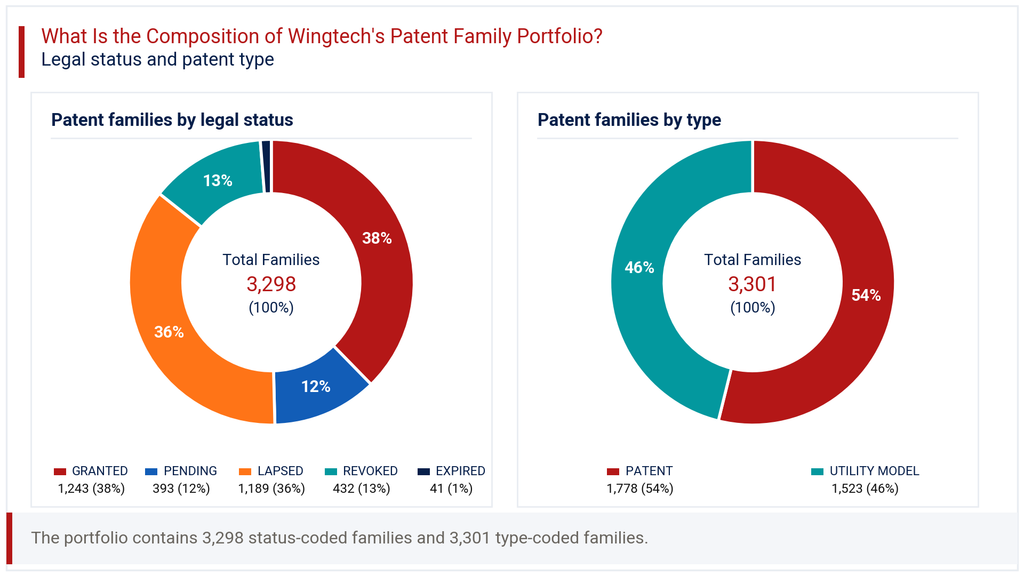
The patent type split adds another layer to this picture. Patents account for 53.9% of filings, while utility models make up the remaining 46.1%. Utility models typically carry shorter protection terms and lighter examination standards in China, which suits companies pursuing fast, incremental product improvements. This mix suggests Wingtech balances deeper, longer-term patent protection with quicker utility model filings for iterative hardware tweaks. The relatively high lapsed and revoked share, combined at nearly half the portfolio, points to active pruning or natural attrition of older filings rather than uniform renewal across the board. For a company operating in fast-moving consumer electronics and semiconductor segments, this pattern is not unusual, though it warrants attention when assessing which specific families still hold force.
How Has the Wingtech Patent Portfolio Evolved Over Time?
Patent filing trends at Wingtech show a long arc of acceleration followed by a plateau. Early filings were modest, with 171 families in 2008 and a slow climb through the early 2010s. Activity dipped sharply to just 1 filing in 2016, an anomaly worth noting before the pace rebuilt steadily from 2017 onward. The filing-trend chart in this section shows this climb clearly, culminating in a peak of 558 families in 2022.
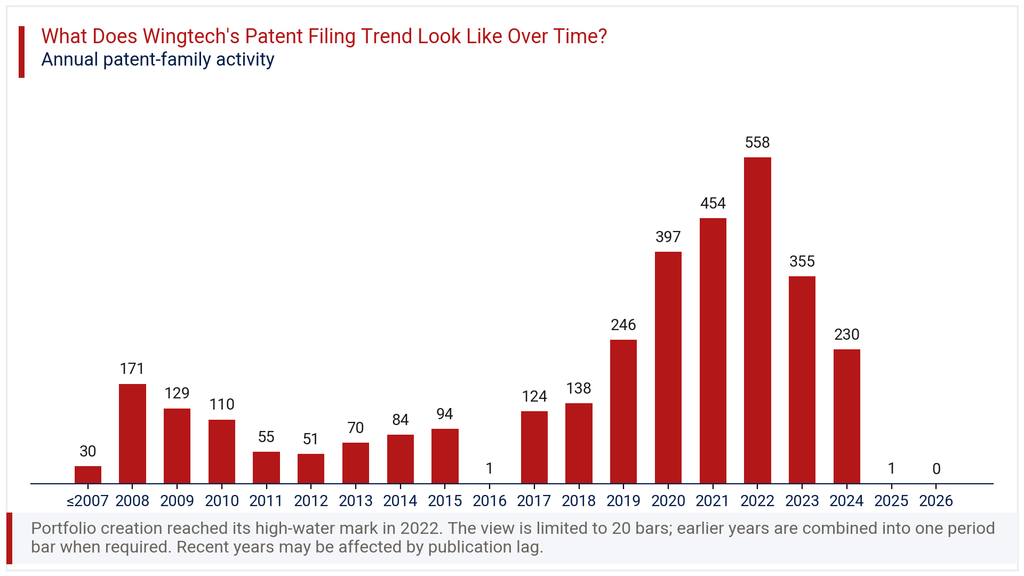
Filings then eased to 355 in 2023 and 230 in 2024, numbers that could suggest a slowdown. Patent publication typically lags actual filing by twelve to eighteen months, so recent years often understate true activity. The apparent -100.0% change in the latest year reflects this lag rather than a genuine halt in filing. Readers should treat 2024 and 2025 figures as provisional rather than conclusive. The broader pattern, spanning 2019 through 2022, shows Wingtech scaling its filing activity considerably, likely tied to its Nexperia and Ofilm acquisitions expanding its technical scope and filing base across semiconductor and imaging domains.
Where Does the Wingtech Patent Portfolio Prioritize Patent Protection?
Patent geography for Wingtech is heavily concentrated in a single market. China accounts for 99.6% of all filings, leaving a thin sliver for the rest of the world. WIPO PCT filings represent 3.6%, serving as the main bridge toward international protection. The geographic chart in this section makes this imbalance visible at a glance, with China towering over every other jurisdiction listed.
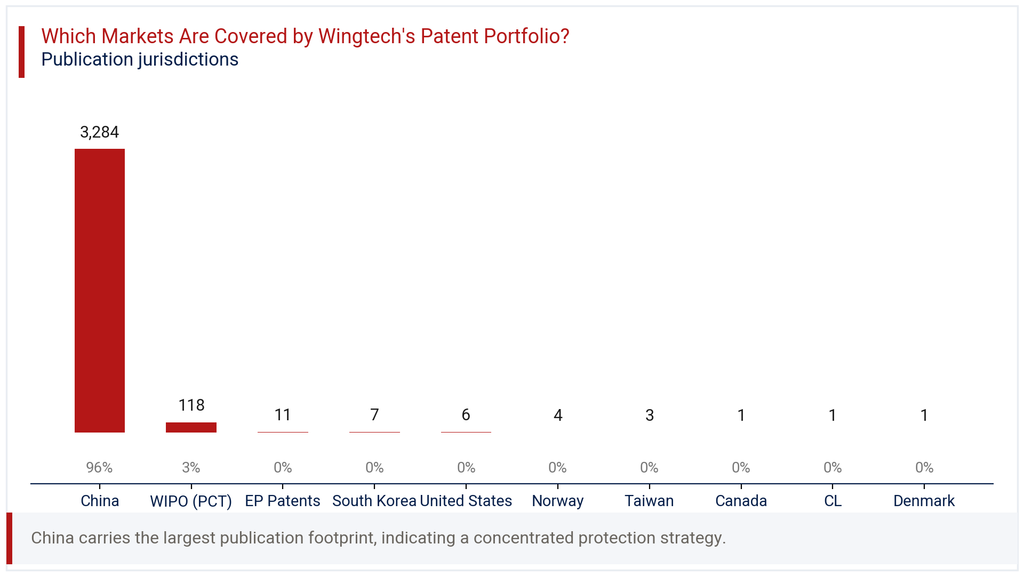
Beyond China and PCT routes, filings trail into Europe, South Korea, the United States, Norway, Taiwan, Canada, Chile, and Denmark, each contributing a fraction of a percent. This pattern is typical for a Chinese manufacturing-heavy company whose primary customer base, supply chain, and regulatory exposure sit domestically. The limited United States and European presence may reflect a deliberate choice to protect core manufacturing and product markets rather than chase broad global coverage. For stakeholders assessing competitive exposure outside China, this concentration suggests Wingtech’s enforceable rights abroad remain thin, a factor worth weighing in any cross-border licensing or litigation risk assessment.
Where is the Wingtech Patent Portfolio Building Protection Across Key Technologies?
IPC analysis of the Wingtech Patent Portfolio points to a clear center of gravity in communications hardware. Telephonic communication, under H04M, leads with 819 families, representing 29.5% of the total. Digital data processing under G06F follows with 591 families, or 21.3%. The technology chart in this section lays out these clusters in descending order, showing a steep drop after the top two categories.
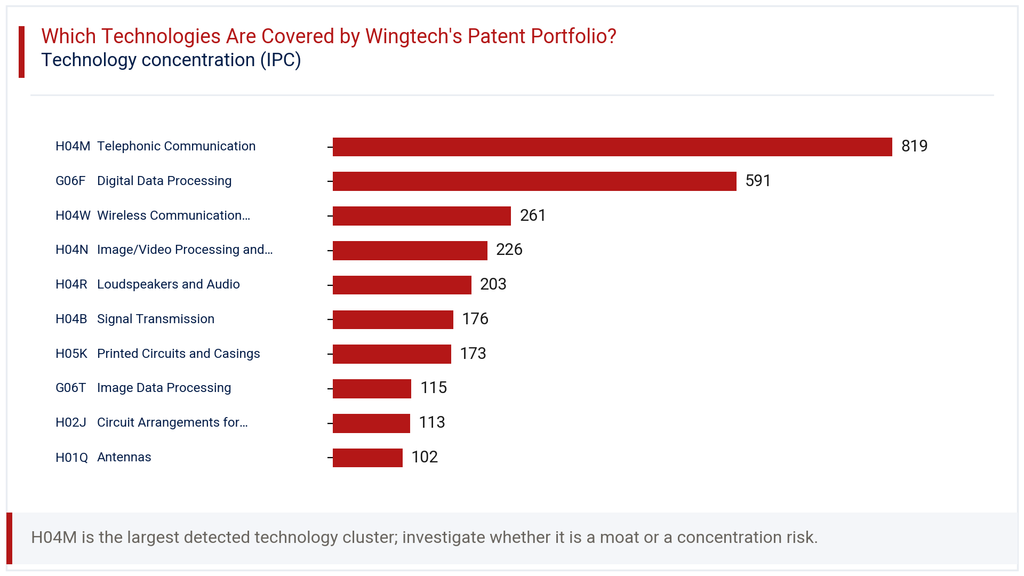
Wireless communication networks under H04W account for 9.4% with 261 families, while image and video processing under H04N adds 8.1% with 226 families. Audio technology under H04R contributes 7.3%, and signal transmission under H04B adds 6.3%. Smaller but meaningful clusters include printed circuits and casings under H05K at 6.2%, image data processing under G06T at 4.1%, power supply circuits under H02J at 4.1%, and antennas under H01Q at 3.7%. This spread confirms Wingtech’s technical identity centers on mobile device hardware, communication protocols, and imaging systems, aligning closely with its smartphone ODM heritage and its newer semiconductor and camera module businesses following the Ofilm acquisition.
How Has the Wingtech Patent Portfolio Evolved Across Filing Geographies?
Viewing filing activity by year and jurisdiction together tells a sharper story than either dimension alone. China has driven almost every wave of growth, climbing from 170 filings in 2008 to a high of 558 in 2022. The heatmap in this section shows this domestic surge clearly, with darker intensity concentrated almost entirely in the China column across later years.
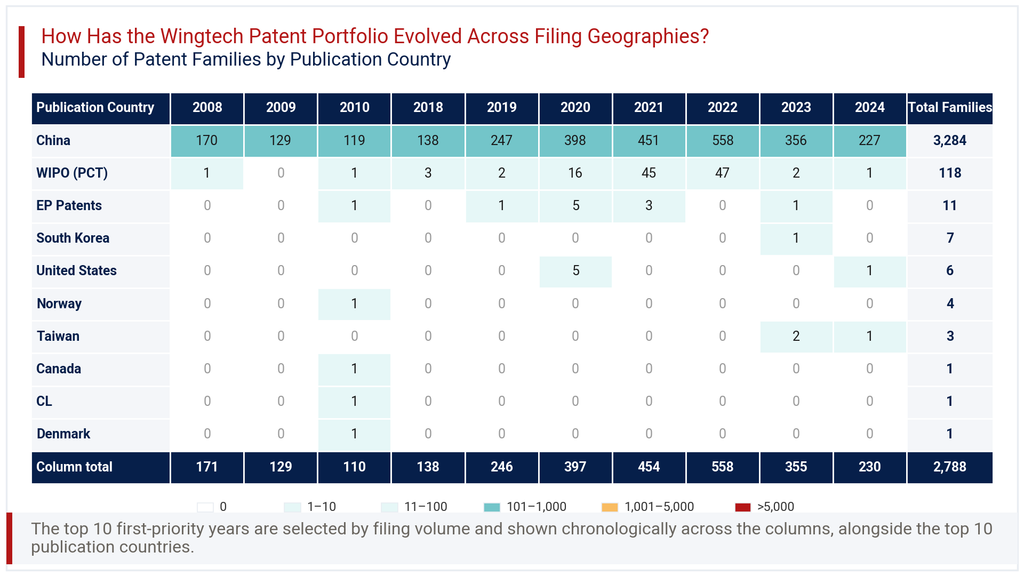
International filings, by contrast, appear only in short bursts. WIPO PCT filings rose to 45 in 2021 and 47 in 2022, coinciding with Wingtech’s peak domestic filing years, suggesting a coordinated push to protect key inventions internationally during that window. European filings touched small numbers in 2020 and 2021 but never developed into a sustained channel. The United States saw just 5 filings in 2020 and 1 in 2024, underscoring how limited and opportunistic Wingtech’s American filing behavior has been. This pattern suggests international protection follows domestic filing peaks with a lag, rather than running as an independent, parallel strategy.
Consultant’s Perspective on Wingtech Patent Portfolio
Viewed as a whole, the Wingtech Patent Portfolio reflects a company whose intellectual property strategy mirrors its operating footprint rather than a global ambition. With 99.6% of filings based in China and a grant rate of 37.7%, the portfolio looks domestically anchored and moderately selective in prosecution outcomes. The concentration in H04M and G06F categories, together making up over half the portfolio, confirms a tight focus on mobile communication and data processing hardware.
The near complete drop in 2016 filings and the subsequent acquisition-linked surge from 2019 onward suggest the portfolio has been shaped as much by corporate transactions as by organic research output. Going forward, the real question for competitors and partners is whether Wingtech converts its PCT filings, currently just 3.6% of the total, into a broader international enforcement position. Given its semiconductor ambitions through Nexperia, a wider non-China footprint would likely follow if global expansion becomes a priority. For now, the portfolio serves domestic market defense more than international assertion, a reasonable posture for a company still consolidating recent acquisitions.
Explore Deeper Insights with Expertlancing Research
Understanding a patent portfolio at this depth takes more than reading summary numbers. Every data point in this article raises further questions about specific families, competitive overlaps, and licensing exposure that general analysis cannot answer. Expertlancing Research helps technology companies, investors, and legal teams dig into these questions with structured patent intelligence and competitive benchmarking. If the Wingtech Patent Portfolio matters to your business decisions, reach out to Expertlancing Research for a tailored assessment built around your specific needs.