


The Wuhan Xinxin Patent Portfolio offers a useful lens into how a leading Chinese memory foundry builds and defends its technology base. Across 1,994 patent families, the portfolio shows an active rate of 68.4%, covering both granted and pending cases still in force. Of these, 1,058 families have been granted, while 305 remain pending before patent offices. The grant rate stands at 53.1%, a reasonably strong conversion figure for a semiconductor-heavy filer. Meanwhile, 631 families fall into lapsed, expired, or revoked status combined. These are prosecution and maintenance metrics only, and should not be read as a judgment on patent quality or enforceability.
Filing activity peaked in 2018, when the company recorded 206 new families, the highest single-year count in the dataset. China dominates the jurisdictional footprint, accounting for 99.8% of filings, with the portfolio spread across 7 jurisdictions in total. On the technology side, the leading cluster is H01L Semiconductor Devices, with 977 families, representing nearly half of all classified filings. This concentration signals where Wuhan Xinxin has placed its heaviest research and development bets over the years.
This report is intended to help readers understand the shape and direction of Wuhan Xinxin’s filing activity, not to establish product success or market dominance. Filing counts alone cannot confirm commercial traction or competitive strength in any given segment. Readers considering business, investment, or licensing decisions should independently verify specific patent families before relying on them. What follows is a structured walk through portfolio health, filing trends, geography, technology focus, and cross-market patterns, each grounded in the figures above.
About Wuhan Xinxin
Company Profile: Wuhan Xinxin Semiconductor Manufacturing Co., Ltd., trading as XMC, is a Chinese semiconductor foundry. The company is a leading 12-inch wafer foundry offering semiconductor specialty technologies, established in 2006. XMC focuses on 3D IC, digital and analog, and specialty memory, delivering diversified wafer foundry services across various technology nodes and process platforms, along with MPW and photomask services.
As the second earliest 12-inch wafer manufacturing line built in mainland China, it has nearly 20 years of operation and manufacturing experience, with two fabs in mass production. In 2017, XMC adopted an IDM strategy, launching a self-owned brand while developing its independently created Xtacking wafer-level 3D IC technology. It has entered a long-term strategic cooperation with Espressif Systems to jointly develop the IoT market.
The company is a subsidiary of Yangtze Memory Technologies, with CN¥3.82 billion revenue reported for 2023.
How Healthy is Wuhan Xinxin Patent Portfolio?
Patent portfolio health depends heavily on legal status composition, and the Wuhan Xinxin Patent Portfolio shows a mixed but workable picture. Granted patents make up 53.1% of the total, the single largest category by legal status. Pending applications add another 15.3%, pointing to an active prosecution pipeline still awaiting examination outcomes. Together these two categories drive the 68.4% active rate referenced earlier, which the composition chart illustrates clearly.
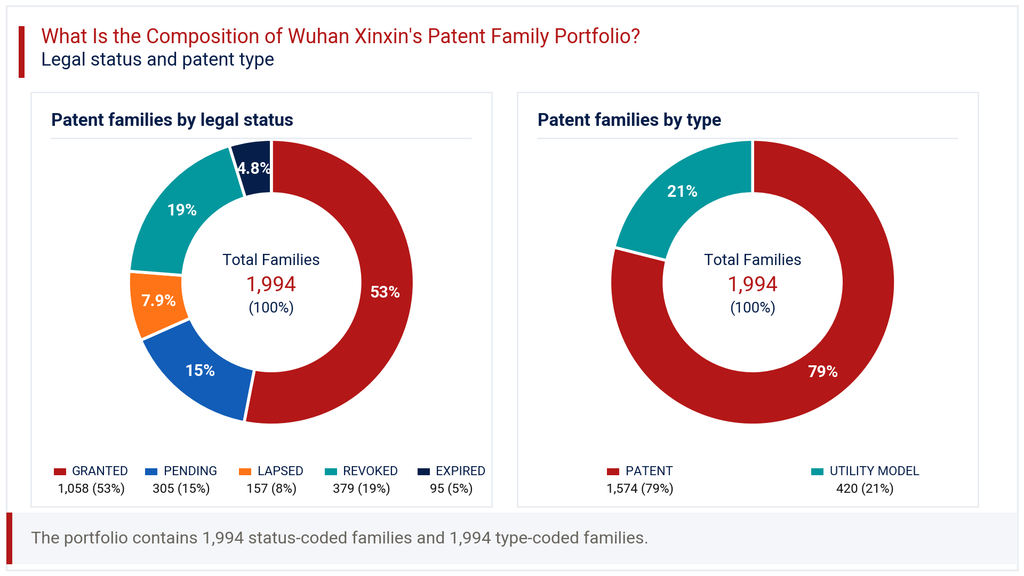
The remaining portion of the portfolio carries more caution. Revoked families account for 19.0%, a notably high share that merits attention from anyone assessing enforceability. Lapsed cases sit at 7.9%, and expired ones at 4.8%, both fairly typical for a portfolio of this age and scale. On patent type, standard invention patents represent 78.9% of filings, with utility models making up the remaining 21.1%. This split suggests Wuhan Xinxin treats utility models as a secondary, faster-to-grant complement rather than its primary protection vehicle. The elevated revocation share is worth deeper due diligence before drawing firm conclusions about the strength of individual claims within the portfolio.
How Has the Wuhan Xinxin Patent Portfolio Evolved Over Time?
Patent filing trends within the Wuhan Xinxin Patent Portfolio reveal a company that scaled its filing activity sharply after 2013. Annual filings rose from just 64 in 2013 to 119 in 2014, then climbed further to 201 by 2016. The filing-trend chart shows a peak of 206 families in 2018, the strongest year on record for the company. Filing volumes then settled into a steadier band, ranging between 131 and 146 families annually from 2021 through 2024.
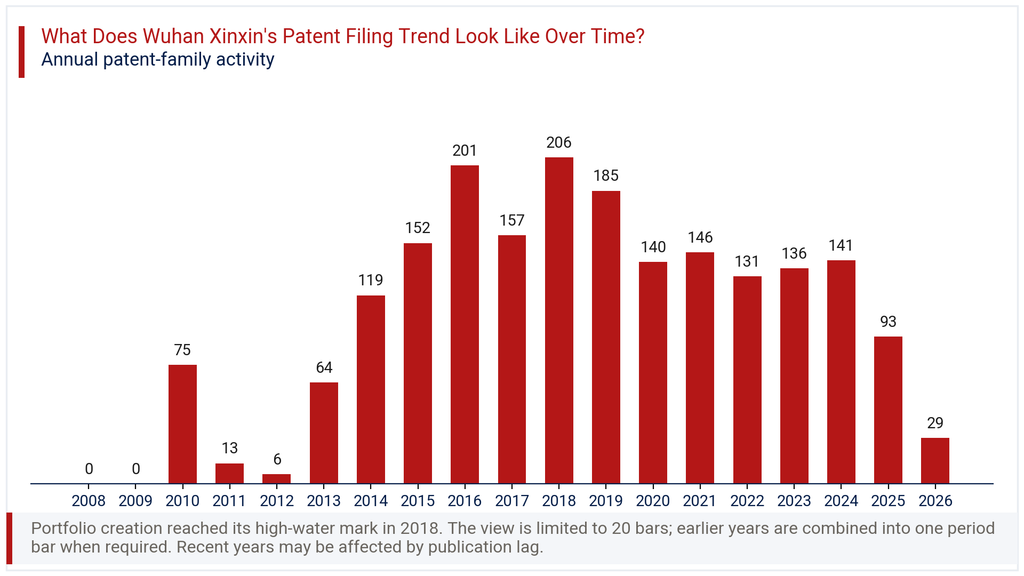
The most recent data points require careful reading. The 2025 and 2026 figures of 93 and 29 respectively reflect a 68.8% decline from the prior year, but this should not be mistaken for a genuine pullback in R&D activity. Patent publication typically lags actual filing by twelve to eighteen months, so recent years are structurally undercounted in any live dataset. The more reliable signal is the sustained plateau through 2024, which suggests Wuhan Xinxin has reached a mature, steady-state filing cadence following its earlier expansion phase.
Where Does the Wuhan Xinxin Patent Portfolio Prioritize Patent Protection?
Patent geography within the Wuhan Xinxin Patent Portfolio is overwhelmingly domestic. China accounts for 99.8% of all filings, underscoring a home-market-first protection strategy typical of foundries serving China’s semiconductor supply chain. The geographic chart shows every other jurisdiction trailing far behind by comparison.
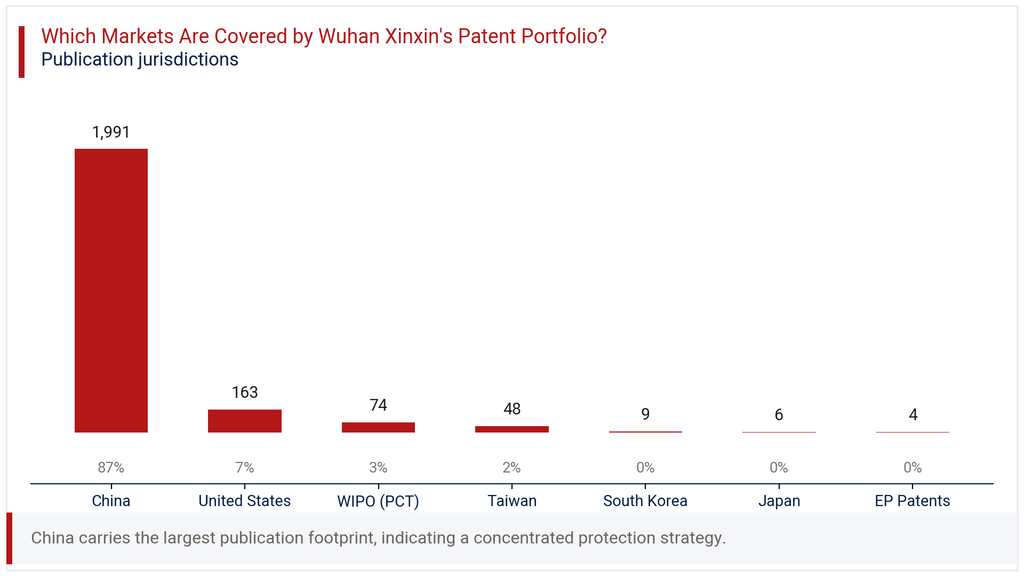
The United States is the leading overseas destination, representing 8.2% of the portfolio’s jurisdictional share, with 163 families filed there. WIPO’s PCT route follows at 3.7%, often used as a bridge toward later national filings in multiple markets. Taiwan holds 2.4%, a sensible choice given its deep semiconductor manufacturing ties. South Korea, Japan, and EP Patents each register below 1%, reflecting narrow, selective filing rather than broad international coverage. This pattern indicates Wuhan Xinxin treats international filing as a targeted exercise, reserved for markets with direct commercial or supply chain relevance, rather than pursuing wide global protection by default.
Where is the Wuhan Xinxin Patent Portfolio Building Protection Across Key Technologies?
IPC analysis of the Wuhan Xinxin Patent Portfolio points to a clear center of gravity in core semiconductor device technology. The technology chart in this section shows H01L Semiconductor Devices leading with 977 families, or 48.2% of all classified filings. This single class covers nearly half the portfolio, reflecting deep investment in fundamental semiconductor device structures.
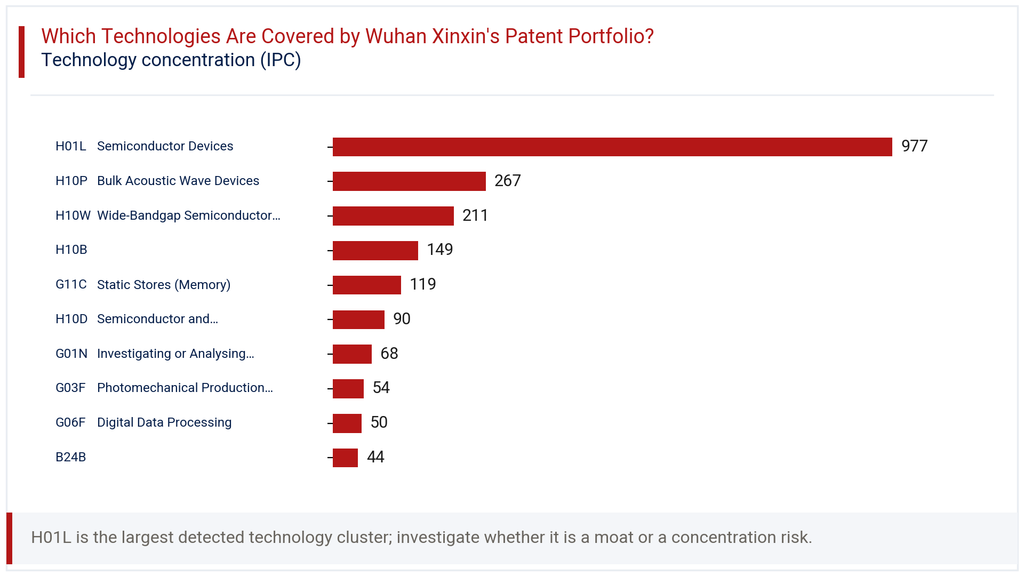
Beyond that lead cluster, the portfolio diversifies into more specialized domains. H10P Bulk Acoustic Wave Devices accounts for 13.2%, while H10W Wide-Bandgap Semiconductor Devices contributes 10.4%. Memory-specific classes also feature prominently, with H10B at 7.3% and G11C Static Stores (Memory) at 5.9%, both consistent with the company’s specialty memory focus under its parent group. Smaller but notable classes include G01N materials investigation at 3.4% and G03F photomechanical pattern production at 2.7%. This spread suggests Wuhan Xinxin is building layered protection, from base semiconductor devices through to memory architecture and process-level innovations.
How Has the Wuhan Xinxin Patent Portfolio Evolved Across Filing Geographies?
Viewing filing activity by year and jurisdiction together, the heatmap reveals how Wuhan Xinxin’s international expansion followed its domestic growth. China’s filings rose steadily from 151 in 2015 to a high of 206 in 2018, before settling near 140 annually through 2024. United States filings only began meaningfully in 2018, jumping to 39 that year before moderating to a range of 13 to 24 in subsequent years.
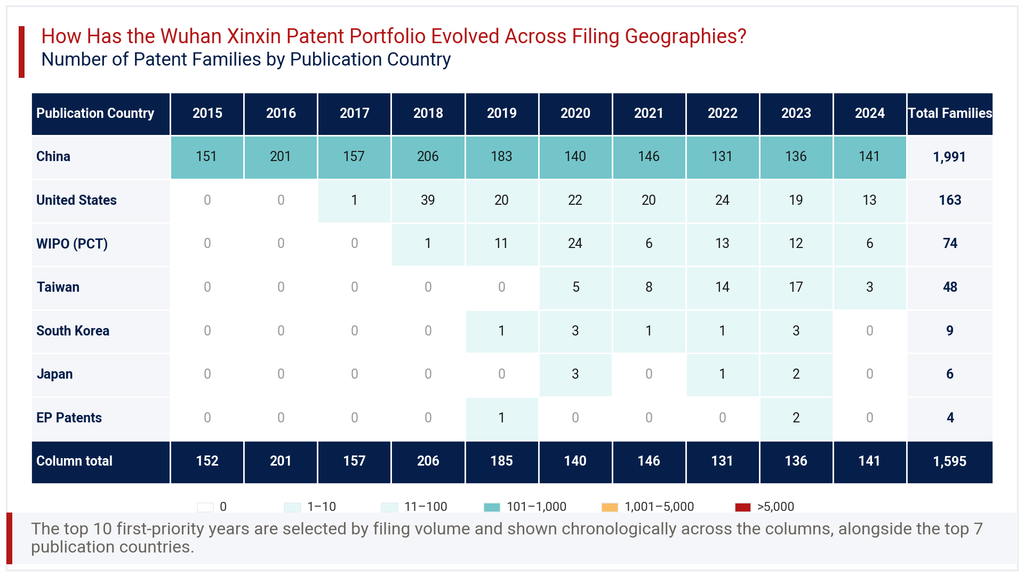
WIPO PCT filings show a similar delayed start, appearing from 2018 onward and peaking at 24 in 2020. Taiwan filings began even later, starting in 2020 and rising to 17 by 2023. This sequencing suggests Wuhan Xinxin first established its domestic patent base, then extended protection internationally once its core technologies matured. South Korea, Japan, and EP Patents each show only sporadic single-digit filings, confirming these remain opportunistic rather than systematic markets within the company’s filing strategy.
Consultant’s Perspective on Wuhan Xinxin Patent Portfolio
Taken as a whole, the Wuhan Xinxin Patent Portfolio reflects a foundry whose patenting strategy mirrors its manufacturing roadmap closely. The heavy concentration in H01L Semiconductor Devices, at 48.2% of filings, aligns naturally with its core wafer foundry business. The later emergence of bulk acoustic wave and wide-bandgap classes suggests deliberate diversification into adjacent specialty areas, likely tied to its Xtacking 3D IC development.
The 19.0% revocation rate stands out as the one figure warranting closer scrutiny. For a portfolio this concentrated in core technology, a near-fifth revocation share could reflect aggressive early filing followed by narrower surviving claims. Buyers, partners, or competitors assessing this portfolio should examine specific revoked families to understand whether revocations stemmed from procedural issues or genuine prior art challenges. The domestic filing concentration, at 99.8% China share, also means that enforcement outside China would require substantially more international filing activity than currently exists.
Looking forward, Wuhan Xinxin would benefit from selectively expanding filings in markets tied to its Espressif IoT partnership and any export-oriented product lines. The current steady-state filing pace, following the 2018 peak, suggests room for renewed growth if international ambitions increase.
Explore Deeper Insights with Expertlancing Research
This overview of the Wuhan Xinxin Patent Portfolio only scratches the surface of what a full competitive and technology analysis can reveal. Expertlancing Research helps clients dig deeper into specific families, assess enforceability risk, and benchmark portfolios against named competitors. Whether you are evaluating a licensing opportunity, assessing supply chain risk, or scoping a freedom-to-operate review, our analysts can tailor the research to your exact decision. Reach out to discuss how a custom patent intelligence engagement can support your next strategic move.